When Turkey's Greatest Discoveries Were Not What They Seemed
Turkey’s most revealing hoax stories are not tales of an unusually credulous society. They are stories about unusually valuable things: ancient civilisations, sacred manuscripts, national history and urgent news from disasters or wars. These subjects create ideal conditions for deception because they combine public emotion with incomplete evidence.
Page outline Jump by section
Introduction
The best-known cases range from James Mellaart’s disputed archaeological discoveries to modern workshops producing fake antiquities and pseudo-ancient religious books. More recently, false photographs and videos have circulated during earthquakes and conflicts. Some episodes were deliberate frauds, others involved reckless reporting or sincere error, and a few remain unresolved. What connects them is the power of a good story to outrun the slower work of establishing provenance, testing materials and checking original sources.
The archaeologist who made drawings do the work of evidence
No figure looms larger in Turkey’s history of archaeological controversy than James Mellaart. The British prehistorian helped transform understanding of early Anatolia through his work at sites including Hacılar and Çatalhöyük. Later excavations broadly supported many of his important observations about Çatalhöyük’s buildings and settlement organisation. His genuine achievements matter because they explain why colleagues, editors and the public were willing to give extraordinary weight to his undocumented discoveries.[Popular Archaeology]popular-archaeology.comjames mellaart pioneer and forgerPopular ArchaeologyJames Mellaart: Pioneer…..and Forger11 Oct 2019 — James Mellaart (1925–2012) is one of the most dazzling researchers i…
The invisible treasure of Dorak
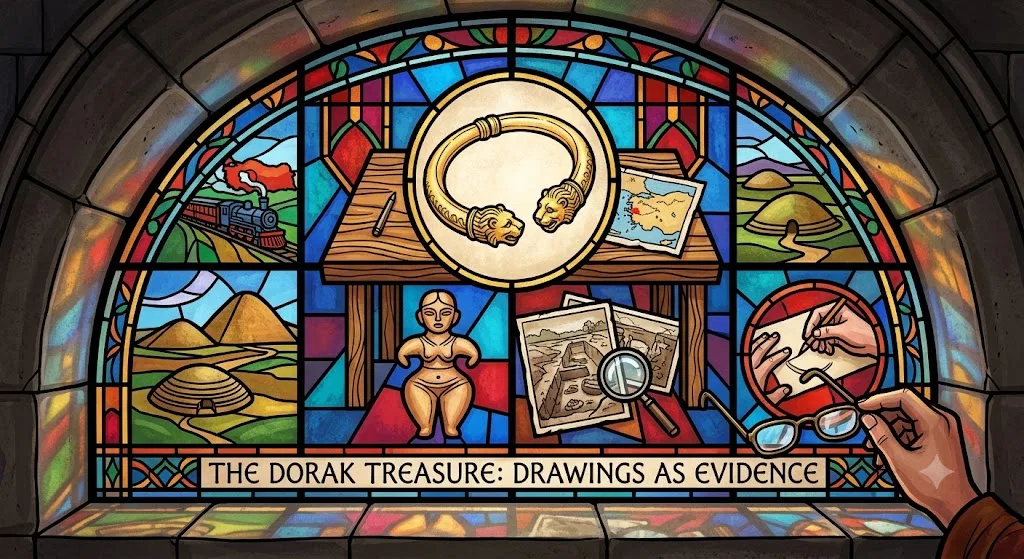
The Dorak affair began with a story that sounded almost designed for an illustrated adventure magazine. Mellaart said that, during the 1950s, he met a woman called Anna Papastrati on a train travelling through western Turkey. After he noticed an ancient-looking bracelet she was wearing, she supposedly took him to a house containing a magnificent collection of Early Bronze Age objects. He was not allowed to photograph them, but spent days making drawings. The objects were said to have come from graves near Dorak, south of the Sea of Marmara.[Wikipedia]WikipediaDorak affairDorak affair
Mellaart published his drawings in the Illustrated London News, giving the supposed treasure international visibility. Yet investigators could not find Papastrati at the address associated with the story, and none of the objects has ever appeared in a museum, auction, legal private collection or verifiable photograph. The case became entangled with accusations of antiquities smuggling, damaging Mellaart’s position in Turkey and temporarily preventing him from leading excavations there.[Wikipedia]WikipediaDorak affairDorak affair
The Dorak Treasure has never been conclusively shown to be either genuine or imaginary. It could have been an illicit collection kept hidden after publication, material shown by dealers attempting to manufacture a respectable pedigree, or a fabrication created by Mellaart himself. What makes the case important is that every interpretation depends heavily on his testimony. There was no documented excavation, no secure chain of ownership and no physical object available for scientific examination.
That weakness became far more serious after Mellaart’s death. In 2018, researchers examining papers and materials in his former study reported evidence that he had invented translations of supposed ancient documents and prepared drawings associated with objects or inscriptions whose existence could not be established. The discovery did not prove that every controversial claim he had ever made was false, but it made the Dorak narrative much harder to defend on trust alone.[luwianstudies.org]luwianstudies.orgLuwian Studies James Mellaart Forged Documents throughout His LifeLuwian StudiesJames Mellaart Forged Documents throughout His LifeFebruary 28, 2018 — 28 Feb 2018 — Last year, Luwian Studies received doc…
Forged documents and the temptation of the grand theory
Some of Mellaart’s posthumously examined papers appeared to support sweeping theories about Late Bronze Age western Anatolia. According to the investigation of his estate, typed “translations” attributed to ancient documents were his own inventions. Drafts and working materials indicated not merely mistaken interpretation but the deliberate manufacture of supporting evidence.[Luwian Studies]luwianstudies.orgLuwian Studies James Mellaart Forged Documents throughout His LifeLuwian StudiesJames Mellaart Forged Documents throughout His LifeFebruary 28, 2018 — 28 Feb 2018 — Last year, Luwian Studies received doc…
The associated Luwian-inscription material requires more careful language. Some researchers involved in publishing it later accepted that Mellaart had fabricated parts of the documentary record, while continuing to argue that particular hieroglyphic texts might preserve authentic material. Other specialists have treated documents known only through Mellaart’s copies with deep suspicion. The safest conclusion is therefore narrower than “everything was forged”: Mellaart demonstrably created false documentation, destroying the evidential value of claims that cannot be independently checked against an original object or reliable earlier record.[uva.nl]pure.uva.nlOpen source on uva.nl.
This was not a simple outsider’s prank against archaeology. It was a case in which an expert’s knowledge made fabrication more persuasive. Mellaart knew what scholars hoped to discover, which missing connections would attract attention and how a plausible artefact should look on paper. His career shows why authority can be both evidence and vulnerability: specialists are trusted because of their expertise, but the same expertise can help them construct claims that non-specialists cannot easily test.
How the market manufactured an ancient Anatolian past
The Mellaart scandals concern the production of knowledge as much as the production of objects. Turkey’s wider antiquities problem is more commercial. Genuine archaeological wealth, illegal digging, international demand and uncertain ownership records have created a market in which authentic objects, modern copies and deliberately aged forgeries can circulate together.
A 2021 study of archaeological fakes in Turkey identified coins, lamps, metalwork, gemstones, figurines, pottery and glass among commonly imitated categories. It also warned that museum and market collections may contain more forgeries than published estimates suggest. Modern casting marks, unsuitable alloys, artificial surface deposits and scientific dating can expose some counterfeits, but not every object receives thorough analysis before it is bought, seized or displayed.[Portal de Revistas da USP]revistas.usp.brOpen source on usp.br.
The Hacılar-style figurines
One of the clearest demonstrations came from objects attributed to Hacılar, a Neolithic settlement in south-western Turkey excavated by Mellaart. The authentic site was extremely important: its houses, pottery and figurines helped establish Anatolia as a major centre of early settled life rather than a cultural backwater dependent entirely on Mesopotamia. That importance increased demand for objects said to come from it.[Time]time.comscience the fakes of hacilarscience the fakes of hacilar
During the 1960s, museums and collectors acquired unprovenanced vessels and figurines presented as being in the Hacılar style. Scientific examination later found that 48 of 66 tested objects had been recently fired and were therefore modern. Their shapes and decoration were sufficiently persuasive that visual comparison alone had not reliably separated them from ancient material. Thermoluminescence testing, which estimates when fired clay was last heated to a high temperature, supplied the decisive evidence.[time.com]time.comscience the fakes of hacilarscience the fakes of hacilar
This episode is sometimes carelessly retold as though the excavation of Hacılar itself were a hoax. It was not. The scandal centred on objects without secure excavation records that entered collections after the site’s art had become recognisable and desirable. Forgers could study published discoveries and manufacture the very features collectors had learned to associate with prehistoric Anatolia.
The damage extended beyond financial loss. Once fake material entered scholarly publications, it could influence classifications of genuine objects, assumptions about prehistoric religion and estimates of how particular artistic styles developed. A forgery does not merely imitate the past; when accepted by experts, it can quietly change the past that later researchers think they are studying.
Fake treasures hidden for gullible buyers
Another trade does not require fooling major museums. Turkish officials have described fraudsters manufacturing objects, placing them in caves or other apparently ancient locations, and sending photographs to prospective buyers. Some painted symbols onto rock surfaces or planted sculptures so that victims would believe they had been shown the location of a hidden historical treasure. The target might then pay for access, information, excavation equipment or a share in the supposed find.[Hürriyet Daily News]hurriyetdailynews.comOpen source on hurriyetdailynews.com.
The trick works because the victim is invited to participate in secrecy. A person who believes an object has been illegally excavated is less likely to request official authentication or report the transaction. The promise of a bargain depends on avoiding the institutions that could reveal the bargain to be false. Heritage crime and forgery therefore reinforce one another: the absence of lawful provenance, which should be a warning, is presented as proof that the treasure is exclusive.
Turkish museums and the Culture and Tourism Ministry have periodically publicised seizures and collections of counterfeit material to make the problem visible. Reports have described hundreds of false artefacts examined or seized, including items that had reached museum displays. Such cases underline an awkward fact: police confiscation establishes that an object was involved in a suspected offence, but it does not automatically establish that the object is ancient.[Hürriyet Daily News]hurriyetdailynews.commuseums in turkey ministry fight back against forged artifacts 90846museums in turkey ministry fight back against forged artifacts 90846
The recurring “ancient Torah” discovery
A particularly distinctive modern pattern involves manuscripts announced as ancient Jewish sacred texts. Turkish police and gendarmerie operations have repeatedly been reported as recovering books or scrolls decorated with gold-coloured writing, supposedly hundreds or even thousands of years old. Photographs of these objects are highly newsworthy: they combine religion, hidden treasure, organised crime and the possibility of a discovery comparable to the Dead Sea Scrolls.
In 2017, for example, Turkish reports described a manuscript seized from smugglers as a roughly 700-year-old Torah offered for about $1.9 million. Specialists who examined the object reportedly concluded that it was a crude modern fake rather than a medieval manuscript.[The Times of Israel]timesofisrael.comThe Times of Israel Turkish security forces seize 700-year-old Torah manuscriptThe Times of Israel Turkish security forces seize 700-year-old Torah manuscript
Researchers and journalists studying this trade have found that such pseudo-ancient manuscripts are often easy for qualified experts to question. The writing may be incorrect or meaningless, the layout may not match Jewish scribal practice, and the combination of gold lettering, darkened animal skin and decorative imagery may owe more to a modern idea of what a mysterious sacred book should look like than to any known manuscript tradition. Nevertheless, early news reports have often repeated spectacular age estimates before specialist authentication is complete.[Taylor & Francis Online]tandfonline.comOpen source on tandfonline.com.
The intended buyer may not be a manuscript scholar. A counterfeit book can be marketed to wealthy collectors, religious enthusiasts or intermediaries who believe they can resell it. Its persuasive force comes from visual theatre and alleged secrecy, not from palaeography—the study of historical handwriting—or a documented history of ownership.
These cases also reveal how an official seizure can unintentionally promote a fake. A police photograph, uniformed officers and a statement that the object is “believed to be” ancient can be stripped of their caution when repeated by other outlets. By the time a museum or specialist rejects the claim, the dramatic first version may already have been translated and copied internationally.

When breaking news recycles old pictures
Turkey’s modern hoax history increasingly belongs to the internet, where the main counterfeit is often not the image itself but its caption. During the devastating earthquakes of 6 February 2023, photographs and videos from unrelated disasters were rapidly relabelled as scenes from Turkey and Syria. Old tsunami footage, a recording of the 2021 collapse of the Champlain Towers South building in Florida and stock photographs of rescue animals all circulated with false descriptions.[Reuters]reuters.comFact Check: Video of people rushing into the street doesFact Check: Video of people rushing into the street does
One widely shared photograph was said to show a dog that had rescued people in Turkey. It actually showed a search dog after the 2014 Oso mudslide in the United States. The picture was emotionally credible because real rescue dogs were working at the earthquake sites. The falsehood did not need to invent an impossible event; it simply attached an authentic-looking image to a story audiences were already prepared to believe.[AP News]apnews.comAP News NOT REAL NEWS: A look at what didn't happen this week1. A misattributed photo of a rescue dog from a 2014 mudslide in Oso, Washington, was falsely claimed to show a dog that rescued people a…
Other posts moved from miscaptioning to conspiracy. A video of unusual lights was claimed to show a secret technology operating over Turkey before the earthquake. The footage actually came from a 2018 SpaceX rocket launch in California. Claims connecting the disaster to weapons or artificial earthquake systems offered a deliberate agent in place of complex geological and political realities.[Reuters]reuters.comnighttime footage bright light sky unrelated 2023 turkey earthquakenighttime footage bright light sky unrelated 2023 turkey earthquake
False disaster content is not always produced for a single purpose. Some users chase attention or advertising income. Others recycle dramatic media without checking it, promote political narratives, seek donations or sincerely believe they are helping. The practical harm is the same: misleading posts compete with genuine requests for rescue, shelter and aid. Social media was also being used by people trapped under rubble to communicate their locations, making verification more than an abstract argument about media accuracy.[arXiv]arxiv.orgOpen source on arxiv.org.
The movement of earthquake footage illustrates another feature of online fakery: the same image can be repeatedly reassigned. Genuine video from Turkey was later falsely described as footage of earthquakes elsewhere, including Morocco and Taiwan. Digital deception often resembles a circulating costume wardrobe rather than a sequence of newly manufactured fakes; familiar visuals are taken out again whenever a fresh event creates demand.[Reuters]reuters.comFact Check: Apartment building collapse video is fromFact Check: Apartment building collapse video is from
Why these stories were persuasive
Turkey’s best-documented hoaxes succeeded for different reasons, but several recurring mechanisms connect them.
A real history supported the false object. Hacılar and Çatalhöyük are genuine and internationally important archaeological sites. That made fake Anatolian artefacts more believable, not less. Forgers did not need to invent an unknown civilisation; they needed only to imitate material that scholars had already authenticated.
Secrecy was mistaken for provenance. Hidden collections, illegal excavations and smugglers’ caches naturally lack paperwork. Fraudsters turn that absence into part of the adventure. Yet provenance—a documented history of where an object came from and who owned it—is one of the strongest protections against both forgery and illicit trade.
Authority travelled faster than qualification. An archaeologist’s sketch, a police seizure photograph or a television report may appear to certify an object. In reality, each may record only a claim awaiting further investigation. “Seized as suspected antiquity” is not the same as “scientifically authenticated antiquity”.
The claims matched emotional expectations. Lost royal treasures, sacred books written in gold and heroic rescue animals are memorable because they fit established story forms. During emergencies, fear and hope reduce the time people spend checking whether an image is old, cropped or geographically impossible.
Corrections lacked the original drama. A spectacular discovery can be summarised in one sentence. Its debunking may require materials analysis, handwriting expertise, archive searches and an explanation of uncertain provenance. The first claim is therefore easier to repeat than the evidence that overturns it.
Research on Turkey’s information environment has also pointed to high reported exposure to completely fabricated political or commercial stories, strong polarisation and an increasing role for closed messaging services in news consumption. Turkey’s fact-checking organisations developed partly in response to medical rumours in the late 2000s and later expanded during an intense succession of elections and political crises. These conditions help explain why recycled imagery and partisan misinformation can travel widely, although they do not make false belief uniquely Turkish.[edam.org.tr]edam.org.trFAC T-CHECKERS AND FACT-CHECKING IN TURKEYFAC T-CHECKERS AND FACT-CHECKING IN TURKEY
Hoax, error or unresolved claim?
Not every false story should be placed in the same category. The distinction matters because motive changes what an episode tells us.
A forgery is an object or document made or altered to pass as something it is not. The false Hacılar-style figurines and crude pseudo-ancient manuscripts fit this category when they were produced for sale as antiquities.
A hoax is a deliberately promoted false claim, often designed to fool the public or a particular institution. A staged treasure location or a knowingly miscaptioned disaster video may qualify.
A fraud seeks material advantage through deception. Forged antiquities, invented hidden treasures and false sales stories become frauds when used to obtain money.
Misinformation can be spread by people who do not know it is false. Someone reposting an old rescue photograph may be careless rather than dishonest. Disinformation is false or misleading material circulated knowingly to manipulate an audience.
An unresolved claim lacks enough evidence for a firm judgement. The Dorak Treasure remains the clearest example. Mellaart’s later proven fabrications make invention plausible, but no surviving evidence conclusively establishes what happened during the original episode. Calling the treasure definitely genuine would be unjustified; calling every detail definitively disproved would go beyond the surviving record.
This approach also prevents genuine archaeology from being swallowed by scandal. Mellaart’s misconduct does not make Çatalhöyük imaginary, just as fake objects in the Hacılar style do not invalidate the excavated settlement. Later fieldwork at Çatalhöyük has confirmed important aspects of the site independently of Mellaart’s contested drawings and theories.[Çatalhöyük Research Project]catalhoyuk.comOpen source on catalhoyuk.com.

What exposure changed
The decisive change in the Hacılar case came from scientific testing. The decisive change in the Mellaart story came from access to his working papers. Fake manuscripts are challenged through language, script, materials and comparison with securely dated examples. Viral photographs can be checked through reverse-image searches, original uploads, landmarks, weather conditions and frame-by-frame comparison.
Across these methods, one principle matters most: claims become stronger when they can be tested independently of the person selling or promoting them. An artefact excavated under recorded conditions, photographed in place and examined by several laboratories is fundamentally different from an object known only through a dealer’s story. A manuscript with a traceable collection history is different from a gold-lettered book said to have emerged from a smuggler’s car. A disaster video linked to its original uploader is different from a cropped copy accompanied by an emotional caption.
Exposure has also changed museums’ public role. Counterfeit collections can be educational rather than merely embarrassing. Displaying seized fakes alongside genuine material shows visitors how modern tools, artificial patination and copied designs are used to create an appearance of age. It also makes visible a problem that museums once had an incentive to handle quietly.
The larger lesson from Turkey’s hoax history is not simply “do not believe extraordinary stories”. Some extraordinary archaeological discoveries in Turkey are entirely real. The better rule is to ask what survives when the storyteller is removed. Can the object be located? Is its excavation recorded? Do independent specialists agree about its age? Has the image appeared before? Does the conclusion rest on physical evidence, or on a chain of people repeating the same exciting claim?
Turkey’s position at the centre of some of the world’s richest archaeological landscapes ensures that stories of hidden civilisations and recovered treasures will continue to attract attention. Its experience also shows why scepticism need not mean cynicism. Careful investigation protects genuine heritage from being confused with merchandise, propaganda or fantasy—and makes the true discoveries more remarkable by separating them from the fakes.
Amazon book picks
Further Reading
Books and field guides related to When Turkey's Greatest Discoveries Were Not What They Seemed. Use these as the next step if you want deeper reading beyond the article.
Frauds, Myths, and Mysteries: Science and Pseudoscience in Ar...
Explains how false claims and hoaxes gain credibility.
The Lie Became Great
Directly addresses fake antiquities, provenance problems and deceptive discoveries.
The Oxford Handbook of the Archaeology of the Levant
Provides context for evaluating claims about ancient Near Eastern finds and evidence.
The Archaeology of Knowledge
Explores how knowledge claims become authoritative, a theme central to the article.
Endnotes
1.
Source: popular-archaeology.com
Title: james mellaart pioneer and forger
Link:https://popular-archaeology.com/article/james-mellaart-pioneer-and-forger/
Source snippet
Popular ArchaeologyJames Mellaart: Pioneer…..and Forger11 Oct 2019 — James Mellaart (1925–2012) is one of the most dazzling researchers i...
2.
Source: Wikipedia
Title: Dorak affair
Link:https://en.wikipedia.org/wiki/Dorak_affair
3.
Source: academia.edu
Title: James Mellaart s Fantasies
Link:https://www.academia.edu/40182290/James_Mellaart_s_Fantasies
Source snippet
Academia(PDF) James Mellaart's FantasiesJames Mellaart's (1925-2012) estate in his former study in northern London, conducted on 24-27 Fe...
4.
Source: scribd.com
Link:https://www.scribd.com/document/860261162/06-ARGUMENTS-FOR-THE-AUTHENTICITY-OF-THE-LUWIAN-HIEROGLYPHIC-TEXTS-FROM-THE-MELLAART-FILES
5.
Source: revistas.usp.br
Link:https://revistas.usp.br/revmae/es/article/view/173939
6.
Source: revistas.usp.br
Link:https://revistas.usp.br/revmae/article/view/173939/175985
7.
Source: time.com
Title: science the fakes of hacilar
Link:https://time.com/archive/6876965/science-the-fakes-of-hacilar/
8.
Source: albanylawreview.org
Link:https://www.albanylawreview.org/article/69704-official-fakes-the-consequences-of-governmental-treatment-of-forged-antiquities-as-genuine-during-seizures-prosecutions-and-repatriations.pdf
9.
Source: reuters.com
Title: Fact Check: Video of people rushing into the street does
Link:https://www.reuters.com/article/fact-check/video-of-people-rushing-into-the-street-does-not-show-turkey-earthquake-dates-f-idUSL1N34O15I/
10.
Source: reuters.com
Link:https://www.reuters.com/article/fact-check/stock-image-of-dog-searching-for-people-in-rubble-miscaptioned-as-turkey-earthqu-idUSL1N34O285/
11.
Source: reuters.com
Link:https://www.reuters.com/article/fact-check/old-video-of-indonesia-tsunami-shared-as-if-from-turkey-earthquake-2023-idUSL1N34N1LX/
12.
Source: reuters.com
Link:https://www.reuters.com/article/fact-check/turkey-earthquake-florida-condo-collapse-video-from-2021-shared-as-if-from-late-idUSL1N34M1FU/
13.
Source: reuters.com
Title: nighttime footage bright light sky unrelated 2023 turkey earthquake 2024 02 22
Link:https://www.reuters.com/fact-check/nighttime-footage-bright-light-sky-unrelated-2023-turkey-earthquake-2024-02-22/
14.
Source: arxiv.org
Link:https://arxiv.org/abs/2302.13403
15.
Source: reuters.com
Title: Fact Check: Apartment building collapse video is from
Link:https://www.reuters.com/fact-check/apartment-building-collapse-video-is-turkey-february-not-morocco-september-2023-09-15/
16.
Source: edam.org.tr
Title: FAC T-CHECKERS AND FACT-CHECKING IN TURKEY
Link:https://edam.org.tr/wp-content/uploads/2020/06/FactCheckers-and-FactChecking-in-Turkey-H.-Ak%C4%B1n-%C3%9Cnver.pdf
17.
Source: reutersinstitute.politics.ox.ac.uk
Link:https://reutersinstitute.politics.ox.ac.uk/news/polarisation-misinformation-and-fear-insights-turkish-media
18.
Source: Wikipedia
Title: Archaeological forgery
Link:https://en.wikipedia.org/wiki/Archaeological_forgery
19.
Source: Wikipedia
Title: List of fake news websites
Link:https://en.wikipedia.org/wiki/List_of_fake_news_websites
20.
Source: Wikipedia
Title: Hobby Lobby smuggling scandal
Link:https://en.wikipedia.org/wiki/Hobby_Lobby_smuggling_scandal
21.
Source: Wikipedia
Title: List of impostors
Link:https://en.wikipedia.org/wiki/List_of_impostors
22.
Source: history.com
Title: 6 infamous impostors
Link:https://www.history.com/articles/6-infamous-impostors
23.
Source: academia.edu
Link:https://www.academia.edu/59639622/Archaeological_fakes_and_forgeries_Falsifica%C3%A7%C3%B5es_arqueol%C3%B3gicas_na_Turquia
24.
Source: fr.scribd.com
Title: Archaeoloigacl fakes in Turkey
Link:https://fr.scribd.com/document/577683840/Archaeoloigacl-fakes-in-Turkey
25.
Source: archive.archaeology.org
Title: praeneste fibula
Link:https://archive.archaeology.org/online/features/hoaxes/praeneste_fibula.html
26.
Source: luwianstudies.org
Title: Luwian Studies James Mellaart Forged Documents throughout His Life
Link:https://luwianstudies.org/james-mellaart-forged-documents-throughout-life/
Source snippet
Luwian StudiesJames Mellaart Forged Documents throughout His LifeFebruary 28, 2018 — 28 Feb 2018 — Last year, Luwian Studies received doc...
Published: February 28, 2018
27.
Source: pure.uva.nl
Link:https://pure.uva.nl/ws/files/47567770/534495_bw_NAHG_87_123.pdf
28.
Source: hurriyetdailynews.com
Link:https://www.hurriyetdailynews.com/fraudsters-tricking-people-by-placing-fake-objects-in-place-of-historical-pieces-minister-114863
29.
Source: hurriyetdailynews.com
Title: museums in turkey ministry fight back against forged artifacts 90846
Link:https://www.hurriyetdailynews.com/museums-in-turkey-ministry-fight-back-against-forged-artifacts-90846
30.
Source: timesofisrael.com
Title: The Times of Israel Turkish security forces seize 700-year-old Torah manuscript
Link:https://www.timesofisrael.com/turkish-security-forces-seize-700-year-old-torah-manuscript/
31.
Source: tandfonline.com
Link:https://www.tandfonline.com/doi/abs/10.1080/14655187.2023.2218729
32.
Source: apnews.com
Title: AP News NOT REAL NEWS: A look at what didn’t happen this week
Link:https://apnews.com/article/420d5d6b11c00639823551894362387e
Source snippet
1. A misattributed photo of a rescue dog from a 2014 mudslide in Oso, Washington, was falsely claimed to show a dog that rescued people a...
33.
Source: catalhoyuk.com
Link:https://www.catalhoyuk.com/archive_reports/1999/ar99_15.html
34.
Source: hal.science
Link:https://hal.science/hal-03088815v1/document
35.
Source: luwianstudies.org
Link:https://luwianstudies.org/?jet_download=3baed28c37ad5610eb53254f871f657181d37f8f
36.
Source: thetimes.com
Title: phaistos disc declared as fake by scholar 008hspn9xqp
Link:https://www.thetimes.com/travel/destinations/europe-travel/italy/rome/phaistos-disc-declared-as-fake-by-scholar-008hspn9xqp
Additional References
37.
Source: library.biblicalarchaeology.org
Title: The BAS Library The Dorak Affair, or The Girl on the Train
Link:https://library.biblicalarchaeology.org/sidebar/the-dorak-affair-or-the-girl-on-the-train/
Source snippet
The BAS LibraryThe Dorak Affair, or The Girl on the Train - The BAS LibraryIt is also possible that the objects were fakes, or that Mella...
38.
Source: youtube.com
Title: Luwians, Anatolia and the Bronze Age Collapse ~ Dr. Zangger
Link:https://www.youtube.com/watch?v=71w6kWWlr-0
Source snippet
Becoming a Çatalhöyük Person: An Integration of the Evidence - Ian Hodder...
39.
Source: hyperallergic.com
Title: eberhard zangger james mellaart alleged forgery
Link:https://hyperallergic.com/eberhard-zangger-james-mellaart-alleged-forgery/
Source snippet
The accusations are difficult to evaluate.Read more...
40.
Source: thebritishacademy.ac.uk
Title: 17 Mellaart 1820
Link:https://www.thebritishacademy.ac.uk/documents/1521/17_Mellaart_1820.pdf
Source snippet
The British AcademyJames Mellaart 1925–2012by J Mellaart — The new excavations that started in 1993, and are planned to continue to 2018...
41.
Source: youtube.com
Title: Beyköy Yazıtını Arkeolog James Mellaart Uydurmuş
Link:https://www.youtube.com/watch?v=qN5KPTOnWGg
Source snippet
Luwians, Anatolia and the Bronze Age Collapse ~ Dr. Zangger...
42.
Source: facebook.com
Link:https://www.facebook.com/groups/ancientnexus/posts/2447372118974943/
43.
Source: researchgate.net
Link:https://www.researchgate.net/publication/391013222_Examination_of_Archaeological_Attitudes_toward_the_Publication_of_Unprovenanced_Antiquities_The_Example_of_Ancient_Arms_and_Armor
44.
Source: researchgate.net
Link:https://www.researchgate.net/publication/267632615_Revisiting_Hacilar
45.
Source: godigit.com
Link:https://www.godigit.com/international-travel-insurance/tourist-scams/tourist-scams-in-turkey
46.
Source: historysnob.com
Link:https://www.historysnob.com/eras/20-archaeological-hoaxes-that-fooled-people-for-way-too-long
Topic Tree
Follow this branch
Related pages 192
- Albanian Hoaxes
- Algerian Hoaxes
- Antigua Deceptions
- Argentina Hoaxes
- Armenian Hoaxes
- +187 more in sidebar