How False Authority Took Hold in Montenegro
Montenegro’s clearest hoax stories are not tales of sea monsters or forged treasure. They are stories about identity, authority and the power of symbols.
Page outline Jump by section
Introduction
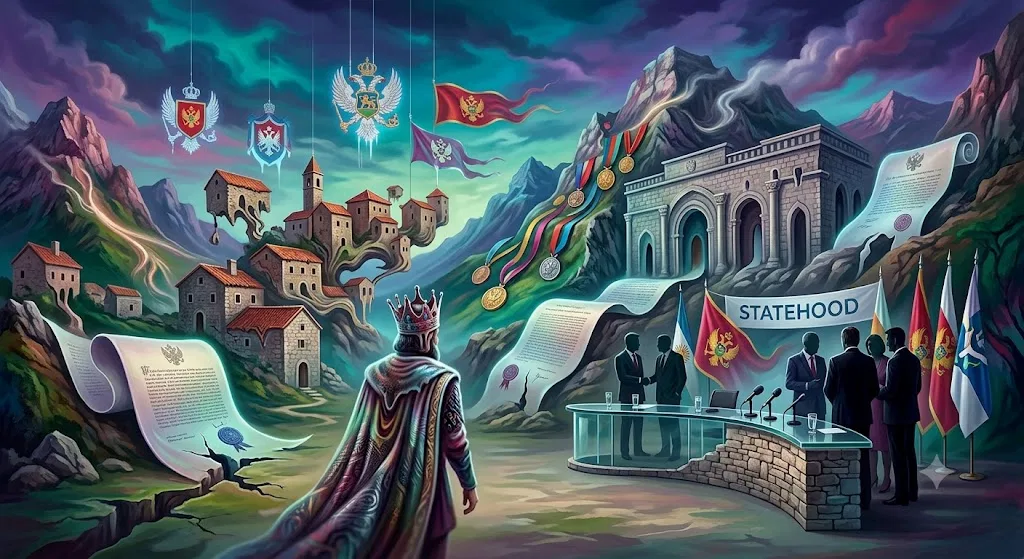
These cases worked because the impostors offered something their audiences wanted: political unity, international prestige or proximity to aristocratic glamour. Modern falsehoods in Montenegro spread differently, through partisan websites, cross-border media and social platforms, but they exploit similar weaknesses. A familiar name, an impressive document or a confident claim can substitute for verification. Montenegro’s history of deception is therefore less a parade of amusing tricks than a study of how borrowed authority becomes believable.
The stranger who became a tsar
In the mid-1760s, a mysterious man appeared near the Montenegrin coast and became known as Šćepan Mali, usually rendered in English as Stephen the Little. His origins remain uncertain. What transformed him from an obscure healer or wanderer into a political phenomenon was a rumour that he was Peter III of Russia, the husband of Catherine the Great.
Peter had been overthrown and died in 1762. Yet his death generated numerous pretenders across the Russian world. In Montenegro, where Orthodox Russia was admired as a possible protector against Ottoman and Venetian power, the idea that the deposed emperor had escaped was emotionally and politically attractive. A supposedly resurrected Russian ruler offered both religious kinship and the promise of a powerful sponsor. Historian Michael Boro Petrovich treated the episode as part of the wider phenomenon of false Peter IIIs, while emphasising the unusual fact that the Montenegrin pretender actually secured effective rule.[JSTOR]jstor.orgCatherine II and a False Peter III in Montenegro | JSTORCatherine II and a False Peter III in Montenegro | JSTOR…
Šćepan appears to have practised calculated ambiguity rather than making a simple, public declaration. He did not need to stand before a crowd and say plainly, “I am Peter III.” He reportedly encouraged the belief through hints, silences and dramatic behaviour, while supporters circulated the claim for him. This distinction matters. The deception was partly collaborative: local elites and ordinary believers helped create the identity because it served existing hopes.
Montenegro at the time was divided among clans and governed through a fragile mixture of ecclesiastical leadership, customary authority and local alliances. Šćepan offered something more decisive. In 1767, leading Montenegrins recognised him as Peter and accepted his authority. By 1768 he had displaced Prince-Bishop Sava from effective power and established himself as the country’s ruler.[Wikipedia]WikipediaŠćepan MaliŠćepan Mali
Why exposure did not end the deception
The supposed emperor’s identity was challenged early. Sava had encountered the real Peter III and sought confirmation from Russian representatives. The Russian ambassador in Constantinople replied that Peter was unquestionably dead and buried. In a modern fraud story, such confirmation might seem decisive. In eighteenth-century Montenegro, it was not.
Information travelled slowly, foreign messages could be distrusted and Russia itself was distant enough to become a screen for political imagination. Šćepan was physically present, while the evidence against him arrived through letters and officials. More importantly, he had begun to demonstrate practical value. He tried to suppress clan feuding, imposed punishments, promoted internal order and created a stronger central authority than Montenegro had previously known. His usefulness helped protect the myth surrounding him.[Wikipedia]WikipediaŠćepan MaliŠćepan Mali
Russia eventually sent Prince Yuri Dolgorukov to investigate. Under interrogation, Šćepan denied having explicitly claimed to be Peter and gave conflicting accounts of his own background. Russian officials treated him as a fraud and briefly imprisoned him. Yet Dolgorukov soon discovered that removing the impostor also removed one of the few figures capable of restraining the clans. Šćepan was restored to a position of authority and continued ruling until his assassination in 1773.[Wikipedia]WikipediaŠćepan MaliŠćepan Mali
The episode therefore resists a simple “foolish people deceived by clever stranger” interpretation. Some followers may have sincerely believed that Šćepan was Peter. Others probably accepted the fiction because it legitimised a ruler they considered effective. The false identity became politically useful even after it was officially discredited.
That ambiguity explains the story’s long afterlife. Šćepan is remembered simultaneously as an impostor, a state-builder and a folk hero. Later literature repeatedly returned to him, including a dramatic work by Montenegro’s nineteenth-century ruler and poet Petar II Petrović-Njegoš. The survival of the story shows how an exposed fraud can become a national historical character when the impostor’s actual achievements complicate the deception.

The modern “Prince of Montenegro”
The twenty-first-century counterpart to Šćepan Mali is Stefano Černetić, an Italian-born man who has presented himself under elaborate variations of the title “Prince of Montenegro and Macedonia”. He claimed descent from the medieval Crnojević dynasty and surrounded that claim with the recognised language of European nobility: coats of arms, diplomatic-style papers, medals, orders of chivalry, formal dress and photographs with prominent people.
Černetić’s performance was effective because royal status is often verified socially rather than legally. A person arrives in an expensive car, displays heraldic insignia, is introduced by respectable hosts and appears in photographs with aristocrats or celebrities. Each encounter then becomes evidence supporting the next one. The more prestigious the social circle, the less willing individuals may be to ask a basic question: who officially recognises this title?
His public activities included presenting honours and noble titles. Pamela Anderson was ceremonially made a countess, while other public figures received decorations or awards associated with his self-styled royal organisation. Reports also described his use of Montenegrin flags and diplomatic-looking insignia.[newsweek.com]newsweek.comPolice Hunt Fake Prince Who Met Pamela Anderson and…June 15, 2017 — 15 Jun 2017 — Italian police are trying to catch a man who…
The performance attracted official attention after a luxury hotel attempted to obtain payment from diplomatic representatives. Italian investigators searched properties associated with Černetić and reported finding documents, seals, medals and other materials connected with his purported status. Montenegro’s authorities made clear that he did not represent the state.[vijesti.me]en.vijesti.meOpen source on vijesti.me.
The legal outcome was less straightforward than the headlines suggesting that a “fake prince” had simply been caught. In 2023, an Italian court reportedly acquitted him of fraud-related charges, accepting that his behaviour was misleading or boastful but concluding that the ceremonial titles and documents did not have the legal force alleged by prosecutors. The ruling did not establish him as Montenegro’s recognised prince; rather, it demonstrated the difficulty of proving criminal fraud when invented honours are treated as private souvenirs and the claimant stops short of formally impersonating the Montenegrin government.[Wikipedia]WikipediaStefano ČernetićStefano Černetić
How the royal performance kept working
Černetić’s case did not end when journalists and authorities questioned his claims. In July 2022, he entered Montenegro’s Statehood Day reception at the Blue Palace in Cetinje, where he was photographed with senior figures, including the president and Prince Nikola Petrović-Njegoš, a genuine descendant of Montenegro’s former ruling dynasty. The presidential office subsequently called for an inquiry into how an uninvited self-proclaimed prince had gained access. A year later, local reporting found that prosecutors had not opened a case over his presence and that the result of the promised internal check had not been made public.[balkaninsight.com]balkaninsight.comOpen source on balkaninsight.com.
This episode shows how an imposture can regenerate itself. A photograph taken at a state reception may look like official recognition even when it records nothing more than a security or protocol failure. Once placed on a website or social-media page, the surrounding circumstances disappear. The image becomes another credential.
The resemblance to Šćepan Mali is striking but imperfect. Šćepan gained power by inhabiting a political hope: the return of a Russian emperor who might protect and unite Montenegro. Černetić inhabits a ceremonial fantasy: the continuation of a royal order in which titles, ribbons and dynastic connections open elite doors. One exploited the authority of empire; the other exploits the visual vocabulary of aristocracy.
Neither case depended on a single forged object. Their most important artefacts were networks of belief. Supporters, hosts, officials, photographers and journalists helped make the claimed identity appear socially real.
When false history becomes political ammunition
Modern misinformation concerning Montenegro often focuses on national identity, religion, elections and the country’s relationships with Serbia, Russia, NATO and the European Union. These campaigns are not always “hoaxes” in the classic sense. Some are propaganda, selective reporting or sincere partisan interpretations. Others, however, rely on demonstrably false statistics, invented incidents or fabricated documents.
The 2023 Montenegrin census became a major target. Fact-checkers documented repeated claims that leaked results showed dramatic changes in national identity before official results existed. Another widely circulated assertion held that 95 per cent of Montenegro’s population had declared itself Serbian in a 1909 census. The cited census did not ask respondents to state a nationality, making the statistic an invention produced by imposing a modern political category on an older record.[SEE Check]seecheck.orgdisinformation report montenegro in 2023disinformation report montenegro in 2023
The claim was persuasive because it looked precise. “Ninety-five per cent” sounds archival and measurable, even when the underlying document contains no such measurement. It also offered a simple historical weapon in a complicated dispute about whether Montenegrin identity is distinct, shared, recently constructed or historically continuous.
An earlier analysis of media coverage surrounding the delayed census found that roughly four in ten examined items were false or misleading. About a third of the misleading material identified in that study originated in neighbouring Serbia, illustrating how Montenegro’s media environment overlaps with a larger shared-language information space.[Debunk.org]debunk.org40 percent of content published about the census in Montenegro was misleading40 percent of content published about the census in Montenegro was misleading
Election periods have produced similarly concrete fabrications. During the 2023 presidential and parliamentary campaigns, false reports described arrests in Podgorica, an assault on the city’s mayor, threats against a candidate and organised convoys supposedly travelling to buy votes. Fake opinion polls were also presented as evidence that particular political blocs were the “real” winners.[SEE Check]seecheck.orgdisinformation report montenegro in 2023disinformation report montenegro in 2023
These stories used the same technique as older impostures: borrowed authority. A fabricated poll borrows the authority of statistics. A false breaking-news report borrows the authority of journalism. A recycled historical claim borrows the authority of an archive.
Health scares, disasters and manufactured certainty
Montenegro also receives the borderless falsehoods that circulate across social media internationally. During and after the coronavirus pandemic, misleading medical claims, anti-vaccine narratives and supposed miracle treatments reached Montenegrin audiences through regional websites, messaging platforms and translated posts. The country’s fact-checking organisations consequently became part of wider Balkan networks designed to identify recurring claims that moved between languages and borders.[European External Action Service]eeas.europa.euOpen source on europa.eu.
Natural disasters provide another powerful setting for misinformation because frightened audiences want immediate explanations. Montenegrin fact-checkers recorded claims that earthquakes, storms and wildfires had been produced by secret “weather weapons”, NATO activity or the High-frequency Active Auroral Research Program, better known as HAARP. Such stories replace complex natural causes with a deliberate human culprit and turn ordinary images—lights in the sky, cloud formations or damaged landscapes—into supposed evidence of attack.[SEE Check]seecheck.orgdisinformation report montenegro in 2023disinformation report montenegro in 2023
By 2025, domestic tragedies were becoming major triggers for false reporting. The Cetinje mass shooting, destructive summer fires and violence followed by hostility towards Turkish residents all generated misleading claims, manipulated narratives or inflammatory rumours. Pro-Russian and anti-Western falsehoods continued alongside them, but immediate local crises increasingly shaped the information environment.[SEE Check]seecheck.orgdisinformation report montenegro in 2025disinformation report montenegro in 2025
The harm in such cases is not merely that readers acquire an incorrect fact. A fabricated report during an election can increase fear of violence. A false rumour following a crime can redirect anger towards an ethnic or national group. Bogus medical advice can affect personal health decisions. The modern hoax therefore tends to be shorter-lived than the legend of Šćepan Mali but capable of producing consequences within hours.
Who exposes the falsehoods?
Exposure has shifted from diplomats and royal envoys to journalists, researchers and specialist fact-checkers. Raskrinkavanje.me, established by Montenegro’s Centre for Democratic Transition in 2018, investigates viral posts, manipulated media and political claims. It participates in regional and international fact-checking networks, reflecting the reality that misinformation circulating in Montenegro frequently begins elsewhere or appears simultaneously across several Balkan countries.[SEE Check]seecheck.orgdisinformation report montenegro in 2023disinformation report montenegro in 2023
Traditional journalism remains important, but it is also part of the problem. A 2019 survey of 50 Montenegrin journalists found that respondents regarded false news as present in both social and traditional media. Ninety per cent said journalists should be the first line of defence, ahead of regulators, media managers and state institutions.[European External Action Service]eeas.europa.euEuropean External Action Service Fake news in the Montenegrin society | EEASEuropean External Action Service Fake news in the Montenegrin society | EEAS
Effective exposure usually depends on returning to the original evidence:
- A royal claimant should be checked against state recognition, documented genealogy and the status of the institutions issuing titles.
- A historical statistic should be compared with the actual questions and categories used in the cited census.
- A photograph should be traced to its first publication rather than interpreted from a reposted caption.
- An election poll should identify its commissioning body, sample, method and publication date.
- A report of an arrest, attack or official decision should be checked against police, court or institutional records.
The hardest falsehoods are not wholly invented. They combine authentic material with a misleading frame: a genuine photograph from the wrong event, a real coat of arms used without legitimate authority, or an old census cited for information it never collected. Such mixtures survive longer than obvious fabrications because every correction must explain not only what is false, but why the real-looking evidence does not prove the claim.
Why Montenegro’s impostor stories endure
Šćepan Mali and Stefano Černetić remain memorable because both stories reveal that identity is partly theatrical. Authority is communicated through names, costumes, seals, ceremonies and the behaviour of other people. When enough respected figures behave as though a claimant is important, observers may reasonably—but incorrectly—assume that somebody else has completed the verification.
Šćepan’s case also contains a deeper historical paradox. He was not Peter III, yet he appears to have exercised real authority and imposed a measure of order. The exposure of his identity did not automatically erase the political results of his rule. Černetić’s case presents the reverse problem: even without formal state power, ceremonial appearances can produce images that resemble recognition and keep an unsupported status claim alive.
These are not stories about a uniquely credulous country. Comparable pretenders, forged pedigrees and invented aristocratic orders have appeared throughout Europe. Montenegro’s particular history made Russian imperial protection especially potent in the eighteenth century and royal symbolism especially resonant after the twentieth-century abolition of its monarchy.
The enduring lesson is that a deception succeeds not simply because somebody lies well. It succeeds when the lie fits an available role. Montenegro’s false tsar offered unity and protection; its modern self-proclaimed prince offers glamour and historical continuity; its contemporary disinformation supplies certainty during elections, disasters and identity disputes. Exposure begins when the role itself is examined rather than merely admired.
Amazon book picks
Further Reading
Books and field guides related to How False Authority Took Hold in Montenegro. Use these as the next step if you want deeper reading beyond the article.
The Confidence Game
Explains the mechanisms that make impostors and false authority persuasive.
The Demon-Haunted World
Rating: 4.5/5 from 43 Google Books ratings
Addresses verification, evidence and belief formation.
The Balkans
First published 2000. Subjects: Histoire, History, Historia, New York Times reviewed, Balkan peninsula, history.
eBay marketplace picks
Marketplace Samples
Live-tested eBay searches with available results related to this page.


Endnotes
1.
Source: jstor.org
Title: Catherine II and a False Peter III in Montenegro | JSTOR
Link:https://www.jstor.org/stable/3000742
Source snippet
Catherine II and a False Peter III in Montenegro | JSTOR...
2.
Source: jstor.org
Link:https://www.jstor.org/stable/650308
Source snippet
The Pretender Phenomenon in Eighteenth-Century Russiaby P Longworth · 1975 · Cited by 41 — "Catherine II and a False Peter III in Mo...
3.
Source: Wikipedia
Title: Šćepan Mali
Link:https://en.wikipedia.org/wiki/%C5%A0%C4%87epan_Mali
4.
Source: newsweek.com
Link:https://www.newsweek.com/man-faked-being-montenegrin-prince-free-trips-meet-pamela-anderson-626006
Source snippet
Police Hunt Fake Prince Who Met Pamela Anderson and...June 15, 2017 — 15 Jun 2017 — Italian police are trying to catch a man who...
Published: June 15, 2017
5.
Source: en.vijesti.me
Link:https://en.vijesti.me/news-b/black-chronicle/669461/no-one-chases-the-false-prince-of-Montenegro%2C-he-claims-to-be-a-descendant-of-a-black-woman
6.
Source: Wikipedia
Title: Stefano Černetić
Link:https://en.wikipedia.org/wiki/Stefano_%C4%8Cerneti%C4%87
7.
Source: balkaninsight.com
Link:https://balkaninsight.com/2022/07/19/montenegrin-president-seeks-probe-after-fake-prince-attends-state-event/bi/montenegro/
8.
Source: debunk.org
Title: 40 percent of content published about the census in Montenegro was misleading
Link:https://www.debunk.org/40-percent-of-content-published-about-the-census-in-montenegro-was-misleading
9.
Source: jstor.org
Link:https://www.jstor.org/stable/pdf/3000741.pdf
10.
Source: jstor.org
Link:https://www.jstor.org/stable/10.2307/i350445
11.
Source: jstor.org
Link:https://www.jstor.org/stable/125595
12.
Source: jstor.org
Link:https://www.jstor.org/stable/pdf/1844981.pdf
13.
Source: balkaninsight.com
Link:https://balkaninsight.com/2020/01/14/montenegro-complains-on-fake-news-campaign/bi/
14.
Source: en.vijesti.me
Title: the false emperor might have been better
Link:https://en.vijesti.me/fun/112958/the-false-emperor-might-have-been-better
15.
Source: thetimes.com
Title: prince stefan of montenegro exposed as italian fraudster nl3hz0h5d
Link:https://www.thetimes.com/world/europe/article/prince-stefan-of-montenegro-exposed-as-italian-fraudster-nl3hz0h5d
Source snippet
The TimesPrince Stefan of Montenegro exposed as Italian fraudster16 Jun 2017 — Mr [Cernetic]({{ 'cernetic/' | relative_url }}) is now being investigated on suspicion of usin...
16.
Source: seecheck.org
Title: disinformation report montenegro in 2023
Link:https://seecheck.org/index.php/2024/06/17/disinformation-report-montenegro-in-2023/
17.
Source: eeas.europa.eu
Link:https://www.eeas.europa.eu/eeas/four-western-balkans%E2%80%99-fact-checking-organisations-join-facebook%E2%80%99s-platform-against-disinformation_en
18.
Source: seecheck.org
Title: disinformation report montenegro in 2025
Link:https://seecheck.org/index.php/2026/03/26/disinformation-report-montenegro-in-2025/
19.
Source: eeas.europa.eu
Title: European External Action Service Fake news in the Montenegrin society | EEAS
Link:https://www.eeas.europa.eu/node/62670_en
20.
Source: facebook.com
Link:https://www.facebook.com/groups/27153053115/posts/10159948610153116/
21.
Source: facebook.com
Link:https://www.facebook.com/ForeverCountryOfficial/posts/beware-of-scammersimposter-pretending-to-be-alan-jackson-scams-woman-out-of-3000/941249104796054/
22.
Source: facebook.com
Link:https://www.facebook.com/groups/119396741908738/posts/557521811429560/
23.
Source: facebook.com
Title: nathan carter has revealed that around 80000 was stolen from one of his fans by
Link:https://www.facebook.com/rsvpmagazine/posts/nathan-carter-has-revealed-that-around-80000-was-stolen-from-one-of-his-fans-by-/1499264075565179/
24.
Source: facebook.com
Link:https://www.facebook.com/ABC30/posts/oprah-winfrey-took-to-instagram-to-warn-her-fans-that-there-is-someone-on-social/10155267787201482/
25.
Source: facebook.com
Link:https://www.facebook.com/groups/2321315414820351/posts/3112491585702726/
26.
Source: facebook.com
Link:https://www.facebook.com/ancientoriginsweb/posts/for-15-years-the-mysterious-bosnian-pyramids-have-been-drenched-in-controversy-w/3712062665501317/
27.
Source: facebook.com
Link:https://www.facebook.com/SecretDalmatia/posts/curious-legend-of-vampire-of-silba-on-our-blog-and-youtube-channel-and-link-to-v/995339202633888/
28.
Source: facebook.com
Link:https://www.facebook.com/ancientoriginsweb/posts/-fascinating-discovery-the-bosnian-pyramids-one-of-the-greatest-finds-ever-trend/1252773326891195/
29.
Source: facebook.com
Link:https://www.facebook.com/MattMellemaWrites/posts/is-there-an-ancient-super-pyramid-hidden-beneath-a-mountain-in-bosnia-matt-think/1351262832330316/
30.
Source: facebook.com
Link:https://www.facebook.com/johanegerkranspublic/posts/vaesen-anniversary-edition-spirits-and-monsters-of-scandinavian-folklore-for-all/1438881418039434/
31.
Source: eeas.europa.eu
Link:https://www.eeas.europa.eu/delegations/montenegro/disinformation-eu-assesses-code-practice-and-publishes-platform-reports-coronavirus-related_en
32.
Source: sigedon.com
Title: peter iii of russia
Link:https://sigedon.com/peter-iii-of-russia/
Additional References
33.
Source: youtube.com
Link:https://www.youtube.com/watch?v=rL7Gv8_nHW4
Source snippet
The Man Who Sold a Nonexistent Country (And Got Away With It)...
34.
Source: youtube.com
Title: 32 People Who Faked Being Royalty (And Almost Got Away With It)
Link:https://www.youtube.com/watch?v=pJqL08TTKwk
Source snippet
Imposters Who Changed History | False Dmitry, Pugachev, Nero, and the Greatest Historical Scams...
35.
Source: youtube.com
Title: The Man Who Sold a Nonexistent Country (And Got Away With It)
Link:https://www.youtube.com/watch?v=3F2hR9vFUDk
Source snippet
New DNA Tests on the Romanovs Reveals a Secret the Russian Monarchy Never Wanted Anyone To Know...
36.
Source: youtube.com
Title: THE FAKE RUSSIAN TSAR WHO RULED MONTENEGRO?The story of a fake tsar Šćepan mali
Link:https://www.youtube.com/watch?v=CTHZl0vPLSs
Source snippet
32 People Who Faked Being Royalty (And Almost Got Away With It)...
37.
Source: irishexaminer.com
Title: arid 30793944
Link:https://www.irishexaminer.com/lifestyle/celebrity/arid-30793944.html
Source snippet
Irish ExaminerPamela Anderson among celebs fooled by fake Prince of...16 Jun 2017 — Cernetic, 56, repeatedly claimed to have been part o...
38.
Source: article19.org
Link:https://www.article19.org/checkitfirst/
39.
Source: gov.me
Link:https://www.gov.me/en/article/204114–government-condemns-fake-media-coverage-calls-on-prosecutor-s-office-to-put-an-end-to-the-spread-of-national-hatred-and-intolera
40.
Source: tumblr.com
Link:https://www.tumblr.com/briefbestiary/763155789801275392/a-late-18th-century-hoax-concerning-a-giant
41.
Source: ejc.net
Link:https://ejc.net/resources/lessons-from-faktografs-cross-border-collaboration-to-reduce-covid-19-misinformation
42.
Source: instagram.com
Link:https://www.instagram.com/p/DYB6yfpj7wi/
Topic Tree
Follow this branch
Related pages 192
- Albanian Hoaxes
- Algerian Hoaxes
- Antigua Deceptions
- Argentina Hoaxes
- Armenian Hoaxes
- +187 more in sidebar