Costa Rica's Most Persistent Hoaxes and Legends
Costa Rica’s history of hoaxes is not dominated by one celebrated national prank.
Page outline Jump by section
Introduction
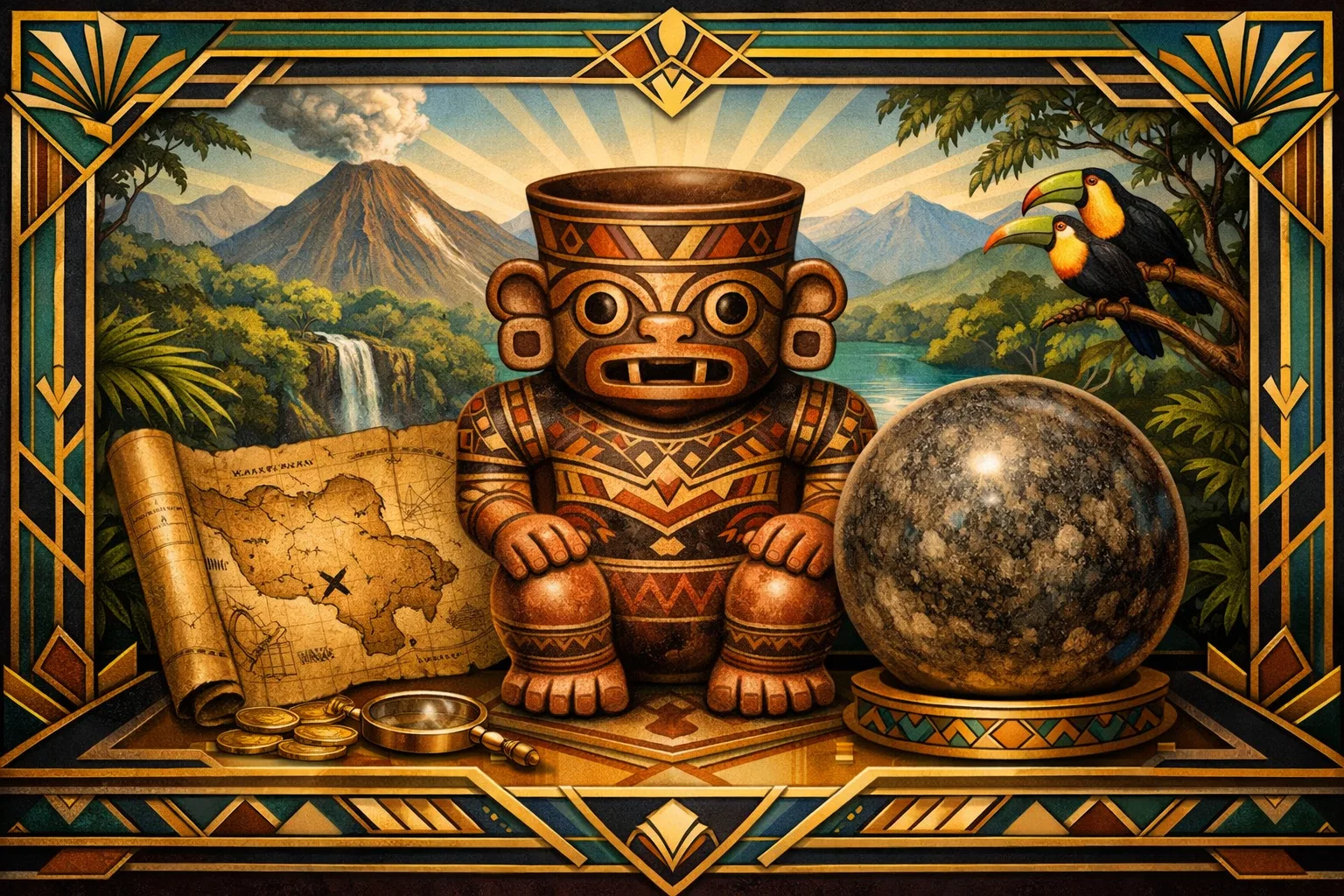
These episodes differ sharply. Some involved deliberate fraud; others were legends, speculative interpretations or genuine mysteries inflated beyond the evidence. What connects them is the way authority was manufactured. An object gained credibility because it looked ancient, a photograph because it came from a government survey, a treasure map because it appeared to preserve secret knowledge, and an advertising story because awards judges saw a polished case study. Costa Rica’s examples show that successful deception rarely depends on a perfect fake. It usually needs only a persuasive story, an interested audience and evidence that is difficult to check.
Forged antiquities and the lure of the lost past
The international market for pre-Columbian art created ideal conditions for forgery. Collectors wanted visually impressive objects from named ancient cultures, but many pieces circulated without a documented excavation site or reliable ownership history. Once an artefact had been separated from its archaeological setting, buyers often had to rely on a dealer’s reputation, stylistic judgement and laboratory tests that might answer only part of the authenticity question.
Objects associated with Costa Rica and neighbouring Panama became especially attractive to collectors and therefore to fakers. Ceramic vessels were particularly vulnerable because convincing imitations could be made with traditional-looking forms, artificial surface wear and invented stories of discovery. Conservation specialists have stressed that scientific testing can identify modern materials or inconsistent manufacture, but an unprovenanced object may remain difficult to authenticate conclusively even when it looks plausible.[Conservation Online]resources.culturalheritage.orgConservation Online Faking pre-Columbian artifactsCosta Rica and Panama became of particular interest to collectors and hence to fakers (Ekholm 1964). Figure 5. Fake. Incan bronze figurin…
The most notorious Costa Rican figure in this trade was Leonardo Patterson, a dealer whose career extended far beyond Costa Rican antiquities. Born in Costa Rica, Patterson built an international business in pre-Columbian objects and moved among collectors, diplomats and museums. Yet accusations of smuggling and forgery followed him for decades. In the United States, he was convicted of wire fraud after attempting to sell a fake Maya wall fragment; investigators said the supposedly ancient work had been fabricated.[Trafficking Culture]traffickingculture.orgTrafficking CultureMaya 'Fresco' FakeAntiquities dealer Leonardo Patterson convicted of federal wire fraud for attempting to sell a fake…
In 2008, German police seized more than 1,000 objects connected with Patterson after a multinational investigation. A German court later convicted him over the deceptive sale of a purported archaeological artefact, imposing probation, home restrictions and a fine. Reporting on the case described a collection that mixed alleged genuine antiquities, illegally exported pieces and modern fabrications—a combination that made the trade particularly hard to untangle.[artnet.com]news.artnet.comPatterson has been convicted of smuggling pre-Columbian artifacts and selling fake objects.Read more…
Patterson’s story matters because it was not simply a case of crude souvenirs fooling careless tourists. The objects travelled through a market in which prestige could substitute for provenance. A dealer’s exhibition history, impressive clients and diplomatic connections helped make doubtful pieces appear respectable. At the same time, genuine looted artefacts could be mixed with forgeries, allowing each category to lend credibility to the other.
The eventual investigations did not expose one workshop or a single coherent hoax. They revealed a broader system in which demand for spectacular ancient art rewarded secrecy. Archaeological context—the exact place, layer and associated material in which an object was found—is often more valuable historically than the object itself. The illicit market destroys that context, while forgery exploits its absence.

The stone spheres: real monuments, invented explanations
Costa Rica’s stone spheres are authentic pre-Columbian monuments, not archaeological fakes. The deception lies in some of the stories imposed upon them.
Hundreds of spheres and fragments have been documented, especially in the Diquís region of southern Costa Rica. They range from small examples to stones more than two metres across. Four archaeological sites containing spheres, settlements, burial areas and other structures were placed on UNESCO’s World Heritage List in 2014. UNESCO dates the associated chiefdom societies broadly to between AD 500 and 1500 and treats the spheres as evidence of complex indigenous social and political organisation.[UNESCO World Heritage Centre]whc.unesco.orgOpen source on unesco.org.
Their exact functions are not fully known. Archaeologists have considered them as markers of status, components of planned settlements, territorial symbols or objects with ceremonial and astronomical associations. Uncertainty about purpose is normal in archaeology, particularly because many spheres were removed from their original locations during twentieth-century agricultural development or looting.
That uncertainty allowed more extravagant claims to flourish. Popular books and tourist retellings have attributed the spheres to survivors of Atlantis, extraterrestrial visitors, mysterious energy systems or forgotten technologies capable of softening stone. Some versions claim that every sphere is mathematically perfect or that the stones were arranged in a global navigational network. These assertions go well beyond the archaeological evidence.[Wikipedia]WikipediaEsferas de piedra de Costa RicaEsferas de piedra de Costa Rica
The attraction is easy to understand. A large, smooth sphere looks technologically demanding, and a displaced sphere standing alone in a garden or public square has lost the settlement remains that once explained it. Presented without indigenous houses, paths, pottery or burial features, it can appear to be an isolated impossibility rather than part of a human landscape.
The extraterrestrial explanation also benefits from a familiar rhetorical trick: it turns gaps in present knowledge into proof of an extraordinary alternative. Archaeologists’ honest statement that the spheres’ precise meanings remain uncertain is recast as an admission that ordinary human manufacture cannot explain them. UNESCO and the National Museum of Costa Rica instead place the stones within known pre-Columbian communities and their wider architecture.[UNESCO World Heritage Centre]whc.unesco.orgOpen source on unesco.org.
This case should therefore be described as pseudohistory rather than a single organised hoax. The spheres themselves are real; the misleading claim is that their impressive workmanship requires a vanished super-civilisation or non-human builders. Such stories attract attention, sell books and add mystery to tourism, but they do so by displacing the indigenous people whose skill produced the monuments.
Cocos Island and the treasure that never appears
Cocos Island, about 550 kilometres from Costa Rica’s Pacific coast, has become one of the world’s great settings for buried-treasure stories. Pirates, mutineers and colonial officials are said to have concealed immense hoards there, including the so-called Treasure of Lima. More than three centuries of retelling have turned the island into a place where the absence of treasure is repeatedly treated as evidence that it remains hidden.
The best-known version claims that, during the struggle for Peruvian independence, authorities in Lima entrusted church and state wealth to a ship commanded by William Thompson. Thompson and his crew supposedly murdered their guards, sailed to Cocos Island and buried the cargo. Captured soon afterwards, the crew were allegedly executed, while Thompson and another man escaped after offering to reveal the hiding place.
The difficulties begin with the documentation. Versions disagree over dates, ships, participants and the contents of the treasure. Later treasure seekers claimed to possess charts, coded directions or information passed down from survivors, but no accepted archival chain connects these documents to the supposed original deposit. Other legends attach the island to the pirates Benito Bonito and Bennett Graham, producing several overlapping treasures rather than one consistent historical account.[Wikipedia]WikipediaCocos IslandCocos Island
The stories nevertheless attracted serious money. The German adventurer August Gissler was appointed a governor of the island in the late nineteenth century and searched for treasure for roughly two decades. His venture was supported through a company and accompanied by attempts to establish a settlement. After extensive digging, he reportedly left with only a handful of gold coins whose connection to any legendary hoard was uncertain. Hundreds of later expeditions likewise failed to uncover the enormous deposits described in treasure literature.[Wikipedia]WikipediaAugust GisslerAugust Gissler
Cocos Island illustrates the boundary between folklore and fraud. A person can sincerely believe a treasure legend and invest in an expedition without deliberately deceiving anyone. Fraud enters when promoters present uncertain documents as authenticated maps, guarantee returns to investors or announce discoveries that cannot be independently inspected.
The island’s landscape helps preserve the belief. Dense vegetation, landslides, streams and rapid erosion mean that almost any failed search can be explained by a changed shoreline or a vanished landmark. Every excavation that finds nothing merely produces another possible location. This makes the legend unusually resistant to disproof.
Today, Cocos Island is internationally valued for its marine ecosystems rather than buried bullion, and unauthorised treasure hunting is prohibited. Yet the treasure narrative survives because it offers a more personalised fantasy than natural history: one lost chart, one correct interpretation and one fortunate expedition could supposedly overturn centuries of failure.

The Lake Cote photograph: evidence without a verdict
On 4 September 1971, an aerial survey conducted for Costa Rica’s National Geographic Institute produced one of the most discussed unidentified-object photographs in the world. A mapping camera aboard an aircraft took a sequence of images over the Lake Cote area near Arenal. In one frame, a bright, disc-like shape appears between the camera and the terrain.
Several features gave the image unusual credibility. It was not presented as a photograph taken by a lone witness anticipating a flying saucer. It emerged from a government mapping operation, was captured on large-format film and appeared only after the survey material was examined. The surrounding landscape is sharply detailed, providing scale and geographic context lacking from many famous UFO images.[The New Yorker]newyorker.comThe New Yorker The Enticing Mysteries of U.F.O. PhotographyHistorical and purportedly authentic U.F.O. photographs, such as Paul Trent’s 1950 images and a 1971 Costa Rica photo, continue to spark…
Researchers Richard Haines and Jacques Vallée examined copies of the photograph and argued that they could find no clear sign of a deliberate double exposure or simple pasted image. Their analysis treated the object as a genuine feature of the negative, although its size depended heavily on assumptions about distance from the camera. UFO proponents later promoted the picture as one of the strongest photographic cases ever recorded.[Scribd]scribd.comNEW HIGH RESOLUTION SCAN OF EXTRAORDINARY UAP IMAGE UAP Media UKNEW HIGH RESOLUTION SCAN OF EXTRAORDINARY UAP IMAGE UAP Media UK
That conclusion remains contested. Sceptical examinations have proposed damage to the film or glass, pressure marks, processing artefacts or a small object close to the camera. The central problem is that one ambiguous frame cannot establish distance. A mark on the negative, a nearby fragment and a large distant object may create similar two-dimensional shapes when there is no second viewpoint or supporting observation.
The photograph has not been demonstrated to be a deliberate hoax. Equally, it does not prove an extraterrestrial vehicle. A later high-resolution scan renewed public interest but increased detail without supplying the missing information about depth, motion or physical origin. A detailed review in The New Yorker found technical arguments on both sides and judged that neither interpretation had conclusively settled the matter.[The New Yorker]newyorker.comThe New Yorker The Enticing Mysteries of U.F.O. PhotographyHistorical and purportedly authentic U.F.O. photographs, such as Paul Trent’s 1950 images and a 1971 Costa Rica photo, continue to spark…
Its continuing fame reveals an important distinction: “unidentified” is a statement about available evidence, not a positive identification as alien technology. The Lake Cote image became powerful because the institutional origin of the film reduced suspicion of an ordinary staged photograph. That credibility was then stretched further than the evidence allowed.
Fake tests, synthetic celebrities and commercial trust
During the COVID-19 pandemic, deception in Costa Rica took a more immediately practical form. In 2021, tourism organisations warned that criminals were selling travellers false coronavirus tests or fabricated certificates, sometimes presenting themselves as legitimate testing providers. The scam exploited rules imposed by destination countries and airlines, even though Costa Rica itself had removed its requirement for arriving visitors to present a negative test in October 2020.[ticotimes.net]ticotimes.netTico Times False Covid tests used to scam tourists in Costa Rica: reportTico Times False Covid tests used to scam tourists in Costa Rica: report
The victims were particularly vulnerable because they faced deadlines. A traveller who needed a result before a flight had limited time to verify a laboratory’s registration, premises or relationship with a hotel. Fraudsters benefited from confusion between Costa Rican entry rules, airline policies and requirements in the traveller’s home country.
This was not merely misinformation. A false certificate could cause financial loss, denied boarding and public-health risk. The episode also showed how criminals can borrow the appearance of official systems: logos, laboratory language, digital documents and test-result formats made an invented service seem legitimate.
More recent investment scams have added artificial intelligence to the same method. Costa Rican media have reported fabricated videos using the faces and imitated voices of recognised journalists and former public officials to promote supposed financial opportunities. In 2025, the television network Teletica warned that scammers had created deepfake material featuring news director Ignacio Santos and former minister Geannina Dinarte.[Teletica]teletica.comCrean videos con “deepfake” con imagen y voz del directorCrean videos con “deepfake” con imagen y voz del director
These frauds work because familiarity is treated as verification. Viewers recognise a presenter’s face, hear a plausible voice and see the visual conventions of a news interview. The endorsement feels pre-checked, even when the person depicted never said the words. Unlike an anonymous phishing message, a deepfake imports years of accumulated trust into a few seconds of synthetic video.
When a publicity stunt becomes a false case study
A particularly revealing Costa Rican controversy emerged from the advertising industry in 2025. Havas Costa Rica and World Vision submitted a campaign called Lessons of Shame to the Cannes Lions awards. The campaign centred on schoolchildren staged in the public gallery of Costa Rica’s Legislative Assembly, with desks arranged to represent a classroom and draw attention to problems in education funding.
The physical demonstration occurred. The dispute concerned the award submission’s account of its scale and consequences. The case-study film claimed that the children had significantly disrupted legislative proceedings and helped produce a major reversal or increase in education funding. Trade journalists who compared those assertions with legislative records and contemporary reporting said they could not verify the claimed political impact.[campaignasia.com]campaignasia.comOpen source on campaignasia.com.
The work won a Gold Lion and a Silver Lion in Brand Experience and Activation. Cannes Lions continued to list the awards, while the controversy contributed to a wider debate about “case-study inflation”: advertising entries that transform modest real-world events into dramatic stories of national change.[canneslions.com]canneslions.comOpen source on canneslions.com.
This was not a fabricated charity or an entirely imaginary protest. It was a real action wrapped in disputed claims about causation. That distinction is important. Modern publicity deception often does not invent every element; it selects genuine footage, compresses chronology and implies that attention, policy discussion and legislative decisions were direct results of the campaign.
Awards systems are vulnerable because judges must assess large numbers of entries produced by the very organisations seeking recognition. A polished video may combine captions, press cuttings, audience figures and policy claims in a form that resembles an independent documentary. Unless organisers check legislative records, budgets and media dates, storytelling skill can be mistaken for evidence of effectiveness.

Why these stories endure
Costa Rica’s best-known cases show several recurring ways in which doubtful claims acquire authority.
A real object supports an unreal story. The stone spheres exist, but their reality does not validate tales of Atlantis or aliens. The Lake Cote negative is genuine photographic material, but that does not identify the disc as a spacecraft.
Missing context creates room for invention. An antiquity without an excavation record can be given a prestigious origin. A treasure map without a traceable history can be presented as a survivor’s secret. A photograph without depth information can support radically different interpretations.
Institutions lend borrowed credibility. Government survey film, diplomatic access, a respected charity, a familiar journalist or an international award can make a claim feel verified even when the institution has confirmed only part of the story.
Failure can preserve belief. Every unsuccessful Cocos Island expedition encourages the claim that searchers chose the wrong cave. Every inconclusive analysis of the Lake Cote photograph allows both believers and sceptics to continue. Claims that cannot specify what would disprove them are especially durable.
Financial incentives reward a better story. Forged artefacts become valuable when assigned a lost culture; treasure promoters attract investors with secret knowledge; scammers imitate trusted public figures; advertising agencies gain prestige by presenting attention as social transformation.
The strongest protection is not blanket cynicism. It is careful classification. A forgery is not the same as folklore; an unidentified image is not necessarily a hoax; an exaggerated campaign is different from an invented event. Asking who first made the claim, where the original evidence is held, whether independent records agree and what finding would count against the story usually reveals more than simply asking whether it sounds possible.
Costa Rica’s history of contested truth is therefore less a catalogue of foolish beliefs than a study in how evidence gains meaning. Stone, film, maps, certificates and videos do not speak for themselves. Their persuasive power depends on the stories attached to them—and on whether anyone takes the trouble to check those stories against the surviving record.
Amazon book picks
Further Reading
Books and field guides related to Costa Rica's Most Persistent Hoaxes and Legends. Use these as the next step if you want deeper reading beyond the article.
Frauds, Myths, and Mysteries: Science and Pseudoscience in Ar...
Directly examines hoaxes, fake artifacts and exaggerated claims.
Fingerprints of the Gods
Represents the type of speculative claims often attached to archaeological mysteries.
eBay marketplace picks
Marketplace Samples
Live-tested eBay searches with available results related to this page.
Endnotes
1.
Source: news.artnet.com
Link:https://news.artnet.com/art-world/antiquities-dealer-convicted-smuggling-forgery-389324
Source snippet
Patterson has been convicted of smuggling pre-Columbian artifacts and selling fake objects.Read more...
2.
Source: culturalpropertynews.org
Link:https://culturalpropertynews.org/careful-collector-no-19-the-life-and-times-of-trail-blazing-antiquities-dealer-leo-patterson/
Source snippet
The Life and Times of Trail-Blazing Antiquities Dealer Leo...27 Sept 2023 — Patterson was convicted of smuggling and selling fraudulent...
3.
Source: whc.unesco.org
Link:https://whc.unesco.org/en/list/1453/
4.
Source: whc.unesco.org
Link:https://whc.unesco.org/en/news/1160
5.
Source: Wikipedia
Title: Esferas de piedra de Costa Rica
Link:https://es.wikipedia.org/wiki/Esferas_de_piedra_de_Costa_Rica
6.
Source: Wikipedia
Title: Stone spheres of Costa Rica
Link:https://en.wikipedia.org/wiki/Stone_spheres_of_Costa_Rica
7.
Source: whc.unesco.org
Link:https://whc.unesco.org/uploads/nominations/1453.pdf
8.
Source: Wikipedia
Title: Cocos Island
Link:https://en.wikipedia.org/wiki/Cocos_Island
9.
Source: Wikipedia
Title: August Gissler
Link:https://en.wikipedia.org/wiki/August_Gissler
10.
Source: Wikipedia
Title: Frank Worsley
Link:https://en.wikipedia.org/wiki/Frank_Worsley
11.
Source: Wikipedia
Title: UFO photographs
Link:https://en.wikipedia.org/wiki/UFO_photographs
12.
Source: scribd.com
Title: NEW HIGH RESOLUTION SCAN OF EXTRAORDINARY UAP IMAGE UAP Media UK
Link:https://www.scribd.com/document/827320581/NEW-HIGH-RESOLUTION-SCAN-OF-EXTRAORDINARY-UAP-IMAGE-UAP-Media-UK
13.
Source: scribd.com
Link:https://www.scribd.com/document/990030806/jse-03-2-haines
14.
Source: teletica.com
Title: Crean videos con “deepfake” con imagen y voz del director
Link:https://www.teletica.com/sucesos/crean-videos-con-deepfake-con-imagen-y-voz-del-director-de-telenoticias-para-estafar_391180
15.
Source: Wikipedia
Title: Archaeological forgery
Link:https://en.wikipedia.org/wiki/Archaeological_forgery
16.
Source: Wikipedia
Title: Pandora Papers
Link:https://en.wikipedia.org/wiki/Pandora_Papers
17.
Source: Wikipedia
Title: COVID 19 pandemic in Costa Rica
Link:https://en.wikipedia.org/wiki/COVID-19_pandemic_in_Costa_Rica
18.
Source: Wikipedia
Title: Leonardo Patterson
Link:https://en.wikipedia.org/wiki/Leonardo_Patterson
19.
Source: whc.unesco.org
Link:https://whc.unesco.org/en/list/1453/maps/
20.
Source: whc.unesco.org
Link:https://whc.unesco.org/en/events/667/
21.
Source: whc.unesco.org
Link:https://whc.unesco.org/zh/list/1453
22.
Source: whc.unesco.org
Link:https://whc.unesco.org/en/statesparties/cr
23.
Source: whc.unesco.org
Link:https://whc.unesco.org/en/news/1162
24.
Source: whc.unesco.org
Link:https://whc.unesco.org/en/activities/831/
25.
Source: unesdoc.unesco.org
Link:https://unesdoc.unesco.org/ark%3A/48223/pf0000245838
26.
Source: resources.culturalheritage.org
Title: Conservation Online Faking pre-Columbian artifacts
Link:https://resources.culturalheritage.org/osg-postprints/wp-content/uploads/sites/8/2015/02/osg014-09.pdf
Source snippet
Costa Rica and Panama became of particular interest to collectors and hence to fakers (Ekholm 1964). Figure 5. Fake. Incan bronze figurin...
27.
Source: traffickingculture.org
Link:https://traffickingculture.org/encyclopedia/case-studies/maya-fresco-fake/
Source snippet
Trafficking CultureMaya 'Fresco' FakeAntiquities dealer Leonardo Patterson convicted of federal wire fraud for attempting to sell a fake...
28.
Source: ticotimes.net
Title: costa rican art dealer gets yet another probation sentence
Link:https://ticotimes.net/2015/11/28/costa-rican-art-dealer-gets-yet-another-probation-sentence
Source snippet
Tico TimesCosta Rican art dealer receives yet another probation...28 Nov 2015 — A German court sentenced Costa Rican Leonardo Patterson...
29.
Source: newyorker.com
Title: The New Yorker The Enticing Mysteries of U.F.O. Photography
Link:https://www.newyorker.com/culture/photo-booth/the-enticing-mysteries-of-ufo-photography
Source snippet
Historical and purportedly authentic U.F.O. photographs, such as Paul Trent’s 1950 images and a 1971 Costa Rica photo, continue to spark...
30.
Source: ticotimes.net
Title: Tico Times False Covid tests used to scam tourists in Costa Rica: report
Link:https://ticotimes.net/2021/10/12/false-covid-tests-used-to-scam-tourists-in-costa-rica-report
31.
Source: cr.usembassy.gov
Link:https://cr.usembassy.gov/20210302-travel-alert/
32.
Source: campaignasia.com
Link:https://www.campaignasia.com/article/havas-costa-ricas-cannes-lions-winning-ad-lessons-of-shame-needs-lessons-of-le/blw2achcj6y9swbzugvik8r9s6
33.
Source: campaignlive.com
Title: havas costa ricas cannes lions winning ad lessons shame needs lessons legitimacy
Link:https://www.campaignlive.com/article/havas-costa-ricas-cannes-lions-winning-ad-lessons-shame-needs-lessons-legitimacy/1925167
34.
Source: canneslions.com
Link:https://www.canneslions.com/awards/lions/brand-experience-activation/what-you-need-to-know
35.
Source: lovethework.com
Title: cannes lions
Link:https://www.lovethework.com/en/awards/results/cannes-lions?entry_type_id=8&year=2025
36.
Source: campaignlive.co.uk
Title: cannes lions ban agencies submit wilfully false campaigns
Link:https://www.campaignlive.co.uk/article/cannes-lions-ban-agencies-submit-wilfully-false-campaigns/1925104
37.
Source: campaignlive.com
Title: jurors pull back curtain cannes lions new integrity era
Link:https://www.campaignlive.com/article/jurors-pull-back-curtain-cannes-lions-new-integrity-era/1963416
38.
Source: sebasquiros.com
Title: Lessons Of Shame
Link:https://sebasquiros.com/lessons-of-shame/index.html
39.
Source: yeudyguido.com
Title: Lessons of Shame
Link:https://yeudyguido.com/lessons-of-shame-1
40.
Source: matheusmatsumoto.com
Link:https://matheusmatsumoto.com/project/lessons
41.
Source: campaignlive.co.uk
Title: cannes lions 2025 watershed moment awards
Link:https://www.campaignlive.co.uk/article/cannes-lions-2025-watershed-moment-awards/1925312
42.
Source: campaignasia.com
Link:https://www.campaignasia.com/keyword/havas-costa-rica
43.
Source: canneslions.com
Title: our partners
Link:https://www.canneslions.com/partnerships/our-partners
Additional References
44.
Source: latimes.com
Title: la xpm 2008 nov 09 adfg antiquities9 story
Link:https://www.latimes.com/archives/la-xpm-2008-nov-09-adfg-antiquities9-story.html
Source snippet
Los Angeles TimesAn antiquities legend in an 'intrinsically lawless' field9 Nov 2008 — Leonardo Patterson's colorful career includes char...
45.
Source: youtube.com
Title: The Hunt For The Billion Dollar Pirate Treasure Buried On Cocos Island
Link:https://www.youtube.com/watch?v=jZvDKnQb6-Y
Source snippet
Cocos Island: A Real Life 'Treasure Island'...
46.
Source: youtube.com
Title: The Ancient Stone Spheres That Shouldn’t Exist
Link:https://www.youtube.com/watch?v=x69Zc-hqZaw
Source snippet
The Hunt For The Billion Dollar Pirate Treasure Buried On Cocos Island...
47.
Source: jstor.org
Link:https://www.jstor.org/stable/279713
Source snippet
Economic Aspects of Commercial Archaeology in Costa Ricaby DB Heath · 1973 · Cited by 34 — It is clear that everyone who has an inte...
48.
Source: instagram.com
Link:https://www.instagram.com/reel/DXZiqhZDglS/?hl=en
49.
Source: facebook.com
Link:https://www.facebook.com/centralnoticiascr/videos/sucesos-ia-potencia-una-vieja-estafa-que-vuelve-a-enga%C3%B1ar-a-costarricensesun-via/1391380099600169/
50.
Source: icfj.org
Link:https://www.icfj.org/sites/default/files/2018-07/A%20Short%20Guide%20to%20History%20of%20Fake%20News%20and%20Disinformation_ICFJ%20Final.pdf
51.
Source: facebook.com
Link:https://www.facebook.com/groups/149844915349213/posts/1986211165045903/
52.
Source: reddit.com
Link:https://www.reddit.com/r/Ticos/comments/1m1k4b1/costa_rica_gana_le%C3%B3n_de_oro_en_cannes_enga%C3%B1ando/?tl=en
53.
Source: ghsindex.org
Link:https://ghsindex.org/wp-content/uploads/2021/12/Costa-Rica.pdf
Topic Tree
Follow this branch
Related pages 192
- Albanian Hoaxes
- Algerian Hoaxes
- Antigua Deceptions
- Argentina Hoaxes
- Armenian Hoaxes
- +187 more in sidebar