How False Stories Borrowed Senegal's Credibility
Senegal does not have a neat catalogue of nationally famous hoaxes comparable with countries whose press archives preserve generations of celebrated newspaper tricks.
Page outline Jump by section
Introduction
These stories matter because they show that deception rarely succeeds through fabrication alone. It borrows credibility from trusted names, existing fears, political conflict or authentic images stripped of their original context. They also require careful labels. Some were deliberate impostures; others were organised propaganda, rumours hardened into false news, or genuine footage repackaged to tell a fictional story.
Ali Dia and football’s most famous false recommendation
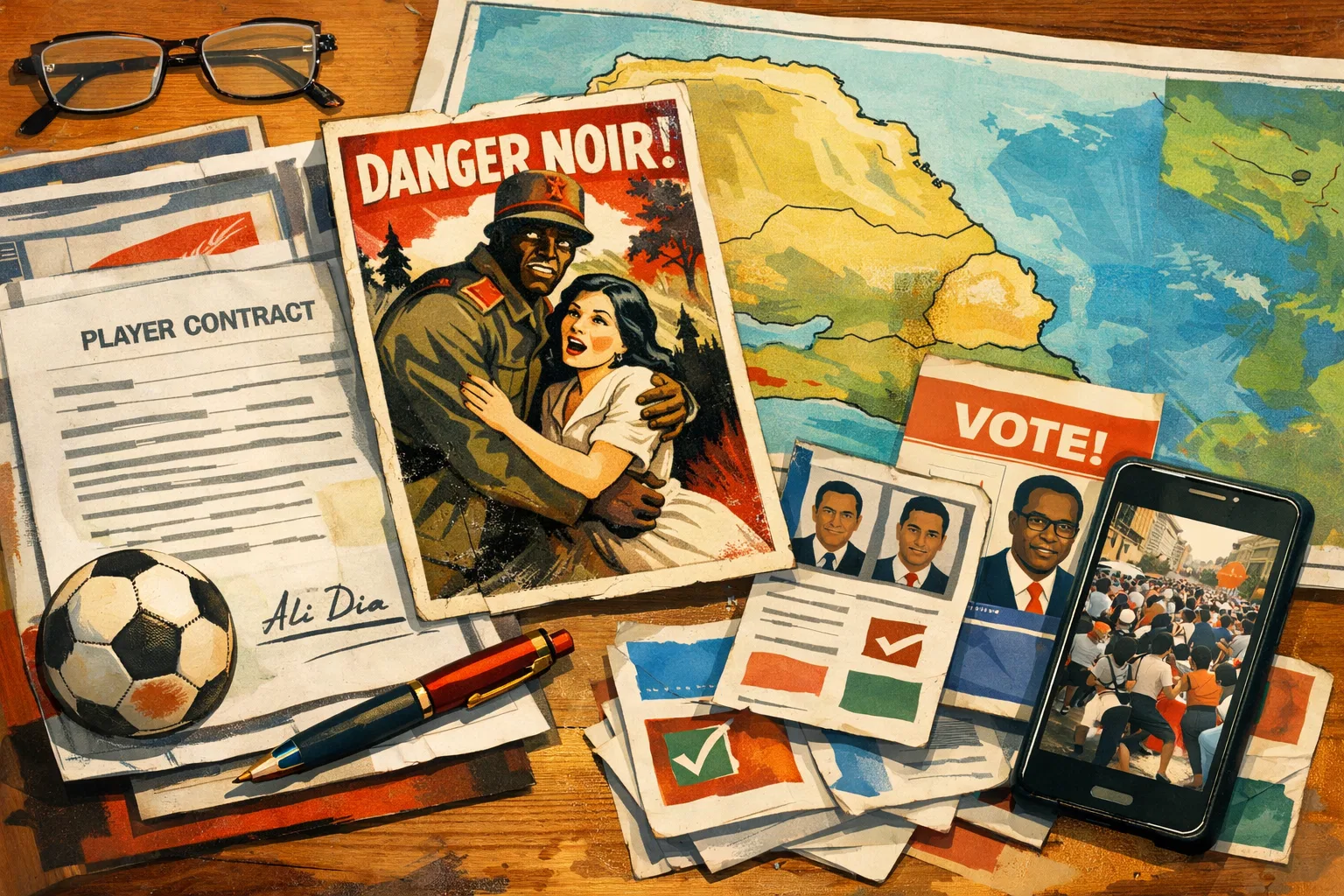
The best-known Senegal-linked imposture began in England in November 1996. Southampton manager Graeme Souness received a telephone call from someone claiming to be George Weah, then one of the world’s most celebrated footballers. The caller reportedly described Ali Dia as Weah’s cousin, a former Paris Saint-Germain player and a Senegal international. Southampton signed Dia on a short contract and soon used him in a Premier League match against Leeds United. He came on as a substitute and was later substituted himself after playing for roughly 53 minutes.[Goal]goal.comFootball's craziest transfers: How 'f*cking hopeless' Ali DiaFootball's craziest transfers: How 'f*cking hopeless' Ali Dia…September 3, 2024 — 4 Sept 2024 — Multiple potential sources of the…
The supposed credentials were false. Dia had played at lower levels in France, Germany and England, but he had not represented Paris Saint-Germain or Senegal as claimed, and George Weah was not his cousin. The precise identity of the caller remains disputed: accounts have variously blamed Dia, a friend or an intermediary. That uncertainty is worth preserving because the basic deception is well established even though some of its most entertaining details have been repeatedly embellished.[Goal]goal.comFootball's craziest transfers: How 'f*cking hopeless' Ali DiaFootball's craziest transfers: How 'f*cking hopeless' Ali Dia…September 3, 2024 — 4 Sept 2024 — Multiple potential sources of the…
The trick worked because it exploited authority rather than documentary evidence. A recommendation apparently coming from the reigning FIFA World Player of the Year encouraged a professional club to suspend ordinary scepticism. Southampton also had little time to examine the claim before injuries created an opportunity for Dia to play. In an era before clubs could instantly search digital performance databases, false career claims were slower to disprove, although a direct call to Weah or the Senegalese football authorities would still have exposed them.
Dia’s appearance on the pitch turned the deception into legend. Had he merely attended a trial, the episode might have disappeared into club folklore. Instead, television footage supplied a visible punchline, while later retellings converted a failure of recruitment into “the greatest hoax in football”. The episode still circulates because it reverses football’s normal power structure: an obscure player briefly gained access to an elite institution by imitating the language of agents, international contacts and insider recommendation.
It is nevertheless misleading to portray Dia simply as a man who had never played football. He had experience in minor and non-league clubs and later appeared for Gateshead. The fraud concerned his identity, pedigree and supposed endorsement, not the invention of a person with no football background whatsoever.[Wikipedia]WikipediaAli DiaAli Dia

The fabricated “Black Horror” surrounding Senegalese troops
A more destructive Senegal-related deception appeared after the First World War. France deployed colonial soldiers, including men described broadly as Senegalese, in the occupied German Rhineland. German nationalist organisations, newspapers and international campaigners then promoted lurid allegations that African troops were committing widespread rape, mutilation and other atrocities against civilians.
The campaign became known as the “Black Horror on the Rhine”. Its imagery presented African soldiers as sexually violent “barbarians” threatening white German women and children. Historians describe it as a racist propaganda movement intended not merely to report individual crimes but to discredit France, the Treaty of Versailles and the use of colonial troops in Europe. An average of about 25,000 French colonial soldiers from North Africa, Senegal and Madagascar served in the occupation zone during the early 1920s, although propaganda frequently treated this diverse force as a single racial menace.[oup.com]academic.oup.comThese soldiers became the targetOUP AcademicWeimar Germany, Race and Occupation after World War Iby J Roos · 2014 — During the early 1920s, on average 25000 colonial tro…
The deception worked through repetition and emotional imagery. Posters, pamphlets, speeches and newspaper stories transformed isolated allegations into a vision of systematic terror. Sexual violence was especially useful to propagandists because it combined racial prejudice, national humiliation and anxiety about defeated Germany’s loss of control. The figure of the “Senegalese soldier” became less a description of a particular serviceman than a stereotype onto which political campaigners projected fears about race and empire.
Evidence gathered at the time did not support the scale of atrocity being alleged. American officials and journalists investigated sensational reports and found that many were unsupported or grossly exaggerated. Later historical research has treated the campaign as a central example of how genuine occupation grievances and possible individual offences were inflated into a general accusation against an entire racialised group.[wikipedia.org]WikipediaBlack Horror on the RhineBlack Horror on the Rhine
This was not a hoax created in Senegal, but it belongs in Senegal’s history of contested truth because Senegalese identity was instrumentalised abroad. The label attached to France’s colonial troops allowed propagandists to erase distinctions between nationalities, regiments and individuals. It also demonstrates how a false story can survive after its immediate political purpose has faded: the emotional image remains memorable even when the statistical and documentary basis collapses.
The episode should not be confused with a claim that no soldier in the occupation forces ever committed a crime. The propaganda deception lay in presenting African troops collectively as participants in an organised wave of racial and sexual terror. That generalisation was the political product.
The vaccine video that became a story of seven dead children
During the opening months of the COVID-19 pandemic, a video filmed in Senegal circulated with the claim that seven children had died after receiving an experimental coronavirus vaccine. The story spread widely on Facebook in April 2020, when no approved COVID-19 vaccine yet existed.
AFP’s investigation found that the children’s deaths had not happened. Senegal’s health ministry denied the alleged incident, while the footage actually showed a crowd reacting to a rumour that a door-to-door salesman was attempting to vaccinate local children. The video therefore captured a real moment of alarm, but the accompanying description converted that alarm into evidence of a fictional medical disaster.[AFP Fact Check]factcheck.afp.comsenegalese children did not die coronavirus vaccine which does not yet existsenegalese children did not die coronavirus vaccine which does not yet exist
This distinction explains why the post was persuasive. Completely fabricated footage can be exposed through visual defects, but authentic images are harder to dismiss. Viewers could see agitation, police activity and a gathering crowd. The false caption supplied a cause that appeared to explain those real scenes. The claim also arrived amid global uncertainty about medical research, disease transmission and the speed at which vaccines might be developed.
The rumour drew strength from deeper suspicions about medical experimentation in Africa. A vague fear that unknown outsiders might test dangerous products on children was turned into a specific claim with a death toll, a location and dramatic video. Once those elements were combined, the story could travel internationally without requiring readers to know anything about the original event.
The case is better described as miscaptioned footage amplifying a local rumour than as a staged film. The camera did not record fake actors or a fabricated medical procedure. The deception occurred when users reassigned the footage a false meaning and shared the new version as confirmed news.
Its consequences extend beyond one viral post. False stories about child deaths can make routine vaccination and legitimate public-health work appear threatening. Senegal later conducted a real COVID-19 vaccination campaign, supported by public-health bodies seeking to overcome access barriers and distrust.[UNICEF]unicef.orgOpen source on unicef.org.

How the 2024 election generated recycled videos and invented authority
Senegal’s 2024 presidential election took place during an unusually tense political period. President Macky Sall’s attempt to delay the vote provoked protests and a constitutional confrontation before the election was eventually held on 24 March. Bassirou Diomaye Faye won and was sworn in on 2 April.
Periods of uncertainty are ideal conditions for false material because old images can be presented as breaking news and invented documents can appear plausible before official information catches up. Researchers examining fake content around Senegal’s election identified false opinion polls, misleading electoral maps, recycled campaign footage, an unauthenticated audio recording, a supposed presidential decree and fabricated claims about the incoming government. Poll graphics were particularly useful because numbers and institutional-looking layouts gave political preferences the appearance of independent measurement.[Africa Check]africacheck.orgAfrica Check Testing the fault linesAfrica Check Testing the fault lines
One widely circulated video was said to show mass protests after Sall postponed the election. The footage was genuinely from Dakar, but Africa Check traced it to a 2023 rally supporting opposition leader Ousmane Sonko. The crowd was real; the date and purpose were wrong. This is a recurring form of political deception because spectacular protest footage is highly shareable and often difficult to place without landmarks, original uploads or local reporting.[Africa Check]africacheck.orgno video 2023 rally senegalese opposition leader sonko notno video 2023 rally senegalese opposition leader sonko not
Another altered video appeared after Faye’s victory. Social-media posts claimed it showed the new president delivering a fluent English speech criticising French influence in Africa. AFP established that the man was actually Ousmane Sonko and that the original footage dated from July 2021. Sonko had spoken in Wolof and French; the English audio was an alteration. Reverse-image searching and comparison with the original Senegalese broadcast exposed both the mistaken identity and the synthetic translation.[AFP Fact Check]factcheck.afp.comOpen source on afp.com.
The clip succeeded because it offered audiences outside Senegal a ready-made political symbol. Faye was young, newly elected and associated with demands for sovereignty and political change. A polished English-language declaration therefore felt consistent with what distant viewers expected him to represent. The falsehood did not need to invent a completely unfamiliar narrative; it merely supplied a more dramatic and internationally accessible version of an existing one.
Research on the election cautions against exaggerating the scale of a single centrally directed disinformation campaign. The documented material included opportunistic posts, altered media, political rumours and anonymous fabrications rather than one proven mastermind controlling every message. The Senegalese sample also contained fewer attempts to undermine the entire electoral process than comparable samples from several other African elections.[Africa Check]africacheck.orgOpen source on africacheck.org.
That makes the election a useful example of an information disorder rather than one grand hoax. Different actors could benefit in different ways: campaign supporters could inflate their candidate’s popularity, influencers could attract attention, partisan accounts could discredit opponents, and anonymous publishers could profit from engagement. The shared method was to borrow authority—from polls, decrees, famous politicians, authentic television footage or apparently spontaneous crowds.
Why these stories were believable
Senegal’s best-documented deception stories differ greatly in subject and seriousness, but they repeatedly use the same mechanisms.
Borrowed prestige. Ali Dia’s supposed connection to George Weah made improbable career claims sound credible. Election fabrications similarly borrowed the appearance of polling organisations, official decrees or presidential speeches.
Authentic material with a false explanation. The vaccine panic and several election stories used genuine footage. The images were not fake; their dates, identities or meanings were.
Existing fear or desire. Rhineland propaganda relied on racism and national humiliation. Vaccine rumours exploited fear of experimentation. Political fabrications offered supporters either proof of persecution or confirmation that their preferred leader possessed extraordinary popularity and authority.
A gap before verification. Falsehoods are most effective when institutions, journalists or witnesses have not yet supplied a clear account. A hurried football transfer, an emergency health crisis and a delayed election each created moments in which verification lagged behind circulation.
Memorable simplification. The surviving version is usually cleaner than the evidence. “A man with no football ability fooled the Premier League”, “Senegalese troops terrorised Germany” and “children died in a secret vaccine test” are dramatic narratives with obvious villains and victims. The documented reality is more complicated, which makes it less likely to be repeated unchanged.
What Senegal’s hoax history actually shows
The available cases do not suggest a peculiarly Senegalese willingness to believe false stories. Several of the most famous deceptions were created or amplified outside the country. Their success arose from familiar pressures: institutional shortcuts, racial propaganda, medical anxiety, political uncertainty and social platforms that reward emotionally satisfying material.
They also show why “fake” is not a sufficient diagnosis. Ali Dia’s case was an apparent imposture built around invented credentials. The “Black Horror” was an organised propaganda campaign that exaggerated and racialised accusations. The vaccine story was a false caption attached to real footage of a rumour-driven disturbance. Election misinformation ranged from recycled video to fabricated polls and digitally altered speech.
Understanding those differences changes how each case should be investigated. Imposture is exposed by checking identity and employment records. Propaganda requires comparison between allegations, statistics and the interests of its promoters. Miscaptioned images can be traced through earlier uploads and reverse-image searches. Altered audio demands comparison with the original recording. In every case, the decisive evidence comes not from whether a story feels strange, inspiring or frightening, but from whether its claimed source, date, identity and context survive verification.
Amazon book picks
Further Reading
Books and field guides related to How False Stories Borrowed Senegal's Credibility. Use these as the next step if you want deeper reading beyond the article.
The Demon-Haunted World
Rating: 4.5/5 from 43 Google Books ratings
Provides a framework for evaluating extraordinary claims.
eBay marketplace picks
Marketplace Samples
Live-tested eBay searches with available results related to this page.

Endnotes
1.
Source: goal.com
Title: Football’s craziest transfers: How ‘f*cking hopeless’ Ali Dia
Link:https://www.goal.com/en/lists/football-craziest-transfers-ali-dia-fooled-southampton-premier-league/blt0dbec5bb0270444a
Source snippet
Football's craziest transfers: How 'f*cking hopeless' Ali Dia...September 3, 2024 — 4 Sept 2024 — Multiple potential sources of the...
Published: September 3, 2024
2.
Source: Wikipedia
Title: Ali Dia
Link:https://en.wikipedia.org/wiki/Ali_Dia
3.
Source: academic.oup.com
Title: These soldiers became the target
Link:https://academic.oup.com/gh/article-abstract/32/1/145/572208
Source snippet
OUP AcademicWeimar Germany, Race and Occupation after World War Iby J Roos · 2014 — During the early 1920s, on average 25000 colonial tro...
4.
Source: Wikipedia
Title: Black Horror on the Rhine
Link:https://en.wikipedia.org/wiki/Black_Horror_on_the_Rhine
5.
Source: jstor.org
Link:https://www.jstor.org/stable/44581604
Source snippet
The "barely restrainable beastiality of the black troops" has to many rapes, an especially serious problem since Africans are ".Read more...
6.
Source: factcheck.afp.com
Title: senegalese children did not die coronavirus vaccine which does not yet exist
Link:https://factcheck.afp.com/senegalese-children-did-not-die-coronavirus-vaccine-which-does-not-yet-exist
7.
Source: unicef.org
Link:https://www.unicef.org/senegal/en/stories/i-got-vaccinated-not-just-myself-my-family
8.
Source: factcheck.afp.com
Link:https://factcheck.afp.com/doc.afp.com.34NE9CW
9.
Source: facebook.com
Title: in 1996 ali dia tricked southamptons manager by claiming to be george weahs cous
Link:https://www.facebook.com/NewsCentralAfrica/posts/in-1996-ali-dia-tricked-southamptons-manager-by-claiming-to-be-george-weahs-cous/1083042193835546/
10.
Source: facebook.com
Link:https://www.facebook.com/GiveMeSport/posts/move-over-ali-dia-gregoire-akcelord-is-the-ultimate-fake-footballer-/1226245082199082/
11.
Source: facebook.com
Link:https://www.facebook.com/groups/3685458004850635/posts/10012986098764429/
12.
Source: facebook.com
Link:https://www.facebook.com/DeeMaestro01/posts/why-do-people-derive-joy-in-circulating-false-information-i-have-seen-this-news-/876110918904552/
13.
Source: facebook.com
Link:https://www.facebook.com/GiveMeSport/posts/meet-the-con-man-who-blagged-a-career-as-a-professional-footballer-without-ever-/5018849091495595/
14.
Source: facebook.com
Link:https://www.facebook.com/MvLSports/posts/tragic-loss-cheick-tour%C3%A9s-story-and-the-dangers-of-fake-football-agentsthe-footb/1399286308865068/
15.
Source: facebook.com
Link:https://www.facebook.com/100086714990624/posts/ali-dia-pulled-off-the-biggest-hoax-in-football-history-%EF%B8%8Fin-1996-southampton-han/867615172805641/
16.
Source: facebook.com
Title: senegal began providing the covid 19 vaccine to government ministers and health
Link:https://www.facebook.com/VOANews/posts/-senegal-began-providing-the-covid-19-vaccine-to-government-ministers-and-health/10158514486423074/
17.
Source: factcheck.afp.com
Link:https://factcheck.afp.com/doc.afp.com.32863GY
18.
Source: factcheck.afp.com
Title: fact checking search results
Link:https://factcheck.afp.com/fact-checking-search-results?keywords=Biden&page=369
19.
Source: factcheck.afp.com
Link:https://factcheck.afp.com/doc.afp.com.B9DU4T3
20.
Source: factcheck.afp.com
Link:https://factcheck.afp.com/doc.afp.com.486X49D
21.
Source: factcheck.afp.com
Title: busting coronavirus myths
Link:https://factcheck.afp.com/busting-coronavirus-myths
22.
Source: factcheck.afp.com
Link:https://factcheck.afp.com/doc.afp.com.36VC3CP
23.
Source: factcheck.afp.com
Link:https://factcheck.afp.com/doc.afp.com.A82N863
24.
Source: factcheck.afp.com
Title: one year fact checking afp
Link:https://factcheck.afp.com/one-year-fact-checking-afp
25.
Source: pubmed.ncbi.nlm.nih.gov
Link:https://pubmed.ncbi.nlm.nih.gov/22454974/
Source snippet
contradictions in the campaign against the "black horror on...by J Roos · 2012 · Cited by 55 — During the early 1920s, an average...
26.
Source: africacheck.org
Title: Africa Check Testing the fault lines
Link:https://africacheck.org/sites/default/files/media/documents/2025-03/Finlay_et_al_Testing%20the%20Faultlines_March_2025.pdf
27.
Source: africacheck.org
Link:https://africacheck.org/sites/default/files/media/documents/2025-03/Testing%20the%20faultlines_report_Finlay_Makena_Ajibola_Sy_Final%20report_Feb_27_2025.pdf.pdf
28.
Source: africacheck.org
Title: no video 2023 rally senegalese opposition leader sonko not
Link:https://africacheck.org/fact-checks/meta-programme-fact-checks/no-video-2023-rally-senegalese-opposition-leader-sonko-not
29.
Source: africacheck.org
Link:https://africacheck.org/get-involved/fact-checking-tips
30.
Source: africacheck.org
Title: africa checks guide zombie claims how spot false information just wont die
Link:https://africacheck.org/fact-checks/guides/africa-checks-guide-zombie-claims-how-spot-false-information-just-wont-die
31.
Source: africacheck.org
Title: fact checks
Link:https://africacheck.org/fact-checks?page=1
32.
Source: africacheck.org
Title: no need fear perfume seller 1990s hoax about fainting after
Link:https://africacheck.org/fact-checks/meta-programme-fact-checks/no-need-fear-perfume-seller-1990s-hoax-about-fainting-after
33.
Source: africacheck.org
Title: election myths health misinformation top 5 claims we fact checked 2024
Link:https://africacheck.org/fact-checks/blog/election-myths-health-misinformation-top-5-claims-we-fact-checked-2024
34.
Source: africacheck.org
Link:https://africacheck.org/what-we-do/african-fact-checking-awards
35.
Source: africacheck.org
Link:https://africacheck.org/fact-checks?page=76
36.
Source: africacheck.org
Title: viral whatsapp warning wrong app does have privacy concerns
Link:https://africacheck.org/fact-checks/blog/viral-whatsapp-warning-wrong-app-does-have-privacy-concerns
37.
Source: africacheck.org
Title: fact checks
Link:https://africacheck.org/fact-checks?field_article_type_value=All&field_country_value=ZA&field_rated_value=All&page=3&sort_bef_combine=created_DESC
38.
Source: africacheck.org
Title: ignore message claiming south african supermarket checkers
Link:https://africacheck.org/fact-checks/meta-programme-fact-checks/ignore-message-claiming-south-african-supermarket-checkers
39.
Source: africacheck.org
Title: comment casting doubts and casting votes real world effects false election fraud
Link:https://africacheck.org/fact-checks/blog/comment-casting-doubts-and-casting-votes-real-world-effects-false-election-fraud
40.
Source: africacheck.org
Title: press release fact checks presidential degree fraud impact climate crisis women
Link:https://africacheck.org/fact-checks/blog/press-release-fact-checks-presidential-degree-fraud-impact-climate-crisis-women
41.
Source: africacheck.org
Title: macky sall and un investigating shadowy holding price limited poll
Link:https://africacheck.org/fact-checks/blog/macky-sall-and-un-investigating-shadowy-holding-price-limited-poll
42.
Source: africacheck.org
Link:https://africacheck.org/fact-checks/blog/cloudy-outlook-what-we-are-learning-about-election-disinformation-africa-and-what
43.
Source: africacheck.org
Link:https://africacheck.org/who-we-are/our-impact
44.
Source: africacheck.org
Link:https://africacheck.org/
45.
Source: dubawa.org
Title: africa check announces winners of 2021 fact checking awards
Link:https://dubawa.org/africa-check-announces-winners-of-2021-fact-checking-awards/
Additional References
46.
Source: cambridge.org
Link:https://www.cambridge.org/core/journals/central-european-history/article/womens-rights-nationalist-anxiety-and-the-moral-agenda-in-the-early-weimar-republic-revisiting-the-black-horror-campaign-against-frances-african-occupation-troops/2E78514BF0242B95A233DC4EB92449BF
Source snippet
Cambridge University Press & AssessmentRevisiting the “Black Horror” Campaign against France's...by J Roos · 2009 · Cited by 40 — Women'...
47.
Source: youtube.com
Title: “He didn’t do well today”
Link:https://www.youtube.com/watch?v=7CTOowuaKqo
Source snippet
The REAL story behind Ali Dia playing for Southampton! | Matt Le Tissier on The Football Show...
48.
Source: youtube.com
Link:https://www.youtube.com/watch?v=a-A0kErdBwI
Source snippet
Countering Disinformation in West Africa...
49.
Source: youtube.com
Title: Countering Disinformation in West Africa
Link:https://www.youtube.com/watch?v=MKWeRYaK7l4
Source snippet
Tackling Misinformation in West Africa - 6 PM News, 21st February, 2025...
50.
Source: scribd.com
Link:https://www.scribd.com/document/639184706/English-The-Imposters-reading-comprehension
51.
Source: dubawa.org
Link:https://dubawa.org/blog-facebook-page-takes-down-steve-harveys-false-claim-after-dubawas-fact-check/
52.
Source: freiheit.org
Link:https://www.freiheit.org/sub-saharan-africa/covid-19-and-fake-news-experiences-senegal
53.
Source: instagram.com
Link:https://www.instagram.com/p/C44tr2et4wz/
54.
Source: researchgate.net
Link:https://www.researchgate.net/publication/321880288_Fake_news_from_Africa_Panics_politics_and_paradigms
55.
Source: pngtree.com
Link:https://pngtree.com/free-backgrounds-photos/hoax-stamp/2
Topic Tree
Follow this branch
Related pages 192
- Albanian Hoaxes
- Algerian Hoaxes
- Antigua Deceptions
- Argentina Hoaxes
- Armenian Hoaxes
- +187 more in sidebar