When Greece's Past Became Too Good to Trust
Greece’s history of hoaxes is inseparable from the extraordinary value attached to its past. An object presented as Minoan, Archaic or Classical can attract money, prestige and intense national or scholarly interest. A story that seems to connect modern Greece directly with heroic antiquity can become equally powerful.
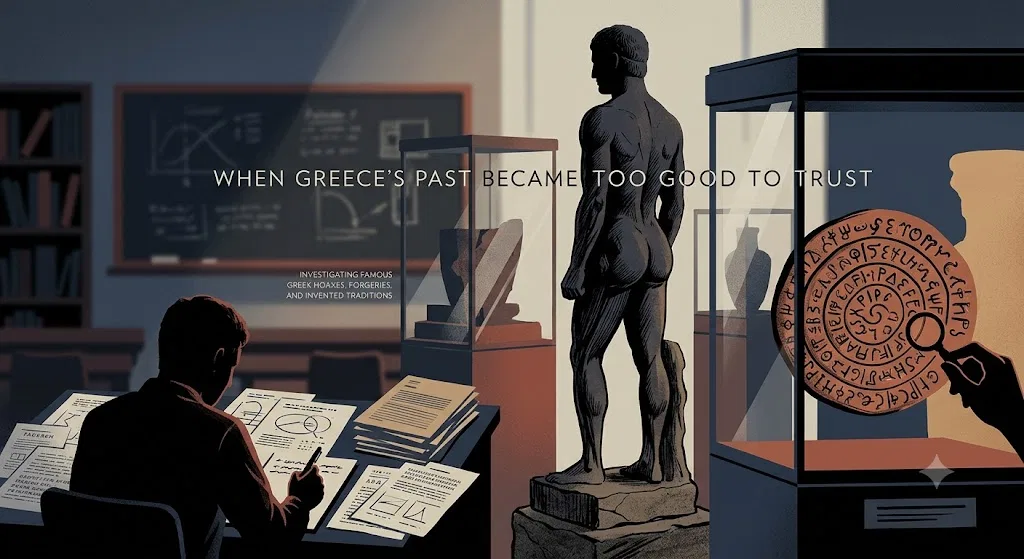
Page outline Jump by section
Introduction
The most revealing Greek cases are therefore not all straightforward tricks. The Getty Kouros came with fabricated ownership documents, yet arguments over the statue itself lasted for decades. The Phaistos Disc has repeatedly been accused of being a modern fabrication, although the balance of archaeological opinion favours authenticity. The famous dying messenger of Marathon is better understood as a later legend reshaped for the modern Olympic Games than as a consciously organised hoax. Together, such stories show why it is essential to separate proven fraud from contested evidence, inherited folklore and sincere error.
When an ancient masterpiece has no trustworthy past
Few objects illustrate the difficulties of detecting antiquities fraud better than the Getty Kouros, an over-life-sized marble statue in the form of an Archaic Greek youth. The J. Paul Getty Museum acquired it in 1985 after extensive investigation and later organised a scholarly conference devoted to the question of its authenticity. The sculpture appeared plausible enough to divide archaeologists, conservators and art historians for years.[Getty]getty.eduKourosMay 5, 2026 — A kouros is a statue of a standing nude youth that did not represent any one individual youth but the idea of yo…
The warning signs were present before the purchase. The statue had no recorded excavation site and entered the market through the dealer Gianfranco Becchina. Its supporting paperwork supposedly traced it through a European collection over several decades, but investigators discovered anachronisms in the documents. A postcode used in one purportedly old letter did not yet exist at the stated date, while a bank account mentioned in another had not yet been opened. Whatever the age of the marble sculpture, its documentary history had plainly been manufactured.[Wikipedia]WikipediaGetty kourosGetty kouros
Scientific examination initially seemed to strengthen the case for antiquity. Researchers found changes in the dolomitic marble’s surface that they believed would require centuries of natural weathering. Later laboratory work showed that comparable chemical alteration could be produced artificially. The case became a lesson in the limits of scientific authentication: a test may establish that a material could be old without proving that the carved object is ancient, and an apparently unusual ageing process may not remain impossible to reproduce.[Wikipedia]WikipediaGetty kourosGetty kouros
Visual analysis caused further concern. Specialists argued that the statue combined features associated with different periods and regional traditions of Greek sculpture. Supporters could answer that ancient artists were not required to obey modern classification systems, but sceptics saw the mixture as the work of a sophisticated forger assembling convincing details from published examples.
The Getty eventually removed the kouros from its main display. Museum director Timothy Potts publicly described it as fake in 2018, although the museum’s collection record has continued to acknowledge the long history of dispute. The crucial point is not simply that experts were deceived. The object succeeded because it arrived at the intersection of strong institutional desire, incomplete provenance and scientific results that appeared more decisive than they really were.[Artsy]artsy.netThe “Getty Kouros” Was Officially Deemed a ForgeryApril 16, 2018 — 16 Apr 2018 — “It's fake, so it's not helpful to show it along wi…
The case also demonstrates why fake provenance matters even when an artefact might be genuine. Invented ownership histories can disguise recent illegal excavation or export just as readily as they can support a modern forgery. A false document does not automatically prove that an object was newly made, but it destroys the chain of evidence needed to judge where the object came from and whether it was legally traded.[ResearchGate]researchgate.netResearch Gatesome observationsFalse provenances, however, are not pro- vided exclusively to forgeries, but also serve to mask illegally excavated and exported works. I…
The Phaistos Disc: suspected forgery, unproved hoax
The Phaistos Disc is one of the most famous objects in the Heraklion Archaeological Museum on Crete. Found in 1908 during Italian excavations at the palace of Phaistos, the fired clay disc carries 241 impressions made from 45 different signs arranged in spirals. No securely deciphered text in the same script has been found, and the method of stamping repeated symbols into clay looks unexpectedly similar to movable type. Its uniqueness has made it both fascinating and vulnerable to claims of fraud.[Academia]academia.eduOpen source on academia.edu.
The most prominent modern accusation came from antiquities specialist Jerome Eisenberg, who argued that excavation director Luigi Pernier may have created the disc to compete with spectacular discoveries made by other archaeologists working on Crete. Eisenberg pointed to the object’s unusual technique, uncertain excavation context and abundance of picturesque symbols. He also suggested that the disc seemed designed to present exactly the sort of tantalising mystery likely to make an excavator famous.[University of Texas at Austin]sites.utexas.eduUniversity of Texas at Austin The Phaistos DiskUniversity of Texas at Austin The Phaistos Disk
That theory is possible, but it has not been proved. Later discoveries produced signs and design features resembling parts of the disc. One important parallel is a symbol found in a secure archaeological context decades after 1908. Other Cretan objects show comparable signs or spiral arrangements. These parallels make it harder to argue that Pernier simply invented the disc’s entire visual language from imagination. Archaeologist Pavol Hnila concluded that the arguments supporting authenticity outweighed those for forgery, while acknowledging that the original find circumstances were less secure than researchers would now prefer.[Academia]academia.eduOpen source on academia.edu.
A decisive modern dating test has not settled the matter. Thermoluminescence can estimate when fired clay was last heated, but testing a unique museum object would require institutional permission and careful sampling. Until stronger physical evidence is produced, calling the Phaistos Disc a confirmed hoax goes beyond what the evidence supports.
The disc therefore belongs in Greek hoax history as a cautionary case rather than an exposed fraud. Its mystery encourages sensational claims in both directions. Some writers declare it a fake; others announce elaborate “decipherments” despite having no substantial body of related texts against which to test their readings. The most responsible conclusion is narrower: the object is unusual, its archaeological documentation is imperfect, and forgery has been seriously proposed, but most specialists continue to treat it as probably ancient.[Academia]academia.eduOpen source on academia.edu.
How national legends can become accepted history
Not every false historical story begins with a fraudster. Some are gradually assembled from art, education, religious memory and political need. Once repeated in classrooms and public ceremonies, they may acquire the authority of documented history even when evidence for them is weak.
A major Greek example is the story of the “secret school”. In its familiar form, the legend says that during Ottoman rule, Greek language, religion and national identity survived because Orthodox priests secretly taught children at night, often in churches or monasteries, while Ottoman authorities prohibited Greek education.
Historians do not deny that schooling was uneven, that local repression occurred, or that Christian communities faced unequal conditions within the Ottoman Empire. The disputed element is the sweeping claim that Greek education was generally forbidden and therefore had to operate through a nationwide clandestine system. Research on schools, church institutions and Greek-language learning under Ottoman rule has found no evidence for such a universal ban. Scholars have consequently described the secret-school story as a national myth rather than an established account of ordinary Ottoman educational policy.[academia.edu]academia.eduOpen source on academia.edu.
The legend became especially persuasive because it compressed a complicated history into one emotionally powerful scene: a priest, a group of children and a threatened culture surviving in darkness. Nineteenth-century nationalist storytelling and a celebrated painting helped fix that scene in popular memory. The image could express real experiences of insecurity, resistance and cultural survival even if the particular institution it depicted was not historically widespread.[Cambridge University Press & Assessment]resolve.cambridge.orgOpen source on cambridge.org.
This makes the secret school different from a forged statue. There was no single moment when one person necessarily invented the whole deception for money. It is better understood as an invented tradition: a story shaped and strengthened because it served religious, educational and national purposes. Its endurance shows how symbolic truth can protect a narrative from documentary criticism. To question the literal history may be heard as denying cultural survival itself, even though the two claims are not the same.
The Marathon messenger was reshaped for a modern age
The most internationally successful Greek historical legend may be the story of Pheidippides. According to the familiar version, an Athenian runner raced from the battlefield of Marathon to Athens in 490 BC, announced victory over the Persians and immediately died. The modern marathon is said to reproduce his route.
The earliest surviving account closest to the events, by Herodotus, tells a different story: a professional runner named Pheidippides was sent from Athens to Sparta before the battle to request military assistance. Accounts of a runner carrying news from Marathon to Athens appear much later and do not consistently name him. Over time, separate stories were blended into the single dramatic narrative now widely repeated.[runnersworld.com]runnersworld.comthe real pheidippides storythe real pheidippides story
The modern race was devised for the first modern Olympic Games in Athens in 1896. French scholar Michel Bréal proposed a long-distance event inspired by the ancient legend, giving the new Olympics a vivid connection with classical Greece. Greek athlete Spyridon Louis won the first Olympic marathon and became a national hero, helping to turn the reconstructed story into an international sporting tradition.[Olympics]olympics.comOpen source on olympics.com.
This was not necessarily a hoax in the sense of an organiser secretly inventing a false event while knowing it would be taken as exact history. Nineteenth-century writers commonly treated ancient anecdotes, patriotic poetry and historical reconstruction as parts of the same cultural inheritance. Yet the result was an invented tradition presented with the simplicity of fact.
The legend remains persuasive because it is almost perfectly designed for sport. It provides a named hero, a measurable route, physical sacrifice and a final declaration of victory. The messier historical record — involving several runners, later sources and uncertain identities — cannot compete with that compact story. Even official and commercial accounts still sometimes describe the race as the direct product of a “true” ancient event, showing how repetition by trusted institutions can keep a doubtful narrative alive.[Athens Marathon]athensauthenticmarathon.grOpen source on athensauthenticmarathon.gr.
Modern forgery follows the market
Although ancient Greek objects dominate public imagination, present-day Greek art is also a target for forgery. The basic mechanism is similar: counterfeiters choose artists whose work is valuable, recognisable and sought after, then add signatures, certificates or sales histories that make the objects appear legitimate.
In December 2024, Greek police arrested three people in northern Greece over an alleged operation involving forged works attributed to prominent twentieth-century Greek artists. An expert from the National Gallery examined 123 paintings and sculptures prepared for an online auction and judged all of them to be clear forgeries. Police also seized more than 800 additional works for investigation. The planned auction was expected to raise between €288,000 and €398,000.[AP News]apnews.comOpen source on apnews.com.
The case is significant because the works were not being sold in a back room to obviously reckless buyers. They were offered through an online auction environment, a format that can imitate the reassuring features of established art commerce: catalogues, estimates, artist biographies and timed bidding. Digital access enlarges the pool of potential buyers while making it harder for them to inspect surfaces, materials, frames and documentation in person.
The alleged forgers also selected artists with established reputations among Greek collectors, including Yannis Gaitis, Nikos Hadjikyriakos-Ghikas and Alekos Fassianos. Their work can command substantial prices, yet it remains more accessible to ordinary private buyers than a major ancient sculpture. That middle market is attractive to fraudsters because buyers may know enough to recognise an artist’s style without having the technical expertise or archive access required for authentication.[AP News]apnews.comOpen source on apnews.com.
Greece has since strengthened its institutional response to art crime. Reforms announced in 2026 broadened penalties connected with creating, possessing, exhibiting, trafficking and selling forged artworks, including the use of falsified documents about provenance, date or condition. The changes recognise that fraud begins before money changes hands: producing a counterfeit inventory or false certificate is part of the deception, not merely preparation for it.[Artnet News]news.artnet.comOpen source on artnet.com.
Why Greek fakes are unusually persuasive
The recurring feature in these cases is not national credulity. It is the power of expectation. Greece occupies a central place in global stories about archaeology, democracy, philosophy, art and sport. Objects and narratives that appear to strengthen those connections encounter audiences already prepared to value them.
Several factors repeatedly make doubtful claims believable:
- Prestige creates pressure. Museums, collectors, excavators and sporting institutions gain status from possessing or promoting a dramatic link to ancient Greece.
- Missing provenance creates room for invention. An artefact without a documented excavation history can be equipped with letters, collection labels and ownership stories that are difficult to verify.
- Science can be overstated. Material tests may exclude some possibilities without proving authenticity. The Getty Kouros showed how a technical result can acquire more certainty in public discussion than the method justifies.
- A good story defeats a complicated record. The dying runner and the secret school survive because each transforms a broad historical experience into one memorable scene.
- Institutions amplify repetition. Museums, schools, tourism organisations, auction catalogues and sporting bodies can make a doubtful claim appear settled simply by presenting it without qualification.
- Mysteries attract confident solutions. Unique objects such as the Phaistos Disc invite both accusations of forgery and unsupported decipherments because the available evidence is too limited to constrain imagination.
The strongest defence is not blanket scepticism. Declaring every unproven antiquity fake would be as careless as accepting every impressive object. Reliable investigation combines documentary research, archaeological context, scientific testing, stylistic comparison and transparent acknowledgement of uncertainty.
What exposure really changes
A successful exposure rarely depends on one dramatic revelation. The Getty Kouros was undermined by the accumulation of false paperwork, stylistic anomalies, changing scientific interpretation and comparisons with known imitations. The secret-school legend weakened through patient study of educational and institutional records. The Phaistos Disc remains unresolved because neither side has produced evidence strong enough to close the case.
These different outcomes matter. “Forgery”, “legend” and “unexplained” are not interchangeable conclusions. A forged ownership letter is a deliberate deception. A patriotic tradition may develop through selective memory rather than conspiracy. A mysterious archaeological object may remain authentic even when extraordinary claims about its meaning are unfounded.
Greece’s most famous contested stories reveal a wider truth about hoaxes: deception works best when it attaches itself to something people genuinely value. The prestige of antiquity, the emotional force of national survival, the romance of athletic heroism and the commercial appeal of famous artists all provide an existing structure of belief. The fake does not create that structure. It borrows it.
Amazon book picks
Further Reading
Books and field guides related to When Greece's Past Became Too Good to Trust. Use these as the next step if you want deeper reading beyond the article.
The Forger's Spell
Directly addresses authenticity, expertise and forged cultural treasures.
The Archaeology of Knowledge
Useful for readers interested in how historical narratives are constructed.
Fake? The art of deception
Closely aligned with disputed artefacts and historical hoaxes.
The Oxford history of the classical world
Supplies broader context for claims about ancient Greece.
eBay marketplace picks
Marketplace Samples
Live-tested eBay searches with available results related to this page.



Endnotes
1.
Source: getty.edu
Link:https://www.getty.edu/art/collection/object/103VNP
Source snippet
KourosMay 5, 2026 — A kouros is a statue of a standing nude youth that did not represent any one individual youth but the idea of yo...
Published: May 5, 2026
2.
Source: getty.edu
Link:https://www.getty.edu/publications-reports/item/242H8P
Source snippet
These essays will be of interest to antiquities specialists and to those who...Read more...
3.
Source: getty.edu
Link:https://www.getty.edu/publications-reports/item/247N0D
Source snippet
The Getty Museum Kouros | Publications and Reports18 Jun 2026 — The archaic Greek statue acquired by the Museum in 1985 has been the...
4.
Source: Wikipedia
Title: Getty kouros
Link:https://en.wikipedia.org/wiki/Getty_kouros
5.
Source: researchgate.net
Title: Research Gatesome observations
Link:https://www.researchgate.net/profile/Kenneth-Lapatin/publication/291542727_PROOF_THE_CASE_OF_THE_GETTY_KOUROS/links/675b4176da24c8537c6823a5/PROOF-THE-CASE-OF-THE-GETTY-KOUROS.pdf
Source snippet
False provenances, however, are not pro- vided exclusively to forgeries, but also serve to mask illegally excavated and exported works. I...
6.
Source: artsy.net
Link:https://www.artsy.net/article/artsy-editorial-getty-kouros-removed-view-museum-officially-deemed-forgery
Source snippet
The “Getty Kouros” Was Officially Deemed a ForgeryApril 16, 2018 — 16 Apr 2018 — “It's fake, so it's not helpful to show it along wi...
Published: April 16, 2018
7.
Source: academia.edu
Link:https://www.academia.edu/5996948/Notes_on_the_Authenticity_of_the_Phaistos_Disk
8.
Source: Wikipedia
Title: Phaistos Disc
Link:https://en.wikipedia.org/wiki/Phaistos_Disc
9.
Source: academia.edu
Link:https://www.academia.edu/88999773/2022Greece_The_Myth_of_Krypho_Scholeio_Secret_School_Issues_of_Historical_Understanding_and_Historical_Culture
10.
Source: cambridge.org
Link:https://www.cambridge.org/core/journals/nationalities-papers/article/religious-nationalism-and-adaptation-in-southeast-europe/91492F434B0AEDDE133D11B6C996D5F8
11.
Source: cambridge.org
Title: University Press & Assessment Part II
Link:https://www.cambridge.org/core/books/history-of-the-athonite-commonwealth/part-ii/C42887EA186B223005B8E960D4A315E9
12.
Source: resolve.cambridge.org
Link:https://resolve.cambridge.org/core/services/aop-cambridge-core/content/view/7082CC7303E2A4A6C815BE6182258169/9781846158322c7_p155-174_CBO.pdf/athens_the_image_of_modern_hellenism.pdf
13.
Source: Wikipedia
Link:https://en.wikipedia.org/wiki/Marathon
14.
Source: time.com
Link:https://time.com/4295749/boston-marathon-history-evolution/
15.
Source: olympics.com
Link:https://www.olympics.com/en/news/local-hero-louis-earns-cult-status-in-marathon
16.
Source: olympics.com
Title: this week in olympic sports history april 8 14
Link:https://www.olympics.com/en/news/this-week-in-olympic-sports-history-april
17.
Source: news.artnet.com
Link:https://news.artnet.com/art-world/greece-art-crime-2763957
18.
Source: Wikipedia
Link:https://en.wikipedia.org/wiki/Kouros
19.
Source: Wikipedia
Title: Greek language
Link:https://en.wikipedia.org/wiki/Greek_language
20.
Source: Wikipedia
Link:https://en.wikipedia.org/wiki/Greeks
21.
Source: Wikipedia
Link:https://en.wikipedia.org/wiki/History
22.
Source: Wikipedia
Title: Kouros (perfume)
Link:https://en.wikipedia.org/wiki/Kouros_%28perfume%29
23.
Source: Wikipedia
Title: Athletics at the 1896 Summer Olympics – Men’s marathon
Link:https://en.wikipedia.org/wiki/Athletics_at_the_1896Summer_Olympics%E2%80%93_Men%27s_marathon
24.
Source: Wikipedia
Link:https://en.wikipedia.org/wiki/Pheidippides
25.
Source: Wikipedia
Title: Krifo scholio
Link:https://en.wikipedia.org/wiki/Krifo_scholio
26.
Source: cambridge.org
Link:https://www.cambridge.org/core/journals/international-journal-of-middle-east-studies/article/school-protests-and-the-making-of-the-postottoman-mediterranean-student-politicization-as-a-challenge-to-italian-colonialism-in-rhodes-19151937/2EA8291020185E52A3EAEBBE8B7CC1A1
27.
Source: cambridge.org
Link:https://www.cambridge.org/core/journals/new-perspectives-on-turkey/article/antiquities-in-exile-ottoman-greek-refugees-trauma-and-ionian-antiquities/D7178E33666BAE0E5638843F8F98DDB6
28.
Source: cambridge.org
Link:https://www.cambridge.org/core/books/disciples-of-the-state/synthesizing-the-religious-and-the-national-in-a-revolutionary-and-irredentist-greece/B295BA5453A3CEEB7913003D398FCC98
29.
Source: cambridge.org
Title: The Growth of Learning (Chapter 2)
Link:https://www.cambridge.org/core/books/japan-and-ancient-greece/growth-of-learning/6F2A6948B036B5F612ABB0146FE918BF
30.
Source: cambridge.org
Link:https://www.cambridge.org/core/books/empire-and-power-in-the-reign-of-suleyman/narrating-imagining-and-managing-the-empire/5E1DC1567F589E5F3CC53D37D693E113
31.
Source: cambridge.org
Title: Epic Without End (Part VI)
Link:https://www.cambridge.org/core/books/cambridge-companion-to-ancient-greek-epic/epic-without-end/BB04B3228E3A6F64AEB932C2CB20FF43
32.
Source: cambridge.org
Link:https://www.cambridge.org/core/books/cambridge-companion-to-constantinople/place-and-its-people/429562FD43B0133EF9164B2B051EB457
33.
Source: researchgate.net
Link:https://www.researchgate.net/publication/364464812_Greece_The_Myth_of_Krypho_Scholeio_Secret_School_Issues_of_Historical_Understanding_and_Historical_Culture
34.
Source: getty.edu
Title: Fragmentary Imitation Kouros
Link:https://www.getty.edu/art/collection/object/103WHK
35.
Source: getty.edu
Link:https://www.getty.edu/art/collection/object/108DZZ
36.
Source: getty.edu
Link:https://www.getty.edu/publications/artistryinbronze/conservation-and-analysis/42-mille-descamps/
37.
Source: getty.edu
Link:https://www.getty.edu/art/collection/object/103TN5
38.
Source: getty.edu
Link:https://www.getty.edu/visit/calendar/days/02032007.html
39.
Source: greek-language.gr
Link:https://www.greek-language.gr/
40.
Source: archive.archaeology.org
Title: praeneste fibula
Link:https://archive.archaeology.org/online/features/hoaxes/praeneste_fibula.html
41.
Source: youtube.com
Title: The Getty Museum Bought a $9.5 Million Fake?
Link:https://www.youtube.com/watch?v=xjy_i1VAeVE
Source snippet
THE GETTY KOUROS...
42.
Source: youtube.com
Title: THE GETTY KOUROS
Link:https://www.youtube.com/watch?v=a5PQs8V7VAA
Source snippet
The Mystery of The PHAISTOS DISC...
43.
Source: sites.utexas.edu
Title: University of Texas at Austin The Phaistos Disk
Link:https://sites.utexas.edu/scripts/wp-content/uploads/sites/3428/2016/07/eisenberg_2008.pdf
44.
Source: sites.utexas.edu
Link:https://sites.utexas.edu/scripts/wp-content/uploads/sites/3428/2016/07/eisenberg_2008a.pdf
45.
Source: runnersworld.com
Title: the real pheidippides story
Link:https://www.runnersworld.com/runners-stories/a20836761/the-real-pheidippides-story/
46.
Source: athensauthenticmarathon.gr
Link:https://www.athensauthenticmarathon.gr/en/diorganosi/1-HISTORY
47.
Source: apnews.com
Link:https://apnews.com/article/6d3fc1537be511ea53fddb9edcb976f5
48.
Source: support.google.com
Link:https://support.google.com/chrome/answer/95589?co=GENIE.Platform%3DAndroid&hl=en-GB
49.
Source: facebook.com
Link:https://www.facebook.com/artnet/posts/artnetnews-after-a-spate-of-forgery-scandals-and-acts-of-vandalism-greece-is-ove/1377575534410115/
50.
Source: arthistorykmg.omeka.net
Link:https://arthistorykmg.omeka.net/exhibits/show/gettykouros/provenance
51.
Source: ebsco.com
Link:https://www.ebsco.com/research-starters/visual-arts/kouros
52.
Source: wordreference.com
Link:https://www.wordreference.com/engr/Greek
53.
Source: athensmarathon.com
Link:https://athensmarathon.com/history/
54.
Source: en.wiktionary.org
Link:https://en.wiktionary.org/wiki/Greek
Additional References
55.
Source: youtube.com
Title: The Mystery of the Phaistos Disc: Archaeology’s Greatest Enigma
Link:https://www.youtube.com/watch?v=z4mRCTic7FU
Source snippet
The Marathon Story | The Legendary Run of Pheidippides | 2D Animation by Ratna Sagar...
56.
Source: historysnob.com
Link:https://www.historysnob.com/eras/20-archaeological-hoaxes-that-fooled-people-for-way-too-long
57.
Source: instagram.com
Link:https://www.instagram.com/p/DY9nZkVE0fp/
58.
Source: facebook.com
Link:https://www.facebook.com/groups/GreaterGreece/posts/1264205187083618/
59.
Source: yslbeauty.com
Link:https://www.yslbeauty.com/int/fragrance/fragrance-for-him/kouros/kouros-eau-de-toilette/282YSL.html
60.
Source: scribd.com
Link:https://www.scribd.com/document/766439822/the-disc-essay
61.
Source: scribd.com
Link:https://www.scribd.com/document/897028475/eisenberg-2008a
62.
Source: scripted.com
Link:https://www.scripted.com/writing-samples/questions-of-provenance-the-getty-ko-9abfb07d-67cf-406f-8a54-76e83c764a93
63.
Source: ineos159challenge.com
Link:https://www.ineos159challenge.com/news/the-history-of-the-marathon
64.
Source: reddit.com
Link:https://www.reddit.com/r/UnresolvedMysteries/comments/9e69hj/the_phaistos_disc_has_never_been_deciphered_is_it/
Topic Tree
Follow this branch
Related pages 192
- Albanian Hoaxes
- Algerian Hoaxes
- Antigua Deceptions
- Argentina Hoaxes
- Armenian Hoaxes
- +187 more in sidebar