Within Bosnian Hoaxes
When Genuine Camp Footage Was Branded a Hoax
Footage of emaciated detainees was later attacked as staged, showing how claims of fakery can be used to discredit real evidence.
On this page
- What British journalists recorded at Trnopolje
- How critics reframed the barbed wire images
- What the dispute reveals about denial and visual proof
Page outline Jump by section
Introduction
One of the most revealing episodes in the history of contested truth during the Bosnian War was not a fabricated photograph but an attempt to convince the public that genuine evidence was fake. In August 1992, British journalists filmed emaciated detainees at the Trnopolje camp near Prijedor, including the now-famous image of Fikret Alić standing behind barbed wire. The footage helped expose a network of Bosnian Serb-run detention camps and became one of the defining visual records of the war. Years later, however, a coordinated campaign argued that the images had been staged or deliberately manipulated. The resulting controversy became a case study in how authentic evidence can be reframed as deception in order to cast doubt on documented atrocities.[Wikipedia]WikipediaFikret AlićFikret Alić

The dispute is important not because the footage was eventually shown to be false—it was not—but because it demonstrated how allegations of fakery can be deployed against real reporting. In the context of Bosnia and Herzegovina, it remains one of the clearest examples of historical denial attaching itself to a famous image.[Wikipedia]WikipediaLiving MarxismLiving Marxism
What British Journalists Recorded at Trnopolje
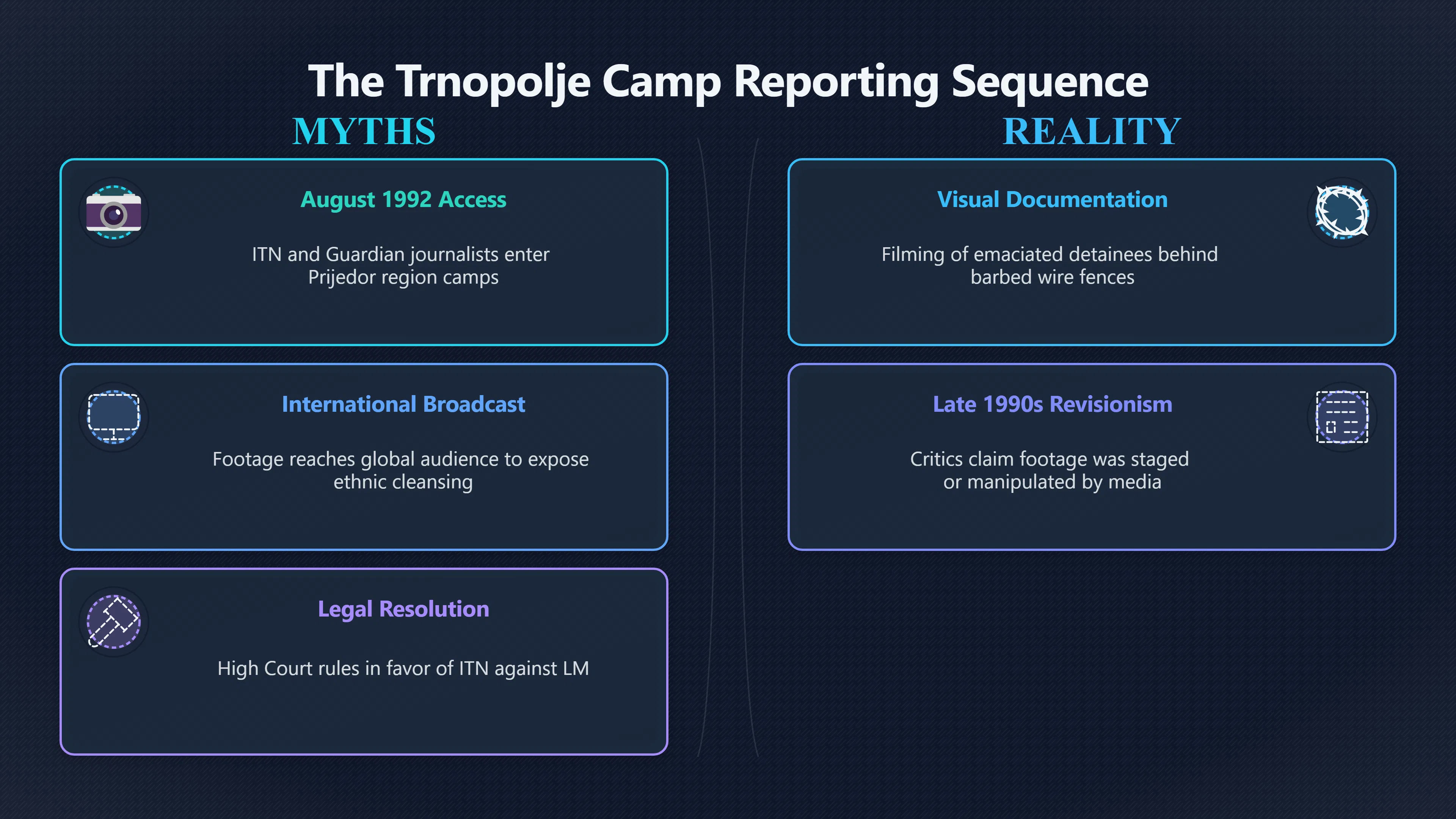
In August 1992, reporters from Independent Television News (ITN), including Penny Marshall and Ian Williams, together with Guardian journalist Ed Vulliamy, gained access to camps in the Prijedor region. Their reporting revealed the existence of detention facilities such as Omarska and Trnopolje, where Bosniaks and Croats were being held during the ethnic-cleansing campaign conducted in north-western Bosnia.[Wikipedia]WikipediaFikret AlićFikret Alić
The most memorable images came from Trnopolje. Television viewers saw visibly undernourished detainees standing near a barbed-wire enclosure. Among them was Fikret Alić, whose gaunt appearance and protruding ribs became a powerful symbol of civilian suffering during the conflict. The footage was broadcast internationally and contributed to growing public awareness of conditions inside the camps. It also intensified demands for international investigation of abuses occurring in Bosnia and Herzegovina.[wikipedia.org]WikipediaFikret AlićFikret Alić
The images were influential because they appeared at a moment when many outside observers still struggled to understand the scale of violence in Bosnia. Photographs and television footage provided a form of evidence that written reports alone could not easily match.[Time]time.comAlic was on the cover of TIME magazine in 1992, depicted as an emaciated prisoner in the Trnopolje camp, a Serb-controlled camp. Recently…
How Critics Reframed the Barbed-Wire Images
The challenge to the footage emerged most prominently in the late 1990s. A German journalist, Thomas Deichmann, wrote an article for the British magazine Living Marxism (later LM) under the headline “The Picture That Fooled the World”. The article argued that television journalists had created a misleading impression by filming through barbed wire and presenting Trnopolje as though it were a Nazi-style concentration camp. According to this interpretation, the reporters were inside a fenced compound while the detainees were outside it, creating a deceptive visual effect.[Wikipedia]WikipediaBosnian genocide denialBosnian genocide denial
This argument was attractive to some audiences because it appeared to offer a technical explanation for a famous image. Rather than denying that the footage existed, critics claimed that camera angles, framing and editing had distorted reality. The allegation transformed a discussion about documented abuses into a discussion about media manipulation.[The Guardian]theguardian.comThe Guardian ITN denies Bosnia report 'fabrication' | UK newsThe GuardianITN denies Bosnia report 'fabrication' | UK newsFebruary 29, 2000 — 29 Feb 2000 — The news organisation ITN yesterday denied…
The claim spread beyond the magazine itself. It became part of a broader revisionist narrative suggesting that Western journalists had exaggerated or invented aspects of the Bosnian conflict. In this retelling, the photograph was presented as evidence not of detention and abuse but of media deception.[Wikipedia]WikipediaBosnian genocide denialBosnian genocide denial

Why the Fakery Claim Collapsed
The central weakness of the denial argument was that it focused narrowly on one visual detail while ignoring the wider body of evidence about the camps. When the dispute reached the High Court in London, ITN sued LM for libel, arguing that the magazine had falsely accused its journalists of deliberate deception. During the proceedings, extensive footage, witness testimony and reporting records were examined.[The Guardian]theguardian.comThe GuardianITN in £375000 libel victory | UK newsMarch 15, 2000 — 14 Mar 2000 — ITN and two reporters won a resounding £375,000 libel vi…
The court found overwhelmingly in favour of ITN. Jurors rejected the allegation that the journalists had deliberately misrepresented what they saw. Damages were awarded to ITN and to the reporters personally. The verdict was financially devastating for LM, which soon ceased publication.[theguardian.com]theguardian.comThe GuardianITN in £375000 libel victory | UK newsMarch 15, 2000 — 14 Mar 2000 — ITN and two reporters won a resounding £375,000 libel vi…
Researchers who later studied the controversy reached similar conclusions. Detailed examinations of the footage found that the famous image did not support claims of fabrication. Even where the geometry of fences and camera positions had been misunderstood or selectively interpreted, the broader reality remained unchanged: detainees were present, many were in poor physical condition, and the camps themselves were real.[squarespace.com]static1.squarespace.comAtrocity memory photography 1British television report that detailed the role of camps such as Omarska and Trnopolje in the ethnic cleansing strategy of the Bosnian S…
Perhaps most importantly, the denial campaign never succeeded in overturning the larger documentary record. Journalists, survivor testimony, International Criminal Tribunal for the former Yugoslavia investigations and later war-crimes trials all established extensive evidence regarding the Prijedor camp system.[Wikipedia]WikipediaTrnopolje campTrnopolje camp
What the Dispute Reveals About Denial and Visual Proof
The Trnopolje controversy illustrates a recurring pattern in modern information disputes. Rather than proving that evidence is false, denial campaigns often concentrate on creating uncertainty. If enough doubt can be attached to a photograph, a camera angle or a reporting decision, some audiences may conclude that the entire event is questionable.[ResearchGate]researchgate.netThe Case of ITN versus Living Marxism, Part 2Part 1 of this article detailed the controversy surrounding the 1992 television…
The episode also shows the limits of photographic evidence. Images are powerful, but they rarely speak entirely for themselves. Viewers need context to understand what they are seeing. Critics exploited that fact by arguing over fences, camera positions and terminology, even while the broader evidence for detention and abuse remained substantial.[Squarespace]static1.squarespace.comAtrocity memory photography 1British television report that detailed the role of camps such as Omarska and Trnopolje in the ethnic cleansing strategy of the Bosnian S…
For historians of Bosnia and Herzegovina, the significance of the affair lies not in a successful exposure of a hoax but in the opposite phenomenon: an unsuccessful attempt to brand authentic documentation as a hoax. The story demonstrates that falsehood does not always take the form of forged photographs or invented events. Sometimes the deception lies in persuading people that genuine evidence cannot be trusted.[Wikipedia]WikipediaLiving MarxismLiving Marxism
What Camp Footage reveals about belief and deception
More than three decades after the footage was filmed, the Trnopolje images remain among the most recognisable visual records of the Bosnian War. They continue to appear in discussions of war reporting, historical memory and genocide denial. The controversy surrounding them has become almost as instructive as the footage itself.[Time]time.comAlic was on the cover of TIME magazine in 1992, depicted as an emaciated prisoner in the Trnopolje camp, a Serb-controlled camp. Recently…
The lasting lesson is that exposure and denial often develop side by side. A photograph that reveals uncomfortable realities may later become the target of campaigns designed to recast it as misleading or fraudulent. The Trnopolje case stands as a reminder that evaluating evidence requires looking beyond a single image and examining the wider network of testimony, documents and corroborating facts that surround it.[researchgate.net]researchgate.netThe Case of ITN versus Living Marxism, Part 2Part 1 of this article detailed the controversy surrounding the 1992 television…
Amazon book picks
Further Reading
No matched book cards were available for When Genuine Camp Footage Was Branded a Hoax, so this fallback keeps a direct Amazon reading path visible.
Topical books
Trnopolje camp guide
Browse books, explainers and reference titles related to this topic.
Search AmazonRelated search
ITN news footage guide
Browse books, explainers and reference titles related to this topic.
Search AmazonRelated search
Prijedor camp evidence guide
Browse books, explainers and reference titles related to this topic.
Search AmazonEndnotes
1.
Source: Wikipedia
Title: Fikret Alić
Link:https://en.wikipedia.org/wiki/Fikret_Ali%C4%87
2.
Source: Wikipedia
Title: Trnopolje camp
Link:https://en.wikipedia.org/wiki/Trnopolje_camp
3.
Source: Wikipedia
Title: Living Marxism
Link:https://en.wikipedia.org/wiki/Living_Marxism
4.
Source: researchgate.net
Link:https://www.researchgate.net/publication/30050158Atrocity_Memory_Photography_Imaging_the_Concentration_Camps_of_Bosnia-_The_Case_of_ITN_versus_Living_Marxism_Part_2
Source snippet
The Case of ITN versus Living Marxism, Part 2Part 1 of this article detailed the controversy surrounding the 1992 television...
5.
Source: Wikipedia
Title: Omarska concentration camp
Link:https://en.wikipedia.org/wiki/Omarska_concentration_camp
6.
Source: time.com
Link:https://time.com/5034826/fikret-alic-time-cover-bosnia/
Source snippet
Alic was on the cover of TIME magazine in 1992, depicted as an emaciated prisoner in the Trnopolje camp, a Serb-controlled camp. Recently...
7.
Source: static1.squarespace.com
Title: Atrocity memory photography 1
Link:https://static1.squarespace.com/static/5f0049c5a48d404988af893f/5f0053465d8ebb04c479be71/5f0053525d8ebb04c479c03f/1593856850058/Atrocity_memory_photography_1.pdf?format=original
Source snippet
British television report that detailed the role of camps such as Omarska and Trnopolje in the ethnic cleansing strategy of the Bosnian S...
8.
Source: Wikipedia
Title: Bosnian genocide denial
Link:https://en.wikipedia.org/wiki/Bosnian_genocide_denial
9.
Source: Wikipedia
Title: Thomas Deichmann
Link:https://en.wikipedia.org/wiki/Thomas_Deichmann
10.
Source: youtube.com
Link:https://www.youtube.com/watch?v=WixrEMS9pnc
Source snippet
Bosnia - Karadzic Tours Prijedor /Omarska Refugees...
11.
Source: youtube.com
Link:https://www.youtube.com/watch?v=MOza57oasdI
Source snippet
War Crime Investigations - Bosnia...
12.
Source: theguardian.com
Title: The Guardian ITN denies Bosnia report ‘fabrication’ | UK news
Link:https://www.theguardian.com/uk/2000/feb/29/juliahartleybrewer
Source snippet
The GuardianITN denies Bosnia report 'fabrication' | UK newsFebruary 29, 2000 — 29 Feb 2000 — The news organisation ITN yesterday denied...
Published: February 29, 2000
13.
Source: theguardian.com
Link:https://www.theguardian.com/uk/2000/mar/15/medialaw.media2
Source snippet
The GuardianITN in £375000 libel victory | UK newsMarch 15, 2000 — 14 Mar 2000 — ITN and two reporters won a resounding £375,000 libel vi...
Published: March 15, 2000
Additional References
14.
Source: youtube.com
Title: ITN, Penny Marshall and The Observer, Ed Vulliamy in Omarska and Trnopolje
Link:https://www.youtube.com/watch?v=FC2LUEiYVow
Source snippet
Guardian's Ed Vulliamy for N1: 'They were dirty savages!'...
15.
Source: youtube.com
Title: Guardian’s Ed Vulliamy for N1: ‘They were dirty savages!’
Link:https://www.youtube.com/watch?v=pDaoNxt_s3s
Source snippet
Bosnia 1992: The Omarska Camp | Al Jazeera World...
16.
Source: docsonline.tv
Link:https://www.docsonline.tv/itn-news-real-footage-for-rapportage-about-the-bosnian-war-in-omarska-and-trnopolje/
17.
Source: facebook.com
Title: the picture that fooled the worlddoes anyone remember the story from living marx
Link:https://www.facebook.com/smajo.beso/photos/the-picture-that-fooled-the-worlddoes-anyone-remember-the-story-from-living-marx/10172960809680529/
18.
Source: quillette.com
Title: denial and defamation the itn lm libel trial revisited ii
Link:https://quillette.com/2019/11/01/denial-and-defamation-the-itn-lm-libel-trial-revisited-ii/
19.
Source: quillette.com
Title: denial and defamation the itn lm libel trial revisited i
Link:https://quillette.com/2019/11/01/denial-and-defamation-the-itn-lm-libel-trial-revisited-i/
20.
Source: iwpr.net
Title: fake camp claim demolished
Link:https://iwpr.net/global-voices/fake-camp-claim-demolished
21.
Source: spiked-online.com
Title: why we were right to fight
Link:https://www.spiked-online.com/2010/03/18/why-we-were-right-to-fight/
22.
Source: youtube.com
Title: War Crime Investigations
Link:https://www.youtube.com/watch?v=rHrgkQMkSNY
23.
Source: wsws.org
Title: livm m25
Link:https://www.wsws.org/en/articles/2000/03/livm-m25.html
Amazon book picks
Further Reading
Books and field guides related to When Genuine Camp Footage Was Branded a Hoax. Use these as the next step if you want deeper reading beyond the article.
The War is Dead, Long Live the War
Closely connected to the media coverage and evidence discussed on the page.
Regarding the Pain of Others
Directly relevant to interpreting photographs and footage from conflicts.
We wish to inform you that tomorrow we will be killed with ou...
Useful comparison for understanding denial and documentary evidence after atrocities.
Topic Tree