When False Stories Became Powerful in Uzbekistan
Uzbekistan does not have a long, neatly catalogued canon of celebrated hoaxes comparable with the best-known European archaeological fakes or American newspaper stunts.
Page outline Jump by section
Introduction
The distinctions matter. The “curse of Timur” is best understood as folklore strengthened by retrospective storytelling, not a proven deliberate fraud. The cotton scandal was organised falsification with enormous political and financial consequences. Recent pyramid schemes are conventional confidence tricks adapted to television, celebrity endorsement, messaging apps and digital payments. None suggests unusual national gullibility. Each succeeded because it fitted the institutions, anxieties and incentives of its own time.
Did opening Timur’s tomb unleash war?
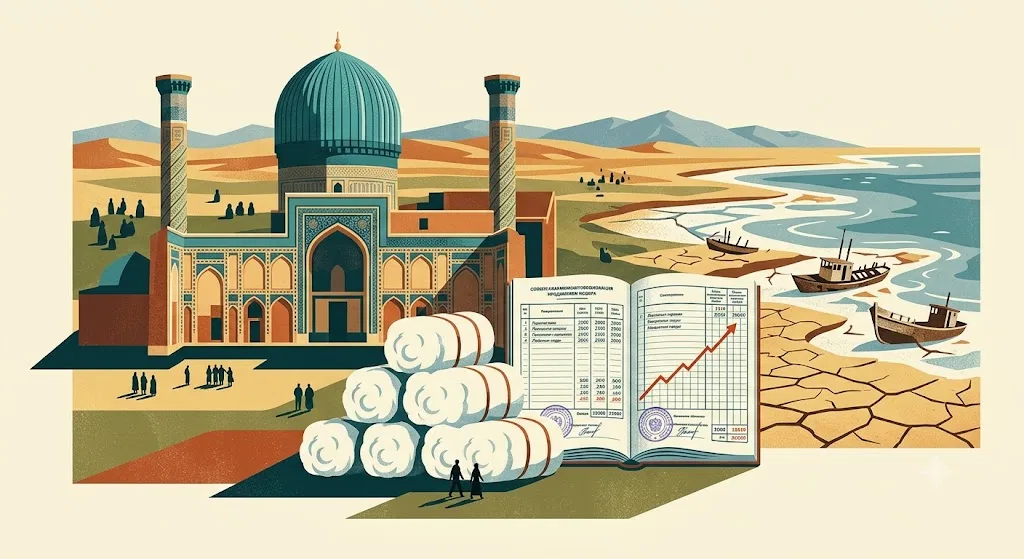
The most famous supernatural story connected with Uzbekistan concerns the Gur-e-Amir mausoleum in Samarkand, burial place of the conqueror Timur. In June 1941, a Soviet scientific expedition opened graves in the mausoleum so that specialists could study the remains and reconstruct historical appearances. Nazi Germany invaded the Soviet Union on 22 June, only days after Timur’s coffin had been opened. That extraordinary coincidence became the foundation of the supposed “curse of Timur”.[Wikipedia]WikipediaCurse of TimurCurse of Timur
In its familiar form, the legend says that the investigators found an inscription warning that anyone who disturbed the grave would release a conqueror more terrible than Timur. Some versions add that frightened local elders had warned the expedition in advance. A second coincidence completes the tale: Timur’s remains were reburied in late 1942, shortly before the Soviet victory at Stalingrad began to look achievable. Later storytellers therefore presented the reburial as the act that broke the curse.[Advantour]advantour.comThe Curse of Tamerlan: legend or fact?The legend about the curse of Tamerlane: history, facts, hypotheses and rumors about the o…
The chronology is real, but the supernatural interpretation is not supported by the physical evidence. Accounts differ over the date of the coffin’s opening, the wording and location of the alleged warning, who supposedly told Stalin about it, and whether Stalin ordered the reburial because he believed the story. The inscriptions actually documented on the tomb and coffin are genealogical and religious rather than an explicit prediction of a coming invasion. The detailed curse narrative also appeared prominently in publications and television decades after the excavation, allowing memories, rumours and dramatic additions to merge.[Wikipedia]WikipediaCurse of TimurCurse of Timur
The practical problems experienced during the opening — including a strong smell and reported electrical difficulties — also acquired supernatural meaning. Yet aromatic resins and embalming substances offer an ordinary explanation for the smell. Technical failures inside an old monument are not exceptional evidence of a curse.[Advantour]advantour.comThe Curse of Tamerlan: legend or fact?The legend about the curse of Tamerlane: history, facts, hypotheses and rumors about the o…
Why the coincidence felt convincing
The story works because it connects two events that were close in time but entirely different in scale. Opening a famous ruler’s grave was a visible, symbolically charged act. Germany’s invasion was a catastrophe so immense that people naturally searched for omens and causes beyond military planning.
It also follows the pattern of other tomb-curse legends. A warning is ignored, disturbing incidents follow, and believers reinterpret later events as confirmation. Evidence that does not fit — such as Hitler’s long-prepared invasion plans or the absence of an authenticated curse inscription — becomes less memorable than the striking sequence of tomb, invasion, reburial and victory.
The result is not simply a fabricated tale imposed on credulous listeners. It is a layered legend made from genuine archaeology, wartime trauma, oral recollection and later media embellishment. Tourism has helped preserve it because a cursed tomb is easier to market and retell than a dispute over inscriptions and the reliability of memories. The legend remains culturally interesting precisely because its strongest ingredient is not fraud but coincidence arranged into a satisfying story.
The cotton harvests that existed on paper
Uzbekistan’s most consequential documented deception was the Soviet-era cotton scandal. Unlike the Timur legend, this was not folklore or a sincere error. Officials repeatedly inflated figures for the amount of cotton planted, harvested and delivered to the state. Payments, bonuses, decorations and political advancement were then awarded for production that had not occurred.[OhioLINK ETD Center]etd.ohiolink.eduOhio LINK ETD Center The Cotton Scandal and Uzbek National ConsciousnessOhioLINK ETD CenterThe Cotton Scandal and Uzbek National ConsciousnessApril 17, 2013 — by DE Peterson · 2013 · Cited by 5 — Rashidov siph…
The fraud grew from the structure of the Soviet planned economy. Moscow expected the Uzbek Soviet Socialist Republic to supply ever-increasing quantities of cotton, even when available land, water and yields made those targets unrealistic. Local officials were punished for missing plans but rewarded for apparently exceeding them. False reporting therefore protected careers at several levels: farm managers exaggerated deliveries, regional administrators confirmed the numbers, and senior political patrons helped prevent effective scrutiny.
The deception extended well beyond writing an incorrect total in a ledger. Investigators alleged that officials claimed state money for fields, irrigation works and storage facilities that had not been created. Cotton was recorded more than once, its quality was misrepresented, and bribes helped move false figures upwards through the system. Contemporary reporting described a network reaching through agriculture, industry, policing and political administration.[Los Angeles Times]latimes.comLos Angeles TimesSoviet 'Cotton Mafia' in Spotlight: Life of Luxury Over, Kin…September 5, 1988 — 5 Sept 1988 — Thousands of people w…
The central authorities had reasons not to look too closely. Uzbek leaders could present themselves as reliable suppliers of an essential crop, while Moscow could announce that national production plans were succeeding. The reported harvests therefore served both local patronage and the wider image of a functioning planned economy. As long as everyone responsible for verification benefited from the numbers, the fiction could appear institutionally real.
How the figures began to unravel
One contradiction was particularly revealing: reported cotton output kept rising, while the supply of cotton goods did not increase accordingly. Investigators also compared official claims about cultivated land with satellite images and other physical evidence. Areas supposedly reclaimed, irrigated and planted remained desert. The landscape could not be reconciled with the paperwork.[Los Angeles Times]latimes.comLos Angeles TimesSoviet 'Cotton Mafia' in Spotlight: Life of Luxury Over, Kin…September 5, 1988 — 5 Sept 1988 — Thousands of people w…
After Leonid Brezhnev’s death in 1982, Yuri Andropov’s administration launched investigations into corruption in Uzbekistan. Prosecutors and security officials pursued networks connected with regional party leaders, police officers and figures in Moscow. The affair eventually implicated thousands of people, although precise totals and financial estimates vary among accounts. It became one of the Soviet Union’s most publicised corruption scandals of the 1980s.[Wikipedia]WikipediaUzbek cotton scandalUzbek cotton scandal
Exposure did not produce an uncontested moral reckoning. The scandal was real, but the investigations were also politically selective. Critics argued that Soviet authorities portrayed corruption as an especially Uzbek failing while giving less attention to the impossible production demands and patronage systems created by Moscow. Scholarship on the scandal shows how later Uzbek narratives reframed it as both a corruption case and an assault on national dignity.[OhioLINK ETD Center]etd.ohiolink.eduOhio LINK ETD Center The Cotton Scandal and Uzbek National ConsciousnessOhioLINK ETD CenterThe Cotton Scandal and Uzbek National ConsciousnessApril 17, 2013 — by DE Peterson · 2013 · Cited by 5 — Rashidov siph…
That tension is essential. Local officials did fabricate harvests and divert funds, but the fraud was sustained by a wider system that rewarded impossible promises. Treating it merely as the work of a few dishonest regional bosses misses how institutional targets converted falsehood into routine administration.
What the cotton fraud concealed
The invented harvests did more than steal public money. They obstructed rational economic decisions because planners could not know how much cotton actually existed, how productive the land was or whether further investment made sense. Success on paper also reduced pressure to confront deteriorating soil, chemical contamination and the excessive diversion of water towards cotton cultivation.
The wider cotton system contributed to the destruction of the Aral Sea by directing the region’s rivers into irrigation networks. The ecological disaster was not itself a hoax: the water was genuinely diverted and the damage was physically visible. Yet false production reports helped preserve the claim that ever-expanding cultivation was economically successful. The accounting fiction made an environmentally ruinous policy appear productive for longer than it should have.[Wikipedia]WikipediaUzbek cotton scandalUzbek cotton scandal
The case therefore resembles a scientific or corporate data fraud more than a theatrical confidence trick. Each individual alteration could look minor — an inflated yield here, a fictitious delivery there — but the accumulation created an alternative reality. Medals were awarded, careers advanced and budgets distributed on the basis of numbers that had ceased to describe the world.
It also demonstrates why official statistics can be difficult to challenge in authoritarian systems. A farmer, accountant or junior inspector who contradicted the reported harvest was not merely correcting a number. They were questioning superiors, threatening patronage networks and undermining a politically valuable account of progress.
Pyramid schemes dressed as opportunity
After independence, Uzbekistan’s better-documented mass deceptions have often been commercial rather than historical. One prominent case involved financier Ahmad Tursunboev, whose scheme attracted tens of thousands of participants with promises of unusually high returns. Public figures reportedly helped give the enterprise social credibility, while the involvement or protection of officials became part of the controversy. Tursunboev was convicted of fraud in 2018.[eurasianet.org]eurasianet.orguzbekistan officials fired over pyramid schemeuzbekistan officials fired over pyramid scheme
Such schemes succeed by borrowing signals of respectability. Early participants may receive payments, creating apparently trustworthy witnesses who tell relatives and neighbours that the opportunity works. Celebrity attention, expensive possessions and connections to officials can substitute for audited accounts or a clear explanation of how profits are generated.
The deception is especially effective when participants do not see themselves as gamblers. They may believe they are joining a private investment circle, supporting a successful entrepreneur or entering an opportunity normally available only to insiders. Personal recommendations make scepticism socially difficult: rejecting the scheme can feel like accusing a friend or respected community member of dishonesty.
A newer example reported in 2025 was the OMD “book-reading” platform. Users were allegedly promised earnings for completing simple reading-related tasks, but were required to deposit money and recruit or participate through a payment structure characteristic of a financial pyramid. Payments were routed through person-to-person bank transfers rather than a transparent, regulated business account, and the organisers reportedly disappeared after collecting large sums.[Kun.uz]kun.uzOpen source on kun.uz.
The book theme was commercially clever. Reading carries associations with education, self-improvement and socially useful work. The scheme therefore disguised speculative recruitment as harmless cultural participation. The activity shown on the screen was not the source of the supposed returns; it was a story that made the transfer of money seem purposeful.
Why modern fraud spreads so quickly
Digital scams in Uzbekistan increasingly combine old confidence tricks with newer forms of impersonation. Government warnings describe callers posing as bank employees, offering fictitious prizes, sponsorship payments or loan approvals in order to obtain card details and personal information. Authorities have also identified malicious links, counterfeit payment platforms, fraudulent cryptocurrency exchanges and forged personal data as recurring methods.[O‘zbekiston Respublikasi Hukumat portali]gov.uzOpen source on gov.uz.
Several features make these deceptions persuasive:
- Borrowed authority: scammers impersonate banks, police officers, government programmes or recognised companies.
- Small initial rewards: early payments persuade users that a task platform or investment programme is genuine.
- Artificial urgency: victims are told that an account is threatened, an offer will expire or immediate verification is required.
- Social proof: friends, celebrities or online group members appear to have earned money.
- Obscured payment routes: transfers go to personal cards or frequently changing accounts, making the underlying organisation difficult to identify.
- A simple cover story: reading books, completing online tasks or trading digital assets provides an understandable explanation for returns that would otherwise appear implausible.
These are not uniquely Uzbek mechanisms. They are internationally familiar forms of social engineering adapted to local languages, payment systems and trusted institutions. What changes is the wrapper; the underlying question remains the same: where does the promised money actually come from?
What Uzbekistan’s deception stories have in common
The curse legend, the cotton scandal and modern investment frauds are very different, but all depend on trusted intermediaries.
In the Timur story, eyewitnesses, documentary makers and tour guides transform coincidence into inherited knowledge. In the cotton scandal, officials, inspectors and statistical offices give fictitious numbers the appearance of state-certified fact. In pyramid schemes, acquaintances, public figures and imitation institutions make an unsustainable promise seem socially verified.
Each case also benefits from delayed verification. A curse cannot easily be disproved because believers can reinterpret almost any later misfortune. False harvest data remains secure while inspectors share the same incentives as the people reporting it. A pyramid scheme looks solvent while new deposits continue to fund visible payouts.
The best defence therefore differs by case. Historical legends require attention to dates, inscriptions and the earliest traceable versions of the story. Bureaucratic fraud requires independent physical measurement and protection for people who report contradictions. Commercial scams require checking licences, ownership, payment routes and the actual source of returns.
Uzbekistan’s most memorable deception stories are ultimately less about spectacular tricksters than about systems of belief. A coincidence becomes a curse when later retellings supply missing details. An impossible agricultural target becomes “achieved” when an entire hierarchy signs the same false report. A dubious investment becomes respectable when trusted people appear to endorse it. The falsehood survives not because evidence is absent, but because authority, incentive and narrative temporarily matter more than evidence.

Amazon book picks
Further Reading
Books and field guides related to When False Stories Became Powerful in Uzbekistan. Use these as the next step if you want deeper reading beyond the article.
The Silk Roads
Provides historical context for Uzbekistan and the narratives that shaped the region.
The Road to Unfreedom
Explores how false stories gain authority within political systems.
Prisoners of Geography
Helps explain how geography and power influence regional myths and political realities.
eBay marketplace picks
Marketplace Samples
Live-tested eBay searches with available results related to this page.



Endnotes
1.
Source: Wikipedia
Title: Curse of Timur
Link:https://en.wikipedia.org/wiki/Curse_of_Timur
2.
Source: advantour.com
Link:https://www.advantour.com/uzbekistan/legends/tamerlane-curse.htm
Source snippet
The Curse of Tamerlan: legend or fact?The legend about the curse of Tamerlane: history, facts, hypotheses and rumors about the o...
3.
Source: etd.ohiolink.edu
Title: Ohio LINK ETD Center The Cotton Scandal and Uzbek National Consciousness
Link:https://etd.ohiolink.edu/acprod/odb_etd/ws/send_file/send?accession=osu1366199014&disposition=inline
Source snippet
OhioLINK ETD CenterThe Cotton Scandal and Uzbek National ConsciousnessApril 17, 2013 — by DE Peterson · 2013 · Cited by 5 — Rashidov siph...
Published: April 17, 2013
4.
Source: Wikipedia
Title: Uzbek cotton scandal
Link:https://en.wikipedia.org/wiki/Uzbek_cotton_scandal
5.
Source: eurasianet.org
Title: uzbekistan officials fired over pyramid scheme
Link:https://eurasianet.org/uzbekistan-officials-fired-over-pyramid-scheme
6.
Source: kun.uz
Link:https://kun.uz/en/news/2025/05/20/new-financial-scam-in-uzbekistan-swindles-billions-through-fake-book-reading-platform
7.
Source: kun.uz
Link:https://kun.uz/en/news/2026/07/13/how-cybercriminals-used-hacked-accounts-and-fake-documents-to-steal-millions-in-uzbekistan-201719
8.
Source: Wikipedia
Title: Archaeological forgery
Link:https://en.wikipedia.org/wiki/Archaeological_forgery
9.
Source: Wikipedia
Title: COVID 19 misinformation
Link:https://en.wikipedia.org/wiki/COVID-19_misinformation
10.
Source: archive.archaeology.org
Link:https://archive.archaeology.org/online/features/hoaxes/
11.
Source: latimes.com
Link:https://www.latimes.com/archives/la-xpm-1988-10-27-mn-480-story.html
Source snippet
Los Angeles TimesNew Uzbek Anti-Corruption Arrests Told: Former Party Leader...The officials allegedly reported inflated figures for th...
12.
Source: latimes.com
Link:https://www.latimes.com/archives/la-xpm-1988-09-05-mn-1076-story.html
Source snippet
Los Angeles TimesSoviet 'Cotton Mafia' in Spotlight: Life of Luxury Over, Kin...September 5, 1988 — 5 Sept 1988 — Thousands of people w...
Published: September 5, 1988
13.
Source: latimes.com
Link:https://www.latimes.com/archives/la-xpm-1988-06-30-mn-7840-story.html
14.
Source: gov.uz
Link:https://gov.uz/en/iiv/news/view/100546
15.
Source: gov.uz
Link:https://gov.uz/en/mirishkor/news/view/67007
16.
Source: gov.uz
Link:https://gov.uz/en/mirishkor/news/view/59361
17.
Source: gov.uz
Link:https://gov.uz/en/iiv/news/view/52319
18.
Source: gov.uz
Link:https://gov.uz/en/iiv/news/view/36509
19.
Source: gov.uz
Link:https://gov.uz/en/yoshlar/news/view/15837
20.
Source: ai.gov.uz
Link:https://ai.gov.uz/ai/files/civil-guide.pdf
21.
Source: gov.uz
Link:https://gov.uz/en/yoshlar/news/view/24656
22.
Source: gov.uz
Link:https://gov.uz/oz/imv/news/view/113580
23.
Source: gov.uz
Title: SEASONA L WORK PROGRAM FOR ENGLAND⚠️ ️Beware of fraud
Link:https://gov.uz/en/migration/news/view/104765
24.
Source: latimes.com
Title: la xpm 1988 07 01 mn 6406 story
Link:https://www.latimes.com/archives/la-xpm-1988-07-01-mn-6406-story.html
25.
Source: accc.gov.au
Link:https://www.accc.gov.au/media-release/its-a-scam-celebrities-are-not-getting-rich-from-online-investment-trading-platforms
Additional References
26.
Source: gw2ru.com
Title: And that’s why the USSR was attacked by
Link:https://www.gw2ru.com/history/3073-timurs-curse-tomb-opening
Source snippet
Timur's curse: Did the opening of his tomb START World...2 Feb 2023 — There's a legend that, by opening up the tomb of Timur in Sam...
27.
Source: hiddencompass.net
Title: the curse of timur
Link:https://hiddencompass.net/story/the-curse-of-timur/
Source snippet
Hidden CompassThe Curse of TimurIn 2003, a provocative Russian documentary titled Prokliatie Tamerlana (Tamerlane's Curse) discussed an a...
28.
Source: youtube.com
Title: Timur: The Man Who Killed 17 Million People | Full Biography
Link:https://www.youtube.com/watch?v=xUI7fjr9mrg
Source snippet
Gold for the Party. The Cotton Affair (2010)...
29.
Source: academia.edu
Link:https://www.academia.edu/43891226/_A_historiographical_inquiry_into_the_falsification_of_Persian_art_in_Proceedings_of_the_Eighth_European_Conference_of_Iranian_Studies_Volume_2_Studies_on_Iran_and_the_Persianate_World_after_Islam_ed_Olga_M_Yastrebova_St_Petersburg_State_Hermitage_Museum_2020_pp
30.
Source: instagram.com
Link:https://www.instagram.com/p/DVvk4EXjIdv/
31.
Source: smithsonianmag.com
Link:https://www.smithsonianmag.com/history/archaeologists-may-have-found-the-lost-city-of-the-silk-road-180987637/
32.
Source: facebook.com
Link:https://www.facebook.com/groups/europechristmasmarkets/posts/770404098956879/
33.
Source: facebook.com
Link:https://www.facebook.com/groups/149844915349213/posts/2232044000462617/
34.
Source: reuters.com
Link:https://www.reuters.com/article/world/fact-check-uk-pm-boris-johnson-did-not-tweet-that-he-was-sorry-for-what-britai-idUSKCN25D2FE/
35.
Source: degruyterbrill.com
Link:https://www.degruyterbrill.com/document/doi/10.1515/9783110714333-005/html?srsltid=AfmBOor_abMm6sn4ULayQnbuLozhnu845ISOkseNh2OKC5aqtmloz1zm
Topic Tree
Follow this branch
Related pages 192
- Albanian Hoaxes
- Algerian Hoaxes
- Antigua Deceptions
- Argentina Hoaxes
- Armenian Hoaxes
- +187 more in sidebar