How False Stories Became Credible in Slovenia
Slovenia does not have a long, tidy catalogue of universally famous hoaxes. Its most revealing cases instead sit on the borders between deliberate forgery, pseudohistory, propaganda and institutional failure.
Page outline Jump by section
Introduction
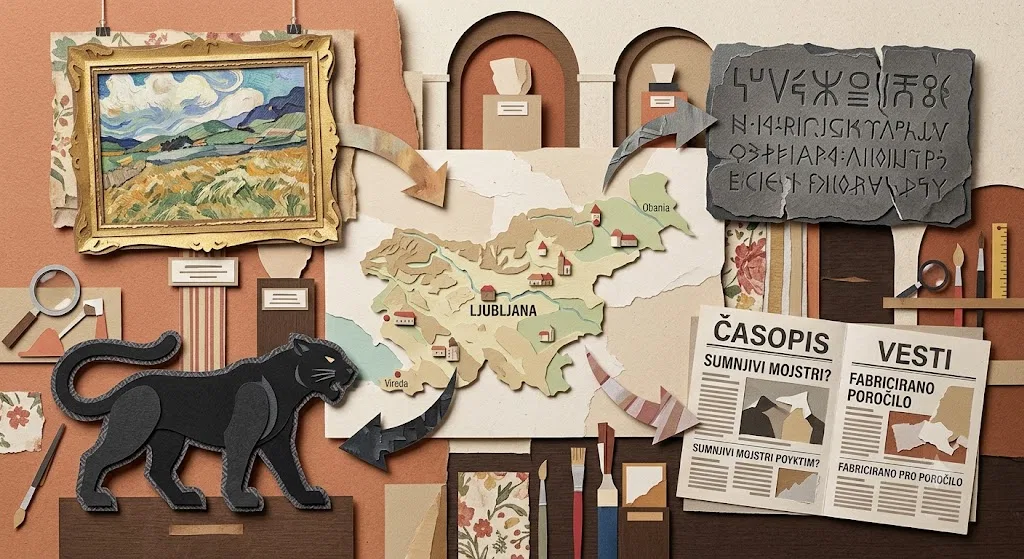
These episodes matter because they show several different ways falsehood acquires authority. A questionable painting becomes persuasive when displayed by a national museum. Speculative history gains force when it offers an emotionally satisfying origin story. A recently designed symbol starts to look ancient through repetition. A fabricated report spreads because it resembles breaking news and confirms existing fears. Slovenia’s history of contested truth is therefore less a parade of colourful pranksters than a study of how institutions, identity and media can make uncertain claims appear established.
The masterpiece exhibition that never opened
The most dramatic recent Slovenian forgery controversy began with an exhibition called Travels, scheduled to open at the National Museum of Slovenia in Ljubljana in June 2022. Promotional material attributed about 160 privately owned works to an extraordinary list of artists, including Pablo Picasso, Vincent van Gogh, Henri Matisse, Marc Chagall, Joan Miró, William Turner and Henri de Toulouse-Lautrec. Had the attributions been genuine, the exhibition would have brought together a collection of exceptional cultural and financial value.[theguardian.com]theguardian.comThe Guardian National Museum of Slovenia cancels art exhibition overThe GuardianNational Museum of Slovenia cancels art exhibition over…June 10, 2022 — 10 Jun 2022 — Show claiming to feature works by Va…
The trouble was that Slovenian art historians and dealers found the display implausible almost immediately. Critics questioned the quality of the works, their provenance — the documented history of ownership — and the lack of convincing authentication from recognised specialists or artist foundations. Art expert Brane Kovič described the pictures as obvious forgeries, while other commentators noted that such a concentration of major works would normally require extensive technical examination, documentary checks and consultation with international authorities before a national museum announced them.[theguardian.com]theguardian.comThe Guardian National Museum of Slovenia cancels art exhibition overThe GuardianNational Museum of Slovenia cancels art exhibition over…June 10, 2022 — 10 Jun 2022 — Show claiming to feature works by Va…
The museum cancelled the exhibition on the day it was due to open. Police began examining the affair, and director Pavel Car resigned shortly afterwards. The works had reportedly come from a collection associated with the family of Josip Boljkovac, a former Croatian interior minister. Car defended the planned display by arguing that the museum was presenting a private collection rather than formally certifying every attribution, but this distinction convinced few critics: placing objects beneath the names of famous artists in a national institution inevitably lends them credibility.[theguardian.com]theguardian.comThe Guardian National Museum of Slovenia cancels art exhibition overThe GuardianNational Museum of Slovenia cancels art exhibition over…June 10, 2022 — 10 Jun 2022 — Show claiming to feature works by Va…
It is important not to overstate what was legally established. Contemporary reporting generally described the works as “alleged” or “suspected” fakes, rather than presenting a final judicial finding that every object was forged or identifying a proven forger. The scandal was nevertheless an authentication failure even before any criminal question was settled. Basic doubts that should have been resolved privately were instead exposed by outside experts after the museum had committed its name and exhibition space.
The case illustrates how art deception depends upon more than skilful imitation. A fake gains value from a chain of borrowed authority: an impressive former owner, a catalogue attribution, an exhibition label and the reputation of the institution displaying it. The proposed show also demonstrates why provenance matters as much as visual resemblance. A supposed Picasso without a credible history, recognised documentation or technical examination is not rescued merely because it looks vaguely Picasso-like.
The ancient-origin theory that modern scholarship rejected
The Venetic theory is Slovenia’s best-known example of pseudohistory becoming part of a wider national argument. Promoted especially during the 1980s by Jožko Šavli, Matej Bor and Ivan Tomažič, it claimed that modern Slovenes were direct descendants of the ancient Veneti and had lived in or around their present territory long before the accepted early medieval Slavic settlement of the Eastern Alps. Some versions expanded the claim dramatically, linking similarly named peoples across large parts of Europe into an ancient, culturally connected population.[ceu.edu]etd.ceu.eduthe dissolution of the slavic identity of - the slovenes…June 17, 2008 — by LL Gabrijelčič · 2008 · Cited by 4 — The true roots of…
This was not a conventional hoax in which its authors were exposed as knowingly inventing evidence for profit. It is better understood as pseudoscience or nationalist speculative history: its advocates appear to have argued for their interpretation seriously, but used methods rejected by professional historians, archaeologists and historical linguists. The distinction matters. Sincere belief can spread unsupported conclusions just as effectively as deliberate fraud, particularly when the conclusion answers questions of identity and belonging.
One of the theory’s central methods was to treat resemblance between words as evidence of common ancestry. Ancient inscriptions and place names were read through modern Slovene, while historical terms such as Veneti, Wends and related names were connected across centuries and regions. Linguists Rado Lencek and Tom Priestly examined these arguments and criticised the selective comparisons, irregular sound correspondences and amateur use of historical linguistics. Words that happen to resemble one another are not, by themselves, proof that two ancient populations spoke the same language or that one modern nation descends directly from the other.[ResearchWorks]journals.lib.washington.eduOpen source on washington.edu.
Mainstream accounts place the ancestors of the Slovenes within the broader movement and settlement of Slavic-speaking populations in the early medieval period. This does not mean the population appeared from nowhere or that earlier inhabitants contributed nothing to later communities. Populations mix, landscapes preserve older names and identities change gradually. What scholars rejected was the much stronger claim of an essentially unchanged Slovene or proto-Slovene nation stretching back into pre-Roman antiquity.[Peter Lang]peterlang.comOpen source on peterlang.com.
The Venetic theory became persuasive because it offered more than an alternative date. It supplied an uplifting national narrative in which a relatively small modern language community became one of Europe’s oldest peoples rather than a later branch of the Slavic world. Research on the controversy connects its popularity to debates about Slovene identity during the final decades of Yugoslavia and the approach of independence. Academic rebuttal could challenge the linguistic evidence, but it could not easily replace the emotional rewards of antiquity, continuity and distinctiveness.[ceu.edu]etd.ceu.eduthe dissolution of the slavic identity of - the slovenes…June 17, 2008 — by LL Gabrijelčič · 2008 · Cited by 4 — The true roots of…
The theory still circulates because its claims are easy to repeat and difficult to disprove in a single sentence. A photograph of an inscription and a modern word that looks similar can seem immediately convincing; explaining sound change, archaeological chronology and the danger of selecting only favourable examples takes much longer. This imbalance is common in pseudohistory: the striking pattern is memorable, while the methodological objection feels technical.
How a modern panther acquired an ancient pedigree
Closely connected to the Venetic controversy is the so-called Carantanian black panther. It is often presented as the emblem of Carantania, an early medieval Slavic principality frequently invoked in discussions of Slovenian statehood. The striking animal has appeared in patriotic design, proposals for national symbols and the insignia of some Slovenian police and military units. Yet historians have found no secure evidence that this particular black panther served as the emblem of early medieval Carantania.[Wikipedia]WikipediaBlack panther (symbolBlack panther (symbol
The familiar version was reconstructed and popularised by Jožko Šavli in the 1980s. His argument drew on heraldic panthers used by later noble families and rulers in Carinthia and Styria. Such animals are genuine medieval heraldic devices, but their later existence does not establish that the same emblem belonged to Carantania centuries earlier. Historian Peter Štih and other specialists have rejected the claimed direct connection, noting the absence of contemporary evidence from the principality itself.[Wikipedia]WikipediaBlack panther (symbolBlack panther (symbol
Calling the panther simply “fake” would miss what makes the case interesting. The image is real, and panthers genuinely occur in the region’s later heraldry. The questionable step is the retrospective attribution: a later symbol was assembled into a persuasive picture of an earlier national past. This makes it an invented tradition rather than a counterfeit object. Invented traditions often take authentic fragments — an old animal motif, a medieval duchy, a modern desire for continuity — and combine them into something that feels older and more settled than the evidence permits.
Repetition then does the work of authentication. Once a symbol appears on badges, flags, websites and official-looking insignia, people naturally assume that its historical status was established before it entered public use. In reality, public adoption can precede scholarly agreement. The black panther shows how a contested reconstruction can become culturally real even while its supposed ancient pedigree remains unsupported.

Fabricated news and the politics of fear
In the internet era, Slovenia’s clearest hoaxes have often been short-lived media fabrications rather than elaborate physical forgeries. One particularly stark example was a report claiming that a migrant had died of Ebola in Slovenia after infecting hospital employees. Slovenian investigative outlet Oštro later cited the story as fabricated and linked it to Hungarian-owned media operating in Slovenia that repeatedly published misinformation about migrants.[Ostro]ostro.siOiling Orbán's Propaganda MachineOiling Orbán's Propaganda Machine
The story used a familiar disinformation formula. It joined a feared disease to a politically charged outsider, placed the event inside a recognisable national institution and presented the supposed danger as already spreading. Each element made the next one feel plausible. Readers did not need prior knowledge of hospital procedures, epidemiology or migration statistics; they needed only to react before checking whether any health authority had reported an outbreak.
No single invented article explains Slovenia’s wider information environment. Research on disinformation in the country nevertheless identifies recurring exploitation of fear, inequality and distrust, particularly in claims concerning migrants, minorities, medicine and political institutions. Financial and political incentives can overlap: inflammatory stories attract attention, support partisan narratives and create audiences for advertising or dubious products.[EU DisinfoLab]disinfo.eurmation landscape in sloveniarmation landscape in slovenia
Cross-border media ownership is especially relevant in Slovenia because its information space interacts closely with those of Hungary, Croatia, Serbia and the wider former Yugoslav region. An investigation by Oštro and partner organisations described Hungarian-linked investment in Slovenian and North Macedonian outlets that supported political allies of Hungarian prime minister Viktor Orbán. It also documented suspicious advertising arrangements used to move millions of euros through media companies. Not every biased article is a hoax, but an ecosystem financed for political influence gives fabricated or distorted stories reliable channels of distribution.[Ostro]ostro.siOiling Orbán's Propaganda MachineOiling Orbán's Propaganda Machine
Slovenian fact-checking has become more organised in response. Oštro founded its Razkrinkavanje project in 2019 and became a Slovenian signatory to the International Fact-Checking Network’s code of principles. The project examines claims circulated by media and public figures, while also training younger journalists in verification. Its importance lies not merely in labelling individual statements false, but in showing readers the documents, original data and missing context needed to test them.[medium.com]medium.comRazkrinkavanje': Debunking Misinformation While TrainingRazkrinkavanje': Debunking Misinformation While Training
Why these stories worked
Slovenia’s major cases differ in motive and method, but they share a pattern: the questionable claim rarely travelled alone. It was carried by some source of apparent authority.
The museum supplied prestige. The suspected masterpieces were not being offered from a car boot. They were announced by the country’s principal historical museum, whose institutional reputation stood between the viewer and the doubtful provenance.
National identity supplied emotional force. The Venetic theory did not simply reinterpret an inscription. It promised that Slovenes possessed deeper and more independent roots than conventional history allowed.
Official use supplied familiarity. The panther’s appearance on modern insignia made its supposed medieval status feel natural, even though modern adoption could not prove ancient use.
Fear supplied urgency. The fabricated Ebola report encouraged immediate emotional reaction. A frightening claim about disease and migration can spread before a careful correction has even been prepared.
These mechanisms also explain why exposure does not always end a story. Cancelling an exhibition can prevent questionable works from receiving further endorsement, because the paintings depend heavily on institutional validation. Pseudohistory is more resistant: supporters can treat criticism as proof that an academic establishment is suppressing uncomfortable truths. Political falsehood is harder still, because its purpose may be to create suspicion rather than establish one durable belief. Once an audience has absorbed the association between migrants and hidden danger, disproving one invented incident may not remove the underlying impression.
Hoax, myth or honest mistake?
A careful history of deception must avoid forcing every disputed Slovenian story into the same category.
The proposed museum exhibition concerned objects suspected of false attribution and therefore belongs to the world of possible forgery, inadequate authentication and institutional negligence. The Venetic theory is pseudohistory: a claim promoted through methods that scholars found unreliable, without clear proof that its proponents were deliberately lying. The Carantanian panther is best described as a contested reconstruction or invented tradition. The Ebola story, by contrast, was a fabricated news report and fits the ordinary meaning of a media hoax.
Folklore requires different treatment again. Slovenia’s dragons, supernatural beings, caves and local legends are not fraudulent simply because they are not literal history. Traditional tales usually communicate communal memory, entertainment or symbolic meaning rather than pretending to be newly verified scientific evidence. Deception begins when a promoter conceals invention, supplies bogus documentation or presents speculation as settled fact.
The most useful question is therefore not merely, “Is this true?” It is also, “What kind of claim is being made, and what would count as evidence?” Paintings require provenance and material analysis. Ancient migrations require archaeology, dated records and disciplined historical linguistics. A medieval emblem requires contemporary visual or written evidence. A report of an infectious disease outbreak should be confirmed by hospitals and public-health authorities. Once the appropriate test is clear, borrowed prestige and emotional appeal become easier to recognise.
What Slovenia’s contested stories reveal
Slovenia’s best-known cases are not evidence of unusual national gullibility. They arose from pressures found elsewhere: a cultural institution eager for a spectacular exhibition, writers seeking a grand national past, political media exploiting social divisions and audiences navigating claims faster than verification can follow.
What makes the Slovenian examples valuable is their compactness. They show an entire chain of credibility being constructed in public view. A famous signature can turn an undistinguished picture into a treasure. A similarity between two words can become a theory of continental history. A recently reconstructed animal can acquire the aura of an ancient national emblem. A fabricated medical emergency can become political ammunition.
The lasting lesson is that exposure depends less on clever sceptical intuition than on ordinary verification. Who owned the object, and where are the records? Is the linguistic comparison systematic or merely suggestive? Does the alleged symbol appear in sources from the claimed period? Has an identifiable authority confirmed the reported event? Slovenia’s hoaxes and disputed legends endure wherever those questions are replaced by a more tempting one: does the story feel as though it ought to be true?
Amazon book picks
Further Reading
Books and field guides related to How False Stories Became Credible in Slovenia. Use these as the next step if you want deeper reading beyond the article.
Extraordinary Popular Delusions and the Madness of Crowds
Rating: 4.0/5 from 5 Google Books ratings
Explains why dubious claims become socially persuasive.
The Demon-Haunted World
Rating: 4.5/5 from 43 Google Books ratings
Matches the page theme of false stories gaining credibility.
Thinking, Fast and Slow
Helps explain cognitive biases behind belief in questionable stories.
eBay marketplace picks
Marketplace Samples
Live-tested eBay searches with available results related to this page.


Endnotes
1.
Source: rehs.com
Title: scandal in slovenia an entire collection filled with fakes
Link:https://rehs.com/eng/2022/06/scandal-in-slovenia-an-entire-collection-filled-with-fakes/
Source snippet
Rehs GalleriesScandal In Slovenia: An Entire Collection Filled With Fakes17 Jun 2022 — The National Museum of Slovenia shut down an exhib...
2.
Source: Wikipedia
Title: Black panther (symbol)
Link:https://en.wikipedia.org/wiki/Black_panther_%28symbol%29
3.
Source: ostro.si
Title: Oiling Orbán’s Propaganda Machine
Link:https://ostro.si/en/stories/oiling-orbans-propaganda-machine/
4.
Source: medium.com
Title: ‘Razkrinkavanje’: Debunking Misinformation While Training
Link:https://medium.com/occrp-unreported/razkrinkavanje-debunking-misinformation-while-training-journalists-in-slovenia-9881238da8c4
5.
Source: ostro.si
Title: becomes the first slovenian signatory to ifcns code of principles
Link:https://ostro.si/en/stories/ostro-becomes-the-first-slovenian-signatory-to-ifcns-code-of-principles/
6.
Source: Wikipedia
Title: Unusual articles
Link:https://en.wikipedia.org/wiki/Wikipedia%3AUnusual_articles
7.
Source: Wikipedia
Title: Archaeological forgery
Link:https://en.wikipedia.org/wiki/Archaeological_forgery
8.
Source: Wikipedia
Title: List of impostors
Link:https://en.wikipedia.org/wiki/List_of_impostors
9.
Source: Wikipedia
Title: Venetic theory
Link:https://en.wikipedia.org/wiki/Venetic_theory
10.
Source: Wikipedia
Title: Loch Ness Monster
Link:https://en.wikipedia.org/wiki/Loch_Ness_Monster
11.
Source: Wikipedia
Title: Karantanischer Panther
Link:https://de.wikipedia.org/wiki/Karantanischer_Panther
12.
Source: ostro.si
Link:https://ostro.si/en/stories/questionable-paperwork-lets-fake-and-faulty-masks-flood-europe/
13.
Source: ostro.si
Title: illegal pesticides the perfect crime low risks high returns minimal sanctions
Link:https://www.ostro.si/en/stories/illegal-pesticides-the-perfect-crime-low-risks-high-returns-minimal-sanctions
14.
Source: slovenia.info
Link:https://www.slovenia.info/en/things-to-do/culture/people-who-changed-the-course-of-history
15.
Source: history.com
Title: 6 infamous impostors
Link:https://www.history.com/articles/6-infamous-impostors
16.
Source: theguardian.com
Title: The Guardian National Museum of Slovenia cancels art exhibition over
Link:https://www.theguardian.com/world/2022/jun/10/national-museum-of-slovenia-cancels-art-exhibition-over-alleged-fakes
Source snippet
The GuardianNational Museum of Slovenia cancels art exhibition over...June 10, 2022 — 10 Jun 2022 — Show claiming to feature works by Va...
Published: June 10, 2022
17.
Source: barrons.com
Title: slovenia museum cancels exhibition over alleged fakes 01654877707
Link:https://www.barrons.com/news/slovenia-museum-cancels-exhibition-over-alleged-fakes-01654877707
Source snippet
you don't need to be an art history expert to notice it," Slovenian art expert Brane Kovic told news website N1.Read more...
18.
Source: etd.ceu.edu
Link:https://www.etd.ceu.edu/2008/lisjak-gabrijelcic_luka.pdf
Source snippet
the dissolution of the slavic identity of - the slovenes...June 17, 2008 — by LL Gabrijelčič · 2008 · Cited by 4 — The true roots of...
Published: June 17, 2008
19.
Source: ernie.uva.nl
Link:https://ernie.uva.nl/viewer.p/21/56/object/122-160361
Source snippet
Romantic Nationalism EncyclopediaThe Venetic theory of Slovenian descentThe idea that Slovenes, in spite of their Slavic vernacular, were...
20.
Source: journals.lib.washington.edu
Link:https://journals.lib.washington.edu/index.php/ssj/article/view/3795
21.
Source: journals.lib.washington.edu
Link:https://journals.lib.washington.edu/index.php/ssj/article/view/14314
22.
Source: journals.lib.washington.edu
Link:https://journals.lib.washington.edu/index.php/ssj/issue/view/1002
23.
Source: peterlang.com
Link:https://www.peterlang.com/document/1460130
24.
Source: disinfo.eu
Title: rmation landscape in slovenia
Link:https://www.disinfo.eu/publications/disinformation-landscape-in-slovenia/
25.
Source: seecheck.org
Title: SEE Check -Razkrinkavanje.si (Slovenia)
Link:https://seecheck.org/index.php/razkrinkavanje-si/
26.
Source: zenodo.org
Link:https://zenodo.org/records/8415286
27.
Source: symbolism.fandom.com
Title: Black Panther
Link:https://symbolism.fandom.com/wiki/Black_Panther
28.
Source: visitljubljana.com
Title: National Museum of Slovenia
Link:https://www.visitljubljana.com/en/poi/national-museum-of-slovenia-metelkova-ulica-street
29.
Source: balto-slavica.org
Link:https://www.balto-slavica.org/forum/index.php?showtopic=328
30.
Source: occrp.org
Link:https://www.occrp.org/en/about-us/our-global-network
31.
Source: ndl.ethernet.edu.et
Link:https://www.ndl.ethernet.edu.et/bitstream/123456789/55982/1/30pdf.pdf
32.
Source: theguardian.com
Title: huge network forging banksy warhol and picasso uncovered in italy
Link:https://www.theguardian.com/world/2024/nov/11/huge-network-forging-banksy-warhol-and-picasso-uncovered-in-italy
Additional References
33.
Source: academia.edu
Link:https://www.academia.edu/80568738/The_Dissolution_of_the_Slavic_Identity_of_the_Slovenes_in_the_1980S_The_Case_of_the_Venetic_Theory
Source snippet
The Dissolution of the Slavic Identity of the Slovenes in...The Venetic theory posited that Slovene ancestry traces back to a pr...
34.
Source: youtube.com
Title: 17 Carantania: The Rule of the People and the Old Law
Link:https://www.youtube.com/watch?v=nUrB-QAfn_g
Source snippet
The Ponso Sanctuary: Decoding the Ancient Adriatic Veneti...
35.
Source: youtube.com
Title: The Ponso Sanctuary: Decoding the Ancient Adriatic Veneti
Link:https://www.youtube.com/watch?v=e0O9orgt9ck
Source snippet
Slovenia: Europe's Most Unique Genetic Melting Pot...
36.
Source: jofcp.org
Link:https://www.jofcp.org/assets/jcp/JCP-July-2024.pdf
37.
Source: academia.edu
Link:https://www.academia.edu/102020334/Fake_Forgery_and_Authenticity_in_Archaeology_Archaeological_Science_in_Practice
38.
Source: academia.edu
Link:https://www.academia.edu/40866955/Linguistic_history_and_historical_linguistics
39.
Source: megalitskaslovenija.si
Link:https://megalitskaslovenija.si/wp-content/uploads/2025/07/11-3-22-Carantanian-Panther-gives-to-his-opponents-no-peace-Jozko-Savli-poobjava-03-7-2025-MegaliSVN.pdf
40.
Source: sistory.si
Link:https://www.sistory.si/cdn/publikacije/2001-3000/2250/Slovenska-zgodovina-ENG.pdf
41.
Source: facebook.com
Link:https://www.facebook.com/groups/1482080471881390/posts/6126268447462546/
42.
Source: academia.edu
Link:https://www.academia.edu/8524636/Between_Myths_and_Ideology_Some_Views_on_Slovene_Contemporary_Historiography
Topic Tree
Follow this branch
Related pages 192
- Albanian Hoaxes
- Algerian Hoaxes
- Antigua Deceptions
- Argentina Hoaxes
- Armenian Hoaxes
- +187 more in sidebar