Which Burundi Stories Were Real, False or Exaggerated?
Burundi has no well-documented parade of forged relics, celebrated newspaper hoaxes or famous photographic frauds comparable with those recorded in some larger media markets.
Page outline Jump by section
Introduction
These cases matter because they show that falsehood does not always begin with an ingenious trick. In Burundi, it has often prospered where reliable information was scarce, institutions were distrusted and the consequences of believing the wrong account were unusually serious. Some episodes were deliberate frauds. Others were propaganda, journalistic error, folklore or unverified claims repeated until they acquired the appearance of fact. The distinction is essential: calling every doubtful story a hoax can obscure who intended to deceive, who merely passed on a rumour and who benefited from confusion.
The giant crocodile that became a legend
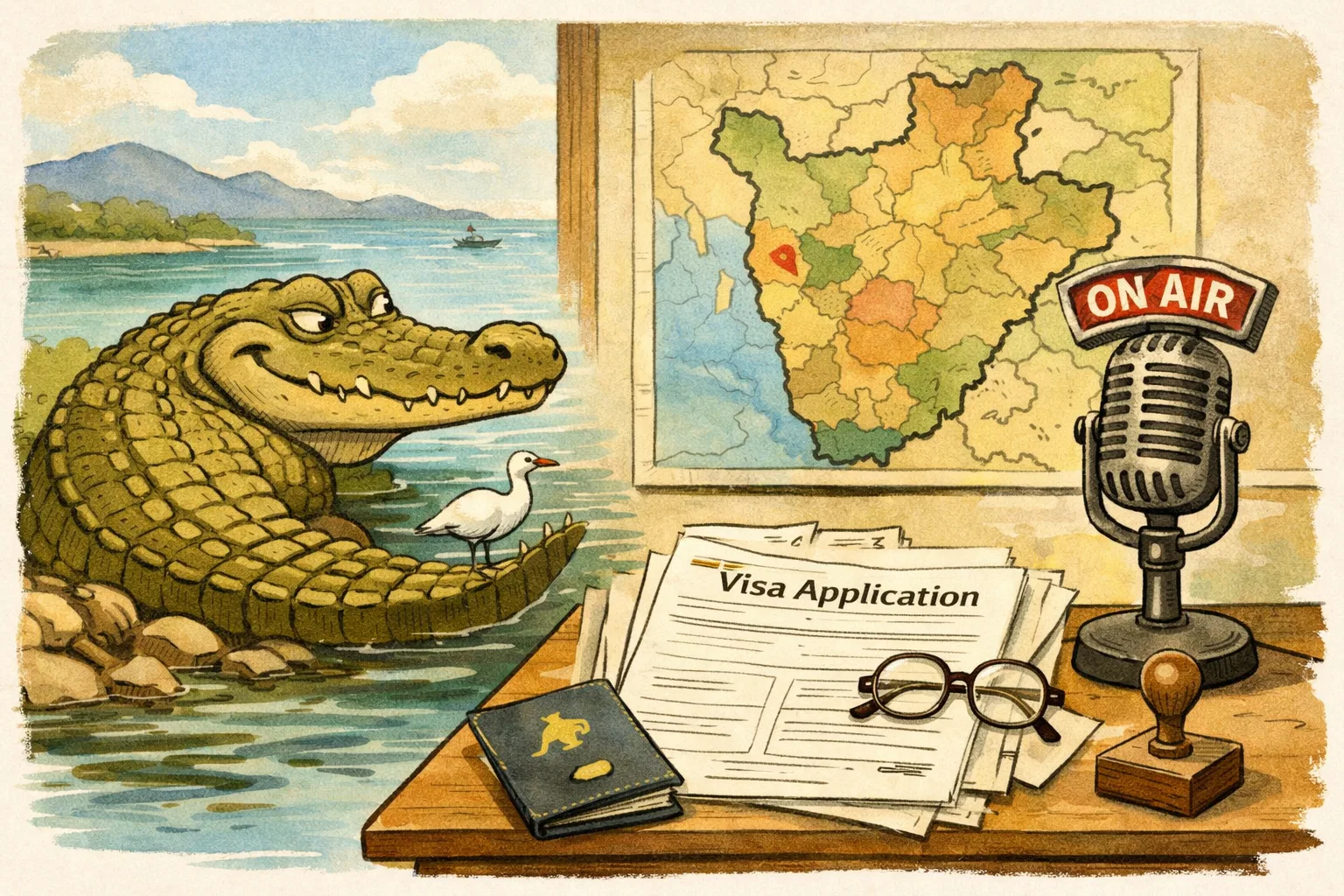
The best-known doubtful story associated with Burundi concerns Gustave, a large Nile crocodile said to inhabit the Rusizi River and the northern shores of Lake Tanganyika. International retellings have credited the animal with killing 200 or even 300 people. Those numbers helped transform a dangerous crocodile into a near-supernatural monster: exceptionally old, resistant to bullets and clever enough to avoid repeated attempts at capture.[Wikipedia]WikipediaGustave (crocodileGustave (crocodile
There is good reason to believe that unusually large crocodiles live in the area and that crocodile attacks have occurred. The doubtful part is the construction of one identifiable animal as the perpetrator of hundreds of deaths. No systematic victim list supports the famous total, and reported encounters accumulated across a broad region and many years. Specialist sceptical analysis has also questioned whether photographs consistently show the same crocodile and whether the claimed size and kill count can be verified.[CrocAttack]crocattack.orggustave the nile crocodileGustave the Nile CrocodileIt is claimed that Gustave has been responsible for around 300 human deaths since 1987. There are man…
Gustave is therefore better understood as a contested monster legend than as a proven deliberate hoax. The story has several ingredients that encourage exaggeration:
- crocodile attacks may leave little evidence linking a death to one particular animal;
- witnesses naturally remember scars, size and behaviour differently;
- accounts from separate places can be merged into the career of a single predator;
- documentary storytelling rewards a named villain more than a general explanation about human–wildlife conflict;
- each retelling tends to repeat the largest previous estimate rather than trace it to a documented source.
The name itself gave the story coherence. Once an elusive animal had been identified as “Gustave”, later sightings and older attacks could be attached to the same character. A genuine local danger became a global fortean tale with a recognisable protagonist.
That does not mean residents invented their fear for entertainment. Lake and river communities face real hazards, and a very large crocodile could have killed several people. The unsupported leap is from “a dangerous crocodile exists” to “this single animal has a precisely measurable toll of hundreds”. Gustave’s continuing appeal lies in that uncertain middle ground between zoology, oral testimony, commercial documentary drama and modern monster folklore.
A fake organisation selling Australian dreams
A clearer case of deliberate fraud emerged in Bujumbura in 2016. Burundian police said they had uncovered a fictitious organisation that promised applicants visas to Australia. The operation had reportedly been running since 2013 and collected substantial fees from people seeking opportunities abroad. Victims were asked to pay roughly 700,000 to 1.5 million Burundian francs per application, with higher demands apparently made when the scammers believed an applicant could afford more.[IWACU]iwacu-burundi.orgpolice uncover migration fraud that swindled victims out of millionsIWACUPolice uncover migration fraud that swindled victims out of…12 Jul 2016 — A serious migration scam by a fake organisation promisi…
The scheme worked because it imitated the outward appearance of a legitimate migration service. Applicants submitted files, paid administrative-looking charges and were encouraged to believe that an intermediary possessed special access to a distant immigration system. Bags of seized application papers provided a physical sign of how the performance of bureaucracy had helped the fraud appear credible.[IWACU]iwacu-burundi.orgpolice uncover migration fraud that swindled victims out of millionsIWACUPolice uncover migration fraud that swindled victims out of…12 Jul 2016 — A serious migration scam by a fake organisation promisi…
The con also exploited a familiar imbalance of knowledge. Most applicants cannot independently observe what happens inside a foreign visa process. Fraudsters can therefore invent officials, appointments, quotas and delays while blaming every problem on an unseen embassy or government department. Australian authorities warn that guaranteed visas, large advance payments and unofficial agents are common signs of migration fraud; only the Australian government can grant an Australian visa.[Immigration and citizenship Website]immi.homeaffairs.gov.auImmigration and citizenship Website Visa scamsgration and citizenship WebsiteVisa scams - Immigration and citizenship4 May 2026 — If you are aware of, or suspect a scam in relatio…
The racket was exposed not through an elaborate undercover operation but after victims complained. That detail is important. Confidence fraud often survives because each target believes that a delay is personal, temporary or caused by paperwork. Once victims compare experiences, the supposed exceptions reveal a repeated script.
Unlike the Gustave story, this episode fits the ordinary definition of a hoax or scam: a knowingly false institution was presented as real for financial gain. Its persuasive force came less from sophisticated technology than from paperwork, aspiration and the authority associated with international migration.
When rumours become weapons
The most consequential falsehoods in Burundi’s modern history have arisen around political crisis and communal violence. Here the language of “hoax” must be used carefully. Conflict rumours may be deliberately manufactured, sincerely believed, distorted in transmission or impossible to verify while events are unfolding. Yet even an unconfirmed story can influence behaviour if it identifies an alleged enemy, predicts an attack or presents retaliation as self-defence.
After the assassination of President Melchior Ndadaye during the October 1993 coup, violence spread rapidly. The subsequent United Nations commission investigated the killing, massacres and other grave abuses, but found that the evidence did not permit simple answers to every question of responsibility. The uncertainty surrounding events created ideal conditions for partisan accounts, atrocity stories and accusations to circulate alongside genuine reports of killings.[United Nations]un.orgited Nations9- Burundi“The Council demands that the perpetrators of the military coup cease all acts of violence, reveal the whereabout…
The information crisis crossed national borders. In neighbouring Rwanda, extremist broadcasters exploited Ndadaye’s death and reportedly embellished its circumstances, portraying it in exceptionally brutal terms to inflame fear and hostility. The episode became part of a wider propaganda environment in which unfounded rumours and claims of imminent extermination were used to portray violence as pre-emptive defence.[United Nations]un.orghistorical background.shtmlhistorical background.shtml
Burundi should not simply be treated as an appendix to the better-documented history of Rwandan hate radio. Its political and media systems developed differently. Nevertheless, the regional connection shows how a real assassination can be repackaged into a misleading atrocity narrative. The central event need not be invented for propaganda to operate. Selective details, fabricated additions and claims about collective guilt can alter what an audience believes the event means.
Media scholars examining Burundi, Rwanda and the Democratic Republic of the Congo have consequently treated broadcasting not merely as a neutral channel but as a possible actor in conflict. Post-war regulation was partly designed to prevent renewed incitement, although strong regulatory powers also created the danger that governments could suppress legitimate criticism by describing it as harmful or false.[Academia]academia.eduOpen source on academia.edu.
This creates a recurring problem for anyone investigating political deception in Burundi: the same vocabulary can describe very different acts.
- A fabricated atrocity story may be propaganda intended to provoke fear.
- An early but inaccurate report may be a journalistic error made during confusion.
- An opposition allegation may be true, false or unverifiable because investigators lack access.
- A government accusation of “fake news” may identify a genuine mistake or serve as a pretext for silencing scrutiny.
The useful question is therefore not merely whether a statement was false. It is who originated it, what evidence was available at the time, whether corrections were made and what political purpose the claim served.

The 2015 coup and the battle to control reality
Those distinctions were visible during the attempted coup of May 2015. General Godefroid Niyombare announced that President Pierre Nkurunziza had been removed while the president was attending a regional meeting in Tanzania. Celebrations followed in parts of Bujumbura, but control of the country remained uncertain. Coup supporters and loyalist commanders issued competing claims about the airport, the capital and strategic broadcasting facilities.[The Guardian]theguardian.comThe Guardian Heavy fighting erupts between rival Burundi troopsThe Guardian Heavy fighting erupts between rival Burundi troops
The announcement was not a fictional coup story: an armed attempt to seize power was genuinely under way. But each faction presented its own desired outcome as established fact. Coup leaders claimed broad control; loyalists announced that the attempt had failed while fighting was continuing. Independent radio stations became physical targets, demonstrating that control of broadcasting was not secondary to the struggle but part of it. The coup collapsed after roughly a day and a half, and its leaders conceded defeat.[The Guardian]theguardian.comThe Guardian Heavy fighting erupts between rival Burundi troopsThe Guardian Heavy fighting erupts between rival Burundi troops
This episode illustrates the difference between deception and premature certainty. In a fast-moving crisis, even responsible journalists may accurately report that someone has announced victory without being able to confirm that victory has occurred. Audiences, however, often remember the headline rather than the attribution. “A general says the president has been overthrown” can quickly become “the president has been overthrown”.
The destruction and closure of independent broadcasters made later verification even harder. When citizens cannot compare accounts from several reporters, official proclamations and rumours gain disproportionate power. Research on breaking-news rumours more generally has found that people tend to support unverified claims while events remain unresolved and that false rumours can persist after denials begin circulating.[arXiv]arxiv.orgOpen source on arxiv.org.
The attempted coup was therefore not itself a hoax. It was an example of contested reality: genuine military action surrounded by claims that repeatedly ran ahead of what could be confirmed.
How “fake news” became a political label
A revealing dispute followed in 2017, when The Guardian published an article about Burundian journalists working in exile and the government’s control of information. Reporters Without Borders later said the article contained reporting errors. Those mistakes allowed government supporters to portray the wider account of press repression as fabricated, even though the underlying restrictions on independent journalism were extensively documented.[Reporters Without Borders]rsf.orgfake news government weapon destroying independent mediafake news government weapon destroying independent media
This is a common mechanism in political information warfare. A flawed detail is isolated and used to discredit an entire body of reporting. The original error is real and deserves correction; the broader conclusion that all critical coverage is therefore fraudulent does not logically follow.
The controversy also demonstrated why accuracy is particularly important when reporting from repressive or inaccessible environments. Journalists in exile often depend on encrypted messages, anonymous contacts and incomplete records because open reporting may expose sources to danger. Those conditions do not excuse errors, but they help explain how mistakes occur and why correcting them promptly is essential.[Reporters Without Borders]rsf.orgfake news government weapon destroying independent mediafake news government weapon destroying independent media
Burundian authorities later suspended or banned international broadcasters while accusing them of spreading lies or threatening national cohesion. Such claims cannot be assessed simply by assuming that either a government or its critics are always truthful. The stronger test is specific: identify the disputed broadcast, examine its sources, compare it with independent evidence and separate demonstrable mistakes from politically motivated denunciations.[peopleandpowerngr.com]peopleandpowerngr.comBurundi Bans BBC, VOA For Allegedly BroadcastingBurundi Bans BBC, VOA For Allegedly Broadcasting
The term “fake news” is especially unhelpful when it merges four separate things: invented reports, honest mistakes, disputed interpretation and accurate information that an authority dislikes. Burundi’s experience shows how easily a language intended to expose deception can itself become a tool of manipulation.
Why these stories remain difficult to verify
Burundi’s record of famous hoaxes appears thin partly because documentation is fragmented. Long periods of political violence damaged institutions, endangered journalists and restricted access to witnesses. Local reporting has also been less extensively digitised than material from wealthier countries. Stories that might elsewhere leave searchable trails of corrections, court papers and newspaper archives may survive primarily through oral accounts or scattered reports.
That scarcity creates two opposite dangers. The first is credulity: repeating dramatic claims because no convenient source disproves them. The second is excessive scepticism: treating poorly documented testimony as false merely because conflict, poverty or censorship prevented the creation of a conventional archive.
A responsible assessment asks what kind of claim is being made.
For folklore and animal legends, look for independently recorded sightings, consistent identifying features, contemporary attack records and evidence connecting incidents to one animal.
For commercial fraud, look for payment records, victims with matching accounts, seized documents, arrests, court proceedings and confirmation from the institution allegedly represented.
For political rumours, preserve the chronology. A statement made during uncertainty should not automatically be judged by information that became available days later, but claims presented as certain without supporting evidence deserve scrutiny.
For accusations of fake news, demand particulars. A government’s general allegation is no more self-proving than an opposition accusation. The relevant questions concern the exact claim, original source, available corroboration and response to correction.
What Burundi’s cases reveal
The most memorable Burundi-related deception stories do not share one motive. Gustave grew through storytelling, uncertain identification and media appetite for a monster. The Australian visa scheme used false institutional authority for money. Conflict propaganda converted fear and real violence into simplified narratives of collective guilt. Political actors used competing announcements to shape events while they were still happening, and the phrase “fake news” later became a means of attacking inconvenient journalism.
Together, these cases show that false belief rarely depends on national gullibility. It depends on circumstances. A frightening animal is difficult to identify. A distant visa system is difficult to inspect. A coup is difficult to verify while broadcasters are being attacked. A massacre is difficult to reconstruct when witnesses are displaced or afraid. In each situation, the person who supplies a confident story gains an advantage over those who honestly admit uncertainty.
The central lesson of Burundi’s hoax history is therefore not that spectacular fakes are everywhere. It is that uncertainty itself can be exploited. Legends turn scattered incidents into one memorable creature; scammers turn paperwork into authority; propagandists turn fear into apparent proof; and governments turn genuine reporting errors into arguments against an independent press. The best defence is not blanket disbelief, but careful separation of documented fact, reasonable inference, unresolved testimony and deliberate invention.
Amazon book picks
Further Reading
Books and field guides related to Which Burundi Stories Were Real, False or Exaggerated?. Use these as the next step if you want deeper reading beyond the article.
The Misinformation Age
Matches the page's focus on distinguishing truth, error and rumor.
eBay marketplace picks
Marketplace Samples
Live-tested eBay searches with available results related to this page.

Endnotes
1.
Source: Wikipedia
Title: Gustave (crocodile)
Link:https://en.wikipedia.org/wiki/Gustave_%28crocodile%29
2.
Source: crocattack.org
Title: gustave the nile crocodile
Link:https://crocattack.org/gustave-the-nile-crocodile/
Source snippet
Gustave the Nile CrocodileIt is claimed that Gustave has been responsible for around 300 human deaths since 1987. There are man...
3.
Source: iwacu-burundi.org
Title: police uncover migration fraud that swindled victims out of millions
Link:https://www.iwacu-burundi.org/englishnews/police-uncover-migration-fraud-that-swindled-victims-out-of-millions/
Source snippet
IWACUPolice uncover migration fraud that swindled victims out of...12 Jul 2016 — A serious migration scam by a fake organisation promisi...
4.
Source: Wikipedia
Title: Burundi–Rwanda relations
Link:https://en.wikipedia.org/wiki/Burundi%E2%80%93Rwanda_relations
5.
Source: academia.edu
Link:https://www.academia.edu/1469868/After_the_Hate_Media_Regulation_in_the_DRC_Burundi_and_Rwanda
6.
Source: time.com
Link:https://time.com/3857879/burundi-coup-protest-pictures/
7.
Source: time.com
Link:https://time.com/3859920/burundis-attempted-coup-fails/
8.
Source: arxiv.org
Link:https://arxiv.org/abs/1511.07487
9.
Source: arxiv.org
Link:https://arxiv.org/abs/1610.07363
10.
Source: peopleandpowerngr.com
Title: Burundi Bans BBC, VOA For Allegedly Broadcasting
Link:https://peopleandpowerngr.com/2019/04/burundi-bans-bbc-voa-for-spreading-fake-news/
11.
Source: Wikipedia
Title: 1993 Burundian coup attempt
Link:https://en.wikipedia.org/wiki/1993_Burundian_coup_attempt
12.
Source: youtube.com
Title: Giant Crocodile Seen in Burundi
Link:https://www.youtube.com/watch?v=c1oaXzTDRWo
Source snippet
Gustave - The world's most DEADLY CROCODILE...
13.
Source: youtube.com
Link:https://www.youtube.com/watch?v=unuZZppqAYQ
Source snippet
This Gustave the Crocodile Documentary explores the origins, alleged attacks, and historical reality behind the legendary man-eating croc...
14.
Source: immi.homeaffairs.gov.au
Title: Immigration and citizenship Website [Visa scams]({{ ‘visa-scam/’ | relative_url }})
Link:https://immi.homeaffairs.gov.au/help-support/visa-scams
Source snippet
gration and citizenship WebsiteVisa scams - Immigration and citizenship4 May 2026 — If you are aware of, or suspect a scam in relatio...
Published: May 2026
15.
Source: bruneidarussalam.embassy.gov.au
Link:https://bruneidarussalam.embassy.gov.au/bnei/Visa_Scams.html
Source snippet
You are at risk of losing money, having your identity stolen, and being lured into unsafe work...Read more...
16.
Source: un.org
Link:https://www.un.org/fr/sc/repertoire/93-95/CHAPTER%208/AFRICA/item09-%20Burundi.pdf
Source snippet
ited Nations9- Burundi“The Council demands that the perpetrators of the military coup cease all acts of violence, reveal the whereabout...
17.
Source: un.org
Title: historical background.shtml
Link:https://www.un.org/en/preventgenocide/rwanda/historical-background.shtml
18.
Source: theguardian.com
Title: The Guardian Heavy fighting erupts between rival Burundi troops
Link:https://www.theguardian.com/world/2015/may/14/heavy-fighting-erupts-between-rival-burundi-troops-witnesses
19.
Source: rsf.org
Title: fake news government weapon destroying independent media
Link:https://rsf.org/en/fake-news-government-weapon-destroying-independent-media
20.
Source: theguardian.com
Title: burundi fake news fuelled civil war used again resident nkurunziza
Link:https://www.theguardian.com/world/2017/feb/28/burundi-fake-news-fuelled-civil-war-used-again-resident-nkurunziza
21.
Source: un.org
Title: Why We Care
Link:https://www.un.org/pt/academic-impact/why-we-care-1-april-2021
22.
Source: un.org
Title: globalstudywps en web
Link:https://www.un.org/peacebuilding/sites/www.un.org.peacebuilding/files/documents/globalstudywps_en_web.pdf
23.
Source: un.org
Title: unyb 2015 12 chapter hr ii protection of human rights eb fm rbb
Link:https://www.un.org/sites/un2.un.org/files/webform/unyb_2015_12_chapter_hr_ii_protection_of_human_rights_eb_fm_rbb.pdf
24.
Source: un.org
Title: secretariat registered vendors english.xlsx
Link:https://www.un.org/procurement/sites/default/files/2026/February%202026/un-secretariat-registered-vendors-english.xlsx
25.
Source: un.org
Link:https://www.un.org/en/global-issues/disarmament
26.
Source: iwacu-burundi.org
Link:https://www.iwacu-burundi.org/englishnews/tag/fraud/
27.
Source: ndl.ethernet.edu.et
Link:https://ndl.ethernet.edu.et/bitstream/123456789/21224/1/49.pdf
28.
Source: india.highcommission.gov.au
Title: highcommission.gov.au Visa and Migration Scams
Link:https://india.highcommission.gov.au/ndli/vm_visaandmigrationscam.html
Additional References
29.
Source: usip.org
Title: Since acts of violence in Burundi.Read more
Link:https://www.usip.org/sites/default/files/file/resources/collections/commissions/Burundi-Report.pdf
Source snippet
United States Institute of PeaceInternational Commission of Inquiry for Burundi: Final Report13 Jan 2004 — massacres and other related se...
30.
Source: researchgate.net
Link:https://www.researchgate.net/publication/385037169_Digital_Media_and_Society_Convenient_Regulators_of_Society_Politics_and_Economics
31.
Source: instagram.com
Link:https://www.instagram.com/reel/DMrS2uZNvBK/?hl=en
32.
Source: facebook.com
Link:https://www.facebook.com/NehandaRadio/posts/burundis-authorities-have-dismissed-a-bbc-investigation-into-alleged-secret-tort/10161156274020156/
33.
Source: facebook.com
Link:https://www.facebook.com/andikamagazine/posts/-burundi-police-warn-of-rising-scams-involving-impersonation-of-state-officialsi/1444830530988172/
34.
Source: instagram.com
Link:https://www.instagram.com/p/DakX-SnJn6G/
35.
Source: linkedin.com
Link:https://www.linkedin.com/pulse/department-confirms-visa-fraud-priority-media-exposes-sheila-woods
36.
Source: facebook.com
Link:https://www.facebook.com/groups/21786920284/posts/10171799376595285/
37.
Source: africacheck.org
Link:https://africacheck.org/fact-checks?page=7
38.
Source: africacheck.org
Link:https://africacheck.org/third-party-fact-checks
Topic Tree
Follow this branch
Related pages 192
- Albanian Hoaxes
- Algerian Hoaxes
- Antigua Deceptions
- Argentina Hoaxes
- Armenian Hoaxes
- +187 more in sidebar