Within Croatian Hoaxes
How Fake Antiquities Entered Dalmatian Museum Collections
A village blacksmith supplied collectors with supposed ancient figures that survived decades of changing museum classifications.
On this page
- Petar Pezelj and the market for ancient finds
- Why unusual objects looked convincingly provincial
- How provenance research exposed the forgeries
Page outline Jump by section
Introduction
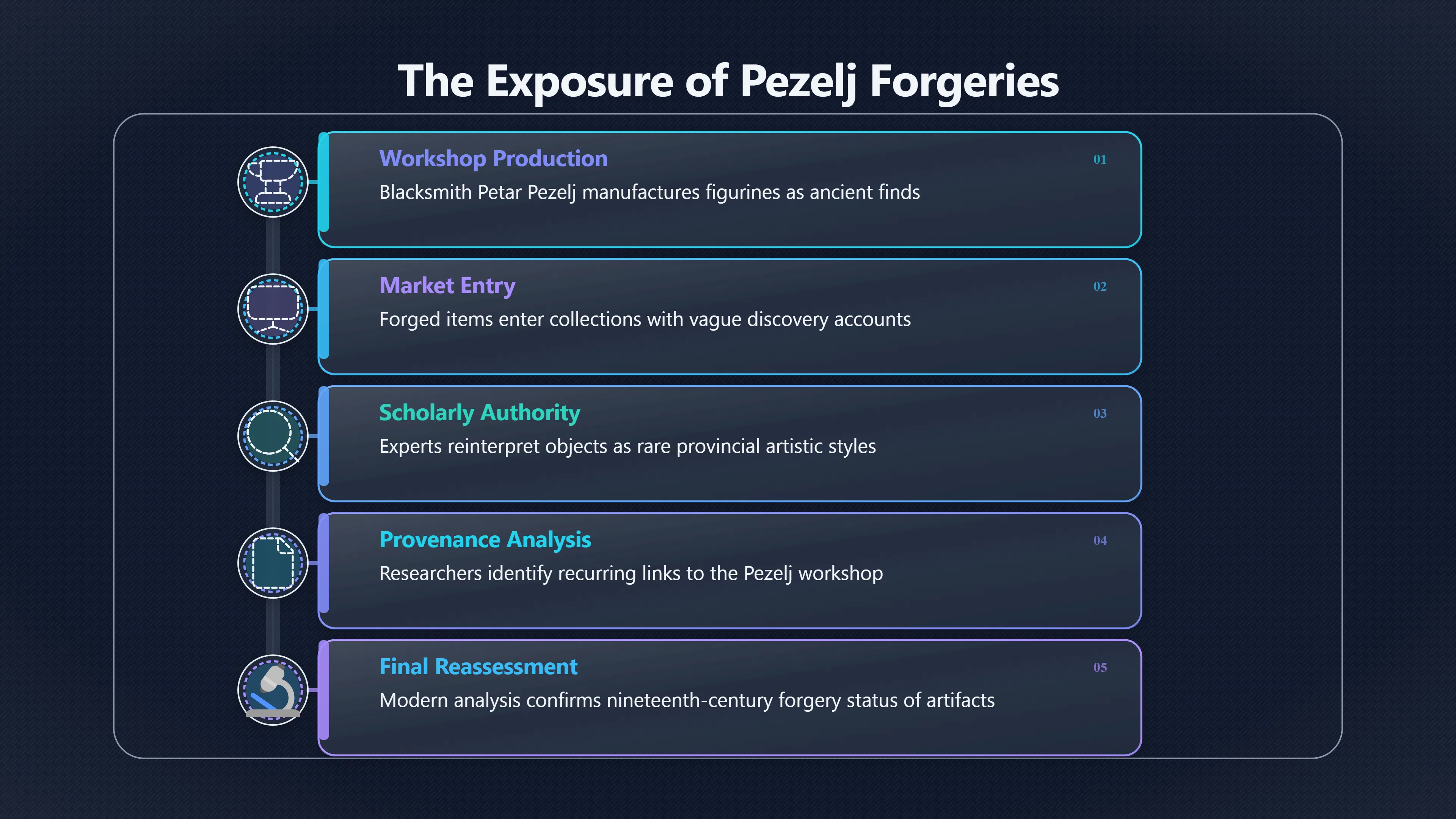
Among Croatia’s lesser-known forgery scandals, the story of the Pezelj workshop shows how fake antiquities can enter museum collections and remain there for decades. In the late nineteenth century, when archaeological collecting in Dalmatia was expanding rapidly, a village blacksmith named Petar Pezelj supplied a stream of supposedly ancient objects to collectors and intermediaries. Some pieces were accepted as Roman, early Christian, Byzantine or medieval artefacts, despite their unusual appearance. What makes the case remarkable is not merely that forged objects were sold, but that several of them acquired scholarly authority and continued to be reinterpreted by generations of experts long after doubts had emerged. The eventual exposure of the workshop depended less on scientific testing than on painstaking provenance research, archival correspondence and a re-examination of how the objects had entered collections.[Hrčak]hrcak.srce.hrHrčak Fit fabricando faberHrčakFit fabricando faberSeptember 11, 2019 — by A Milošević · 2018 — this figurine is actually a forgery made by blacksmith Petar Pezelj…

Petar Pezelj and the market for ancient finds
The Pezelj affair developed in a period when Dalmatia was attracting growing archaeological attention. Roman military sites, ancient settlements and early Christian remains were being investigated more systematically, while museums sought representative artefacts from newly studied regions. Yet standards for documenting discoveries were often less rigorous than those expected today. Objects could pass from local finders to dealers, collectors and institutions with only vague accounts of where they had supposedly been unearthed.[Hrčak]hrcak.srce.hrHrčak Fit fabricando faberHrčakFit fabricando faberSeptember 11, 2019 — by A Milošević · 2018 — this figurine is actually a forgery made by blacksmith Petar Pezelj…
Within this environment, Petar Pezelj, a blacksmith from the area around Trilj and Sinj, found an opportunity. According to later research, he manufactured figurines and other objects that were presented as archaeological discoveries. Some pieces were linked to well-known ancient locations such as Tilurium, the Roman legionary site near modern Gardun. The association with genuine archaeological landscapes helped make the artefacts appear credible.[Hrčak]hrcak.srce.hrHrčak Fit fabricando faberHrčakFit fabricando faberSeptember 11, 2019 — by A Milošević · 2018 — this figurine is actually a forgery made by blacksmith Petar Pezelj…
Contemporary investigators eventually connected Pezelj with the production of forged antiquities. Archaeologist and priest Frane Bulić gathered testimony indicating that the blacksmith had created at least some of the suspicious pieces circulating in Dalmatian collections. Reports from local informants suggested that Pezelj was aware of growing scrutiny and avoided direct encounters with investigators who were trying to establish the origin of the objects.[Hrčak]hrcak.srce.hrHrčak Fit fabricando faberHrčakFit fabricando faberSeptember 11, 2019 — by A Milošević · 2018 — this figurine is actually a forgery made by blacksmith Petar Pezelj…
Why unusual objects looked convincingly provincial
One reason the forgeries survived for so long was that they did not resemble obvious copies of famous classical masterpieces. Instead, many appeared awkward, eccentric or stylistically mixed. Modern observers might see these features as warning signs, but nineteenth- and early twentieth-century scholars could interpret them differently.
Dalmatia occupied the edge of several historical worlds: Roman, Illyrian, Byzantine, medieval and local folk traditions. When an object combined unfamiliar motifs or seemed difficult to classify, specialists sometimes explained the anomaly as evidence of a distinctive provincial artistic tradition. Rather than proving forgery, strangeness could be taken as proof that a rare local style had finally been discovered.[Hrčak]hrcak.srce.hrHrčak Fit fabricando faberHrčakFit fabricando faberSeptember 11, 2019 — by A Milošević · 2018 — this figurine is actually a forgery made by blacksmith Petar Pezelj…
This process can be seen in the history of several Pezelj-linked figurines. Scholars assigned different dates and identities to the same objects over the years. Depending on the interpreter, a figure might be labelled Roman pagan, associated with an eastern cult, described as Italic or Etruscan in character, or classified as an early Christian or Byzantine artefact. Each new interpretation reinforced the object’s apparent legitimacy by treating it as a genuine archaeological puzzle rather than a modern fabrication.[Hrčak]hrcak.srce.hrHrčak Fit fabricando faberHrčakFit fabricando faberSeptember 11, 2019 — by A Milošević · 2018 — this figurine is actually a forgery made by blacksmith Petar Pezelj…
The result was a form of institutional momentum. Once a piece entered a museum catalogue or scholarly publication, later researchers often inherited earlier assumptions. The object’s status as an archaeological artefact became part of the evidence used to defend its authenticity.[Hrčak]hrcak.srce.hrHrčak Fit fabricando faberHrčakFit fabricando faberSeptember 11, 2019 — by A Milošević · 2018 — this figurine is actually a forgery made by blacksmith Petar Pezelj…
The silver orant and the problem of changing classifications
The best-known example is a small silver figurine from Gardun, often described as an orant, a figure shown in prayer. Over many decades, scholars proposed dramatically different explanations for its origin and meaning. It was variously interpreted as a pagan cult object, an eastern religious figure, an Italic-Etruscan ritual image and an early Byzantine Christian artefact.[Hrčak]hrcak.srce.hrHrčak Fit fabricando faberHrčakFit fabricando faberSeptember 11, 2019 — by A Milošević · 2018 — this figurine is actually a forgery made by blacksmith Petar Pezelj…
The shifting interpretations reveal how difficult it was to fit the object into any recognised archaeological tradition. Rather than converging on a stable identification, experts repeatedly reclassified it as intellectual fashions and comparative material changed. This instability later became one of the strongest arguments against authenticity. If an artefact can plausibly belong to many unrelated traditions, the problem may lie not with scholarly disagreement but with the object itself.[Hrčak]hrcak.srce.hrHrčak Fit fabricando faberHrčakFit fabricando faberSeptember 11, 2019 — by A Milošević · 2018 — this figurine is actually a forgery made by blacksmith Petar Pezelj…
In a detailed reassessment published in 2018, archaeologist Ante Milošević argued that the figurine should no longer be treated as an ancient artefact at all. After reviewing earlier interpretations, archival evidence and the wider history of Pezelj’s activity, he concluded that the piece was a nineteenth-century forgery produced by the blacksmith’s workshop. Significantly, Milošević also rejected his own earlier view that the object was an authentic early Byzantine work, illustrating how reassessment can overturn even long-held scholarly positions.[Hrčak]hrcak.srce.hrHrčak Fit fabricando faberHrčakFit fabricando faberSeptember 11, 2019 — by A Milošević · 2018 — this figurine is actually a forgery made by blacksmith Petar Pezelj…
How provenance research exposed the forgeries
The exposure of the Pezelj workshop did not come from a single dramatic discovery. Instead, it emerged through the accumulation of evidence from several different directions.
Researchers revisited museum acquisition records, old correspondence, local testimony and publication histories. These sources revealed recurring links between suspicious objects and the same geographical area, the same intermediaries and, ultimately, the same blacksmith. The pattern became increasingly difficult to dismiss as coincidence.[Hrčak]hrcak.srce.hrHrčak Fit fabricando faberHrčakFit fabricando faberSeptember 11, 2019 — by A Milošević · 2018 — this figurine is actually a forgery made by blacksmith Petar Pezelj…
Equally important was the absence of secure archaeological provenance. Many of the disputed artefacts lacked reliable excavation records. They were known only through claims about where they had supposedly been found. As archaeological standards evolved, scholars became less willing to accept such undocumented histories at face value. Objects that once seemed plausible because they came from a region rich in Roman remains now appeared problematic precisely because their discovery stories could not be verified.[Hrčak]hrcak.srce.hrHrčak Fit fabricando faberHrčakFit fabricando faberSeptember 11, 2019 — by A Milošević · 2018 — this figurine is actually a forgery made by blacksmith Petar Pezelj…
The case therefore became a classic example of provenance research at work. Rather than focusing solely on style or metallurgy, investigators reconstructed the social history of the objects: who made them, who sold them, who bought them and how they acquired authority. That reconstruction ultimately proved more persuasive than attempts to identify the artefacts through artistic comparison alone.[Hrčak]hrcak.srce.hrHrčak Fit fabricando faberHrčakFit fabricando faberSeptember 11, 2019 — by A Milošević · 2018 — this figurine is actually a forgery made by blacksmith Petar Pezelj…

What the Pezelj case reveals about museum collections
The significance of the Pezelj workshop extends beyond one blacksmith and a handful of forged artefacts. It illustrates a broader vulnerability in nineteenth-century collecting culture. Museums and scholars often worked with incomplete information, while demand for new discoveries encouraged the acceptance of poorly documented objects. A convincing story could sometimes substitute for a secure archaeological context.[Hrčak]hrcak.srce.hrHrčak Fit fabricando faberHrčakFit fabricando faberSeptember 11, 2019 — by A Milošević · 2018 — this figurine is actually a forgery made by blacksmith Petar Pezelj…
The episode also demonstrates how scholarly authority can preserve an error. Once a forged artefact enters catalogues, exhibitions and academic literature, it may continue influencing research long after its origins become doubtful. Correcting the record can require decades of re-examination.[Hrčak]hrcak.srce.hrHrčak Fit fabricando faberHrčakFit fabricando faberSeptember 11, 2019 — by A Milošević · 2018 — this figurine is actually a forgery made by blacksmith Petar Pezelj…
Within Croatia’s wider history of deception and contested evidence, the Pezelj workshop stands out because the forgery was not exposed by a spectacular confession or modern laboratory breakthrough. Instead, it was unravelled through careful historical detective work. The lesson remains relevant for museums today: an artefact’s appearance, rarity or scholarly reputation cannot compensate for an uncertain history of discovery and ownership.[Hrčak]hrcak.srce.hrHrčak Fit fabricando faberHrčakFit fabricando faberSeptember 11, 2019 — by A Milošević · 2018 — this figurine is actually a forgery made by blacksmith Petar Pezelj…
Amazon book picks
Further Reading
Books and field guides related to How Fake Antiquities Entered Dalmatian Museum Collections. Use these as the next step if you want deeper reading beyond the article.
Frauds, Myths, and Mysteries: Science and Pseudoscience in Ar...
Shows how archaeological myths and dubious finds are investigated.
Fake? The art of deception
Directly explores forged historical objects and how they fool experts.
eBay marketplace picks
Marketplace Samples
Live-tested eBay searches with available results related to this page.


Endnotes
1.
Source: hrcak.srce.hr
Title: Hrčak Fit fabricando faber
Link:https://hrcak.srce.hr/file/328013
Source snippet
HrčakFit fabricando faberSeptember 11, 2019 — by A Milošević · 2018 — this figurine is actually a forgery made by blacksmith Petar Pezelj...
Published: September 11, 2019
2.
Source: hrcak.srce.hr
Link:https://hrcak.srce.hr/file/328014
Source snippet
fabricando faberby A Milošević · 2018 — this figurine is actually a forgery made by blacksmith Petar Pezelj in the surroundings of Trilj...
3.
Source: hrcak.srce.hr
Title: hr Fit fabricando faber
Link:https://hrcak.srce.hr/clanak/328013
Source snippet
fabricando faber - Hrčak - Srceby A Milošević · 2018 — Fit fabricando faber Ante Milošević. Petar Pezelj iz okolice Trilja, u zadnjim des...
4.
Source: hrcak.srce.hr
Link:https://hrcak.srce.hr/file/386176
Source snippet
srce.hrČASOPIS METALURGIJA 1962.–2022. god.by I Mamuzić · 2022 — Pezelj Zaključci o. International Symposium of Croatian Metallurgists, “...
5.
Source: godisnjak.anubih.ba
Link:https://godisnjak.anubih.ba/index.php/godisnjak/article/view/64?articlesBySimilarityPage=10
Additional References
6.
Source: academia.edu
Link:https://www.academia.edu/38980546/Finds_Of_The_Roman_Military_Equipment_In_Croatia
Source snippet
(PDF) Finds Of The Roman Military Equipment In CroatiaThe paper discusses the organization and preparation of the exhibition "Finds of Ro...
7.
Source: godisnjak.anubih.ba
Link:https://godisnjak.anubih.ba/index.php/godisnjak/de/article/view/64?articlesBySimilarityPage=8
Source snippet
GodišnjakOnce More about the Silver Orant from GardunPetar Pezelj, archaeological forgery … figurine is actually a forgery made by blacks...
8.
Source: x-legio.com
Link:https://x-legio.com/file/87/Finds%20Of%20The%20Roman%20Military%20Equipment%20In.pdf
Source snippet
Legio X Fretensisthe smith Petar Pezelj from Vojnić, who forged some of the finds.5 Two... VII legion in Dalmatia, and with this also in...
9.
Source: youtube.com
Title: 8 Great Archaeological Discoveries That Turned Out to Be Fake
Link:https://www.youtube.com/watch?v=Nzu_XZqmsrs
Source snippet
Frane Bulic archaeology Dalmatia The story of Don Frane Bulić, Archaeological Museum Split Dalmatia storytelling destination...
10.
Source: youtube.com
Title: Interpretive walk “Walk with Frane Bulić” – archaeological site Salona
Link:https://www.youtube.com/watch?v=jkVxtfkH7bM
Source snippet
How Fake Artifacts Fooled the World’s Best Museums...
11.
Source: youtube.com
Title: The story of Don Frane Bulić, Archaeological Museum Split
Link:https://www.youtube.com/watch?v=KGbrv3wPnAM
Source snippet
Interpretive walk “Walk with Frane Bulić” – archaeological site Salona...
12.
Source: academia.edu
Link:https://www.academia.edu/6550382/Prilozi_Instituta_za_arheologiju_u_Zagrebu_Vol_24_Contributions_of_Institute_of_Archaeology_in_Zagreb_Vol
13.
Source: metal-pezelj.hr
Link:https://metal-pezelj.hr/kontakt/
14.
Source: scribd.com
Link:https://www.scribd.com/document/434770720/Godisnjak46-Full
15.
Source: youtube.com
Title: Museum Fakes and Forgeries
Link:https://www.youtube.com/watch?v=y5D97X4n1JA
Source snippet
8 Great Archaeological Discoveries That Turned Out to Be Fake...
Topic Tree