Why France's Most Famous Hoaxes Worked
France’s history of hoaxes is not a story of national gullibility. It is a history of authority being borrowed, staged or counterfeited: a forged letter placed before an academy, an imaginary radiation demonstrated in a darkened laboratory, a false antiquity accepted by a great museum, or an urban rumour repeated until ordinary caution seemed irresponsible.
Page outline Jump by section
Introduction
Several of the best-known French cases succeeded because they offered influential audiences something they already wanted. Scholars hoped for discoveries that enhanced French prestige. Religious campaigners welcomed lurid confirmation of their enemies’ wickedness. Military officers protected the reputation of their institution. Newspapers and publishers found that mystery, scandal and secret knowledge sold extremely well.
These episodes also differ sharply from one another. Denis Vrain-Lucas manufactured documents for money; Léo Taxil deliberately deceived ideological opponents; the N-ray affair appears to have arisen largely from experimental error and expectation; the Orléans kidnapping panic spread without a central inventor. Understanding who intended to deceive — and who merely helped a falsehood travel — is essential to understanding how hoaxes work.
Forged history for patriotic buyers
One of the boldest documentary frauds of the nineteenth century began when the forger Denis Vrain-Lucas found an unusually receptive customer in Michel Chasles, a respected mathematician and member of the French Academy of Sciences. From the early 1860s, Vrain-Lucas supplied Chasles with supposedly historic letters written by famous scientists, monarchs, classical authors and biblical figures.
The fraud was not technically flawless. Many documents were written in modern French even when attributed to people who could never have used the language. Others contained anachronisms or rested on implausible chains of ownership. Yet Vrain-Lucas used old-looking paper, prepared inks and packed his inventions with enough historical detail to satisfy a collector who desperately wanted them to be genuine. Over several years, Chasles acquired tens of thousands of supposed documents from him.[Wikipedia]WikipediaDenis Vrain-LucasDenis Vrain-Lucas
The most consequential letters appeared to show that Blaise Pascal had anticipated Isaac Newton’s work on gravity. This was not merely an antiquarian curiosity. It promised a symbolic French victory in a long-running dispute over scientific priority. Chasles presented the material to the Academy of Sciences, where other scholars challenged its handwriting, chronology and provenance. When an objection appeared, Vrain-Lucas often answered it by producing another convenient “historic” document. The expanding archive therefore behaved like many later conspiracy systems: contradictory evidence did not close the story but generated another layer of explanation.
The affair finally became a criminal case. Vrain-Lucas was arrested in 1869 and convicted in Paris in 1870. The scandal demonstrated that expertise in one field did not automatically confer skill in document authentication. It also showed how patriotism could weaken scrutiny: the forged evidence was attractive partly because it restored scientific glory to a French hero.[Wikipedia]WikipediaDenis Vrain-LucasDenis Vrain-Lucas
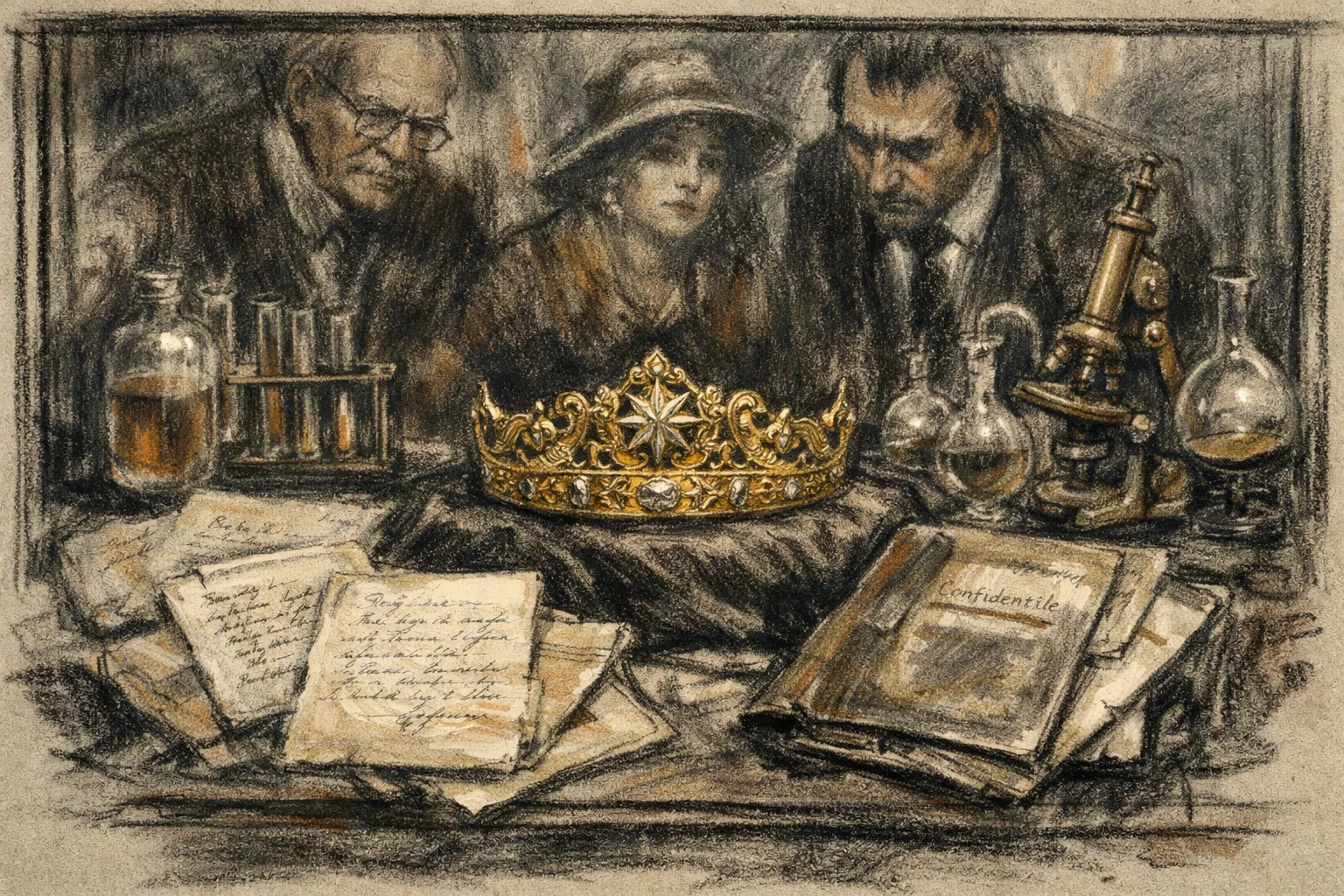
A similar hunger for prestigious objects later helped the forged Tiara of Saitaphernes enter the Louvre. Acquired in 1896 as an ancient Scythian royal treasure, it was soon challenged by specialists and eventually identified as the work of the contemporary goldsmith Israel Rouchomovsky. The object had been genuinely and skilfully made; what was false was its antiquity, provenance and historical meaning. The Louvre retained it and later displayed it as a celebrated fake — a useful reminder that a forgery can acquire a second life as evidence about collecting, taste and institutional error.[Archaeology Magazine]archive.archaeology.orgsaitaphernes tiaraArchaeology MagazineHoaxes, Fakes, and Strange Sites - Saitaphernes' Golden TiaraThe Louvre still owns the Tiara of Saitaphernes, though…
When exposure became entertainment
Léo Taxil’s anti-Masonic deception worked because it exploited an existing conflict rather than inventing one from nothing. Taxil, whose real name was Gabriel Jogand-Pagès, had previously made a career from anticlerical publishing. In the mid-1880s he announced a conversion to Catholicism and began producing sensational accounts of Freemasonry as a hidden system of devil worship.
His books and collaborators described secret Masonic orders, satanic ceremonies and a supposed former high priestess named Diana Vaughan. Taxil’s material resembled popular adventure fiction but was presented as testimony and investigation. The stories circulated within a climate in which senior Catholic authorities had already denounced Freemasonry and many readers were prepared to treat it as a vast spiritual and political conspiracy. Academic work on the episode emphasises that the fraud drew power from the fierce religious and ideological divisions of late nineteenth-century France.[search.informit.org]search.informit.orgCatholics, conspiracy theory, and leo taxil's 'mystification'by B Doherty · 2021 · Cited by 1 — As described in the first part of this ar…
Taxil benefited through sales, publicity and access to a large new audience. His admirers benefited in another sense: the stories appeared to prove that their suspicions had been justified. Sceptics pointed to internal absurdities, while the British occult scholar Arthur Edward Waite examined the claims and rejected the supposed Palladian conspiracy. Nevertheless, a complicated fiction could appear persuasive when its books, witnesses and invented institutions seemed to confirm one another.
In April 1897 Taxil summoned journalists to a public meeting in Paris, ostensibly to reveal Diana Vaughan. Instead, he announced that the entire satanic narrative had been a prolonged deception. The confession humiliated supporters who had treated his publications as evidence.[Wikipedia]WikipediaTaxil hoaxTaxil hoax
The Taxil affair remains important because it was more than a practical joke. It was an adversarial hoax in which the deceiver supplied opponents with an exaggerated version of what they were already inclined to believe. Modern satirical fabrications sometimes work in the same way: material created to expose credulity can escape its intended frame, reach people who miss the satire and continue circulating after the author admits the trick.
A forgery at the heart of a national crisis
The Dreyfus affair cannot be reduced to a hoax. It was a miscarriage of justice shaped by espionage, institutional secrecy, flawed handwriting analysis, antisemitism and political conflict. Yet deliberate falsification became one of its decisive mechanisms.
Captain Alfred Dreyfus was convicted of treason in 1894 after military investigators attributed an intercepted memorandum to him. The document had in fact been written by Major Ferdinand Walsin Esterhazy. Evidence shown secretly to the judges was withheld from Dreyfus and his defence, while a handwriting expert produced an elaborate theory to explain why the writing did not closely resemble Dreyfus’s own.[The New Yorker]newyorker.comThe New Yorker Trial of the CenturyPublicly humiliated, Dreyfus was sent to prison on Devil’s Island. His case, initially driven by flawed evidence, was fueled by rampant a…
When Lieutenant-Colonel Georges Picquart later uncovered evidence pointing towards Esterhazy, senior officers did not simply correct the case. They suppressed and resisted the discovery. Major Hubert-Joseph Henry created a false letter, later known as the Henry forgery, that explicitly strengthened the accusation against Dreyfus. The fabricated document entered the military’s secret file and helped officials defend the original verdict.[affairedreyfus.com]affairedreyfus.comSecret file digitizedSecret file digitized
Henry confessed in 1898 after the forgery was exposed and died in custody shortly afterwards. The revelation transformed the public argument. It did not immediately free Dreyfus, but it made it harder to portray every challenge to the conviction as an attack on France. The case continued through further trials, a presidential pardon and, finally, Dreyfus’s full exoneration in 1906.[Research Guides]guides.loc.govOpen source on loc.gov.
This episode shows how institutional deception can differ from the work of a lone forger. Henry’s document was effective because it entered a protected system whose authority discouraged external checking. Officials had reputations, national security claims and secret procedures on their side. Once the Army’s honour became bound to the verdict, admitting error appeared more dangerous to some officers than preserving a falsehood.
Science misled by what observers expected to see
In 1903 the French physicist René Blondlot announced the discovery of a previously unknown form of radiation, which he called N-rays after Nancy, the city where he worked. The proposed rays were said to produce extremely slight changes in the brightness of sparks or dimly illuminated screens. French researchers reported confirming experiments, and the subject quickly generated scientific papers and considerable national attention.
N-rays appeared at a persuasive moment. X-rays, radioactivity and other unfamiliar phenomena had recently transformed physics. Another invisible radiation was therefore not inherently absurd. Blondlot was an established scientist, and the observations were made with specialised apparatus in a laboratory setting. The problem was that the reported effect depended heavily on subjective judgements of tiny brightness changes, often in darkness, rather than on robust measurements.[American Physical Society]aps.orgrobert wood debunks nraysrobert wood debunks nrays
Researchers outside France struggled to reproduce the results. In 1904 the American physicist Robert W. Wood visited Blondlot’s laboratory. During one demonstration, Wood secretly removed a crucial prism from the apparatus. The experimenters continued to report the expected N-ray effects even though the device could no longer have worked as described. He also found that observers announced changes when he had not altered the supposed beam. Wood published his account in Nature, and interest in N-rays rapidly collapsed.[American Physical Society]aps.orgrobert wood debunks nraysrobert wood debunks nrays
Calling the affair a deliberate fraud is probably too simple. The stronger interpretation is that suggestion, weak experimental controls, national rivalry and selective confirmation allowed sincere investigators to perceive what they expected. Blondlot’s claims were testable, but his methods made unconscious cueing and wishful observation difficult to detect.
The case consequently became a classic example of “pathological science”: research in which a claimed effect remains near the threshold of perception, negative results are explained away and increasingly elaborate reasoning protects a phenomenon that has not been objectively demonstrated. Its enduring lesson is not that scientists are unusually credulous, but that credentials cannot replace blinding, replication and instruments capable of recording an effect independently of the observer.
Glozel and the problem of the compromised excavation
In 1924 objects began appearing on farmland near the village of Glozel in central France. The finds included inscribed tablets, pottery, bones and carved objects. Some supporters believed they represented an unexpectedly ancient culture with a developed form of writing. If genuine, the assemblage could have forced a substantial revision of European prehistory.
The dispute soon became as much about personalities and professional authority as about artefacts. The young farmer Émile Fradin and the doctor Antonin Morlet defended the site, while established archaeologists divided over its authenticity. Supporters excavated objects that appeared convincing to them; opponents alleged that finds had been planted. Committees reached conflicting conclusions, and newspapers turned the controversy into a public drama about amateurs confronting an academic establishment.[Wikipedia]WikipediaGlozel artifactsGlozel artifacts
In 1927 the archaeologist René Dussaud publicly accused the material of being forged. A later forensic investigation judged many objects to be recent, and Fradin was prosecuted for fraud, although the case against him collapsed. He subsequently won a defamation action against Dussaud. These legal outcomes did not establish the entire collection’s archaeological authenticity; they showed how difficult it was to prove individual responsibility for a mixed and badly compromised body of material.[Wikipedia]WikipediaGlozel artifactsGlozel artifacts
Glozel is therefore best treated as a contested assemblage rather than a tidy, fully confessed hoax. Later tests have produced varied dates, and discussions continue over whether the collection contains some authentic material alongside modern or intrusive objects. What the affair established beyond doubt was the vulnerability of archaeology when excavation controls, documentation and secure layers are missing.
An extraordinary object is not authenticated simply because it emerges from the ground in front of witnesses. Investigators must know whether the surrounding soil is undisturbed, whether every stage has been recorded and whether independent specialists can reproduce the analysis. Once a site becomes famous, it may also become contaminated by souvenir hunters, pranksters, defenders, opponents or people hoping to increase the value of future discoveries.
False danger without a single hoaxer
In Orléans during the spring of 1969, a rumour claimed that young women were disappearing from fashion shops. According to versions of the story, customers were drugged in fitting rooms and transported through underground passages into sexual slavery. No missing victims corresponding to the tale were found. Nevertheless, anxious discussion grew, crowds gathered and the shops accused were those owned by Jewish traders.[Cambridge Repository]repository.cam.ac.ukOpen source on cam.ac.uk.
The rumour illustrates a different kind of falsehood. There was no necessary master planner, forged document or staged demonstration. People transmitted the story through conversation, embellishing details that sounded as though they came from a well-informed friend, doctor, police officer or relative. The absence of named victims did not prevent belief because the story presented itself as a warning about hidden danger.
Several anxieties converged within it: changing sexual behaviour, the popularity of new fashions, fear of trafficking and long-established antisemitic fantasies about secret predation. Sociological investigation found that the supposed events lacked a factual foundation, but public correction had to compete with a narrative that was vivid, emotionally charged and easy to retell.[Cambridge Repository]repository.cam.ac.ukOpen source on cam.ac.uk.
The Orléans rumour matters because it complicates the category of hoax. Participants could spread it sincerely while still contributing to a harmful collective fabrication. Asking only “Who invented it?” may therefore miss the more important questions: What social fear made the story plausible? Why were particular businesses targeted? Which trusted figures repeated it? What made denial seem less persuasive than hearsay?
Modern internet rumours often retain this structure. The technology accelerates circulation, but the basic form — an unnamed victim, a hidden network, an urgent warning and a claim suppressed by authorities — long predates social media.
The secret society invented in public archives
The Priory of Sion story demonstrates how a fabrication can acquire authority by being planted inside respectable repositories. Pierre Plantard founded an organisation under that name in France in 1956. He later promoted the much grander claim that it continued an ancient secret order connected to the Merovingian dynasty and a hidden royal bloodline.
Plantard and his associates created genealogies and other documents supporting this supposed history. Some were deposited in the National Library of France, where their physical presence gave them the appearance of independent archival evidence. Fabricated medieval parchments were also linked to the village of Rennes-le-Château and to stories about the priest Bérenger Saunière discovering a great secret or treasure.[Wikipedia]WikipediaPriory of SionPriory of Sion
This was an ingenious form of circular verification. A book could cite an archival document; the document could appear authoritative because it was held by a national institution; and later writers could cite the book as confirmation. The library’s role was custodial, however. Preserving a submitted item did not certify that the history described inside it was genuine.
The claims reached an international audience through The Holy Blood and the Holy Grail, published in 1982, and later influenced the fictional conspiracy in The Da Vinci Code. By then, a comparatively recent French invention had become entangled with stories about the Knights Templar, the descendants of Jesus and centuries of suppressed European history. Investigators traced the supposed evidence back to Plantard and his circle, while surviving correspondence and the modern registration of the organisation contradicted the ancient lineage.[Wikipedia]WikipediaPriory of SionPriory of Sion
The Priory mythology still circulates because exposure does not necessarily destroy a compelling narrative. The story offers treasure, coded parchments, sacred bloodlines, remote churches and official secrecy. Each debunked claim can be repackaged as proof that powerful people are concealing the truth. Fictional adaptations then introduce the material to audiences who may never encounter the documentary history of its manufacture.
Why the same weaknesses recur
France’s most memorable deceptions crossed very different worlds, but several recurring mechanisms made them persuasive.
Borrowed authority. Vrain-Lucas used the names of famous historical figures; the N-ray claim carried the authority of a respected physicist; the Priory papers gained status from their location in an important library. A claim often succeeds not because its evidence is strong, but because it arrives wearing institutional clothing.
Evidence made difficult to inspect. Dreyfus could not challenge a secret file. N-rays depended on effects too faint for straightforward observation. Alleged secret societies explain missing records by saying secrecy was their purpose. Claims become resistant to correction when ordinary verification is presented as impossible or improper.
A reward for believing. Chasles was offered French scientific priority. Taxil’s readers received confirmation that Freemasonry was diabolical. Supporters of Glozel were promised a revolutionary archaeological discovery. The belief provided prestige, moral certainty, commercial value or access to privileged knowledge.
Self-protecting explanations. When critics identified problems in the forged letters, more letters appeared. When investigators found no abducted women in Orléans, secrecy remained part of the rumour. When Priory documents were exposed as modern, later retellings treated the exposure itself as possible concealment. A false claim becomes unusually durable when every objection can be absorbed into the story.
Media multiplication. Pamphlets, newspapers, books, public lectures and, later, television and online culture carried claims far beyond their original setting. Seventeenth-century French periodicals were already mixing reportage, entertainment and royal propaganda, while political pamphlets circulated accusations whose truth was difficult for readers to establish. The communication technology changes; the commercial and political value of dramatic information does not.[Trinity College Dublin]tcd.iefrondeurs and fake news how misinformation ruled in 17th century francefrondeurs and fake news how misinformation ruled in 17th century france

What exposure actually changes
Hoaxes are rarely defeated by ridicule alone. The strongest exposures introduce evidence that is independent of the original claim: a controlled experiment, a secure provenance check, a confession, a documented anachronism or records showing how the supporting material was created.
Wood’s removal of the N-ray prism was decisive because the observers’ reports continued without the supposed cause. Vrain-Lucas’s documents failed when scholars compared language, paper, handwriting and chronology rather than admiring their contents. The Henry forgery collapsed under documentary examination and confession. The Priory of Sion lost historical credibility when its ancient pedigree was traced to modern registrations, planted papers and identifiable collaborators.[aps.org]aps.orgrobert wood debunks nraysrobert wood debunks nrays
Even then, correction is uneven. A court verdict may settle responsibility without answering every historical question, as Glozel shows. A rumour may disappear locally while surviving as a generic urban legend. A confessed invention may flourish in novels and tourism after failing as history.
The most useful question is therefore not simply whether France has produced famous hoaxes. It is why particular institutions and audiences accepted particular claims at particular moments. The answer repeatedly lies in the interaction of desire and authority: people trust evidence more readily when it appears to come from the right institution, confirms a valued identity, explains an existing fear or promises access to a truth denied to everyone else. France’s great frauds and contested discoveries remain instructive because the techniques that exposed them — provenance, open evidence, independent replication and careful attention to incentives — remain the basic tools for separating an extraordinary story from an extraordinary fact.
Amazon book picks
Further Reading
Books and field guides related to Why France's Most Famous Hoaxes Worked. Use these as the next step if you want deeper reading beyond the article.
Extraordinary Popular Delusions and the Madness of Crowds
Rating: 4.0/5 from 5 Google Books ratings
Matches the page's broad theme of influential falsehoods.
Mistakes Were Made (but Not by Me)
Explains why institutions cling to mistaken narratives.
eBay marketplace picks
Marketplace Samples
Live-tested eBay searches with available results related to this page.
Endnotes
1.
Source: Wikipedia
Title: Denis Vrain-Lucas
Link:https://en.wikipedia.org/wiki/Denis_Vrain-Lucas
2.
Source: archive.archaeology.org
Title: saitaphernes tiara
Link:https://archive.archaeology.org/online/features/hoaxes/saitaphernes_tiara.html
Source snippet
Archaeology MagazineHoaxes, Fakes, and Strange Sites - Saitaphernes' Golden TiaraThe Louvre still owns the Tiara of Saitaphernes, though...
3.
Source: search.informit.org
Link:https://search.informit.org/doi/10.3316/informit.253328209662805
Source snippet
Catholics, conspiracy theory, and leo taxil's 'mystification'by B Doherty · 2021 · Cited by 1 — As described in the first part of this ar...
4.
Source: Wikipedia
Title: Taxil hoax
Link:https://en.wikipedia.org/wiki/Taxil_hoax
5.
Source: affairedreyfus.com
Title: Secret file digitized
Link:https://www.affairedreyfus.com/p/dossier-secret-accueil-site-du-dossier.html
6.
Source: Wikipedia
Title: Dreyfus affair
Link:https://en.wikipedia.org/wiki/Dreyfus_affair
7.
Source: Wikipedia
Title: Glozel artifacts
Link:https://en.wikipedia.org/wiki/Glozel_artifacts
8.
Source: Wikipedia
Title: Priory of Sion
Link:https://en.wikipedia.org/wiki/Priory_of_Sion
9.
Source: Wikipedia
Link:https://en.wikipedia.org/wiki/Mediumship
10.
Source: Wikipedia
Link:https://en.wikipedia.org/wiki/N-ray
11.
Source: Wikipedia
Title: Pierre Plantard
Link:https://en.wikipedia.org/wiki/Pierre_Plantard
12.
Source: Wikipedia
Title: List of hoaxes
Link:https://en.wikipedia.org/wiki/List_of_hoaxes
13.
Source: Wikipedia
Title: Tiara of Saitaferne
Link:https://en.wikipedia.org/wiki/Tiara_of_Saitaferne
14.
Source: Wikipedia
Title: List of people who disappeared mysteriously (1910–1970)
Link:https://en.wikipedia.org/wiki/List_of_people_who_disappeared_mysteriously_%281910%E2%80%931970%29
15.
Source: cambridge.org
Title: return to orleans racism rumor and social scientists in 1960s france
Link:https://www.cambridge.org/core/services/aop-cambridge-core/content/view/1017EC70FB25BDF95B1D679F0C9AFC14/S0010417524000136a.pdf/return_to_orleans_racism_rumor_and_social_scientists_in_1960s_france.pdf
16.
Source: youtube.com
Title: 223-The Prince of Forgers
Link:https://www.youtube.com/watch?v=cnyFlpu9D5k
Source snippet
Freemasonry - The Taxil Hoax...
17.
Source: youtube.com
Link:https://www.youtube.com/watch?v=79QlX5dNgyw
Source snippet
Leo Taxil’s Masonic Revelations (Freemasonry, Satanism) - Jimmy Akin's Mysterious World...
18.
Source: newyorker.com
Title: The New Yorker Trial of the Century
Link:https://www.newyorker.com/magazine/2009/09/28/trial-of-the-century
Source snippet
Publicly humiliated, Dreyfus was sent to prison on Devil’s Island. His case, initially driven by flawed evidence, was fueled by rampant a...
19.
Source: guides.loc.gov
Link:https://guides.loc.gov/chronicling-america-dreyfus-affair
20.
Source: aps.org
Title: robert wood debunks nrays
Link:https://www.aps.org/apsnews/2007/08/robert-wood-debunks-nrays
21.
Source: repository.cam.ac.uk
Link:https://www.repository.cam.ac.uk/bitstreams/b00951ab-6216-4467-85a7-3ca780c48f2b/download
22.
Source: cbsnews.com
Title: the priory of sion
Link:https://www.cbsnews.com/news/the-priory-of-sion/
23.
Source: tcd.ie
Title: frondeurs and fake news how misinformation ruled in 17th century france
Link:https://www.tcd.ie/news_events/articles/frondeurs-and-fake-news-how-misinformation-ruled-in-17th-century-france/
24.
Source: x.com
Link:https://x.com/VisionaryVoid/status/2076124635931058681
Additional References
25.
Source: britishmuseum.org
Link:https://www.britishmuseum.org/collection/object/H_1986-1021-1-a-b
26.
Source: researchoutput.csu.edu.au
Title: fanaticism frisson and fin de siécle france catholics conspiracy
Link:https://researchoutput.csu.edu.au/en/publications/fanaticism-frisson-and-fin-de-si%C3%A9cle-france-catholics-conspiracy-/
Source snippet
Hoax'.1 This somewhat distasteful piece of post-mortem polemic gave a brief... Dive into the research topics of 'Fanaticism, frisson, an...
27.
Source: wired.com
Title: fantastically wrong n rays
Link:https://www.wired.com/2014/09/fantastically-wrong-n-rays
Source snippet
American physicist Robert W. Wood conducted a critical experiment in Blondlot's lab, revealing that the supposed N-ray effects were nonex...
28.
Source: mathshistory.st-andrews.ac.uk
Title: Maths History Forgery 1
Link:https://mathshistory.st-andrews.ac.uk/HistTopics/Forgery_1/
Source snippet
Maths HistoryForgery 1 - MacTutor History of MathematicsOver the next sixteen years, Vrain-Lucas would create tens of thousands of autogr...
29.
Source: youtube.com
Title: Leo Taxil’s Masonic Revelations (Freemasonry, Satanism)
Link:https://www.youtube.com/watch?v=JrYPaHm3NC0
Source snippet
Albert Pike & Lucifer: Debunking the Leo Taxil Hoax That Won't Die...
30.
Source: youtube.com
Title: Albert Pike & Lucifer: Debunking the Leo Taxil Hoax That Won’t Die
Link:https://www.youtube.com/watch?v=VVMmrUvrdSY
Source snippet
Denis Vrain-Lucas hoax 223-The Prince of Forgers Futility Closet...
31.
Source: academia.edu
Link:https://www.academia.edu/126048450/Fakes_in_the_history_of_archaeology
32.
Source: spu.edu
Link:https://spu.edu/depts/uc/response/spring2k4/bookfilm/factfiction.html
33.
Source: andrewgough.co.uk
Link:https://andrewgough.co.uk/hoax/
34.
Source: researchgate.net
Link:https://www.researchgate.net/publication/347390439_How_Writing_Came_about_in_Glozel_France
Topic Tree
Follow this branch
Related pages 192
- Albanian Hoaxes
- Algerian Hoaxes
- Antigua Deceptions
- Argentina Hoaxes
- Armenian Hoaxes
- +187 more in sidebar