Within Latvia Hoaxes
How a Fake Meteorite Became a Real Emergency
Tele2's smoking crater fooled reporters and emergency services before scientists exposed a carefully staged advertising stunt.
On this page
- How the crater, fire and amateur video were staged
- The scientific clues that exposed the impact as false
- Why Tele 2's publicity victory became a reputational failure
Page outline Jump by section
Introduction
On the evening of 25 October 2009, Latvia briefly appeared to be the site of a spectacular meteorite impact. Reports from a field near the northern town of Mazsalaca described a fiery object crashing to Earth, leaving a smoking crater and attracting police, firefighters, soldiers, scientists and journalists. Within hours the story had spread far beyond Latvia, fuelled by dramatic photographs and an amateur-style video that seemed to capture the discovery of the impact site.[Wikipedia]Wikipedia2009 Latvian meteorite hoax2009 Latvian meteorite hoax
The event was not a natural disaster at all. It was a carefully staged publicity stunt organised by the Latvian branch of the telecommunications company Tele2. The crater had been dug by hand, chemicals had been used to create heat and smoke, and the apparent emergency was part of a marketing campaign. What makes the Mazsalaca incident notable in Latvia’s history of hoaxes is not simply that it fooled the public. It briefly transformed advertising into a real public emergency, consuming official resources and creating a backlash that damaged the very company that had hoped to gain attention.[Wikipedia]Wikipedia2009 Latvian meteorite hoax2009 Latvian meteorite hoax
How the crater, fire and amateur video were staged
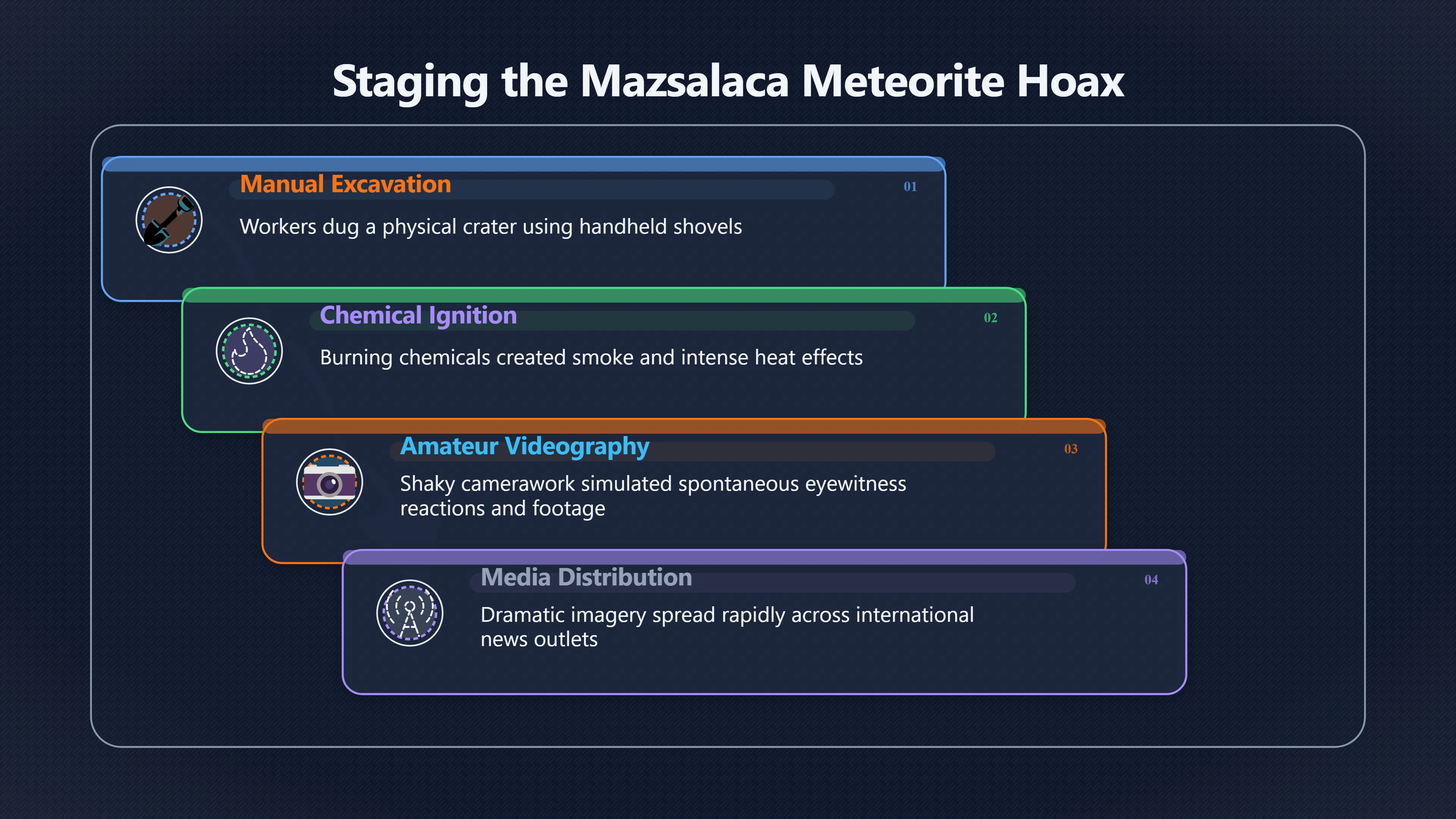
The stunt was designed to look authentic from the beginning. Witnesses reported seeing what appeared to be a fireball crossing the sky before a smoking crater was discovered in a field near Mazsalaca. Video footage showed excited young people approaching the site and finding a glowing object at the bottom of a hole. The deliberately shaky camerawork and spontaneous reactions gave the footage the appearance of a genuine eyewitness recording rather than a professional production.[Wikipedia]Wikipedia2009 Latvian meteorite hoax2009 Latvian meteorite hoax
The visual elements were carefully chosen because they matched popular expectations of what a meteorite impact should look like. There was a crater, smoke, heat and apparent debris. The story also arrived in a media environment eager for unusual and dramatic news. International outlets quickly repeated reports from Latvia, often before scientific examination had been completed.[Wikipedia]Wikipedia2009 Latvian meteorite hoax2009 Latvian meteorite hoax
Tele2 later admitted that the operation had been planned in advance. Company representatives said that a team dug the hole and used burning chemicals to create the appearance of a recent impact. The stunt was reportedly intended to divert attention from Latvia’s severe economic difficulties and generate interest ahead of a broader marketing campaign.[Wikipedia]Wikipedia2009 Latvian meteorite hoax2009 Latvian meteorite hoax
What made the deception unusually effective was that it was not confined to the internet. Instead of merely publishing a false claim, the organisers created physical evidence that officials could inspect. The presence of emergency responders and scientists initially appeared to confirm that something extraordinary had happened, giving the story additional credibility before the investigation was complete.[Wikipedia]Wikipedia2009 Latvian meteorite hoax2009 Latvian meteorite hoax
The scientific clues that exposed the impact as false
The hoax began to unravel as soon as specialists examined the site closely. Initial uncertainty was understandable: unusual events often require investigation before firm conclusions can be reached. However, daylight inspections quickly revealed features that did not fit a genuine meteorite impact.[Wikipedia]Wikipedia2009 Latvian meteorite hoax2009 Latvian meteorite hoax
Scientists identified several warning signs:
- The crater showed evidence of manual excavation, including indications that it had been dug with shovels.
- Grass remained visible inside parts of the hole, inconsistent with the intense forces expected from a real impact.
- No meteorite fragments were found around the site.
- The burning material appeared to be a chemical substance rather than extraterrestrial debris.
- There was no independently verified record of the large fireball that should have accompanied an impact capable of creating such a crater.[Wikipedia]Wikipedia2009 Latvian meteorite hoax2009 Latvian meteorite hoax
Geologists and astronomers visiting the scene became increasingly sceptical. University researchers described the crater as a man-made hole rather than an impact structure. Experts also noted a basic physical problem: meteorites do not normally sit burning at the bottom of a crater after landing. A genuine impact large enough to produce a hole of that size would have generated far more widespread observations and physical evidence.[Wikipedia]Wikipedia2009 Latvian meteorite hoax2009 Latvian meteorite hoax
The rapid scientific response is an important part of the story. The incident is often remembered because the hoax briefly succeeded, but it also demonstrated how specialist knowledge can dismantle a convincing-looking fabrication. The same authorities whose attendance helped legitimise the event were ultimately responsible for exposing it.[Wikipedia]Wikipedia2009 Latvian meteorite hoax2009 Latvian meteorite hoax
Why the stunt imposed real public costs
Although nobody was physically harmed, the fake impact consumed public resources that would normally be reserved for genuine emergencies. Firefighters, police officers, military personnel and scientific experts were dispatched to investigate what appeared to be a potentially serious event. The area was examined, secured and tested while officials attempted to determine whether a meteorite had actually struck the ground.[Wikipedia]Wikipedia2009 Latvian meteorite hoax2009 Latvian meteorite hoax
Latvian authorities estimated that the response cost at least 2,000 lats, a significant sum during a period when the country was experiencing severe economic hardship and implementing austerity measures. Officials argued that taxpayers should not bear the cost of a manufactured publicity exercise. Tele2 later promised to reimburse the government for expenses linked to the response.[taipeitimes.com]taipeitimes.comTaipei TimesTelecoms firm hoped to 'inspire Latvia' with hoax28 Oct 2009 — Latvian authorities said the cost of calling out firefighters…
The costs were not purely financial. Emergency services spent time investigating a fabricated incident rather than focusing on genuine public needs. Scientists were diverted to a false alarm. News organisations devoted resources to reporting a story that turned out to be invented. The episode also risked undermining public trust in future warnings and emergency announcements.[Wikipedia]Wikipedia2009 Latvian meteorite hoax2009 Latvian meteorite hoax
In this sense, the Mazsalaca affair illustrates a broader problem with hoaxes that imitate disasters. Even when intended as humour or marketing, they can trigger real institutional responses whose costs are transferred to the public.
Why Tele2’s publicity victory became a reputational failure
Measured purely by attention, the stunt initially succeeded. The story was reported around the world, and the name of Mazsalaca suddenly appeared in international headlines. For a brief period Tele2 achieved the kind of global visibility that would have been expensive to purchase through conventional advertising.[Wikipedia]Wikipedia2009 Latvian meteorite hoax2009 Latvian meteorite hoax
However, publicity and goodwill are not the same thing. Once the deception was revealed, criticism arrived from politicians, advertisers and members of the public. Interior Minister Linda Mūrniece condemned the stunt as a cynical misuse of public resources and announced that the Interior Ministry would stop doing business with the company. Other public figures also criticised Tele2 for creating unnecessary alarm.[Wikipedia]Wikipedia2009 Latvian meteorite hoax2009 Latvian meteorite hoax
The controversy extended into debates about advertising ethics. Critics argued that a prank based on a fabricated emergency crossed a line because it relied on public authorities and emergency responders becoming unwilling participants in a commercial campaign. Advertising industry representatives questioned whether the stunt had damaged public confidence and whether it should have been revealed much sooner.[Wikipedia]Wikipedia2009 Latvian meteorite hoax2009 Latvian meteorite hoax
Public-relations commentators later cited the incident as an example of a marketing campaign that generated attention while failing to generate respect. Instead of being remembered as a clever piece of creativity, it became a case study in how publicity stunts can backfire when they impose costs on others.[The Guardian]theguardian.comlatvia swedenThe GuardianMeteor PR stunt backfires | Latvia1 Nov 2009 — Tele2 hastily announced that it would reimburse any expenses the government ha…

Why claims about Meteorite Stunt remained persuasive
The Mazsalaca meteorite hoax remains one of Latvia’s most famous modern deceptions because it combined nearly every ingredient needed for rapid belief: dramatic imagery, apparent eyewitnesses, a physical site that could be photographed, and the visible involvement of official institutions. For a few hours, the crater seemed more convincing precisely because experts and emergency services were treating it seriously.[Wikipedia]Wikipedia2009 Latvian meteorite hoax2009 Latvian meteorite hoax
The episode also foreshadowed later debates about viral misinformation. Long before deepfakes became a common concern, the Mazsalaca stunt showed how easily a compelling visual narrative could travel across media systems before verification caught up. Yet it also demonstrated the value of sceptical investigation. The deception was exposed not by a confession alone but by scientific scrutiny that revealed inconsistencies between the story and the physical evidence.[Wikipedia]Wikipedia2009 Latvian meteorite hoax2009 Latvian meteorite hoax
Within Latvia’s wider history of hoaxes and fabricated claims, the fake meteorite stands out because the deception created genuine consequences. The crater was artificial, but the emergency response, political anger, financial costs and reputational damage were entirely real.[wikipedia.org]Wikipedia2009 Latvian meteorite hoax2009 Latvian meteorite hoax
Amazon book picks
Further Reading
Books and field guides related to How a Fake Meteorite Became a Real Emergency. Use these as the next step if you want deeper reading beyond the article.
The Demon-Haunted World
Rating: 4.5/5 from 43 Google Books ratings
Useful for evaluating extraordinary reports and evidence.
A Field Guide to Lies
Matches a media-driven publicity stunt that fooled many observers.
eBay marketplace picks
Marketplace Samples
Live-tested eBay searches with available results related to this page.
Endnotes
1.
Source: Wikipedia
Title: 2009 Latvian meteorite hoax
Link:https://en.wikipedia.org/wiki/2009_Latvian_meteorite_hoax
2.
Source: taipeitimes.com
Link:https://www.taipeitimes.com/News/world/archives/2009/10/28/2003457018
Source snippet
Taipei TimesTelecoms firm hoped to 'inspire Latvia' with hoax28 Oct 2009 — Latvian authorities said the cost of calling out firefighters...
3.
Source: theguardian.com
Title: latvia sweden
Link:https://www.theguardian.com/media/organgrinder/2009/nov/02/latvia-sweden
Source snippet
The GuardianMeteor PR stunt backfires | Latvia1 Nov 2009 — Tele2 hastily announced that it would reimburse any expenses the government ha...
Additional References
4.
Source: prweek.co.uk
Title: debate rages meteorite stunt backfires phone company tele2
Link:https://www.prweek.co.uk/article/949475/debate-rages-meteorite-stunt-backfires-phone-company-tele2
Source snippet
PR WeekHoax meteorite stunt backfires for mobile phone company...30 Oct 2009 — Why chose an idea based around a hoax where the clear int...
5.
Source: baltic-course.com
Title: markets and companies
Link:https://www.baltic-course.com/eng/markets_and_companies/?doc=19820
Source snippet
The Interior Ministry of Latvia plans to switch from Tele2 to another mobile phone operator due to the "Mazsalaca meteorite" prank...Re...
6.
Source: baltic-course.com
Title: markets and companies
Link:https://www.baltic-course.com/eng/markets_and_companies/?doc=19872
Source snippet
Baltic CourseTele2 in a hole as Latvia not amused by fake meteor strike:...29 Oct 2009 — An elaborate publicity stunt by Swedish mobile...
7.
Source: campaignlive.co.uk
Link:https://www.campaignlive.co.uk/article/meteorite-stunt-backfires-swedish-telecoms-firm/948637
Source snippet
Campaign LiveMeteorite stunt backfires on Swedish telecoms firm28 Oct 2009 — Tele2 has admitted that it staged a meteorite crash in the L...
8.
Source: youtube.com
Title: Tele2 Latvija
Link:https://www.youtube.com/watch?v=H-6zAcMLFVM
Source snippet
Ekspedīcija - Mazsalacas (TELE2) meteorīts un dzīve pēc tā...
9.
Source: youtube.com
Link:https://www.youtube.com/watch?v=jNBFoiKYRHs
Source snippet
Tele2 Latvija - Tarifu plāns "Meteorīts" par 4 Ls mēnesī...
10.
Source: youtube.com
Link:https://www.youtube.com/watch?v=nm4LgW5aAo4
Source snippet
Mazsalacas novadā nokrīt meteorīts...
11.
Source: dokumen.pub
Title: britannica book of the year 2008 9781593394943
Link:https://dokumen.pub/britannica-book-of-the-year-2008-9781593394943.html
12.
Source: youtube.com
Link:https://www.youtube.com/watch?v=n6d8M74A35s
Source snippet
Tele2Meteorite.mov...
13.
Source: wieringernieuws.nl
Link:https://www.wieringernieuws.nl/index.php?cid=264&optie=Detail&pagina=Column
Topic Tree