How False Stories Changed Guatemala's History
Guatemala’s most consequential deceptions are not quaint practical jokes.
Page outline Jump by section
Introduction
These episodes differ sharply. Some were deliberate political operations, one was an extraordinary personal imposture, some grew from commercialised misunderstanding rather than a single hoaxer, and others were institutional abuses concealed by secrecy. What links them is the manufacture of credibility: a broadcast sounded like battlefield reporting, a dead man appeared to identify his killers, ancient inscriptions were presented as prophecy, and scientific authority disguised the absence of consent. Guatemala’s history therefore offers a particularly stark lesson in how falsehood succeeds when it borrows the appearance of trusted evidence.
The imaginary army that helped overthrow a government
The best-documented mass deception in modern Guatemalan history formed part of Operation PBSUCCESS, the covert campaign through which the United States helped remove President Jacobo Árbenz in June 1954. Árbenz had introduced land reform that affected the holdings of the US-owned United Fruit Company, while officials in Washington portrayed his government as a dangerous communist foothold. The operation combined diplomatic pressure, economic isolation, a small exile army, aerial attacks and psychological warfare.[The Washington Post]washingtonpost.compolicy decisions toward Venezuela, including CIA-authorized covert operations and military pressure against President Nicolás Maduro, mir…
The military weakness of the rebel force made deception essential. Carlos Castillo Armas crossed into Guatemala with only several hundred men, far too few to defeat the national army in a conventional campaign. The CIA therefore worked to create the impression that a much larger uprising was advancing on the capital and that resistance was already collapsing. Declassified planning material shows that psychological operations were not an improvised side effort but a central part of the campaign.[CIA]cia.govMATERIALS FOR PSYCHOLOGICAL WARFARE SUPPORTOn the other hand, the Arbenz government does utilize the official radio, "La Voz de Guatem…
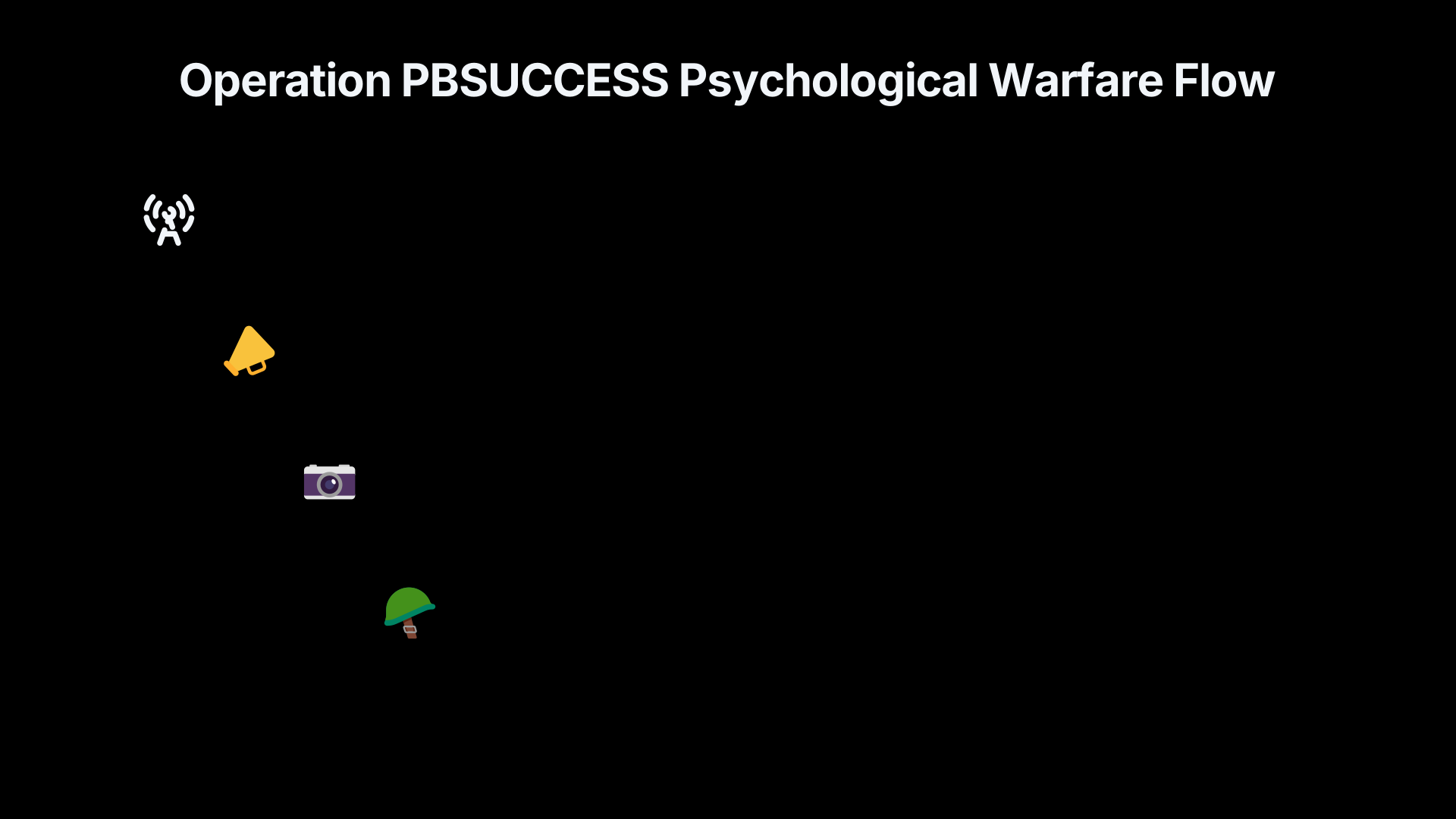
Its most effective instrument was the clandestine radio station known as the Voice of Liberation. It claimed to be transmitting from rebel-held territory inside Guatemala, but its programmes were devised by CIA personnel and Guatemalan exiles, with broadcasts produced or relayed from outside the supposed battlefield. The station issued urgent bulletins about troop movements, defections, sabotage and rebel successes, giving listeners the impression that they were hearing live reports from a rapidly expanding domestic revolt.[Radio Survivor]radiosurvivor.comhow the cia used radio in the 1954 guatemala coupRadio SurvivorHow the CIA used radio in the 1954 Guatemala coupMar 30, 2011 — The CIA had been waging psychological warfare in Guatemala…
Some announcements were fabricated or greatly exaggerated. The station reported phantom forces converging on Guatemala City and spread alarming stories, including claims about threats to the water supply. It benefited from an extraordinary coincidence when the government radio service went off air for planned antenna work, leaving the clandestine broadcaster with less competition. Foreign correspondents also treated some of its output as reliable, allowing invented battlefield news to move from covert propaganda into wider reporting.[The New Yorker]newyorker.comThe New Yorker A Murder ForetoldRosenberg, deeply troubled by the murder of his client, Khalil Musa, and Musa's daughter Marjorie, with whom he was having an affair, emb…
The deception worked because it targeted perception rather than territory. Aircraft supplied to the rebels carried out limited bombing and strafing raids whose psychological effect exceeded their military value. Threatening messages, leaflets and rumours reinforced the belief that the government was isolated and that a powerful force stood behind Castillo Armas. Soldiers and civilians could not easily distinguish between genuine developments, covert broadcasts and repeated hearsay.[The Washington Post]washingtonpost.compolicy decisions toward Venezuela, including CIA-authorized covert operations and military pressure against President Nicolás Maduro, mir…
Árbenz resigned on 27 June 1954 after senior officers declined to continue supporting him. It would be too simple to say that a fake radio station alone overthrew the government: US diplomatic pressure, the fear of direct intervention, aerial attacks and divisions within the Guatemalan military were also decisive. Yet the Voice of Liberation remains an unusually clear example of “black” propaganda — material designed to conceal its real sponsor and pretend to come from another source. It did not merely argue for the rebels. It manufactured the appearance that they were already winning.
The operation’s long afterlife matters because its central illusion was repeated for decades in simplified accounts of the coup: a popular domestic liberation movement supposedly defeated a communist-controlled regime. Declassified records instead show a foreign-backed operation that used a small armed force and an elaborate information campaign to magnify its strength. The episode demonstrates that propaganda is most powerful not when everyone believes every detail, but when enough people become uncertain about who is winning and whether resistance is futile.[The Washington Post]washingtonpost.compolicy decisions toward Venezuela, including CIA-authorized covert operations and military pressure against President Nicolás Maduro, mir…
The murder victim who framed the president
On 10 May 2009, prominent Guatemalan lawyer Rodrigo Rosenberg was shot dead while cycling in Guatemala City. Soon afterwards, a video recorded before his death was released publicly. Rosenberg looked directly into the camera and declared that, should viewers be watching the recording, President Álvaro Colom, the president’s wife Sandra Torres and several associates were responsible for his murder.[Reuters]reuters.comVideo of murdered lawyer stirs scandal in GuatemalaVideo of murdered lawyer stirs scandal in GuatemalaMay 12, 2009 — 12 May 2009 — Guatemalan President Alvaro Colom denied involveme…
The accusation appeared uniquely persuasive because Rosenberg was dead. A living political critic might lie, exaggerate or retreat under pressure; a murder victim apparently speaking from beyond the grave seemed to provide both testimony and proof. The modest production — a plain background, direct delivery and the atmosphere of a final statement — made the video resemble an authentic warning rather than polished political propaganda. It spread through television, YouTube, Facebook and email, provoking protests and demands for Colom’s resignation.[The New Yorker]newyorker.comThe New Yorker A Murder ForetoldRosenberg, deeply troubled by the murder of his client, Khalil Musa, and Musa's daughter Marjorie, with whom he was having an affair, emb…
The story also fitted Guatemala’s political experience. After decades of civil conflict, clandestine security structures, assassinations and impunity, the allegation that powerful officials had silenced an inconvenient lawyer did not seem inherently implausible. Rosenberg had been distressed by the earlier murders of businessman Khalil Musa and Musa’s daughter Marjorie, with whom Rosenberg had had a relationship. He believed those deaths involved high-level corruption, although the evidence available to him did not establish the presidential conspiracy asserted in his video.[The New Yorker]newyorker.comThe New Yorker A Murder ForetoldRosenberg, deeply troubled by the murder of his client, Khalil Musa, and Musa's daughter Marjorie, with whom he was having an affair, emb…
The United Nations-backed International Commission against Impunity in Guatemala, commonly known as CICIG, reconstructed a markedly different sequence. Investigators concluded that Rosenberg had arranged his own killing. According to their findings, he asked intermediaries to hire assassins to kill a supposed extortionist, while concealing that the intended victim was Rosenberg himself. He also used a newly obtained mobile telephone to help create the appearance that he was receiving threats.[Time]time.comthe guatemalan who ordered his own murderthe guatemalan who ordered his own murder
Telephone records, purchase information and the movements of the hired gunmen allowed investigators to connect the supposedly anonymous communications to Rosenberg. CICIG’s reconstruction suggested that he had designed his death as both suicide and political accusation: the killers would believe they were carrying out an ordinary contract, while the pre-recorded video would place responsibility on the government. The announcement cleared Colom of the central allegation and transformed a national scandal into one of the strangest documented cases of self-incrimination and posthumous framing.[Time]time.comthe guatemalan who ordered his own murderthe guatemalan who ordered his own murder
The case should not be reduced to a clever “YouTube hoax”. Rosenberg really was murdered, hired killers were used, and the surrounding criminal world was not imaginary. Nor did CICIG establish that every concern Rosenberg had expressed about corruption was invented. Later proceedings concerning the Musa murders remained complicated, and a Guatemalan court convicted several participants without accepting every proposed account of motive.[The New Yorker]newyorker.comafter a murder foretoldafter a murder foretold
What was false was the central evidential trick: Rosenberg’s death was presented as proof that the people he named must have ordered it. The video exploited a common assumption that someone expecting to die has little reason to fabricate an accusation. In reality, death made the allegation harder to question because its author could never be cross-examined.
The investigation also showed why institutional independence mattered. Had the accusation been examined solely by officials working under the president, many Guatemalans might reasonably have dismissed the result as a cover-up. CICIG combined international personnel with Guatemalan prosecutors and used telecommunications evidence to test the story’s mechanics. Its conclusion was persuasive not because it offered a more dramatic narrative, but because it explained how the calls, intermediaries, gunmen and video fitted together.
The Maya apocalypse that the Maya did not predict
The claim that the Maya calendar forecast the end of the world on 21 December 2012 became one of the most commercially successful pseudohistorical stories of the internet era. Guatemala was central to its imagery because sites such as Tikal and inscriptions from the Guatemalan lowlands were repeatedly invoked as the remains of a civilisation supposedly possessing secret knowledge of a coming catastrophe.
No surviving Classic Maya text predicts that the world would end on that date. The day marked the completion of a major cycle in the Long Count, a system used to record dates across spans much longer than an ordinary lifetime. Treating the completion of the thirteenth cycle as the termination of time was comparable to assuming that the arrival of a new millennium meant that no further years could be counted. Maya specialists repeatedly explained that the calendar could continue beyond 2012 and that ancient inscriptions referred to dates far into the future.[UT Austin News]news.utexas.eduUT Austin News Maya Scholar Debunks World-Ending MythUT Austin News Maya Scholar Debunks World-Ending Myth
The apocalyptic interpretation developed through layers of modern speculation. Early twentieth-century descriptions of Maya imagery sometimes used dramatic language about floods and cosmic destruction. Later New Age writers combined the Long Count with astrology, spiritual transformation, extraterrestrials, the invented planet Nibiru and other ideas that did not originate in ancient Maya texts. Films, television programmes, books, websites and commercial events then blended these incompatible claims into a single marketable prophecy.[Wikipedia]Wikipedia2012 phenomenon2012 phenomenon
Evidence found in Guatemala directly contradicted the supposed deadline. At Xultún, archaeologists uncovered ninth-century astronomical and calendrical calculations covering immense periods of time. Rather than stopping at 2012, the numerical tables extended thousands of years beyond it. At La Corona, another Guatemalan site, an inscription mentioning the end of the thirteenth cycle placed the date within a historical and dynastic narrative, not a forecast of global destruction.[National Geographic]nationalgeographic.com120510 maya 2012 doomsday calendar end of world science120510 maya 2012 doomsday calendar end of world science
Living Maya representatives also objected to outsiders presenting the date as an ancestral prophecy of extinction. Guatemalan Indigenous organisations described it as the close of one cycle and the opening of another, while criticising the use of Maya identity as decoration for imported apocalyptic beliefs. This distinction is important: the 2012 panic was not an example of Maya people deceiving the world, but of international media and commercial culture attaching modern fantasies to Maya heritage.[Cultural Survival]culturalsurvival.org2012 end world prophecy discredited again2012 end world prophecy discredited again
The episode sits on the boundary between hoax, sincere error and commercial pseudoscience. There was no single author secretly fabricating the whole story. Some promoters probably believed in a coming transformation; others repeated dramatic claims because they sold books, tours, documentaries or advertising. News coverage often debunked the apocalypse while simultaneously amplifying it through countdowns and sensational imagery.
Its persistence reveals a broader pattern in stories about Guatemala’s ancient past. Maya achievements are sometimes treated as too mysterious to be understood through archaeology, mathematics and history, encouraging tales of lost super-civilisations, aliens or secret cosmic warnings. Such claims appear complimentary because they describe the Maya as possessing extraordinary knowledge. In practice, they can obscure the genuine sophistication of Maya astronomy and writing while marginalising the expertise of present-day Maya communities and professional researchers.[The Guardian]theguardian.comThe article highlights how colonialism, pseudoscientific narratives, and the erasure of Indigenous memory have distorted Maya history and…
When the antiquities market rewards uncertainty
Guatemala’s Maya heritage also forms part of an international market in looted, falsely restored and forged antiquities. The problem is difficult to describe through a neat list of celebrated “Guatemalan fakes” because objects often reach dealers without reliable excavation records. A vessel may be labelled “Maya” or assigned to Guatemala on stylistic grounds even when its precise origin is unknown, invented or deliberately concealed.
This uncertainty benefits both traffickers and forgers. Looters destroy archaeological context when they remove an object from a tomb or building. Dealers may then supply a persuasive story of discovery or ownership. Forgers imitate familiar gods, glyphs and court scenes, sometimes using ancient-looking materials or genuine fragments to make modern work harder to detect. High prices and limited supplies create a market in which buyers may prefer an exciting attribution to a cautious assessment. Research into Maya ceramics notes that demand has encouraged forgery and that microscopy, ultraviolet examination and material analysis can help identify modern painting or restoration.[ResearchGate]researchgate.netOpen source on researchgate.net.
A revealing international example is antiquities dealer Leonardo Patterson, who was convicted in the United States of wire fraud after attempting to sell a fake Maya-style fresco. The case did not prove that the entire Maya market was fraudulent, but it showed how authoritative language, undocumented origin stories and the romance of a supposedly rescued masterpiece could be used to sell a modern object as ancient.[Trafficking Culture]traffickingculture.orgOpen source on traffickingculture.org.
Authentication is rarely achieved by a single spectacular test. Investigators compare pigments, tool marks, surface deposits, clay composition, iconography and writing. A chemically old material does not guarantee an old artwork: a forger may paint on an ancient potsherd. Conversely, unusual imagery is not automatically evidence of forgery, because genuine discoveries can expand what scholars know. Provenance — the documented history of where an object came from and who owned it — is therefore as important as visual plausibility.
This is where forgery and looting reinforce one another. An object with no excavation record is difficult to authenticate, while a forged provenance can disguise both a fake and a genuinely looted artefact. The buyer’s desire for secrecy may further prevent independent study. In the end, even a convincing object loses much of its historical value when its archaeological setting has been destroyed or fabricated.
The public-facing warning is not that every unprovenanced Maya object is false. It is that “possibly genuine” and “legally or archaeologically trustworthy” are different judgements. A technically authentic vessel may have been illegally removed from Guatemala, while an apparently lawful sale may involve a modern imitation. The most alluring story — a hidden temple, a dying collector or a miraculous private discovery — is often the part that deserves the closest inspection.
Secret science and manufactured consent
Between 1946 and 1948, US-led researchers conducted sexually transmitted infection experiments in Guatemala involving prisoners, soldiers, psychiatric patients and other vulnerable people. Researchers deliberately exposed some participants to syphilis, gonorrhoea or chancroid while studying infection and the preventive use of penicillin. The work remained largely unknown until historian Susan Reverby discovered records in 2010.[The Hastings Center for Bioethics]thehastingscenter.orgOpen source on thehastingscenter.org.
This episode was not a hoax in the ordinary sense: the experiments were real, and the researchers were not fabricating their laboratory results for public consumption. It belongs in Guatemala’s history of deception because subjects were not given truthful, meaningful information or a genuine opportunity to consent. Scientific authority concealed what was being done from many of the people whose bodies supplied the data.
The US Presidential Commission for the Study of Bioethical Issues later described the research as involving grave and unconscionable ethical violations. Contemporary correspondence showed that members of the research team understood that disclosure could bring condemnation. The programme produced no transparent public account at the time, and affected Guatemalans lived for decades without being told that they had been used in the experiments.[The Guardian]theguardian.comOpen source on theguardian.com.
Researchers benefited from unequal power. Institutionalised patients, prisoners and soldiers were accessible populations whose ability to refuse was severely constrained. Guatemala also offered US researchers political and regulatory conditions in which experiments considered unacceptable at home could be attempted with reduced scrutiny. The deception was therefore structural rather than theatrical: forms of permission, medical language and institutional cooperation created the appearance of legitimate research without informed participation.
The exposure of the programme changed the story because archival evidence replaced institutional silence. Reverby’s discovery led to official apologies from the United States in 2010 and a wider investigation into how the studies had been approved and conducted. Later litigation sought compensation from organisations alleged to have been connected to the research, although those institutions disputed responsibility and argued that they had not directed or funded the experiments.[The Guardian]theguardian.comOpen source on theguardian.com.
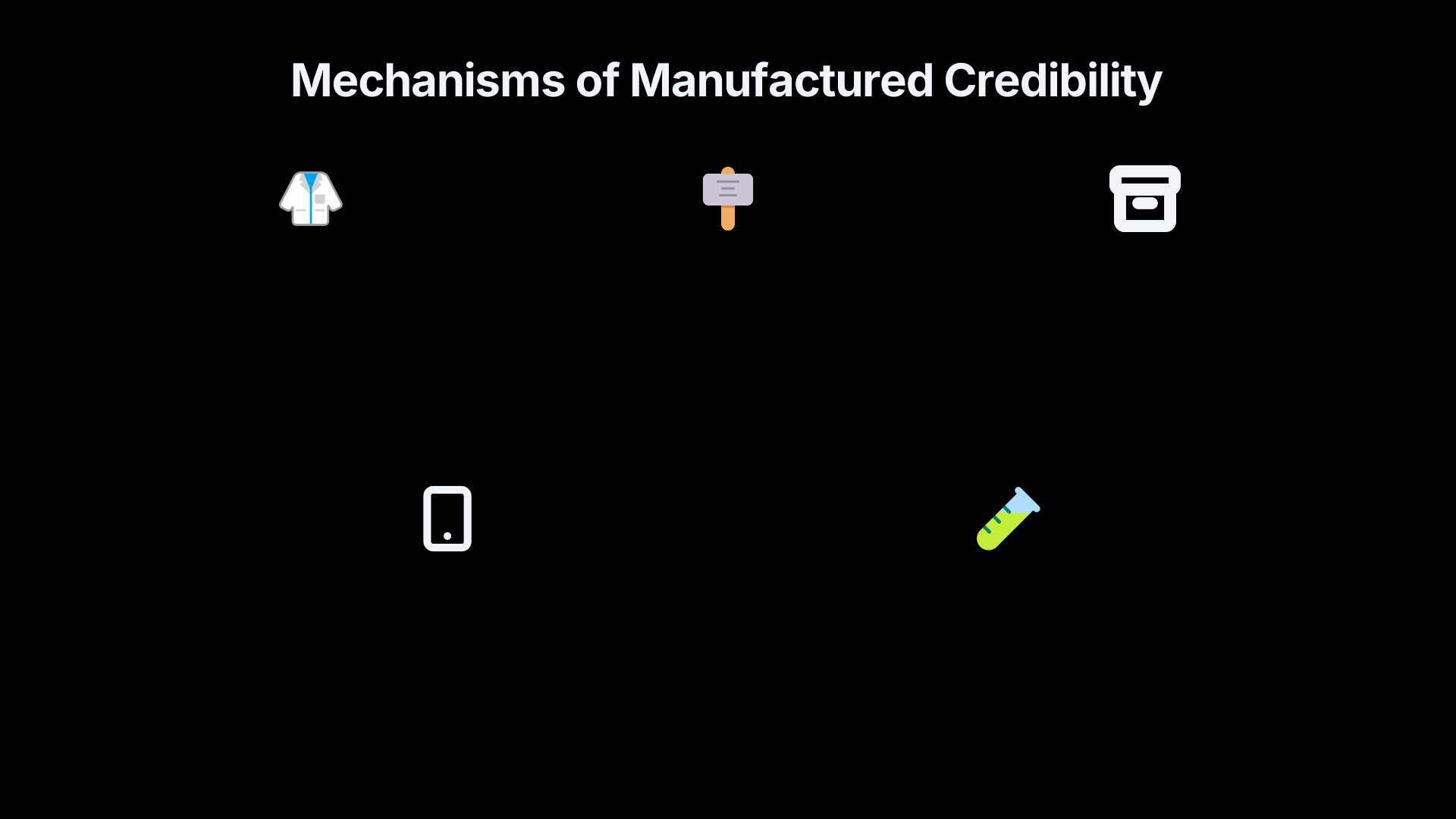
The case demonstrates why consent is not simply a signature or an administrative form. A person cannot consent to an experiment when its purpose, procedures and risks are hidden or misrepresented. In that sense, the Guatemala studies show scientific deception operating through authority: the white coat and the official institution made coercion appear like care.
Why these stories remain believable
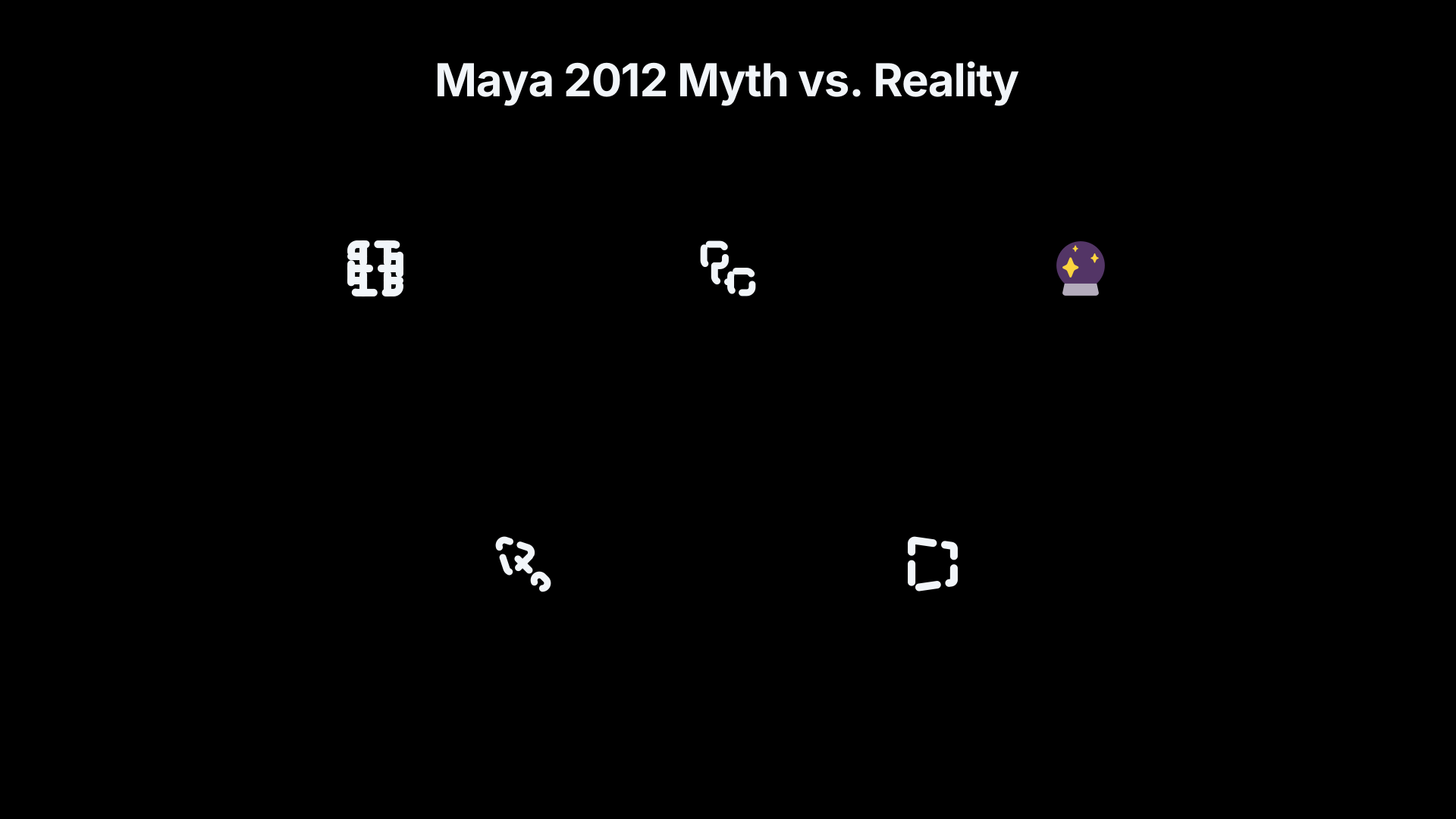
Guatemala’s major deception cases succeeded for different reasons, but several mechanisms recur.
Falsehood was attached to a trusted format. The Voice of Liberation imitated urgent radio journalism. Rosenberg’s recording resembled a victim’s final testimony. The 2012 story borrowed archaeological inscriptions and astronomical vocabulary. The infection experiments operated under the appearance of medicine and research.
The claims fitted genuine fears. In 1954, Guatemalans knew that an invasion and foreign intervention were possible. In 2009, political murder and impunity were familiar realities. Apocalyptic stories flourished amid wider millennial anxiety. Medical subjects had little reason to imagine that recognised institutions might deliberately expose them to disease.
Secrecy made verification difficult. Listeners could not inspect the supposed rebel army. The dead Rosenberg could not be questioned. Maya inscriptions required specialist knowledge unavailable to most audiences. Experimental records remained buried in archives for more than six decades.
Repetition produced apparent confirmation. Covert broadcasts were echoed by rumour and foreign reporting. Rosenberg’s video circulated continuously at demonstrations and online. The 2012 prediction appeared across films, documentaries, news reports and commercial advertising, making independent repetition look like independent evidence.
The exposures likewise shared a method. Investigators moved away from dramatic narratives and examined material traces: transmission arrangements and declassified plans, telephone records and receipts, inscriptions and calendrical calculations, archived correspondence and experimental files. These cases endure because their false stories were emotionally simple, while the truth required reconstruction. The imaginary army, the murdered accuser and the ancient prophecy could each be understood in a sentence. Explaining how they were manufactured took far longer.
That imbalance is one reason the claims still circulate. Debunking does not erase the original image, and a revelation may even renew interest in it. Guatemala’s history of contested truth is therefore not merely a collection of exposed lies. It is a record of how political power, media form, commercial desire and institutional prestige can make a claim feel proven before its evidence has been tested.
Amazon book picks
Further Reading
Books and field guides related to How False Stories Changed Guatemala's History. Use these as the next step if you want deeper reading beyond the article.
Bitter Fruit
Directly covers CIA intervention, propaganda and political deception in Guatemala.
eBay marketplace picks
Marketplace Samples
Live-tested eBay searches with available results related to this page.
Endnotes
1.
Source: Wikipedia
Title: 1954 Guatemalan coup d’état
Link:https://en.wikipedia.org/wiki/1954_Guatemalan_coup_d%27%C3%A9tat
2.
Source: cia.gov
Link:https://www.cia.gov/readingroom/docs/DOC_0000914007.pdf
Source snippet
MATERIALS FOR PSYCHOLOGICAL WARFARE SUPPORTOn the other hand, the Arbenz government does utilize the official radio, "La Voz de Guatem...
3.
Source: cia.gov
Link:https://www.cia.gov/readingroom/docs/DOC_0000935207.pdf
Source snippet
rybat/pbsuccessOn 30 January the so-called. "White Paper" was released in Guatemala, which paper included a picture of. CASTILLO Armas...
4.
Source: reuters.com
Title: Video of murdered lawyer stirs scandal in Guatemala
Link:https://www.reuters.com/article/economy/video-of-murdered-lawyer-stirs-scandal-in-guatemala-idUSN12325991/
Source snippet
Video of murdered lawyer stirs scandal in GuatemalaMay 12, 2009 — 12 May 2009 — Guatemalan President Alvaro Colom denied involveme...
Published: May 12, 2009
5.
Source: time.com
Title: the guatemalan who ordered his own murder
Link:https://time.com/archive/6949110/the-guatemalan-who-ordered-his-own-murder/
6.
Source: cicig.org
Title: Versión antigua
Link:https://www.cicig.org/history//index.php?cntnt01articleid=417&cntnt01returnid=105&mact=News%2Ccntnt01%2Cdetail%2C0
7.
Source: Wikipedia
Title: 2012 phenomenon
Link:https://en.wikipedia.org/wiki/2012_phenomenon
8.
Source: researchgate.net
Link:https://www.researchgate.net/publication/335651760_Non-invasive_Techniques_to_Authenticate_the_Painted_Surfaces_of_Ancient_Maya_Ceramics
9.
Source: facebook.com
Link:https://www.facebook.com/groups/149844915349213/posts/2677566292577050/
10.
Source: facebook.com
Link:https://www.facebook.com/breakingbelizenews/posts/-unravel-the-mystery-of-the-belize-crystal-skull-an-intriguing-artifact-that-sti/615539097271362/
11.
Source: facebook.com
Link:https://www.facebook.com/PHMfan/posts/by-the-evening-of-june-26-1954-president-jacobo-%C3%A1rbenz-guzm%C3%A1n-sat-alone-in-the-p/1306835631049142/
12.
Source: facebook.com
Link:https://www.facebook.com/groups/149844915349213/posts/2135916683408683/
13.
Source: facebook.com
Link:https://www.facebook.com/groups/2286725175146462/posts/2388160051669640/
14.
Source: facebook.com
Link:https://www.facebook.com/UniverseBYU/posts/french-archaeologist-dr-marion-forest-and-byu-grad-student-chloe-burkey-worked-t/10159722955848245/
15.
Source: facebook.com
Link:https://www.facebook.com/groups/149844915349213/posts/2355958861404463/
16.
Source: facebook.com
Link:https://www.facebook.com/groups/Archaeology.Prehistoric/posts/1434815076667697/
17.
Source: Wikipedia
Title: Unusual articles
Link:https://en.wikipedia.org/wiki/Wikipedia%3AUnusual_articles
18.
Source: Wikipedia
Title: Giant human skeletons
Link:https://en.wikipedia.org/wiki/Giant_human_skeletons
19.
Source: Wikipedia
Title: Rodrigo Rosenberg Marzano
Link:https://en.wikipedia.org/wiki/Rodrigo_Rosenberg_Marzano
20.
Source: youtube.com
Link:https://www.youtube.com/watch?v=CPWdLQCalX8
21.
Source: youtube.com
Link:https://www.youtube.com/watch?v=7o0uEKgCXOg
22.
Source: youtube.com
Link:https://www.youtube.com/shorts/HHJBNtEz_M0
23.
Source: youtube.com
Title: How CIA Created a Banana Republic
Link:https://www.youtube.com/watch?v=63y237ybCuw
24.
Source: youtube.com
Link:https://www.youtube.com/watch?v=aueCG6wYVDA
25.
Source: reuters.com
Link:https://www.reuters.com/article/latestCrisis/idUSN15283780/
26.
Source: youtube.com
Link:http://www.youtube.com/watch?v=NHIWwhQLCZ0
Source snippet
The Guatemala Inoculation Experiments...
27.
Source: youtube.com
Title: The Guatemala Inoculation Experiments
Link:https://www.youtube.com/watch?v=ClYR0wTKyCg
Source snippet
In Guatemala, Human 'Experiment' Brings Outcry...
28.
Source: youtube.com
Title: In Guatemala, Human ‘Experiment’ Brings Outcry
Link:https://www.youtube.com/watch?v=2SrfkIw7hw8
Source snippet
Asesinato Rodrigo Rosenberg 1 (English Subs)...
29.
Source: youtube.com
Title: Asesinato Rodrigo Rosenberg 1 (English Subs)
Link:http://www.youtube.com/watch?v=VxZptUp9a44
Source snippet
ScienceCasts: Why the World Didn't End Yesterday...
30.
Source: youtube.com
Title: Science Casts: Why the World Didn’t End Yesterday
Link:https://www.youtube.com/watch?v=2wimiRUHMI4
Source snippet
Guatemala syphilis experiment PBS BBC Ugly History: The U.S. Syphilis Experiment - Susan M. Reverby TED-Ed...
31.
Source: washingtonpost.com
Link:https://www.washingtonpost.com/national-security/2025/12/10/cia-latin-america-trump-venezuela/
Source snippet
policy decisions toward Venezuela, including CIA-authorized covert operations and military pressure against President Nicolás Maduro, mir...
32.
Source: radiosurvivor.com
Title: how the cia used radio in the 1954 guatemala coup
Link:https://www.radiosurvivor.com/2011/03/how-the-cia-used-radio-in-the-1954-guatemala-coup/
Source snippet
Radio SurvivorHow the CIA used radio in the 1954 Guatemala coupMar 30, 2011 — The CIA had been waging psychological warfare in Guatemala...
33.
Source: newyorker.com
Title: The New Yorker A Murder Foretold
Link:https://www.newyorker.com/magazine/2011/04/04/a-murder-foretold
Source snippet
Rosenberg, deeply troubled by the murder of his client, Khalil Musa, and Musa's daughter Marjorie, with whom he was having an affair, emb...
34.
Source: theguardian.com
Title: guatemala murder rodrigo rosenberg
Link:https://www.theguardian.com/world/2010/jan/13/guatemala-murder-rodrigo-rosenberg
35.
Source: newyorker.com
Title: after a murder foretold
Link:https://www.newyorker.com/news/news-desk/after-a-murder-foretold
36.
Source: news.utexas.edu
Title: UT Austin News Maya Scholar Debunks World-Ending Myth
Link:https://news.utexas.edu/2012/12/17/maya-scholar-debunks-world-ending-myth/
37.
Source: culturalsurvival.org
Title: 2012 end world prophecy discredited again
Link:https://www.culturalsurvival.org/publications/cultural-survival-quarterly/2012-end-world-prophecy-discredited-again
38.
Source: nationalgeographic.com
Title: 120510 maya 2012 doomsday calendar end of world science
Link:https://www.nationalgeographic.com/science/article/120510-maya-2012-doomsday-calendar-end-of-world-science
39.
Source: theguardian.com
Link:https://www.theguardian.com/news/2026/feb/12/apocalypse-no-how-almost-everything-we-thought-we-knew-about-the-maya-is-wrong
Source snippet
The article highlights how colonialism, pseudoscientific narratives, and the erasure of Indigenous memory have distorted Maya history and...
40.
Source: traffickingculture.org
Link:https://traffickingculture.org/encyclopedia/case-studies/all/
41.
Source: thehastingscenter.org
Link:https://www.thehastingscenter.org/after-the-media-frenzy-preventing-another-guatemala/
42.
Source: theguardian.com
Link:https://www.theguardian.com/us-news/2015/apr/02/johns-hopkins-lawsuit-deliberate-std-infections-guatemala
43.
Source: nationalgeographic.com
Title: skeleton giant photo hoax
Link:https://www.nationalgeographic.com/history/article/skeleton-giant-photo-hoax
44.
Source: nationalgeographic.com
Title: 140808 maya guatemala looter antiquities archaeology science
Link:https://www.nationalgeographic.com/culture/article/140808-maya-guatemala-looter-antiquities-archaeology-science
45.
Source: art.utexas.edu
Link:https://art.utexas.edu/news/ut-antiquities-action-symposium-cited-science-article-detailing-archaeologists-combatting
46.
Source: ndl.ethernet.edu.et
Link:https://ndl.ethernet.edu.et/bitstream/123456789/35241/1/7.pdf
47.
Source: washingtonpost.com
Title: Maya Artifacts In Dispute
Link:https://www.washingtonpost.com/archive/lifestyle/1985/05/04/maya-artifacts-in-dispute/3d4a078f-4ddb-456b-b645-fcb46927ba81/
Additional References
48.
Source: history.state.gov
Link:https://history.state.gov/historicaldocuments/frus1952-54Guat/d224
49.
Source: academia.edu
Link:https://www.academia.edu/100788502/Fake_for_Real_The_Exhibition_Narrative
50.
Source: academia.edu
Link:https://www.academia.edu/69797403/Forgery_and_the_Science_of_the_Authentic_Mexican_antiquities_
51.
Source: academia.edu
Link:https://www.academia.edu/37120752/The_Fourth_Skull_A_Tale_of_Authenticity_and_Fraud
52.
Source: fatf-gafi.org
Link:https://www.fatf-gafi.org/content/dam/fatf-gafi/publications/Comprehensive-Update-on-Terrorist-Financing-Risks-2025.pdf.coredownload.inline.pdf
53.
Source: illicitculturalproperty.com
Link:https://illicitculturalproperty.com/tag/forgery/
54.
Source: abertzalekomunista.net
Link:https://www.abertzalekomunista.net/images/Liburu_PDF/Internacionales/Tottle_Duouglas/Fraud_famine_and_fascism-K.pdf
55.
Source: ebsco.com
Link:https://www.ebsco.com/research-starters/history/guatemala-invasion
56.
Source: un.org
Link:https://www.un.org/sexualviolenceinconflict/wp-content/uploads/2019/06/report/option-for-justice-a-handbook-for-designing-accountability-mechanisms-for-grave-crimes/options-for-justice-20180918.pdf
57.
Source: justiceinitiative.org
Link:https://www.justiceinitiative.org/voices/justice-guatemala-stranger-fiction
Topic Tree
Follow this branch
Related pages 192
- Albanian Hoaxes
- Algerian Hoaxes
- Antigua Deceptions
- Argentina Hoaxes
- Armenian Hoaxes
- +187 more in sidebar