Within Samoa
How Much of Moana Was Really Documentary?
Robert Flaherty filmed real Samoan people and practices while arranging performances that made reconstruction look like untouched daily life.
On this page
- How Flaherty constructed the story
- The tattooing scene and manufactured reality
- What the film still preserves
Page outline Jump by section
Introduction
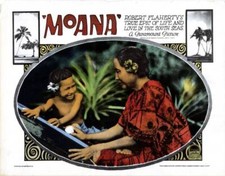
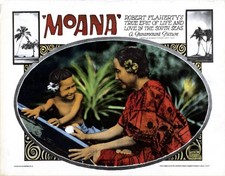
Was Moana really a documentary? The short answer is yes and no. Robert J. Flaherty’s 1926 film was shot in Samoa using real Samoan people, real locations and genuine cultural practices. Yet many of the scenes that audiences assumed were everyday life were carefully arranged, reconstructed or adapted for the camera. The result was one of the most influential films in cinema history and one of the clearest examples of how early documentary blurred the line between observation and performance.[The Museum of Modern Art]moma.orgMo MA Auteurist History DocumentaryJohn Grierson (1898–1972) was a disciple of Flaherty's, he not only invented the term “documentary” but also developed a…
For readers interested in Samoa’s history of contested truth, Moana is not a straightforward hoax. Flaherty did not invent Samoa or use actors pretending to be Samoan. Instead, he presented a recreated version of the past as if viewers were watching an untouched traditional society in the present. The film became famous as the work that inspired the term “documentary”, even though much of what it showed had been staged or deliberately reconstructed.[griersontrust.org]griersontrust.org100 years of documentary8 Feb 2026 — He first used the phrase in a 1926 review of Robert J. Flaherty's Moana for the New York Sun, arguing that it carried real “…
How Flaherty Constructed the Story
Flaherty arrived in Samoa after the success of Nanook of the North, another film later criticised for reconstructing aspects of traditional life. He settled in Safune on the island of Savai‘i and spent more than a year filming local people. Rather than recording daily events as they happened, he developed a narrative centred on a young man named Moana and his family.[Wikipedia]WikipediaOpen source on wikipedia.org.
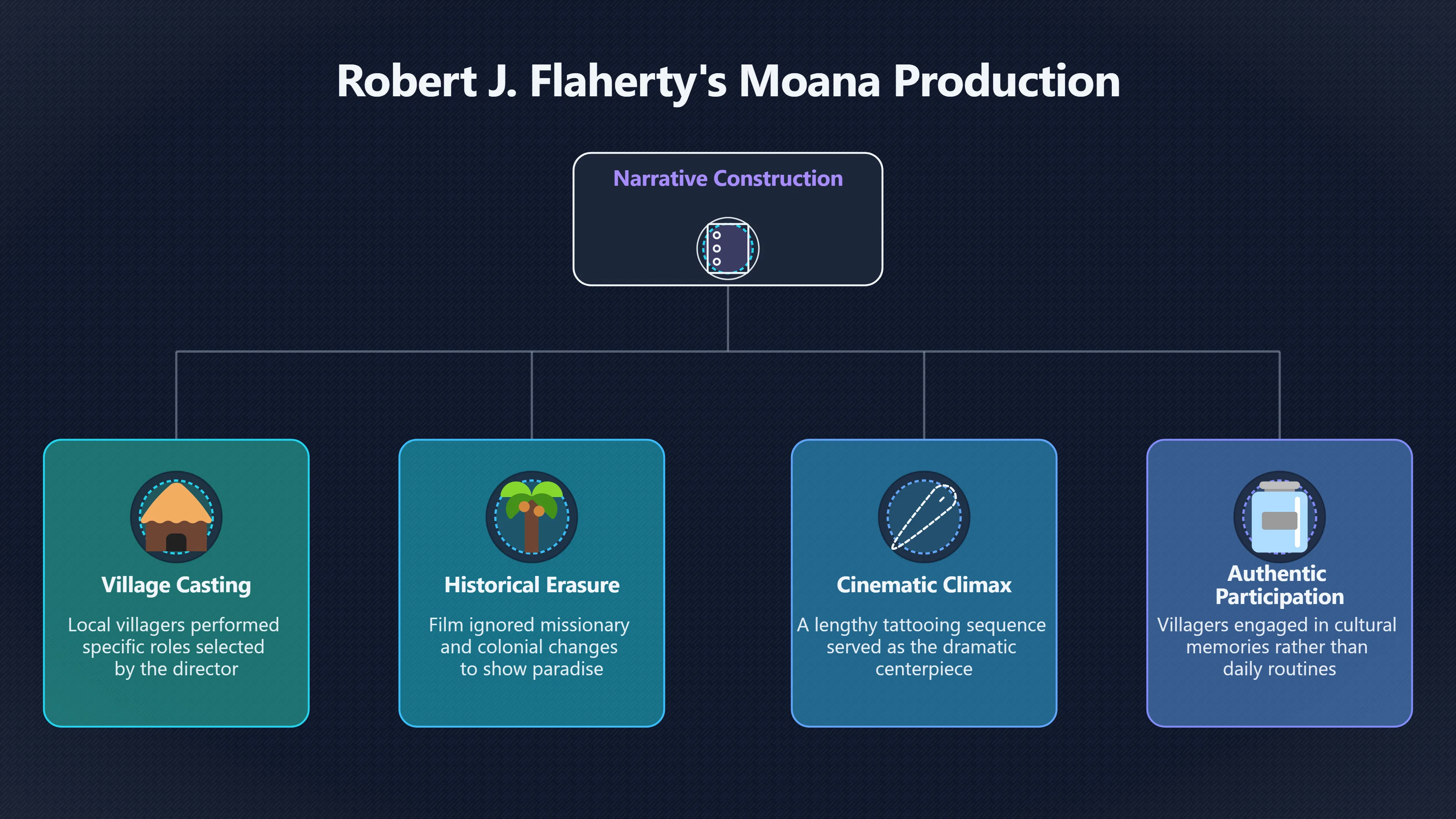
The crucial detail is that this family was largely a cinematic creation. The people on screen were villagers playing roles selected by Flaherty. The lead character’s name was chosen for the film, and family relationships were organised to fit the story he wanted to tell. What appeared to audiences as a natural record of village life was therefore partly a scripted drama performed by real Samoans.[The Guardian]theguardian.comFlaherty, known for Nanook of the North, intended to create a perilous sea-monster story but ended up documenting an idyllic vision of…
Flaherty also preferred images that matched Western expectations of a timeless Polynesian paradise. By the 1920s Samoa had already experienced decades of missionary influence, colonial administration and economic change. Clothing styles, social customs and ideas about modesty had evolved. Yet the film often presented people in ways intended to evoke an earlier era. Critics later argued that this created the impression of a society untouched by modern history.[mubi.com]mubi.comThe Beautiful Lies of Robert JFlaherty's "Moana with Sound"30 Aug 2017 — When the pioneering documentarian Robert J. Flaherty went to Polynesia to make Moana, he found…
This was not hidden from everyone involved. Villagers participated in the reconstruction, and many scenes represented cultural memories rather than contemporary daily routines. The problem arose because international audiences generally saw these reconstructions as direct observation rather than historical recreation.[The Guardian]theguardian.comFlaherty, known for Nanook of the North, intended to create a perilous sea-monster story but ended up documenting an idyllic vision of…
The Tattooing Scene and Manufactured Reality
The most famous example of staged reality in Moana is the lengthy tattooing sequence that forms the film’s dramatic climax.
Flaherty struggled to find the sort of conflict that conventional cinema demanded. His footage of fishing, climbing coconut trees and village activities lacked the dramatic danger expected by film distributors. The ritual application of a traditional Samoan tattoo therefore became the centrepiece of the story.[The American Society of Cinematographers]theasc.comOpen source on theasc.com.
The ceremony itself was genuine. Traditional Samoan tattooing was a real cultural practice performed by expert tattooists. However, the sequence was arranged specifically for filming and represented a tradition that had become less common by the 1920s. Contemporary accounts note that the practice was declining, making the filmed event closer to a cultural reconstruction than a routine part of everyday village life.[The American Society of Cinematographers]theasc.comOpen source on theasc.com.
The production required extraordinary commitment. The tattoo depicted in the film was not a special-effects trick. The participant underwent a real traditional tattooing process that took weeks to complete. Because audiences were not told how much reconstruction had gone into arranging the scene, many assumed they were witnessing ordinary contemporary life rather than a deliberately revived ritual selected for its visual and dramatic power.[Wikipedia]WikipediaOpen source on wikipedia.org.
This sequence illustrates the central tension of Moana. Nothing shown is necessarily fake in the sense of being invented. Yet the context is carefully manufactured. Real cultural practices are reorganised into a narrative that creates an impression different from the reality of Samoa in the 1920s.[The Guardian]theguardian.comFlaherty, known for Nanook of the North, intended to create a perilous sea-monster story but ended up documenting an idyllic vision of…
Why Audiences Accepted the Illusion
The film succeeded because it matched popular ideas about the South Pacific.
Western audiences in the 1920s were fascinated by visions of remote societies supposedly untouched by industrial civilisation. Travel writing, adventure stories and colonial-era photography had already established a powerful image of Polynesia as a surviving paradise. Flaherty’s film fitted neatly into that expectation.[MUBI]mubi.comThe Beautiful Lies of Robert JFlaherty's "Moana with Sound"30 Aug 2017 — When the pioneering documentarian Robert J. Flaherty went to Polynesia to make Moana, he found…
The camera itself also carried authority. Viewers often assume that film records reality directly. Early documentary audiences were especially likely to trust what they saw on screen. Because the performers were real Samoans and the locations were genuine, few viewers questioned how much arrangement had occurred before filming began.[JSTOR]jstor.orgGrierson on DocumentaryGrierson used it to describe Robert Flaherty's Moana which, he wrote, 'being a visual account of events in th…
Ironically, the film’s reputation grew even stronger when critic John Grierson reviewed it in 1926 and described it as having “documentary value”. That review is famous because it introduced the word “documentary” into film criticism. The label encouraged later generations to think of Moana as a straightforward record of reality, even though Flaherty had openly embraced reconstruction as a filmmaking method.[griersontrust.org]griersontrust.org100 years of documentary8 Feb 2026 — He first used the phrase in a 1926 review of Robert J. Flaherty's Moana for the New York Sun, arguing that it carried real “…
What the Film Still Preserves
Recognising the staging does not mean dismissing Moana as worthless or fraudulent. The film remains an extraordinary visual record of Samoa.
Many details captured by Flaherty are historically valuable: landscapes, village layouts, techniques of food preparation, canoe use, ceremonial practices and aspects of material culture that changed over subsequent decades. Even critics of the film acknowledge that it preserves images and practices that might otherwise have gone unrecorded.[The Guardian]theguardian.comFlaherty, known for Nanook of the North, intended to create a perilous sea-monster story but ended up documenting an idyllic vision of…
Modern Samoan perspectives are often more nuanced than outside debates suggest. Scholars have criticised the film’s romanticism and its presentation of reconstructed traditions as present-day reality. Yet many people in the communities where it was filmed regard it as an important record of local heritage and a rare visual glimpse of earlier generations.[The Guardian]theguardian.comFlaherty, known for Nanook of the North, intended to create a perilous sea-monster story but ended up documenting an idyllic vision of…
The film therefore occupies an unusual place in the history of contested truth. It is neither a pure documentary nor a straightforward fiction. Instead, it demonstrates how easily audiences can mistake a carefully staged representation for unmediated reality when the reconstruction is built from authentic people, places and traditions.[The Guardian]theguardian.comFlaherty, known for Nanook of the North, intended to create a perilous sea-monster story but ended up documenting an idyllic vision of…

A Documentary Built on Reconstruction
Moana endures because it reveals a contradiction at the heart of documentary filmmaking. The film helped define a genre associated with truth-telling, yet it achieved its effect through selection, staging and historical reconstruction. Flaherty wanted to capture what he believed was the essence of Samoan life, not necessarily Samoa exactly as it existed in 1924.[MUBI]mubi.comThe Beautiful Lies of Robert JFlaherty's "Moana with Sound"30 Aug 2017 — When the pioneering documentarian Robert J. Flaherty went to Polynesia to make Moana, he found…
For Samoa’s wider history of disputed representations, the lesson is significant. The film did not deceive through fabricated evidence or invented people. Its distortion came from presenting a recreated past as a living present. That made Moana one of the most influential examples of how documentary images can be both authentic and misleading at the same time.[The Guardian]theguardian.comFlaherty, known for Nanook of the North, intended to create a perilous sea-monster story but ended up documenting an idyllic vision of…
Amazon book picks
Further Reading
Books and field guides related to How Much of Moana Was Really Documentary?. Use these as the next step if you want deeper reading beyond the article.
Introduction to Documentary
Examines the boundary between observation and construction.
The Story of Film
Provides broader context for early cinema and documentary traditions.

Introduction to Documentary, Third Edition
First published 2017. Subjects: Documentary films, History and criticism, LANGUAGE ARTS & DISCIPLINES, Journalism, Documentary films--his...
eBay marketplace picks
Marketplace Samples
Live-tested eBay searches with available results related to this page.
Endnotes
1.
Source: Wikipedia
Title: Moana (1926 film)
Link:https://en.wikipedia.org/wiki/Moana_%281926_film%29
Source snippet
John Grierson coined the term "documentary" in his review for the film written under the name "The Moviegoer" in the New York Sun on Febr...
2.
Source: griersontrust.org
Title: 100 years of documentary
Link:https://griersontrust.org/about-us/news/100-years-of-documentary/
Source snippet
8 Feb 2026 — He first used the phrase in a 1926 review of Robert J. Flaherty's Moana for the New York Sun, arguing that it carried real “...
3.
Source: jstor.org
Link:https://www.jstor.org/stable/jj.8306047
Source snippet
Grierson on DocumentaryGrierson used it to describe Robert Flaherty's Moana which, he wrote, 'being a visual account of events in th...
4.
Source: Wikipedia
Link:https://en.wikipedia.org/wiki/Safune
5.
Source: mubi.com
Title: The Beautiful Lies of Robert J
Link:https://mubi.com/en/notebook/posts/the-beautiful-lies-of-robert-j-flaherty-s-moana-with-sound
Source snippet
Flaherty's "Moana with Sound"30 Aug 2017 — When the pioneering documentarian Robert J. Flaherty went to Polynesia to make Moana, he found...
6.
Source: Wikipedia
Title: John Grierson
Link:https://en.wikipedia.org/wiki/John_Grierson
7.
Source: jstor.org
Link:https://www.jstor.org/stable/26776153
8.
Source: documentary.org
Title: restoring lost flaherty classic moana sound
Link:https://www.documentary.org/online-feature/restoring-lost-flaherty-classic-moana-sound
9.
Source: moma.org
Title: Mo MA Auteurist History Documentary
Link:https://www.moma.org/momaorg/shared/pdfs/docs/learn/courses/MoMA_AuteuristHistory_Documentary.pdf
Source snippet
John Grierson (1898–1972) was a disciple of Flaherty's, he not only invented the term “documentary” but also developed a...
10.
Source: theguardian.com
Link:https://www.theguardian.com/film/2026/jun/30/the-original-moana-did-a-1926-documentary-give-birth-to-a-21st-century-disney-blockbuster
Source snippet
Flaherty, known for *Nanook of the North*, intended to create a perilous sea-monster story but ended up documenting an idyllic vision of...
11.
Source: theasc.com
Link:https://theasc.com/article/wrap-shot-moana-a-romance-of-the-golden-age-1926/
12.
Source: sabzian.be
Link:https://www.sabzian.be/film/moana
Additional References
13.
Source: creativebloq.com
Link:https://www.creativebloq.com/entertainment/movies-tv-shows/the-original-moana-looked-very-different-to-disneys-movies-but-was-it-any-more-authentic
Source snippet
Flaherty. Flaherty’s film, one of the earliest examples of documentary filmmaking, depicted life in Samoa through staged scenes that roma...
14.
Source: instagram.com
Link:https://www.instagram.com/reel/DFIstDRT4qh/?hl=en
15.
Source: reddit.com
Link:https://www.reddit.com/r/moana/comments/5gkozw/moana_is_not_in_hawaii_spoilers/
16.
Source: facebook.com
Link:https://www.facebook.com/IheartJeannieMai/posts/moana-is-so-much-more-than-a-disney-movie-its-a-beautiful-celebration-of-ancestr/1591092069044908/
17.
Source: youtube.com
Link:https://www.youtube.com/watch?v=Z0q2HFfzg7E
Source snippet
The village of Safune remembers "Moana" the documentary...
18.
Source: today.oregonstate.edu
Title: osu anthropologist patricia fifita consulted polynesian culture disney’s moana 2
Link:https://today.oregonstate.edu/all-stories/osu-anthropologist-patricia-fifita-consulted-polynesian-culture-disney%E2%80%99s-moana-2
19.
Source: facebook.com
Title: this sunday marks 100 years since john grierson coined the term documentary rela
Link:https://www.facebook.com/griersontrust/posts/this-sunday-marks-100-years-since-john-grierson-coined-the-term-documentary-rela/1593442145068931/
20.
Source: facebook.com
Title: was disneys moana inspired by the worlds first documentary film us filmmaker rob
Link:https://www.facebook.com/Creativebloq/posts/was-disneys-moana-inspired-by-the-worlds-first-documentary-film-us-filmmaker-rob/1354355283566327/
21.
Source: youtube.com
Title: MOANA WITH SOUND A Short History
Link:https://www.youtube.com/watch?v=n-F9VhDzZ9o
Source snippet
Robert Flaherty - A Boatload of Wild Irishmen...
22.
Source: researchgate.net
Title: 326986704 Beyond Paradise Retelling Pacific Stories in Disney’s Moana
Link:https://www.researchgate.net/publication/326986704_Beyond_Paradise_Retelling_Pacific_Stories_in_Disney%27s_Moana
Topic Tree