Within Congo Hoaxes
What Does the Ishango Bone Really Prove?
The Ishango bone is genuine, but claims that it was a calculator or lunar calendar remain interpretations rather than settled facts.
On this page
- What the object is and how it was dated
- Competing explanations for the grouped notches
- How possibility became certainty in popular retellings
Page outline Jump by section
Introduction
The Ishango bone is one of the most famous prehistoric artefacts ever found in what is now the Democratic Republic of the Congo. It is genuine, ancient and archaeologically important. The problem is not the object itself but the certainty that later writers have attached to it. Over the decades, the bone has been described as the world’s first calculator, a table of prime numbers, a sophisticated base-12 computing device, a lunar calendar and even evidence that women invented mathematics. Yet none of these interpretations has been conclusively demonstrated. What the Ishango bone really proves is more limited: people around 20,000 years ago deliberately carved organised groups of notches onto a bone. Exactly why they did so remains uncertain.[Wikipedia]WikipediaIshango boneIshango bone

The Ishango bone is therefore a useful example of how a genuine archaeological discovery can accumulate layers of speculation. In popular retellings, possibilities often become facts, and tentative hypotheses can harden into seemingly settled history.
What the Object Is and How It Was Dated
The artefact was discovered by Belgian geologist and archaeologist Jean de Heinzelin near Ishango, close to Lake Edward and the Semliki River in eastern DR Congo. It is a small bone tool marked with groups of notches arranged in three columns. A piece of quartz is attached to one end, suggesting it may have served as a tool as well as a marked object.[Wikipedia]WikipediaIshango boneIshango bone
Dating the bone has never been completely straightforward. Early estimates varied widely, and volcanic activity in the region complicated some dating methods. The current archaeological consensus places it at roughly 20,000 years old, making it a remarkable Upper Palaeolithic artefact regardless of how the notches are interpreted.[Wikipedia]WikipediaIshango boneIshango bone
That age alone makes the bone significant. It demonstrates that people living in central Africa during the late Ice Age were creating structured marks on objects long before the invention of writing. What remains unresolved is whether those marks represented counting, calculation, timekeeping, symbolism or something else entirely.[Wikipedia]WikipediaIshango boneIshango bone
Why the Notches Attracted Mathematical Theories
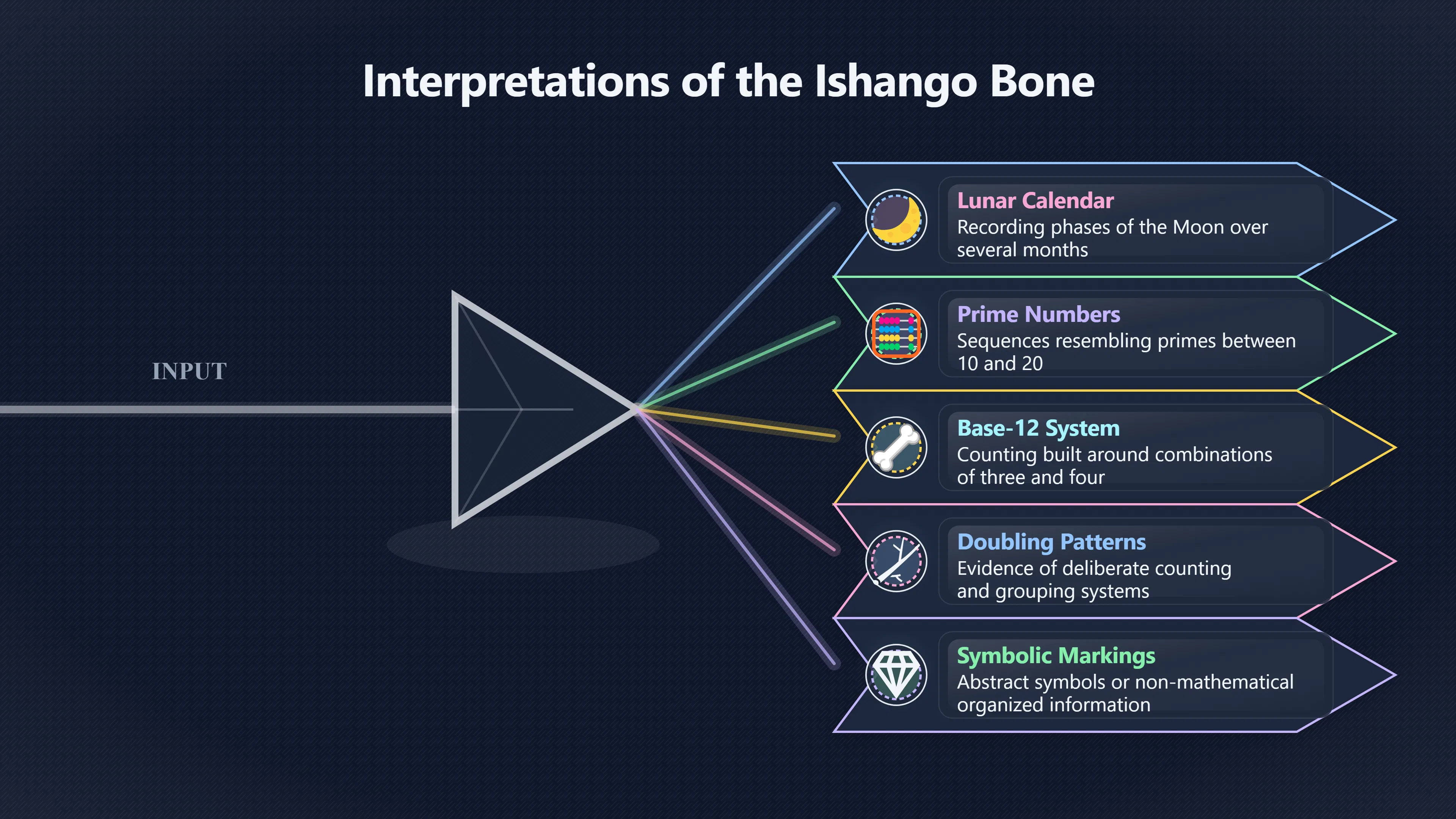
The notches do not appear random. They are grouped, and the groups vary in size and arrangement. This pattern encouraged de Heinzelin and later researchers to look for numerical meaning. Some proposed that the markings reflected simple arithmetic. Others suggested doubling patterns, grouping systems or evidence of deliberate counting.[Wikipedia]WikipediaIshango boneIshango bone
More ambitious interpretations followed. One influential claim was that one column contains a sequence resembling prime numbers between 10 and 20. Another proposed that the bone reflects a base-12 counting system built around combinations of three and four. Advocates of these theories argued that the arrangement was too organised to be accidental.[wikipedia.org]WikipediaIshango boneIshango bone
The difficulty is that patterns can often be found after the fact. Once researchers begin searching for numerical relationships, multiple competing explanations can fit the same marks. The existence of a pattern does not automatically reveal the intention behind it. Even scholars sympathetic to mathematical interpretations have acknowledged that the evidence does not prove knowledge of prime numbers or advanced arithmetic.[Wikipedia]WikipediaIshango boneIshango bone
The Lunar Calendar Hypothesis
One of the most widely repeated ideas came from archaeologist Alexander Marshack. After microscopic examination of the notches, he suggested that the bone may have functioned as a lunar calendar, recording phases of the Moon over several months.[Wikipedia]WikipediaIshango boneIshango bone
The proposal gained attention because it seemed to offer a dramatic insight into prehistoric thought. It also fitted broader arguments that early humans tracked celestial cycles long before written calendars existed. Later writers expanded the idea further, suggesting links to menstrual cycles and proposing that the creator may have been a woman keeping lunar records.[Wikipedia]WikipediaIshango boneIshango bone
However, critics argued that Marshack’s interpretation depended heavily on selecting one pattern from many possible patterns. Archaeologists and historians of mathematics noted that the evidence did not uniquely support a lunar calendar over other explanations. The hypothesis remains possible, but it has never been verified.[Wikipedia]WikipediaIshango boneIshango bone
This distinction often disappears in popular accounts. Articles and social media posts frequently present the lunar-calendar theory as an established fact rather than a debated interpretation.
How Possibility Became Certainty in Popular Retellings
The Ishango bone illustrates a common process in the history of disputed claims. A cautious scholarly suggestion enters public discussion. Repetition gradually removes the uncertainty.
A typical progression looks like this:
- Researchers suggest the notches might represent counting.
- Writers describe the bone as a counting tool.
- Later accounts call it the world’s first calculator.[scomot.com]scomot.comIshango Bone, World's first calculator2 Jan 2024 — The bone is estimated to be over 20,000 years old and is inscribed with a series of notches that appear to be a sophis…
- Popular summaries present that description as proven fact.
The same pattern appears in claims about prime numbers, lunar calendars and base-12 mathematics. Each began as an interpretation of the markings, yet many websites, educational materials and media features now state them with far greater confidence than the evidence allows.[wikipedia.org]WikipediaIshango boneIshango bone
This does not mean the interpretations are necessarily wrong. Some may eventually prove close to the truth. The issue is that the archaeological evidence cannot currently distinguish with certainty between several plausible explanations.
What Skeptics Actually Argue
Sceptics of the stronger claims are not usually arguing that the notches are meaningless. Instead, they question whether modern observers are projecting familiar mathematical concepts onto a prehistoric object.[Wikipedia]WikipediaIshango boneIshango bone
Several concerns recur in the debate:
Pattern hunting. Humans are exceptionally good at finding patterns, even when multiple interpretations fit the same data.
Missing context. No accompanying text explains the markings. Unlike later historical artefacts, the Ishango bone comes without instructions.
Selective interpretation. Different researchers highlight different numerical relationships while downplaying others.
Modern assumptions. Concepts such as prime numbers, calendars and arithmetic tables carry meanings that may not have existed in the same form 20,000 years ago.[Wikipedia]WikipediaIshango boneIshango bone
As mathematician and historian commentators have noted, the bone may well reflect sophisticated thought without necessarily being a calculator in the modern sense.[Wikipedia]WikipediaIshango boneIshango bone
A Genuine Artefact Surrounded by Speculation
Unlike forged relics or fabricated archaeological discoveries, the Ishango bone is not a hoax. The artefact is real, ancient and important. The controversy lies in the claims made about it.[Wikipedia]WikipediaIshango boneIshango bone
Within the wider history of contested truth in DR Congo, the Ishango bone belongs to a category of cases where evidence exists but interpretations outrun what the evidence can securely support. It shows how an authentic object can acquire legendary status through repetition, enthusiasm and the desire to discover dramatic origins for mathematics, astronomy or scientific thinking.
The safest conclusion is also the most defensible. The Ishango bone demonstrates that people in central Africa around 20,000 years ago deliberately created structured notched markings and may have been recording or organising information in some way. Beyond that point, the famous stories about calculators, prime numbers and lunar calendars remain intriguing possibilities rather than established facts.[wikipedia.org]WikipediaIshango boneIshango bone
Amazon book picks
Further Reading
Books and field guides related to What Does the Ishango Bone Really Prove?. Use these as the next step if you want deeper reading beyond the article.
Frauds, Myths, and Mysteries: Science and Pseudoscience in Ar...
Shows how speculative interpretations can become accepted stories.
Archaeology : theories, methods, and practice
Explains how archaeologists evaluate uncertain evidence.
eBay marketplace picks
Marketplace Samples
Live-tested eBay searches with available results related to this page.
Endnotes
1.
Source: Wikipedia
Title: Ishango bone
Link:https://en.wikipedia.org/wiki/Ishango_bone
2.
Source: Wikipedia
Link:https://en.wikipedia.org/wiki/Ishango
3.
Source: historyofinformation.com
Link:https://www.historyofinformation.com/detail.php?id=2
Source snippet
The Ishango Bone, Possibly One of the Oldest CalendarsUsing microscopic analysis, Marshack showed that seemingly random or meaningless no...
4.
Source: researchgate.net
Link:https://www.researchgate.net/publication/222106237_Does_the_Ishango_Bone_Indicate_Knowledge_of_the_Base_12_AnInterpretation_of_a_Prehistoric_Discovery_the_First_Mathematical_Tool_ofHumankind
Source snippet
Does the Ishango Bone Indicate Knowledge of the Base 12...Early interpretations have suggested that the Ishango Bone functio...
5.
Source: scomot.com
Title: Ishango Bone, World’s first calculator
Link:https://scomot.com/ishango-bone-worlds-first-calculator/
Source snippet
2 Jan 2024 — The bone is estimated to be over 20,000 years old and is inscribed with a series of notches that appear to be a sophis...
6.
Source: researchgate.net
Title: (PDF) Decoding the Ishango Bone: Unveiling Prehistoric
Link:https://www.researchgate.net/publication/390639355_Decoding_the_Ishango_Bone_Unveiling_Prehistoric_Mathematical_Art
7.
Source: researchgate.net
Link:https://www.researchgate.net/profile/Hamsa-Venkat/publication/324461943_Connecting_Whole_Number_Arithmetic_Foundations_to_Other_Parts_of_Mathematics_Structure_and_Structuring_Activity/links/5af9885e4585157136f404b0/Connecting-Whole-Number-Arithmetic-Foundations-to-Other-Parts-of-Mathematics-Structure-and-Structuring-Activity.pdf
8.
Source: math.buffalo.edu
Link:https://www.math.buffalo.edu/mad/Ancient-Africa/ishango.html
9.
Source: afrolegends.com
Title: Ishango bone
Link:https://afrolegends.com/tag/ishango-bone/
Additional References
10.
Source: blogs.baruch.cuny.edu
Title: Baruch Blogs The Ishango Bone: mathematics or merely decoration?
Link:https://blogs.baruch.cuny.edu/plimpton322/2011/09/12/the-ishango-bone-mathematics-or-merely-decoration/
Source snippet
Sep 12, 2011 — The Ishango Bone is the oldest artifact mentioned in Plimpton 322. Is it really mathematical? Without knowing its context...
11.
Source: reddit.com
Title: the ishango bone a 22000 year old lunar calendar
Link:https://www.reddit.com/r/badhistory/comments/m5hzjw/the_ishango_bone_a_22000_year_old_lunar_calendar/
Source snippet
The Ishango Bone: a 22000 year old lunar calendar made...One popular theory is the idea that the Ishango Bone was created by a wom...
12.
Source: realclearscience.com
Title: the earliest evidence of logical reasoning
Link:https://www.realclearscience.com/blog/2015/11/the_earliest_evidence_of_logical_reasoning.html
Source snippet
Is the 20000-Year-Old Ishango Bone the Earliest Evidence...24 Nov 2015 — The Ishango bone has notches that seem to form...
13.
Source: tysllp.com
Title: what are the ishango and lebombo bones
Link:https://tysllp.com/what-are-the-ishango-and-lebombo-bones/
Source snippet
?Jan 14, 2026 — The Ishango and Lebombo bones are ancient artifacts that represent the earliest known evidence of mathematical counting a...
14.
Source: youtube.com
Link:https://www.youtube.com/watch?v=DAW4G1iHJ4c
Source snippet
The Ishango Bone: Proof That Africans Invented Mathematics...
15.
Source: youtube.com
Title: Africa’s Oldest Mathematical Tool The Ishango Bone
Link:https://www.youtube.com/watch?v=K76PkC_bR_0
Source snippet
Science was born black: Before Pythagoras... There Was Ishango...
16.
Source: youtube.com
Title: The Ishango Bone: Proof That Africans Invented Mathematics
Link:https://www.youtube.com/watch?v=9GQasag5ZQs
Source snippet
Math Secrets That Disappeared Before Science...
17.
Source: youtube.com
Title: Math Secrets That Disappeared Before Science
Link:https://www.youtube.com/watch?v=ami8YZ_in38
Source snippet
Great Maths Stories for Curious Minds: Story of the Ishango Bone...
18.
Source: academia.edu
Link:https://www.academia.edu/2101124/Ishango_Bone
19.
Source: academia.edu
Link:https://www.academia.edu/9502005/Pointed_Bone_Tool_technology_in_Southern_Africa
Topic Tree