When Did Tunisia's Most Persuasive Stories Become Doubtful?
Tunisia does not have a single world-famous hoax comparable with Piltdown Man or the Cottingley Fairies.
Page outline Jump by section
Introduction
These episodes should not all be labelled hoaxes. Some were deliberate deceptions; others were propaganda, commercially motivated fakery, unverified reports or genuine historical disputes. Together, however, they show how false or uncertain claims become persuasive when they fit what audiences already fear, hope or expect. Tunisia’s history also demonstrates a further danger: concern about misinformation can itself be exploited, allowing those in power to describe criticism or inconvenient reporting as “false news”.
Did Carthage really sacrifice children?
The most enduring contested story associated with ancient Tunisia concerns the Carthaginians and the alleged sacrifice of infants. Greek and Roman writers portrayed Carthage as a place where parents offered children to the gods. Because these accounts came largely from political and military enemies, later scholars often treated them as hostile propaganda: a lurid accusation used to make Rome’s destruction of Carthage appear morally justified.
The discovery of a sacred burial area at Carthage complicated that interpretation. The site contained urns holding cremated remains of very young children, sometimes mixed with animal bones, alongside inscribed stone monuments. The central dispute is whether this was an ordinary cemetery for infants who died naturally or a place where at least some children were deliberately killed as religious offerings.[Cambridge University Press & Assessment]cambridge.orgCambridge University Press & AssessmentTwo tales of one city: data, inference and Carthaginian…by JH Schwartz · 2017 · Cited by 37 — A…
Researchers arguing for sacrifice point to the combination of human and animal remains, the specialised character of the site and inscriptions apparently recording offerings. A widely reported 2014 study concluded that attempts to dismiss the ancient accusations as mere anti-Carthaginian propaganda were not consistent with the full archaeological evidence.[Oxford University]ox.ac.uk2014 01 23 ancient carthaginians really did sacrifice their childrenford UniversityAncient Carthaginians really did sacrifice their children23 Jan 2014 — Shocking new research confirms the ancient Cartha…
Other specialists remain more cautious. Cremation damages and shrinks bones, making the age and cause of death difficult to establish. Critics have argued that the age distribution may be consistent with high natural infant mortality and that the surviving evidence cannot prove how every child died. The debate has therefore continued in the archaeological literature rather than ending in a universally accepted verdict.[Cambridge University Press & Assessment]cambridge.orgCambridge University Press & AssessmentTwo tales of one city: data, inference and Carthaginian…by JH Schwartz · 2017 · Cited by 37 — A…
This is not a simple case of a legend being exposed as true or false. The memorable claim survived because it combined enemy testimony with disturbing physical remains. Modern retellings often erase the uncertainty, presenting either “Roman propaganda completely invented it” or “archaeology proved mass sacrifice”. The evidence supports a more careful conclusion: ritual sacrifice probably occurred, according to many researchers, but the scale, frequency and interpretation of individual burials remain disputed.
The controversy is an unusually clear example of how ancient propaganda can preserve genuine information while exaggerating it for political effect. It also shows why the exposure of a supposed “hoax” may not settle the matter. New scientific techniques can change the balance of probability without producing the clean ending that popular history prefers.
The revolutionary rumour that became politically useful
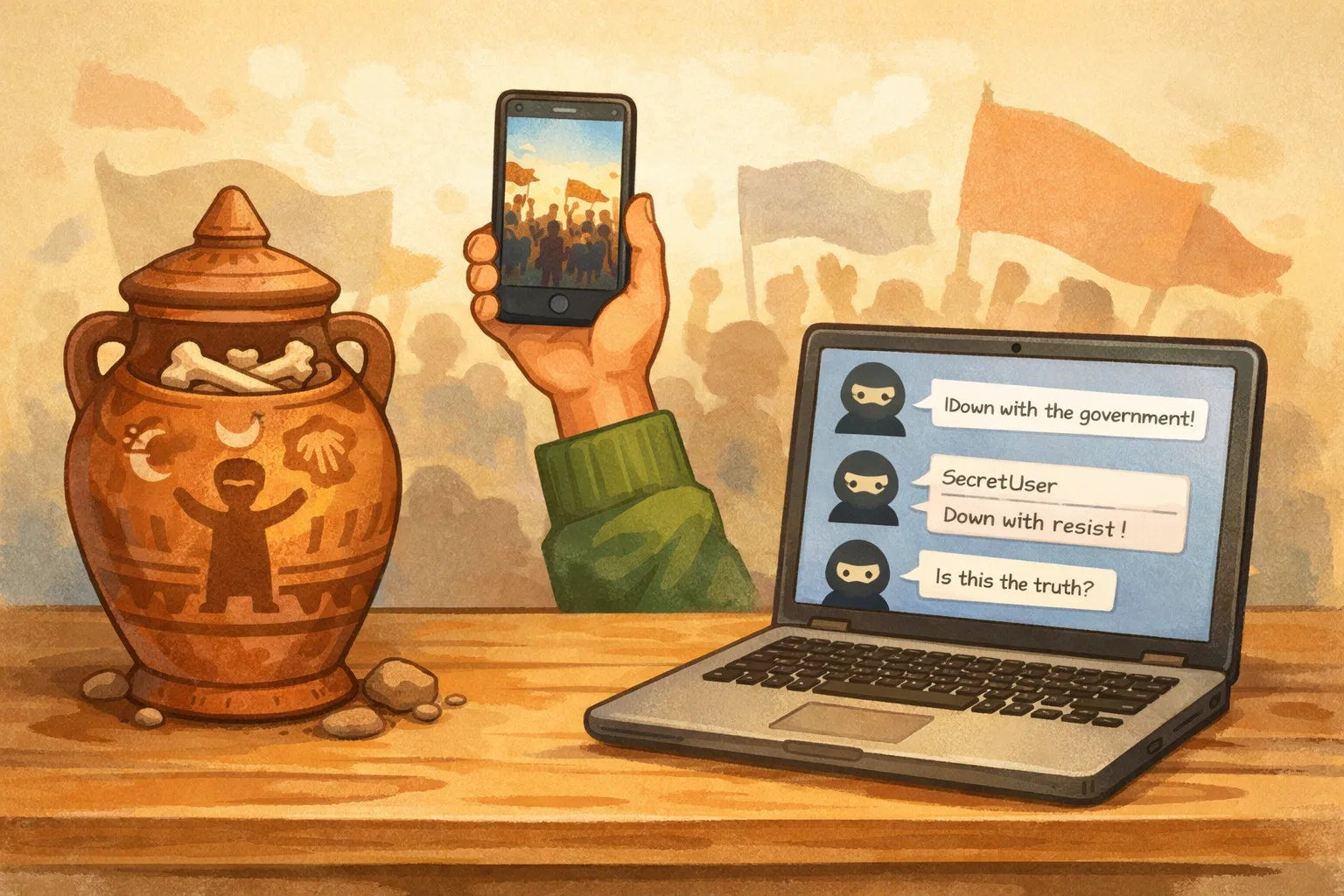
During the uprising of December 2010 and January 2011, a powerful report spread that Tunisia’s army had refused President Zine el-Abidine Ben Ali’s orders to fire on demonstrators. In many later accounts, the military’s principled refusal became a decisive turning point: the army supposedly sided with the people, leaving the president without the force needed to remain in power.
The evidence is less straightforward. The Tunisian military was comparatively small and had long been kept at some distance from the regime’s internal-security machinery. There were signs of hesitation, local defections and disagreement within the state, but the sweeping claim that the army’s leadership had received and rejected a direct order to shoot was not securely established while events were unfolding.
The rumour nevertheless mattered. It matched what protesters were observing: police violence continued, yet the army did not appear to be conducting the same broad campaign of repression. Because the story was plausible and hopeful, it encouraged resistance and may have increased uncertainty among officials deciding whether Ben Ali could survive. Later research has described it as disinformation that helped fuel a revolution—not necessarily because a single organiser invented it, but because an unverified claim produced real political effects.[New Lines Magazine]newlinesmag.comNew Lines Magazine How Disinformation Fueled the Tunisian RevolutionNew Lines MagazineHow Disinformation Fueled the Tunisian RevolutionJanuary 12, 2024 — 12 Jan 2024 — The “fake news” worked because it ali…
This case challenges the assumption that false information always benefits governments or reactionary movements. A rumour can weaken an authoritarian regime when it creates the impression that obedience is collapsing. People who believe that soldiers will not fire may be more willing to gather publicly; officials who think the army is defecting may begin protecting themselves rather than the president.
The story also illustrates the difficulty of separating deliberate fabrication from revolutionary folklore. Tunisia’s uprising was reported through eyewitness testimony, mobile-phone footage, satellite broadcasting and rapidly circulating online posts. Journalists were receiving important evidence from people on the ground, but verification systems for such material were still developing. Al Jazeera’s journalism training material later acknowledged that the network’s attempts to verify activist images from Tunisia and Egypt did not yet amount to a fully developed policy for handling these unconventional sources.[Al Jazeera Institute]institute.aljazeera.netAl Jazeera Institute Finding the Truth Amongst the FakesAl Jazeera Institute Finding the Truth Amongst the Fakes
The claim about the army survived because it offered a satisfying explanation for Ben Ali’s fall and a reassuring national memory of military restraint. Whether understood as misinformation, an exaggeration of partial truth or a founding legend of the revolution, it demonstrates how political myths can emerge before historians have access to orders, communications and testimony from all sides.
Anonymous pages, fake polls and the 2019 election
Tunisia’s competitive elections after the revolution created a new market for digital manipulation. By the 2019 presidential contest, Facebook pages and loosely identified media brands had become important distributors of political information. Some claimed to be neutral news or fact-checking services while promoting particular candidates or attacking their opponents.
One prominent example examined by the Atlantic Council’s Digital Forensic Research Lab was a page called “Fake News Checking”. Although it presented itself as politically independent, reporting linked it to a journalist who openly supported one of the presidential candidates. The case demonstrated a basic weakness in online verification culture: a page can acquire authority merely by describing itself as a fact-checker, even when its ownership, methods and political interests are opaque.[DFRLab]dfrlab.orgSorting fact from fiction in Tunisia's presidential electionSorting fact from fiction in Tunisia's presidential election
Fake or methodologically dubious opinion polls were another recurring problem. Tunisia restricted the publication of polling during parts of the electoral period, but the resulting information gap did not stop numbers from circulating. An international election-observation report warned that the restrictions could create space for fake or poorly conducted polls on social media, where audiences might have no reliable way to identify who commissioned them or how the figures were produced.[ndi.org]ndi.orgTUNISI A INTERNATIONAL ELECTION OBSERVATIONTUNISI A INTERNATIONAL ELECTION OBSERVATION
The attraction of fabricated polls is easy to understand. They look numerical and therefore authoritative. They can create the impression that a candidate is surging, collapsing or inevitably heading for victory. Even when readers doubt the exact figures, repeated exposure can alter perceptions of momentum and electability.
Tunisia also became connected to a wider influence operation targeting several African countries. In 2020, Facebook removed accounts linked to a Tunisia-based network that used false identities, posed as local people and operated pages presented as independent news organisations. According to the platform’s statement reported by investigators, the network promoted its own material, managed deceptive pages and attempted to influence political discussion beyond Tunisia as well as within it.[Medium]medium.comDFRLab uncovers Tunisia-based political influenceDFRLab uncovers Tunisia-based political influence
These operations did not need to invent one spectacular lie. Their power came from accumulation: selective stories, anonymous commentary, imitation news brands, coordinated engagement and apparently spontaneous public support. Unlike an old-fashioned newspaper hoax, such a campaign may have no single moment of exposure. Accounts are removed, but screenshots and narratives remain, while new pages can reappear under different names.
Research on Tunisia’s contemporary information environment also emphasises the role of emotionally charged wording, sensational framing and movement between different languages and writing styles. A recent multilingual research corpus covering Tunisia and Algeria found that false narratives often gained visibility through emotional language and hybrid forms of online expression, while debunking tended to use a more factual and less dramatic register.[arXiv]arxiv.orgOpen source on arxiv.org.

When the ancient souvenir is too good to be true
Tunisia’s Roman, Punic and prehistoric heritage gives antiquities an immediate commercial appeal. A coin, lamp, figurine or fragment of mosaic offered near an archaeological site can be sold with a persuasive miniature story: it was supposedly found by a farmer, inherited from a relative or recovered from an undisclosed excavation.
Some such objects are modern reproductions passed off as ancient. Others may be genuine but illegally excavated or exported. Still others are ordinary ancient coins whose rarity and value are heavily exaggerated. These categories matter because forgery, smuggling and misleading salesmanship are different offences, even though buyers may encounter them through the same informal trade.
The market became more difficult to police after the upheaval of 2011. Research into North African cultural-property crime found that Tunisia’s black market in antiquities intensified after the revolution, identifying Tunis, El Djem and Monastir as important centres of illicit dealing. The same study connected trafficking to looting, weak site protection, corruption and cross-border routes involving neighbouring Algeria and Libya.[enact-africa.s3.amazonaws.com]enact-africa.s3.amazonaws.comCulture in ruinsCulture in ruins
An undocumented object is particularly vulnerable to fakery because its supposed history cannot be tested. A dealer may provide an attractive verbal provenance—a story of ownership and discovery—but no excavation record, export permit or chain of custody. Even a genuine artefact loses much of its archaeological value when it has been removed without documentation, since its exact location and relationship to surrounding objects may be impossible to recover.
Fake mosaics reveal how sophisticated the trade can become. Scholars investigating mosaics returned to Lebanon argued that several were modern works copied from well-known ancient designs, including examples preserved in Tunisia and elsewhere around the Mediterranean. The controversy showed that forgers do not always invent images from scratch; they may borrow recognisable ancient motifs so that an object looks immediately convincing to dealers, officials or collectors.[The Guardian]theguardian.comOpen source on theguardian.com.
Authentication therefore depends on more than whether an object “looks old”. Specialists examine tool marks, casting seams, pigments, stone or clay composition, patterns of wear, inscriptions and provenance documents. Scientific testing may establish when materials were made, but it cannot automatically prove the truth of the ownership story attached to them. A genuinely ancient coin can be accompanied by forged paperwork, while a skilful modern copy can be mixed into a group of authentic objects.
For visitors, the simplest warning sign is the secret bargain: an apparently important antiquity offered casually, cheaply and without legal documentation. Tunisia’s heritage laws and the damage caused by looting make such purchases risky even when the object is authentic. The romantic tale of a newly discovered Roman treasure is often the mechanism of the deception, not evidence for the object’s history.
The danger of turning “fake news” into a criminal label
Tunisia’s experience with political manipulation created genuine reasons to improve verification, election transparency and media literacy. Yet the state’s response has also demonstrated how an anti-disinformation campaign can become a means of controlling speech.
Decree-Law 54, issued in September 2022, criminalised the intentional use of communication networks to produce or spread false information under broadly framed circumstances. Rights organisations objected that terms such as “fake news” were insufficiently precise and that severe penalties could be used against journalists, lawyers, opposition figures and ordinary critics rather than narrowly targeted at demonstrable fraud or coordinated manipulation.[article19.org]article19.orgtunisia president must scrap law undermining free expression and the presstunisia president must scrap law undermining free expression and the press
Those concerns were reinforced by subsequent prosecutions. Journalists Mourad Zeghidi and Borhane Bsaïs were sentenced in 2024 in a case involving accusations of publishing false information harmful to public security. Lawyer and commentator Sonia Dahmani also received a prison sentence under the law after making critical remarks about conditions in Tunisia and the treatment of migrants. Press-freedom advocates argued that these cases formed part of a broader restriction on dissent.[Reuters]reuters.comTunisia sentences two journalists to one year in prisonTunisia sentences two journalists to one year in prison
The problem is not that every online claim deserves protection from correction. Fabricated evidence, fake accounts, fraudulent impersonation and organised political manipulation can cause substantial harm. The problem arises when the authority deciding what is false is also the target of the criticism. A vague law can collapse the distinction between a forged document, an inaccurate report, satire, disputed analysis and an allegation that embarrasses the government.
Tunisia’s long history of contested claims suggests that exposure works best when it makes evidence visible. Archaeologists debate burial remains and inscriptions; election observers demand transparent polling methods; digital investigators trace networks of coordinated accounts; journalists compare images, dates and original sources. These methods do not require every disagreement to become a criminal matter.
What Tunisia’s disputed stories have in common
The Carthage controversy, the revolutionary army rumour, counterfeit antiquities and digital election manipulation belong to different eras, but they share several mechanisms.
A believable claim fits existing expectations. Roman audiences were ready to believe the worst about an enemy city. Tunisian protesters were ready to believe that the army might abandon an unpopular ruler. Tourists expect ancient objects to emerge from a landscape filled with archaeological sites. Voters may trust polling figures that confirm their preferred candidate’s momentum.
Authority can be imitated. Ancient writers presented moral accusations as history. Dealers invent provenance. Political pages copy the language and appearance of journalism. Self-appointed verification accounts borrow the status of professional fact-checkers without necessarily following transparent methods.
Uncertainty helps stories survive. Missing records and damaged evidence create room for competing narratives. The Carthage burials cannot be replayed; revolutionary decisions were made amid confusion; anonymous social-media networks obscure responsibility; illegally excavated objects arrive without reliable context.
Exposure rarely erases the original story. A correction is usually less vivid than the claim it challenges. “Researchers disagree about the interpretation of cremated infant remains” cannot compete easily with a tale of sacrificial fires. A detailed explanation of polling methodology travels less quickly than a striking percentage displayed in a graphic.
Tunisia’s history of deception is therefore not a catalogue of national credulity. It is a record of recurring incentives: political legitimacy, commercial profit, wartime or revolutionary advantage, social prestige and the desire for a satisfying explanation. The most useful question is seldom simply whether Tunisians “believed a hoax”. It is who supplied the claim, what made it plausible, how it travelled, which evidence was missing and who gained from keeping the story alive.
Amazon book picks
Further Reading
Books and field guides related to When Did Tunisia's Most Persuasive Stories Become Doubtful?. Use these as the next step if you want deeper reading beyond the article.
Carthage Must be Destroyed
Relevant to Tunisia's most famous historical controversies.
The Demon-Haunted World
Rating: 4.5/5 from 43 Google Books ratings
Useful for evaluating disputed historical and political claims.
eBay marketplace picks
Marketplace Samples
Live-tested eBay searches with available results related to this page.

Endnotes
1.
Source: cambridge.org
Link:https://www.cambridge.org/core/journals/antiquity/article/two-tales-of-one-city-data-inference-and-carthaginian-infant-sacrifice/5006E240CB75A1E324B3230F6DA17389
Source snippet
Cambridge University Press & AssessmentTwo tales of one city: data, inference and Carthaginian...by JH Schwartz · 2017 · Cited by 37 — A...
2.
Source: archaeology.org
Title: Magazine Features
Link:https://archaeology.org/issues/online/features/child-burials-carthage-tunisia/
Source snippet
Archaeology MagazineFeatures - Child Burials - Carthage, Tunisiathe Carthaginians carried out large-scale child sacrifice from the eighth...
3.
Source: dfrlab.org
Title: Sorting fact from fiction in Tunisia’s presidential election
Link:https://dfrlab.org/2019/10/11/sorting-fact-from-fiction-in-tunisias-presidential-election/
4.
Source: ndi.org
Title: TUNISI A INTERNATIONAL ELECTION OBSERVATION
Link:https://www.ndi.org/sites/default/files/Tunisia%20IOM%20final%20report_0.pdf
5.
Source: medium.com
Title: DFRLab uncovers Tunisia-based political influence
Link:https://medium.com/dfrlab/dfrlab-uncovers-tunisia-based-political-influence-operation-on-facebook-8c4d16b90744
6.
Source: arxiv.org
Link:https://arxiv.org/abs/2606.00193
7.
Source: enact-africa.s3.amazonaws.com
Title: Culture in ruins
Link:https://enact-africa.s3.amazonaws.com/site/uploads/2020-11-12-culture-in-ruins-main-paper-01.pdf
8.
Source: article19.org
Title: tunisia president must scrap law undermining free expression and the press
Link:https://www.article19.org/resources/tunisia-president-must-scrap-law-undermining-free-expression-and-the-press/
9.
Source: amnesty.org
Link:https://www.amnesty.org/en/wp-content/uploads/2022/12/MDE3062902022ENGLISH.pdf
10.
Source: reuters.com
Title: Tunisia sentences two journalists to one year in prison
Link:https://www.reuters.com/world/africa/tunisian-court-sentences-two-prominent-journalists-one-year-prison-2024-05-22/
11.
Source: reuters.com
Title: video does not show immigrant france threatening rape white women 2024 07 25
Link:https://www.reuters.com/fact-check/video-does-not-show-immigrant-france-threatening-rape-white-women-2024-07-25/
12.
Source: facebook.com
Link:https://www.facebook.com/groups/Archaeology.Prehistoric/permalink/1805054742977060/
13.
Source: facebook.com
Link:https://www.facebook.com/lyobserver/posts/antiquities-smuggler-arrested-inside-the-archaeological-area-of-sousse/5045380285567011/
14.
Source: facebook.com
Link:https://www.facebook.com/AlFanarMedia/posts/tired-of-seeing-viral-images-and-not-knowing-whats-realevery-major-story-online-/1420405256795562/
15.
Source: facebook.com
Link:https://www.facebook.com/Tunisie.Numerique/posts/tunisia-dismantling-of-a-trafficking-network-for-archaeological-artifacts/3791942457539426/
16.
Source: facebook.com
Title: the allied advance at kasserine on the thala front in tunisia on 24 february 194
Link:https://www.facebook.com/SSAFAOfficial/posts/the-allied-advance-at-kasserine-on-the-thala-front-in-tunisia-on-24-february-194/1382759400559729/
17.
Source: facebook.com
Link:https://www.facebook.com/middleeastmonitor/posts/rights-organisations-and-un-experts-have-warned-that-the-continued-silence-of-th/1441955604631131/
18.
Source: facebook.com
Link:https://www.facebook.com/100092236158772/posts/one-lesser-known-aspect-of-d-day-was-the-massive-deception-effort-beforehand-as-/914155928335604/
19.
Source: amnesty.org
Title: tunisia quash unjust heavy convictions in conspiracy case
Link:https://www.amnesty.org/en/latest/news/2025/11/tunisia-quash-unjust-heavy-convictions-in-conspiracy-case/
20.
Source: history.army.mil
Link:https://history.army.mil/portals/143/Images/Publications/catalog/72-12.pdf
21.
Source: armyupress.army.mil
Link:https://www.armyupress.army.mil/Portals/7/Army-Press-Online-Journal/documents/2020/CARMINATI-1.pdf
22.
Source: state.gov
Link:https://www.state.gov/reports/2022-country-reports-on-human-rights-practices/tunisia
23.
Source: ox.ac.uk
Title: 2014 01 23 ancient carthaginians really did sacrifice their children
Link:https://www.ox.ac.uk/news/2014-01-23-ancient-carthaginians-really-did-sacrifice-their-children
Source snippet
ford UniversityAncient Carthaginians really did sacrifice their children23 Jan 2014 — Shocking new research confirms the ancient Cartha...
24.
Source: theguardian.com
Title: carthaginians sacrificed own children study
Link:https://www.theguardian.com/science/2014/jan/21/carthaginians-sacrificed-own-children-study
Source snippet
The GuardianCarthaginians sacrificed own children, archaeologists say21 Jan 2014 — The Carthaginians did kill their own infant children...
25.
Source: newlinesmag.com
Title: New Lines Magazine How Disinformation Fueled the Tunisian Revolution
Link:https://newlinesmag.com/essays/how-disinformation-fueled-the-tunisian-revolution/
Source snippet
New Lines MagazineHow Disinformation Fueled the Tunisian RevolutionJanuary 12, 2024 — 12 Jan 2024 — The “fake news” worked because it ali...
Published: January 12, 2024
26.
Source: institute.aljazeera.net
Title: Al Jazeera Institute Finding the Truth Amongst the Fakes
Link:https://institute.aljazeera.net/sites/default/files/2018/FINDING%20THE%20TRUTH%20AMONGEST%20THE%20FAKES.pdf
27.
Source: theguardian.com
Link:https://www.theguardian.com/culture/2023/nov/19/us-accused-of-sending-fake-roman-mosaics-back-to-lebanon
28.
Source: hal.science
Link:https://hal.science/hal-03088815v1/document
29.
Source: shs.hal.science
Link:https://shs.hal.science/halshs-03687484/document
30.
Source: theguardian.com
Title: ben ali tunisia trial theft
Link:https://www.theguardian.com/world/2011/jun/17/ben-ali-tunisia-trial-theft
Additional References
31.
Source: researchgate.net
Link:https://www.researchgate.net/publication/273293693_Cemetery_or_sacrifice_Infant_burials_at_the_Carthage_Tophet
Source snippet
Cemetery or sacrifice? Infant burials at the Carthage Tophetclaims the Carthaginians practiced infant sacrifice. a children's...
32.
Source: youtube.com
Title: MOLOCH: Did child sacrifice actually happen or was it propaganda?
Link:https://www.youtube.com/watch?v=kNa5MkmoEAs
Source snippet
Carthage tophet child sacrifice Did The Ancient Carthaginians Sacrifice Children? | Blood On The Altar Timeline - World History Documenta...
33.
Source: belfercenter.org
Title: how disinformation fueled tunisian revolution 0
Link:https://www.belfercenter.org/publication/how-disinformation-fueled-tunisian-revolution-0
Source snippet
Belfer CenterHow Disinformation Fueled the Tunisian Revolution12 Jan 2024 — A rumor about the army's refusal to repress protesters embold...
34.
Source: youtube.com
Title: Did Carthage Really Sacrifice Children? Or Was It Roman Propaganda
Link:https://www.youtube.com/watch?v=G7DonQo-Gss
Source snippet
MOLOCH: Did child sacrifice actually happen or was it propaganda?...
35.
Source: youtube.com
Title: The Tophet Mystery: Did Carthage Really Sacrifice Children?
Link:https://www.youtube.com/watch?v=AyeaeYA70yo
Source snippet
Did Carthage Really Sacrifice Children? Or Was It Roman Propaganda...
36.
Source: academia.edu
Link:https://www.academia.edu/102135190/Fake_Truth_The_Legal_Issue_of_Archaeological_Forgery
37.
Source: academia.edu
Link:https://www.academia.edu/100788502/Fake_for_Real_The_Exhibition_Narrative
38.
Source: conseilsdejournalistes.com
Link:https://conseilsdejournalistes.com/en/fact-checking/04-inkyfada-le-fact-checking-a-la-tunisienne/
39.
Source: apnews.com
Link:https://apnews.com/article/5d1cd879bb081796439a469db744014e
40.
Source: scispace.com
Link:https://scispace.com/pdf/an-annotated-select-bibliography-of-the-piltdown-forgery-1z0rg39iwi.pdf
Topic Tree
Follow this branch
Related pages 192
- Albanian Hoaxes
- Algerian Hoaxes
- Antigua Deceptions
- Argentina Hoaxes
- Armenian Hoaxes
- +187 more in sidebar