How Latvia's Most Famous Hoaxes Fooled the Public
Latvia’s best-known hoaxes are not ancient mysteries but modern demonstrations of how authority, spectacle and repetition can make doubtful claims seem real.
Page outline Jump by section
Introduction
The evidence does not support portraying Latvia as unusually prone to deception. Rather, these episodes show familiar weaknesses in modern information systems. Reporters race to publish; audiences trust convincing images and official formats; advertisers seek attention without bearing the initial cost of public alarm; and propaganda combines authentic suffering with invented numbers. Latvia is especially instructive because several of its most revealing cases were exposed quickly and publicly, leaving a clear record of how the falsehood worked.
The meteorite that was dug with shovels
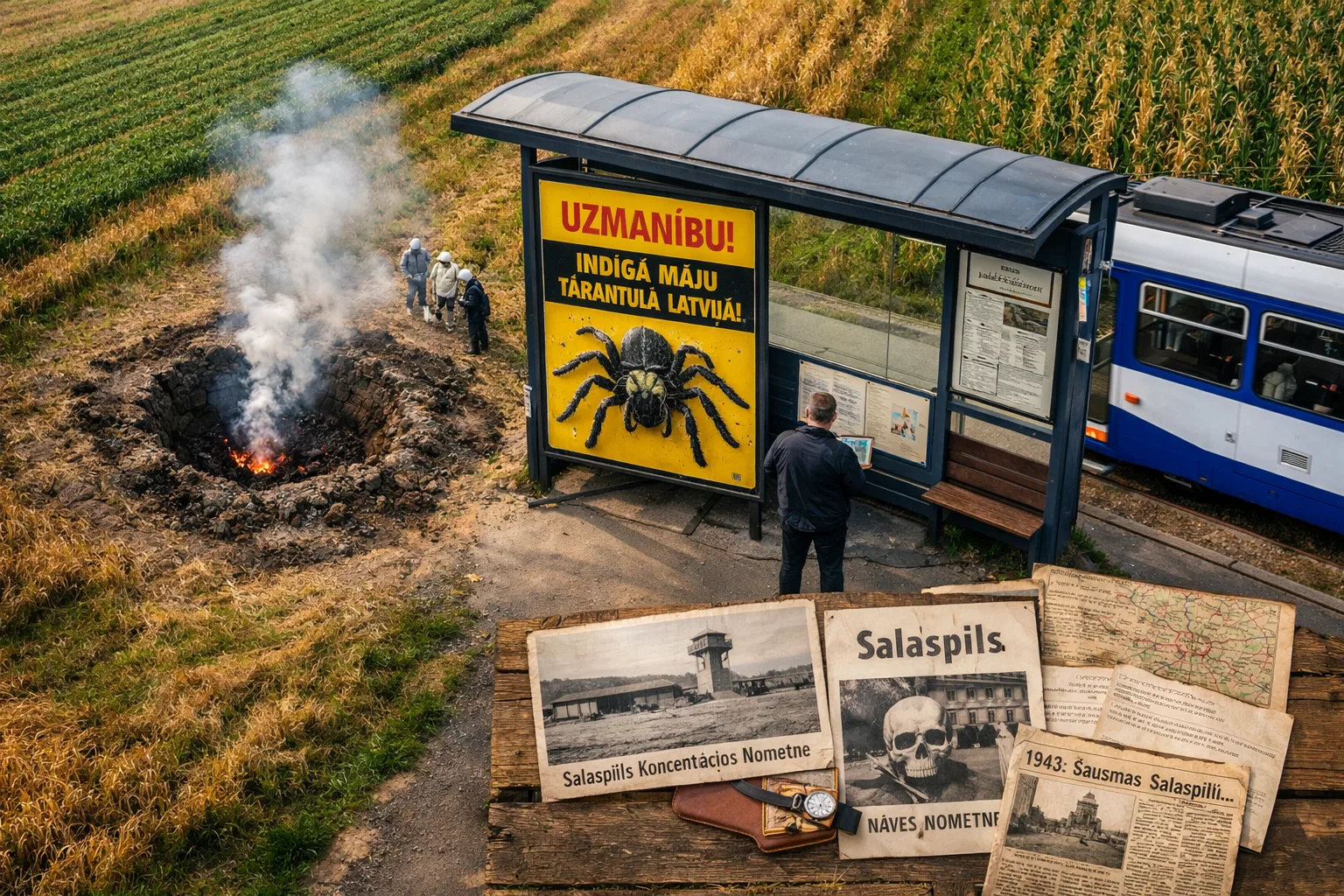
On the evening of 25 October 2009, reports emerged that a meteorite had struck a field near Mazsalaca in northern Latvia. Amateur-looking video showed people approaching a large, smoking hole with burning material at its base. Emergency services, police, soldiers and scientists attended, while photographs and footage travelled rapidly through international media. The scene appeared to offer everything a news story needed: eyewitness excitement, spectacular images and a physical crater that authorities could inspect.[Wikipedia]Wikipedia2009 Latvian meteorite hoax2009 Latvian meteorite hoax
The claim began to unravel in daylight. Uldis Nulle of the Latvian Environment, Geology and Meteorology Centre concluded that the crater was artificial, and another Latvian scientist observed evidence that it had simply been dug. Caroline Smith, then a meteorite curator at London’s Natural History Museum, pointed to two basic scientific problems: meteorites do not normally sit burning in a crater after landing, and an impact large enough to make such a hole should have produced a conspicuous fireball seen across a wide area. No matching space-debris re-entry had been identified either.[WIRED]wired.comDid a Meteorite, or Nerdy Hoaxsters, Strike Latvia?It is artificial," Uldis Nulle, a scientist at the Latvian Environment, Geology and Meteorology Center, told the …Read more
The decisive revelation came from Tele2. The telecommunications company admitted that its Latvian operation, working with a media agency, had staged the “impact” as a publicity stunt. A group had excavated the hole and used burning chemicals to manufacture the appearance of a fresh celestial event. Tele2 said it wanted to distract people from gloomy coverage of Latvia’s economic crisis and promised to repay the emergency services’ costs. Latvian officials estimated that the response had cost at least 2,000 lats, while Interior Minister Linda Mūrniece condemned the stunt and said the ministry would cease doing business with the company.[wikipedia.org]Wikipedia2009 Latvian meteorite hoax2009 Latvian meteorite hoax
The Mazsalaca affair remains Latvia’s classic media hoax because it briefly converted advertising into a public emergency. Its creators did not merely publish a fictional claim: they built physical evidence, arranged witnesses, produced apparently spontaneous video and allowed official responders to authenticate the event by taking it seriously. In effect, the presence of police and scientists became part of the publicity before those same investigators exposed the deception.
It also illustrates the difference between a successful attention stunt and a successful fraud. Tele2 certainly gained worldwide recognition, but the revelation shifted the story from wonder to corporate irresponsibility. The company benefited from visibility while emergency services, scientists and the public initially carried the costs and risks. That imbalance explains why the stunt was remembered less as ingenious advertising than as a warning about publicity campaigns that impersonate real emergencies.
A medieval toilet becomes breaking news
In August 2014, Latvian media carried a story that archaeologists working in Riga had discovered a thirteenth-century latrine possibly connected with Bishop Albert, traditionally regarded as the city’s founder. The supposed identification rested on a mixture of excavation detail, historical colour and comic appeal. A medieval toilet is ordinary enough to sound archaeologically plausible, yet a toilet used by a famous founder is unusual enough to attract headlines. Latvian Public Broadcasting repeated the claim before updating its coverage when the story was exposed as false.[LSM.lv]eng.lsm.lvlv Riga founder's outhouse story a fake scoop / Articlefounder's outhouse story a fake scoop / ArticleSeptember 1, 2014 —… 13th-century commode likely that of Riga founder Bishop Albert (UP…
The episode worked partly because it attached an extravagant conclusion to a believable setting. Old Riga genuinely contains extensive medieval remains, and archaeologists routinely interpret rubbish pits, drains and latrine deposits. Readers therefore did not need to accept anything supernatural. They only had to accept that specialists had found a way to associate one feature with a celebrated historical person.
That association was the weak point. Archaeological evidence can often establish a structure’s approximate date and function, but connecting a particular waste pit to a named individual generally requires unusually strong documentary or material proof. In this instance, the colourful attribution was not a cautious scholarly interpretation but a fabricated scoop. The newspaper that originated it had supplied the media ecosystem with a ready-made discovery story, and other outlets amplified it before verification caught up.[LSM.lv]eng.lsm.lvlv Riga founder's outhouse story a fake scoop / Articlefounder's outhouse story a fake scoop / ArticleSeptember 1, 2014 —… 13th-century commode likely that of Riga founder Bishop Albert (UP…
The joke was relatively harmless compared with the meteorite stunt, but it exposed a persistent problem in reporting archaeology. A genuine excavation gives an article a factual foundation; an invented connection to a famous person supplies the headline. Once those elements are fused, readers may struggle to distinguish what was actually found from what was merely suggested—or, in this case, made up.
The story still circulates because it is almost perfectly designed for retelling. It combines Riga’s origin story with bodily humour and the familiar fantasy that archaeology can reveal intimate traces of famous lives. Its durability does not depend on continued belief. Like many exposed newspaper hoaxes, it survives as an amusing tale about the press itself.
The poisonous spiders that borrowed an official voice
In July 2018, posters appeared at public transport stops in Riga warning that dangerous spiders were spreading through the capital. They used official-looking presentation, named a particular spider and instructed people to contact the Latvian Health Inspectorate or the emergency number 112. The Health Inspectorate publicly denied issuing the warning, stated that the information was false and referred the matter to police.[lsm.lv]eng.lsm.lvlv Invasion of the fake news spiders!lv Invasion of the fake news spiders!
This was a modest physical hoax, but an unusually clear lesson in visual authority. The posters did not need forged scientific reports or complicated online networks. Their persuasive force came from placement, formatting and practical instructions. A notice displayed in a public transport shelter, carrying the name of a health body and an emergency number, resembles the sort of communication people are trained to obey rather than investigate.
An artist using the name SOME1 later claimed responsibility, describing the false alert as an artistic intervention. That explanation places the episode on the contested boundary between hoax, street art and social experiment. Whatever its intended meaning, the public-facing mechanism remained deceptive: it imitated a health warning and encouraged people to treat a fictional danger as an official emergency.[Xinhua News]xinhuanet.comc 137360085c 137360085
The posters also exploited a particularly effective fear. Many people cannot identify spider species, assess the likelihood of an invasive population or judge the medical significance of a bite. The warning therefore presented a threat that was vivid but difficult for an ordinary commuter to disprove. Its official appearance supplied the missing expertise.
Unlike a purely digital rumour, the spider scare also shows that “fake news” need not look like news. False information can travel through notices, labels, maps, signs and other formats that appear to perform a public service. The crucial deception was not only the claim that dangerous spiders had arrived; it was the impersonation of the institution responsible for assessing that claim.
When propaganda enlarges a real atrocity
The history of the Salaspils camp outside Riga requires more care than a conventional prank or publicity hoax. The camp was a genuine place of Nazi imprisonment, forced labour, hunger, disease and death. Thousands of people passed through it, including political prisoners, civilians and children. The deception lies not in denying those crimes but in the Soviet-era transformation of the camp into a heavily manipulated propaganda symbol.[LSM.lv]eng.lsm.lvlv New book attempts real history of Holocaust camplv New book attempts real history of Holocaust camp
Soviet accounts sometimes claimed that as many as 100,000 people had been killed at Salaspils. Later historical research based on camp documentation, burial evidence and wider archival work has produced a far lower estimate, with approximately 2,000 deaths commonly cited in the major Latvian study discussed by Latvian Public Broadcasting. The difference is not a minor statistical correction: the Soviet figure multiplied the likely death toll many times over.[LSM.lv]eng.lsm.lvlv New book attempts real history of Holocaust camplv New book attempts real history of Holocaust camp
This case demonstrates why debunking propaganda about an atrocity must not become denial of the atrocity itself. Salaspils was brutal regardless of the inflated total. Prisoners suffered appalling conditions, and children were among those who died. Correcting invented numbers restores the identities and experiences of actual victims; it does not excuse the regime responsible for their suffering.[Wikipedia]WikipediaSalaspils campSalaspils camp
The exaggerated version became persuasive because it was built around undeniable crimes. Soviet authorities did not have to invent the camp, its prisoners or its dead. They could combine authentic evidence with selective testimony, dramatic memorial culture and figures that served a wider political narrative about the Second World War. A claim anchored to real suffering is often harder to challenge than an entirely fictional story, since critics risk appearing to dispute the underlying crime.
Salaspils also shows how political falsehood can survive exposure. Historical corrections compete not only with books and archives but with monuments, school memories, songs, family stories and contemporary geopolitical messaging. Once a number becomes part of a moral narrative, replacing it with a better-supported estimate can be interpreted as an attack on collective memory. The historian’s task is therefore double: to expose the distortion while explaining clearly that the documented crime remains serious.
From Soviet myth-making to digital influence
Since Latvia restored independence in 1991 and later joined NATO and the European Union, it has also become a target of recurring political disinformation. These operations are broader than isolated hoaxes, but they use many of the same techniques: fabricated incidents, misleading headlines, impersonated sources and emotionally charged stories designed for rapid repetition.
One false narrative claimed that NATO troops in Latvia would be permitted to move around with loaded weapons, implying an unusual danger to civilians. The claim was reproduced across several Russian-language outlets even though it distorted the legal and practical circumstances of the deployment. Other campaigns have portrayed NATO forces in the Baltic region as diseased, violent, occupying or secretly experimenting on local populations.[Medium]medium.comRussian Narratives on NATO's Deployment | by @DFRLabRussian Narratives on NATO's Deployment | by @DFRLab
The aim of such stories is often less to secure permanent belief in one allegation than to establish a general atmosphere of suspicion. A reader may reject a specific claim yet retain the impression that foreign troops are reckless, that local authorities conceal scandals or that no news source can be trusted. Researchers at the NATO Strategic Communications Centre of Excellence in Riga distinguish misinformation, which may spread without deceptive intent, from disinformation deliberately created or distributed to mislead or obtain advantage.[StratCom Centre of Excellence]stratcomcoe.orgfact checking and debunkingfact checking and debunking
Modern operations can also manufacture credibility by compromising genuine media infrastructure. Investigations into the wider Ghostwriter campaign found false anti-NATO stories planted on legitimate Central and Eastern European news websites and then promoted through social media and spoofed communications. Although many documented intrusions centred on neighbouring countries, the method is directly relevant to Latvia’s information environment: a fabricated article is much more persuasive when it appears under the name and design of a real publication. Attribution in such campaigns can remain uncertain even when the coordinated behaviour is clear.[WIRED]wired.comHackers Broke Into Real News Sites to Plant Fake StoriesHackers Broke Into Real News Sites to Plant Fake Stories
This is the digital counterpart of Riga’s spider posters. Both borrow an established channel’s authority. One imitates a health agency’s notice; the other exploits a real newsroom’s website or the appearance of an ordinary news report. The core trick is not making a false statement sound brilliant. It is placing that statement where people expect reliable information to appear.
Why these stories worked
Latvia’s major hoaxes and contested falsehoods differ greatly in seriousness, but several mechanisms recur.
They began with something plausible. Meteorites do fall, medieval latrines are found, unfamiliar species sometimes spread, and Nazi crimes at Salaspils were real. Effective deception usually modifies reality rather than replacing it completely.
They borrowed authority. Emergency responders gathered around the Mazsalaca crater; archaeological language dignified the Riga toilet claim; the spider posters impersonated a health body; and Soviet institutions supplied official numbers and memorial narratives.
They offered unusually strong images. A flaming crater, a founder’s toilet, a venomous spider and a monumental camp all provide memorable mental pictures. The correction is usually less vivid than the initial claim.
They exploited publication speed. News outlets and social users could circulate the apparent discovery before specialists had examined the evidence. Research on online misinformation has found that fact-checking commonly trails the original false claim, allowing the first version to shape attention before a correction arrives.[arXiv]arxiv.orgarXiv Hoaxy: A Platform for Tracking Online MisinformationarXiv Hoaxy: A Platform for Tracking Online Misinformation
They shifted costs to others. Tele2 received attention while public services investigated. The newspaper gained a scoop while later reporting had to repair the record. The spider artist created an intervention while health officials handled public reassurance. Propagandists benefit from uncertainty while historians and journalists perform the slower work of verification.
What Latvia’s hoax history reveals
The strongest Latvian cases are valuable because their exposures are as instructive as the deceptions. Scientists did not disprove the meteorite by declaring it ridiculous; they examined crater shape, heat, witness reports and astronomical expectations. The Health Inspectorate answered the spider scare through direct institutional denial. Historians revised Salaspils claims through archives and demographic reconstruction rather than replacing one politically convenient story with another.
They also show why the word “hoax” should be used carefully. The Mazsalaca meteorite was a deliberate commercial fabrication. The Riga toilet was a false media scoop. The spider posters were deceptive street art presented as an official warning. Inflated Salaspils figures belonged to state propaganda constructed around a real crime. Modern anti-NATO stories form part of organised political influence rather than simple practical joking.
What connects them is the management of credibility. Each case asked the public to trust a sign of authenticity: physical evidence, professional language, official design, institutional repetition or the apparent reputation of a media outlet. Their exposures therefore offer a practical sceptical lesson. The most useful first question is not merely whether a claim sounds strange. It is who is supplying the appearance of authority, what independent evidence should exist if the claim is true, and who bears the cost while verification is still catching up.
Amazon book picks
Further Reading
Books and field guides related to How Latvia's Most Famous Hoaxes Fooled the Public. Use these as the next step if you want deeper reading beyond the article.
The Demon-Haunted World
Rating: 4.5/5 from 43 Google Books ratings
Fits a page covering multiple hoaxes and doubtful claims.

eBay marketplace picks
Marketplace Samples
Live-tested eBay searches with available results related to this page.



Endnotes
1.
Source: Wikipedia
Title: 2009 Latvian meteorite hoax
Link:https://en.wikipedia.org/wiki/2009_Latvian_meteorite_hoax
2.
Source: wired.com
Link:https://www.wired.com/2009/10/did-a-meteorite-or-nerdy-hoaxsters-strike-latvia
Source snippet
However, analysis from experts, including NASA specialists and Latvian scientists, revealed inconsistencies. Evidence, such as burning ma...
4.
Source: eng.lsm.lv
Title: lv Riga founder’s outhouse story a fake scoop / Article
Link:https://eng.lsm.lv/article/society/society/riga-founders-outhouse-story-a-fake-scoop.a96646/
Source snippet
founder's outhouse story a fake scoop / ArticleSeptember 1, 2014 —... 13th-century commode likely that of Riga founder Bishop Albert (UP...
Published: September 1, 2014
5.
Source: eng.lsm.lv
Link:https://eng.lsm.lv/article/society/society/13th-century-commode-likely-that-of-riga-founder-bishop-albert-update-exposed-as-hoax.a95792/
Source snippet
LSM.lv13th-century commode likely that of Riga founder Bishop...25 Aug 2014 — 13th-century commode likely that of Riga founder Bishop Al...
6.
Source: Wikipedia
Title: Neatkarīgā Rīta Avīze
Link:https://en.wikipedia.org/wiki/Neatkar%C4%ABg%C4%81_R%C4%ABta_Av%C4%ABze
7.
Source: eng.lsm.lv
Title: lv Invasion of the fake news spiders!
Link:https://eng.lsm.lv/article/society/health/invasion-of-the-fake-news-spiders.a287005/
8.
Source: eng.lsm.lv
Title: lv New book attempts real history of Holocaust camp
Link:https://eng.lsm.lv/article/culture/history/new-book-attempts-real-history-of-holocaust-camp.a166107/
9.
Source: Wikipedia
Title: Salaspils camp
Link:https://en.wikipedia.org/wiki/Salaspils_camp
10.
Source: medium.com
Title: Russian Narratives on NATO’s Deployment | by @DFRLab
Link:https://medium.com/dfrlab/russian-narratives-on-natos-deployment-616e19c3d194
11.
Source: wired.com
Title: Hackers Broke Into Real News Sites to Plant Fake Stories
Link:https://www.wired.com/story/hackers-broke-into-real-news-sites-to-plant-fake-stories-anti-nato
12.
Source: arxiv.org
Title: arXiv Hoaxy: A Platform for Tracking Online Misinformation
Link:https://arxiv.org/abs/1603.01511
13.
Source: eng.lsm.lv
Title: lv Luxury toilet craze continues / Article
Link:https://eng.lsm.lv/article/society/society/riga-to-buy-two-toilets-for-90000-each.a236759/
14.
Source: eng.lsm.lv
Title: six myths about latvias way to statehood.a263068
Link:https://eng.lsm.lv/article/culture/history/six-myths-about-latvias-way-to-statehood.a263068/
15.
Source: eng.lsm.lv
Title: nato stratcomcoe checking fact checking.a389310
Link:https://eng.lsm.lv/article/features/media-literacy/nato-stratcomcoe-checking-fact-checking.a389310/
16.
Source: eng.lsm.lv
Link:https://eng.lsm.lv/article/society/crime/latvian-police-ask-for-help-identifying-spider-man.a287185/
17.
Source: Wikipedia
Title: Unusual articles
Link:https://en.wikipedia.org/wiki/Wikipedia%3AUnusual_articles
18.
Source: Wikipedia
Title: Pseudo mythology
Link:https://en.wikipedia.org/wiki/Pseudo-mythology
19.
Source: nato.int
Title: s approach to counter information threats
Link:https://www.nato.int/en/what-we-do/wider-activities/natos-approach-to-counter-information-threats
20.
Source: thelocal.se
Link:https://www.thelocal.se/20091027/22910
Source snippet
The Local SwedenSwedish telecoms firm admits to Latvia meteorite hoaxWhile Sprogis added that Tele2 will reimburse Latvian emergency serv...
21.
Source: baltictimes.com
Title: fake news about poisonous spiders spread in riga
Link:https://www.baltictimes.com/fake_news_about_poisonous_spiders_spread_in_riga/
22.
Source: xinhuanet.com
Title: c 137358002
Link:https://www.xinhuanet.com/english/2018-07/31/c_137358002.htm
23.
Source: xinhuanet.com
Title: c 137360085
Link:https://www.xinhuanet.com/english/2018-08/01/c_137360085.htm
24.
Source: scienceopen.com
Link:https://www.scienceopen.com/book?vid=a10b9675-4303-43b2-bc01-106efb17eb47
25.
Source: stratcomcoe.org
Title: fact checking and debunking
Link:https://stratcomcoe.org/publications/fact-checking-and-debunking/8
26.
Source: stratcomcoe.org
Title: fake news a roadmap
Link:https://stratcomcoe.org/publications/fake-news-a-roadmap/137
27.
Source: dfrlab.org
Title: fact checkers identity stolen to spread disinfo about nato and covid 19
Link:https://dfrlab.org/2020/04/29/fact-checkers-identity-stolen-to-spread-disinfo-about-nato-and-covid-19/
Additional References
28.
Source: taipeitimes.com
Link:https://www.taipeitimes.com/News/world/archives/2009/10/28/2003457018
Source snippet
Taipei TimesTelecoms firm hoped to 'inspire Latvia' with hoax28 Oct 2009 — Latvian authorities said the cost of calling out firefighters...
29.
Source: youtube.com
Title: Call Center Scammer Reveals Phone Fraud Scheme Targeting Latvia Residents
Link:https://www.youtube.com/watch?v=q1TSJF1mc3M
Source snippet
The Untold Truth About Latvia Revealed by a Local...
30.
Source: youtube.com
Title: Latvia Reality Check: The Truth Youtubers Don’t Tell You
Link:https://www.youtube.com/watch?v=YbMFHUEA3KA
Source snippet
Call Center Scammer Reveals Phone Fraud Scheme Targeting Latvia Residents...
31.
Source: facebook.com
Link:https://www.facebook.com/groups/675577425915990/posts/3453464508127254/
32.
Source: researchgate.net
Link:https://www.researchgate.net/publication/238431550_On_the_Role_of_Myths_and_History_in_the_Construction_of_National_Identity_in_Modern_Europe
33.
Source: historysnob.com
Link:https://www.historysnob.com/eras/20-archaeological-hoaxes-that-fooled-people-for-way-too-long
34.
Source: academia.edu
Link:https://www.academia.edu/1976662/A_Disciplinary_History_of_Latvian_Mythology_PhD_thesis
35.
Source: instagram.com
Link:https://www.instagram.com/artaleacom/
36.
Source: culturaobscura.com
Link:https://www.culturaobscura.com/salaspils-memorial-park/
37.
Source: facebook.com
Link:https://www.facebook.com/groups/thearchaeologynewsnetwork/posts/4691720397509468/
Topic Tree
Follow this branch
Related pages 192
- Albanian Hoaxes
- Algerian Hoaxes
- Antigua Deceptions
- Argentina Hoaxes
- Armenian Hoaxes
- +187 more in sidebar