Within Mali Mysteries
How Fake Papers Made Malian Art Look Genuine
Modern fakes, looted originals and counterfeit export papers often became convincing only when respectable institutions appeared to endorse them.
On this page
- Why Malian terracottas attracted collectors
- How fakes and invented provenance worked
- Why counterfeit certificates persuaded buyers
Page outline Jump by section
Introduction
Mali’s most famous antiquities are not gold treasures or royal regalia but fragile terracotta figures excavated from ancient settlements along the Inland Niger Delta. These sculptures, particularly those associated with the Djenné region, became highly sought-after by collectors, museums and dealers during the late twentieth century. That demand created two linked problems: genuine artefacts were looted from archaeological sites, and fake artefacts or altered objects were supplied to buyers who often had little reliable information about their origins. In many cases, what persuaded purchasers was not the object itself but the paperwork attached to it. False provenance histories, forged export permits and counterfeit certificates gave questionable pieces an appearance of legitimacy and helped them move through the international art market.[Enact Africa]enact-africa.s3.amazonaws.comEnact AfricaC A SE STUD YNovember 12, 2020 — by J Stanyard · 2020 · Cited by 4 — Illegal trade in Malian cultural heritage encompasses bo…
The resulting story is less a single hoax than a recurring mechanism of deception. Malian antiquities became valuable because they appeared ancient, rare and culturally significant. Fraudsters learned that convincing documentation could be as important as the artefact itself, especially when buyers wanted reassurance that an object had been legally exported and ethically acquired.[issafrica.org]issafrica.orginstability is decimating malis cultural heritageISS AfricaInstability is decimating Mali's cultural heritage23 Jun 2021 — The million-euro fraud involved the sale of artefacts – includi…
Why Malian Terracottas Attracted Collectors
Ancient terracotta sculptures from the Djenné area entered international collections in large numbers during the twentieth century. Their striking forms, great age and association with one of West Africa’s most important archaeological regions made them especially attractive to collectors. Before major archaeological investigations clarified their context, many pieces were already circulating through dealers and private collections.[Wikipedia]WikipediaOpen source on wikipedia.org.
Their popularity created a classic market incentive. As demand increased, so did the rewards for looting archaeological sites. Farmers, middlemen, smugglers and dealers could all profit from supplying objects to foreign buyers. Once artefacts were removed from the ground without proper excavation, however, their historical context was lost. Archaeologists stressed that the destruction of sites often caused more long-term damage than the removal of any individual object.[Trafficking Culture]traffickingculture.orgTrafficking Culture Looters or Heroes?Production of Illegality and Memories…November 11, 2014 — by C Panella · 2014 · Cited by 25 — My paper proposes an ethnographical pers…
Collectors frequently wanted objects with a clear story attached: where they had been found, how they had left Mali and who had owned them. That desire for provenance created an opportunity for another layer of deception.
How Fakes and Invented Provenance Worked
In the antiquities trade, provenance is the documented history of an object’s ownership and movement. A convincing provenance can dramatically increase both value and credibility. Because many Malian artefacts reached the market through informal or illicit channels, sellers often faced a problem: they had objects but lacked lawful documentation showing how those objects had left the country.[Smarthistory]smarthistory.orgcultural heritage risk maliCultural heritage at risk: MaliMali also ratified the 1970 UNESCO Convention in 1987, showing its support in regulating the t…
Several forms of deception emerged:
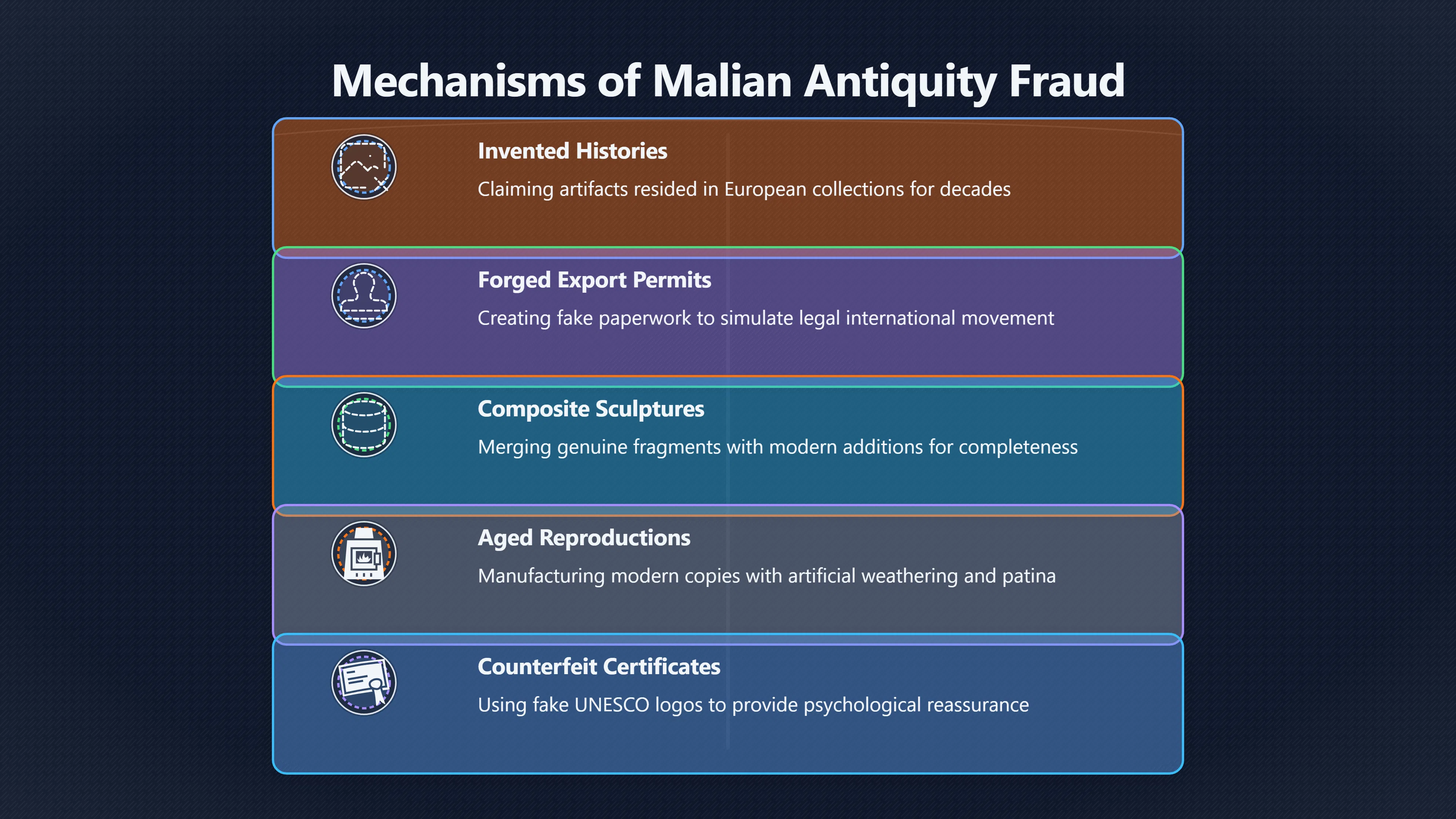
- Invented ownership histories claimed that an artefact had been in a European collection for decades, placing it outside modern cultural-property restrictions.
- Forged export paperwork attempted to make recently trafficked objects appear legally exported.
- Composite or altered artefacts combined genuine fragments with modern additions to create apparently complete sculptures.
- Entirely modern reproductions were artificially aged and presented as authentic archaeological discoveries.[coupdefoudre.com]coupdefoudre.comCoup de FoudreFaking African ArtAfter spending years putting fragments of authentic pieces in fakes, counterfeiters are now putting fake…
The fraud often depended on distance. A collector in Europe or North America could rarely verify a claimed discovery site in rural Mali. Instead, trust shifted to documents, dealer reputations and institutional endorsements. Once a questionable provenance entered catalogues, auction records or collection histories, later buyers sometimes accepted it without independent verification.
This helps explain why forged paperwork became so important. A fake object with convincing documentation could appear safer than a genuine artefact whose history was uncertain.

Why Counterfeit Certificates Persuaded Buyers
The most revealing examples involved certificates that appeared to come from respected organisations. In 2020 UNESCO publicly warned buyers about a scheme involving African antiquities, including Malian Djenné terracottas, that were being marketed with certificates falsely presented as UNESCO-authorised documents. The fraud reportedly involved artefacts worth millions of euros and relied on the prestige of an internationally recognised institution.[un.org]africarenewal.un.orgesco urges caution over fraudulent african artefacts sold its nameesco urges caution over fraudulent african artefacts sold its name
The deception worked because certificates perform a psychological function as much as a legal one. Many buyers cannot personally judge an artefact’s authenticity, age or export status. A document bearing an official-looking logo, signature or stamp appears to transfer responsibility to an authority figure. If a certificate seems to come from UNESCO, a national museum or another respected body, purchasers may assume the necessary checks have already been completed.[Africa Renewal]africarenewal.un.orgesco urges caution over fraudulent african artefacts sold its nameesco urges caution over fraudulent african artefacts sold its name
In reality, authentic export controls in Mali require official authorisation through national heritage authorities, including export licensing procedures designed to regulate the movement of cultural property. A forged certificate exploits the fact that many collectors know such systems exist but may not understand exactly which institutions issue genuine documents.[Smarthistory]smarthistory.orgcultural heritage risk maliCultural heritage at risk: MaliMali also ratified the 1970 UNESCO Convention in 1987, showing its support in regulating the t…
The result is a paperwork hoax layered on top of the antiquities trade itself. The deception is not merely “this object is ancient”; it is “a trusted authority has already confirmed that this object is legitimate”.
When Respectability Became Part of the Fraud
One reason these schemes proved durable is that they often blended truth and falsehood. Some objects were genuine antiquities but accompanied by fabricated ownership histories. Others may have been modern creations supported by elaborate documentation. Still others moved through networks where dealers, collectors and institutions possessed incomplete information rather than explicit knowledge of fraud.[ENACT Africa]enactafrica.orginside the illegal trade in west africas cultural heritageinside the illegal trade in west africas cultural heritage
This blurred boundary made detection difficult. Investigators had to examine not only the artefact but also shipping records, export permits, collection histories and acquisition files. Provenance research became a specialised discipline because forged paperwork could sometimes look more convincing than the object itself.[UNODC]unodc.orgcriminal models in cross-border trafficking of cultural propertyas a concern, with permits acquired through forgery, fraud or…
The return of trafficked Djenné terracottas from foreign museum collections has illustrated how scrutiny of documentation can change assessments decades after acquisition. In several cases, attention focused not simply on whether an artefact was ancient but on whether the records supporting its movement across borders could withstand examination.[Hyperallergic]hyperallergic.comIllegally Trafficked Djenné Figurines in Boston MuseumIllegally Trafficked Djenné Figurines in Boston Museum
What These Cases Reveal About Trust and Cultural Heritage
The story of Malian antiquities shows that fraud in the art world is often less about manufacturing objects than manufacturing credibility. Looted artefacts, forged provenance records and counterfeit certificates all exploit the same weakness: buyers need a trustworthy narrative explaining why an object is where it is.
For Mali, the consequences extend beyond financial loss. When archaeological sites are looted, information about past societies disappears. When forged documentation enters the market, it becomes harder to distinguish legal ownership from illicit trafficking and harder for museums, collectors and governments to reconstruct an artefact’s true history.[Enact Africa]enact-africa.s3.amazonaws.comEnact AfricaC A SE STUD YNovember 12, 2020 — by J Stanyard · 2020 · Cited by 4 — Illegal trade in Malian cultural heritage encompasses bo…
As a result, some of the most influential deceptions connected to Malian heritage were not dramatic fabrications aimed at the public. They were quieter paperwork frauds that transformed doubtful objects into apparently legitimate treasures. The lesson is that in the antiquities market, authenticity depends not only on what an artefact is, but on who can convincingly claim to know where it came from.[issafrica.org]issafrica.orginstability is decimating malis cultural heritageISS AfricaInstability is decimating Mali's cultural heritage23 Jun 2021 — The million-euro fraud involved the sale of artefacts – includi…
Amazon book picks
Further Reading
Books and field guides related to How Fake Papers Made Malian Art Look Genuine. Use these as the next step if you want deeper reading beyond the article.
Frauds, Myths, and Mysteries: Science and Pseudoscience in Ar...
Covers issues of authenticity and evidence.
eBay marketplace picks
Marketplace Samples
Live-tested eBay searches with available results related to this page.


Endnotes
1.
Source: smarthistory.org
Title: cultural heritage risk mali
Link:https://smarthistory.org/cultural-heritage-risk-mali/
Source snippet
Cultural heritage at risk: MaliMali also ratified the 1970 UNESCO Convention in 1987, showing its support in regulating the t...
2.
Source: unodc.org
Link:https://www.unodc.org/documents/gpcd/Cultural_Property/TCPdiscussionpaper1-Nexus.pdf
Source snippet
criminal models in cross-border trafficking of cultural propertyas a concern, with permits acquired through forgery, fraud or...
3.
Source: Wikipedia
Link:https://en.wikipedia.org/wiki/Djenn%C3%A9-Djenno
4.
Source: Wikipedia
Title: Antiquities trade
Link:https://en.wikipedia.org/wiki/Antiquities_trade
5.
Source: Wikipedia
Title: Looted art
Link:https://en.wikipedia.org/wiki/Looted_art
6.
Source: hyperallergic.com
Title: Illegally Trafficked Djenné Figurines in Boston Museum
Link:https://hyperallergic.com/illegally-trafficked-djenne-figurines-in-boston-museum-will-return-to-mali/
7.
Source: unesdoc.unesco.org
Link:https://unesdoc.unesco.org/ark%3A/48223/pf0000122277
8.
Source: enact-africa.s3.amazonaws.com
Link:https://enact-africa.s3.amazonaws.com/site/uploads/2020-11-12-calture-in-ruins-mali-case-study.pdf
Source snippet
Enact AfricaC A SE STUD YNovember 12, 2020 — by J Stanyard · 2020 · Cited by 4 — Illegal trade in Malian cultural heritage encompasses bo...
Published: November 12, 2020
9.
Source: issafrica.org
Title: instability is decimating malis cultural heritage
Link:https://issafrica.org/iss-today/instability-is-decimating-malis-cultural-heritage
Source snippet
ISS AfricaInstability is decimating Mali's cultural heritage23 Jun 2021 — The million-euro fraud involved the sale of artefacts – includi...
10.
Source: enactafrica.org
Title: crime without punishment the illegal trade in malis cultural artefacts
Link:https://enactafrica.org/enact-observer/crime-without-punishment-the-illegal-trade-in-malis-cultural-artefacts
Source snippet
ENACT AfricaCrime without punishment: the illegal trade in Mali's...4 Jun 2021 — The million-euro scam involves the sale of artefacts –...
11.
Source: traffickingculture.org
Title: Trafficking Culture Looters or Heroes?
Link:https://traffickingculture.org/uploads/2015/02/Panella-2014.pdf
Source snippet
Production of Illegality and Memories...November 11, 2014 — by C Panella · 2014 · Cited by 25 — My paper proposes an ethnographical pers...
Published: November 11, 2014
12.
Source: coupdefoudre.com
Link:https://coupdefoudre.com/CurrentArticle/TerracottaForgeries.html
Source snippet
Coup de FoudreFaking African ArtAfter spending years putting fragments of authentic pieces in fakes, counterfeiters are now putting fake...
13.
Source: enactafrica.org
Title: inside the illegal trade in west africas cultural heritage
Link:https://enactafrica.org/enact-observer/inside-the-illegal-trade-in-west-africas-cultural-heritage
14.
Source: africarenewal.un.org
Title: esco urges caution over fraudulent african artefacts sold its name
Link:https://africarenewal.un.org/en/magazine/unesco-urges-caution-over-fraudulent-african-artefacts-sold-its-name
15.
Source: issafrica.org
Title: inside the illegal trade in west africas cultural heritage
Link:https://issafrica.org/iss-today/inside-the-illegal-trade-in-west-africas-cultural-heritage
Additional References
16.
Source: youtube.com
Link:https://www.youtube.com/watch?v=WNqTqDieCwg
Source snippet
Illegal Excavations and Antiquities Trade | Journal Interview...
17.
Source: youtube.com
Title: Lost History: the terracotta sculpture of Djenné Djenno
Link:https://www.youtube.com/watch?v=9YW3FwYEiK8
Source snippet
African traditional art market: Between looted art and art trafficking (Documentary, 2015)...
18.
Source: youtube.com
Title: Reviving Timbuktu by preserving its priceless manuscripts
Link:https://www.youtube.com/watch?v=i9BS5Jp1uRA
Source snippet
Imaging Culture: Photography in Mali, West Africa...
19.
Source: scribd.com
Link:https://www.scribd.com/document/422551770/Art-and-Crime
20.
Source: youtube.com
Title: Mali museum struggles to save artifacts
Link:https://www.youtube.com/watch?v=t4wR4YuRbyI
Source snippet
Reviving Timbuktu by preserving its priceless manuscripts...
21.
Source: facebook.com
Title: it took more than a decade but artefacts smuggled from mali to the us are back w
Link:https://www.facebook.com/trtworld/posts/it-took-more-than-a-decade-but-artefacts-smuggled-from-mali-to-the-us-are-back-w/268544441974471/
22.
Source: culturalpropertynews.org
Title: mali government wants u s blockade on art as russian mercenaries secure regime
Link:https://culturalpropertynews.org/mali-government-wants-u-s-blockade-on-art-as-russian-mercenaries-secure-regime/
23.
Source: youtube.com
Title: Illegal Excavations and Antiquities Trade | Journal Interview
Link:https://www.youtube.com/watch?v=fMPvUelDlFk
Source snippet
Mali museum struggles to save artifacts...
24.
Source: youtube.com
Title: Imaging Culture: Photography in Mali, West Africa
Link:https://www.youtube.com/watch?v=PcqshJ-NsTY
25.
Source: referenceworks.brill.com
Link:https://referenceworks.brill.com/downloadpdf/display/entries/HACO/A9780792332831-01.pdf
Topic Tree