Which Albanian Deceptions Became Believable History?
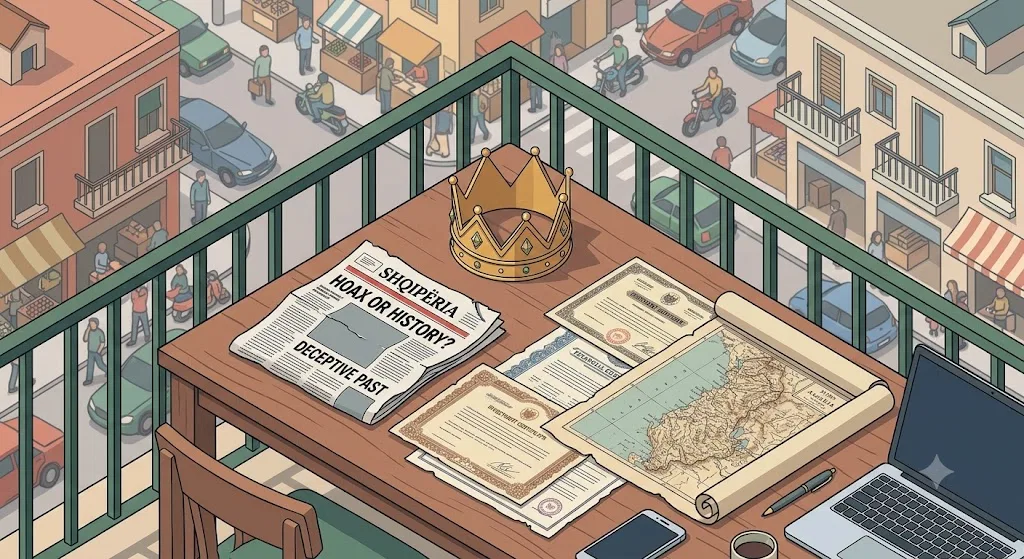
Albania’s best-known stories of deception do not form a simple parade of practical jokes. They range from a German showman’s invented royal adventure to state propaganda, nationwide investment fraud, repeated tourist statistics and a false earthquake warning that sent frightened residents into the streets. The common thread is not national gullibility.
Page outline Jump by section
Introduction
The clearest cases also require careful labels. Otto Witte’s supposed reign as king was almost certainly a self-promoting fantasy. The prosecutions after the 1951 Soviet Embassy bombing were a political fabrication built around a real incident. The investment companies of the 1990s were financial frauds, though some began with genuine business activities. Albania’s celebrated figure of 750,000 communist bunkers is better treated as an unverified statistic than a deliberate hoax. The 2019 earthquake scare, meanwhile, shows how quickly an unsupported claim can become a public emergency.
The circus performer who claimed Albania’s throne
The most entertaining Albanian hoax may never have happened in Albania at all. Otto Witte, a German circus performer, claimed that in 1913 he impersonated an Ottoman prince, arrived in the port of Durrës, won the loyalty of local troops and ruled as “King Otto I” for five days. According to his increasingly colourful account, he issued orders, enjoyed royal ceremony, declared military ambitions and escaped before genuine messages exposed him.
Witte’s tale exploited a real historical opening. Albania had declared independence from the Ottoman Empire in November 1912, but its political future remained unsettled while the European powers debated who should govern the new state. In 1914 the German prince Wilhelm of Wied really did arrive as Albania’s ruler, although his reign lasted only about six months. That genuine episode made the idea of an unexpected foreign prince plausible to audiences who knew little about the complicated Albanian situation.
The evidence for Witte’s own kingship, however, begins and ends with Witte. No persuasive Albanian record confirms his arrival, coronation or commands. Versions of the story changed, and some of its details do not fit the political chronology. Even the supposed prince whom Witte claimed to impersonate appears to have been confused with other Ottoman candidates discussed for the Albanian throne. The tale also resembles popular impostor fiction in which an adventurer takes the place of a monarch.[Wikipedia]WikipediaOtto WitteOtto Witte
What kept the story alive was not documentary proof but repetition. Witte performed his royal identity for decades, displayed an identity card describing him as a former king and had the claim placed on his gravestone. A 1958 Time profile repeated his account with much of its theatrical detail, while acknowledging his broader habit of telling extraordinary stories about his supposed exploits. The official-looking identity card was not evidence of a reign; it was effectively recognition of a stage name.[Time]time.comtollbit.time.com…
The Witte legend is therefore a hoax about Albania rather than a hoax successfully carried out against Albanians. It worked because the country’s brief post-independence uncertainty seemed exotic and disorderly to foreign readers. Each retelling converted that unfamiliar history into a comic tale about a circus man fooling an entire nation. The more accurate lesson is about how a performer, a receptive press and a genuine constitutional crisis can manufacture “history” without contemporary evidence.
When a real explosion became a fabricated conspiracy
A much darker deception followed a small explosion at the Soviet Embassy in Tirana on 19 February 1951. Albania’s communist leadership treated the incident as evidence of a broad hostile conspiracy. Within days, 22 intellectuals and other citizens were executed. They had not received a genuine trial establishing that they were responsible for the attack.
The important distinction is that the explosion itself was not invented. The fabrication lay in attaching selected political enemies to it and presenting punishment as the result of lawful investigation. Later accounts of the case describe arrests based on lists of people already regarded as suspect, collective accusations and legal approval produced only after the executions. The victims were eventually recognised as innocent after the collapse of communist rule.[Wikipedia]Wikipedia1951 executions in Albania1951 executions in Albania
The episode served a larger political purpose. Enver Hoxha’s government had aligned Albania closely with Stalin’s Soviet Union and portrayed internal dissent as part of a foreign-backed assault. By responding to a limited bombing with mass punishment, the authorities could frighten intellectuals, discipline potential opponents and demonstrate loyalty to Moscow. At a 2016 commemoration, the Organization for Security and Co-operation in Europe described the executions as crimes intended to instil terror in the population, particularly among intellectuals.[albania.osce.org]albania.osce.orgOpen source on osce.org.
This was not a conventional hoax designed for amusement or profit. It was an official false narrative enforced through police power. Its persuasive force came from the state’s control of information: the government could name the guilty, suppress contradictions and turn accusation into accepted fact. The later exposure did not depend on a single dramatic confession. It emerged from the opening of historical discussion, the recovery of records, testimony about the absence of due process and the post-communist rehabilitation of the dead.
The case remains significant because it shows how propaganda can be built around a genuine event. A real bomb supplied the emotional shock; invented collective guilt supplied the political utility. That combination is often more powerful than a completely fabricated story because authorities can point to the undeniable first fact while concealing the weakness of everything that follows.
The investment fraud that overwhelmed the state
Albania’s pyramid-scheme crisis of 1996–97 was one of the rare frauds large enough to help bring down public order. Investment companies promised exceptionally high monthly returns, paid earlier customers with money from later depositors and presented themselves as successful businesses in the new market economy. By November 1996, the schemes’ nominal liabilities had reached about $1.2 billion, an immense sum for Albania at the time.[IMF]imf.orgOpen source on imf.org.
Not every company fitted the same model. Some were pure pyramids without meaningful assets. Others, including several of the largest firms, owned real businesses or were alleged to earn money through smuggling and other criminal activity before their obligations outgrew their assets. That mixture helped the deception. A firm with offices, employees, construction projects or political connections looked more credible than an anonymous operator collecting cash.[IMF]imf.orgOpen source on imf.org.
The schemes spread in the difficult transition from communist isolation to capitalism. Albania had few private banks, limited access to ordinary credit and a public with little experience of regulated investment products. Remittances from Albanians working abroad brought cash into the country, while rapid economic change made previously unimaginable profits appear possible. High early payments acted as advertisements: neighbours who had already received money seemed to prove that the companies were genuine.
Government conduct further strengthened the illusion. Senior officials appeared at company events, some firms supported the ruling party and regulators failed to act decisively even as interest rates rose to obviously unsustainable levels. The government created an investigative committee in late 1996, but according to the International Monetary Fund account, it never met. Official hesitation encouraged investors to believe that the companies were either legitimate or protected.[IMF]imf.orgOpen source on imf.org.
The mechanism collapsed when new deposits slowed. Sude stopped making payments in November 1996; Sude and Gjallica declared bankruptcy in January 1997, and confidence in the remaining companies evaporated. Protests over lost savings became an uprising against the government. Police and soldiers deserted, armouries were looted and large parts of the country slipped beyond central control. The IMF later estimated that roughly 2,000 people were killed in the ensuing violence.[IMF]imf.orgOpen source on imf.org.
A contemporary House of Commons Library paper stressed that the crisis reflected more than reckless investing. Poverty, the absence of a proper banking system, flawed elections and suspicions of political involvement all intensified public anger. The international image of Albania as a successful democratic and free-market transition had also delayed recognition of serious institutional weaknesses.[Research Briefings]researchbriefings.files.parliament.ukResearch Briefings AlbaniaResearch Briefings Albania
The pyramid crisis is sometimes retold as a cautionary story about inexperienced citizens being seduced by easy money. That explanation is incomplete. Investors encountered companies that paid reliably for a time, possessed visible assets and enjoyed apparent political acceptance. The fraud succeeded not simply because the promised returns were attractive, but because private deception and public authority reinforced one another. When the companies failed, people did not merely discover that an investment had gone wrong. They discovered that much of the new economic order had been resting on claims the state had declined to test.
The uncertain total of Albania’s bunkers
Few facts about Albania are repeated more readily than the claim that Enver Hoxha’s government built 750,000 concrete bunkers—roughly one for every four inhabitants at the time. The bunkers themselves are real and remain among the most visible physical remnants of communist rule. The exact total is not.
Published estimates vary enormously, from about 150,000 or 175,000 to 750,000. Albania’s secretive government did not leave a readily verifiable public inventory, and later authorities inherited incomplete or missing information. National Geographic has reported a range of roughly 175,000 to 750,000, while other accounts acknowledge that nobody knows how many were actually constructed.[National Geographic]nationalgeographic.comOpen source on nationalgeographic.com.
The highest figure persists because it is memorable. “Seven hundred and fifty thousand bunkers” captures the scale and absurdity of Hoxha’s militarisation in a way that “an uncertain number in the hundreds of thousands” does not. The number has consequently circulated through travel writing, photo essays and tourism promotion, often stripped of its original uncertainty. Some reputable outlets have presented it as settled fact, helping to convert an estimate into a national legend.[WIRED]wired.comParanoid Dictator's Communist-Era Bunkers NowMarch 12, 2013 — 12 Mar 2013 — In Albania, 750,000 Communist-era bunkers populate the landscape, relics of the paranoia and skewed p…
Calling the figure a hoax would go too far unless evidence emerges that someone knowingly invented it. It is more accurately a case of false precision: an uncertain estimate repeated until familiarity gives it authority. The larger historical claim remains sound. Hoxha’s government built an extraordinary network of defensive structures, diverted resources into preparations for invasion and used the landscape itself to reinforce a permanent sense of external threat. The disputed total changes the arithmetic, not the reality of militarisation.
The bunker story is useful precisely because it shows how myths can grow around authentic objects. Visitors can see the concrete domes with their own eyes, so the accompanying statistic feels equally tangible. Yet physical evidence of “many” bunkers cannot prove a particular nationwide count.
A false earthquake prediction that produced real panic
On 21 September 2019, a magnitude-5.8 earthquake damaged buildings around Tirana and Durrës and injured more than 100 people. The following evening, Albanian media reports warned that a magnitude-6 aftershock had been predicted near midnight and urged residents to leave their homes. No reliable seismological prediction supported the claim.
The warning was especially potent because it followed a genuine earthquake. Residents had felt the ground move, seen damaged buildings and experienced repeated aftershocks. Many therefore treated the report as practical safety advice rather than speculation. People gathered in streets, slept in cars, moved towards open spaces and carried small bags in case they could not return home.[Voice of America]voanews.comOpen source on voanews.com.
Authorities publicly rejected the report, explaining that earthquakes cannot be forecast with that level of precision. Police questioned two journalists and described the publication as an attempt to cause fear and panic. The media outlet involved argued that the investigation was politically motivated, turning the incident into a dispute not only about accuracy but also about press freedom and the government’s power to punish alleged “fake news”.[Voice of America]voanews.comOpen source on voanews.com.
That dispute matters. A demonstrably unsupported emergency warning can cause harm, but broad laws against fearmongering may also be used against legitimate reporting. The exposure of the false prediction therefore did not settle every issue raised by the case. It established that the claimed forecast was unreliable; it did not automatically justify every official response to those who published it.
Two months later, Albania suffered a far more destructive magnitude-6.4 earthquake in which buildings collapsed and people were killed. That later disaster may make the September warning seem retrospectively prophetic, but it was not. A subsequent earthquake does not validate a precise prediction that named the wrong time and circumstances. Instead, the sequence illustrates why earthquake misinformation is so difficult to extinguish: when a region is genuinely seismically active, almost any vague warning can eventually appear to have “come true”.[The Guardian]theguardian.comThe Guardian Albania earthquake: at least 21 dead and hundreds injuredThe Guardian Albania earthquake: at least 21 dead and hundreds injured
Why these stories remain persuasive
Albania’s notable hoaxes and contested truths endured for different reasons, but each borrowed credibility from something real. Witte attached his fantasy to an actual search for a foreign ruler. Communist prosecutors attached fabricated guilt to an actual explosion. Pyramid companies displayed real offices, assets and early payments. The bunker statistic described genuine structures. The false aftershock warning appeared during a genuine seismic emergency.
They also reveal different beneficiaries. Witte gained fame and a lifelong stage identity. The communist state removed opponents and spread fear. Pyramid operators acquired deposits while political allies enjoyed economic activity and financial support. Travel writers gained an irresistible statistic. Online publishers gained attention from an alarming headline.
Exposure likewise took different forms. Historical chronology and missing records undermine Witte’s story. Legal and archival scrutiny revealed the injustice of the 1951 executions. Basic financial arithmetic, followed by default, exposed the pyramid companies. Conflicting surveys weakened confidence in the bunker count. Seismological expertise challenged the earthquake forecast almost immediately.
The most useful sceptical question is therefore not simply, “Is this story false?” It is, “Which part is documented, which part has been added, and who gains when the two are presented together?” Albania’s history shows that the most durable deceptions are rarely made from nothing. They are built around recognisable facts, then strengthened by authority, repetition and the audience’s understandable need to make sense of uncertainty.
Amazon book picks
Further Reading
Books and field guides related to Which Albanian Deceptions Became Believable History?. Use these as the next step if you want deeper reading beyond the article.
The Demon-Haunted World
Rating: 4.5/5 from 43 Google Books ratings
Useful for evaluating folklore, propaganda and hoaxes.
The Balkans
Provides context for Albanian myths, political narratives and historical controversies.
Modern Albania
Covers many of the political conditions behind notable Albanian deceptions.
eBay marketplace picks
Marketplace Samples
Live-tested eBay searches with available results related to this page.
Endnotes
1.
Source: Wikipedia
Title: Otto Witte
Link:https://en.wikipedia.org/wiki/Otto_Witte
2.
Source: time.com
Link:https://time.com/archive/6806317/albania-the-man-who-was-king/
Source snippet
tollbit.time.com...
3.
Source: Wikipedia
Title: 1951 executions in Albania
Link:https://en.wikipedia.org/wiki/1951_executions_in_Albania
4.
Source: albania.osce.org
Link:https://albania.osce.org/sites/default/files/f/documents/d/b/225931.pdf
5.
Source: imf.org
Link:https://www.imf.org/external/pubs/ft/fandd/2000/03/pdf/jarvis.pdf
6.
Source: wired.com
Title: Paranoid Dictator’s Communist-Era Bunkers Now
Link:https://www.wired.com/2013/03/david-galjaard-albanian-bunkers/
Source snippet
March 12, 2013 — 12 Mar 2013 — In Albania, 750,000 Communist-era bunkers populate the landscape, relics of the paranoia and skewed p...
Published: March 12, 2013
8.
Source: Wikipedia
Title: Otto Witte (Schausteller)
Link:https://de.wikipedia.org/wiki/Otto_Witte_%28Schausteller%29
9.
Source: Wikipedia
Title: List of miscellaneous fake news websites
Link:https://en.wikipedia.org/wiki/List_of_miscellaneous_fake_news_websites
10.
Source: Wikipedia
Title: [Pyramid schemes]({{ ‘pyramid-schemes/’ | relative_url }}) in Albania
Link:https://en.wikipedia.org/wiki/Pyramid_schemes_in_Albania
11.
Source: Wikipedia
Title: Museum of Secret Surveillance
Link:https://en.wikipedia.org/wiki/Museum_of_Secret_Surveillance
12.
Source: Wikipedia
Title: Bunkers in Albania
Link:https://en.wikipedia.org/wiki/Bunkers_in_Albania
13.
Source: history.state.gov
Link:https://history.state.gov/historicaldocuments/frus1951v04p2/d195
14.
Source: youtube.com
Link:https://www.youtube.com/watch?v=yHtWfJDFxA8
Source snippet
Albania - Crisis of confidence...
15.
Source: youtube.com
Link:https://www.youtube.com/watch?v=KOy1xCIly-U
Source snippet
pyramid scheme 1997 civil war The Ponzi Scam That Turned Albania Into WAR | 1997 Collapse Historic Wealth...
16.
Source: researchbriefings.files.parliament.uk
Title: Research Briefings Albania
Link:https://researchbriefings.files.parliament.uk/documents/RP97-59/RP97-59.pdf
17.
Source: nationalgeographic.com
Link:https://www.nationalgeographic.com/travel/article/photos-forgotten-military-bunkers
18.
Source: voanews.com
Link:https://www.voanews.com/a/europe_quake-rattled-albania-journalists-detained-fake-news-charges-after-falsely-warning/6176290.html
19.
Source: theguardian.com
Title: The Guardian Albania earthquake: at least 21 dead and hundreds injured
Link:https://www.theguardian.com/world/2019/nov/26/albania-earthquake-rescuers-search-rubble-after-most-powerful-tremor-in-decades
20.
Source: strangeflowers.wordpress.com
Title: otto witte
Link:https://strangeflowers.wordpress.com/tag/otto-witte/
21.
Source: ia800700.us.archive.org
Title: Abrams Atrocity Fab
Link:https://ia800700.us.archive.org/32/items/abrams-atrocity-fabrications/Abrams_AtrocityFab.pdf
22.
Source: amazingfacts.org
Title: Otto Witte
Link:https://www.amazingfacts.org/listen/bible-answers-live/otto-witte-king-for-five-days/
23.
Source: paschamd.jimdoweb.com
Title: otto witte
Link:https://paschamd.jimdoweb.com/geschichte-n/otto-witte/
Additional References
24.
Source: theretrospectors.com
Link:https://theretrospectors.com/on-this-day-the-fake-king-of-albania/
Source snippet
The Fake King of AlbaniaGerman circus performer Otto Witte went to his death-bed claiming he had been crowned King of Albania on 13th Aug...
25.
Source: roadsandkingdoms.com
Title: albanias bunker problem
Link:https://roadsandkingdoms.com/2017/albanias-bunker-problem/
Source snippet
Roads & KingdomsAlbania's Bunker Problem8 May 2017 — Indeed, no one knows how many were built in the first place; estimates range from 15...
Published: May 2017
26.
Source: balkanweb.com
Link:https://www.balkanweb.com/en/atentati-i-poshter-qe-armiku-i-eger-i-popullit-tone-dhe-i-bashkimit-sovjetik-na-beri-kunder-legates-sovjetike-ne-tirane-eshte-refleksionet-e-studiuesit-te-njohur-nga-shba/
27.
Source: researchgate.net
Link:https://www.researchgate.net/publication/320587525The_Activity_of_Pyramid_Schemes_in_Albania_1992-_1997_and_the_Effects_of_Their_Decline
28.
Source: onthisday.com
Link:https://www.onthisday.com/photos/a-royal-fantasy
29.
Source: facebook.com
Link:https://www.facebook.com/groups/589445355951479/posts/956122175950460/
30.
Source: facebook.com
Link:https://www.facebook.com/groups/589445355951479/posts/1203923054503703/
31.
Source: communistcrimes.org
Link:https://communistcrimes.org/en/countries/albania
32.
Source: facebook.com
Link:https://www.facebook.com/groups/589445355951479/posts/1062891128606897/
33.
Source: worksthatwork.com
Link:https://worksthatwork.com/3/albania-bunkers
Topic Tree
Follow this branch
Related pages 192
- Algerian Hoaxes
- Antigua Deceptions
- Argentina Hoaxes
- Armenian Hoaxes
- Austria Hoaxes
- +187 more in sidebar