Within Zambian Hoaxes
Did a Flying Reptile Haunt Western Zambia?
The kongamato story grew from local testimony, colonial retelling and weak identification methods rather than verified zoological proof.
On this page
- How the Kongamato Entered Print
- Why the Pterosaur Comparison Is Weak
- Folklore, Misidentification and Later Fakes
Page outline Jump by section
Introduction
The kongamato is one of Zambia’s most persistent mystery-animal stories: a reported flying creature from the wetlands of western and northern Zambia that later became famous in cryptozoology as a possible surviving pterosaur. The central question is simple: did witnesses describe a real unknown animal, or did a mixture of folklore, misidentification and enthusiastic retelling create the impression of a prehistoric survivor? The available evidence strongly favours the second explanation. While reports of unusual flying creatures have been recorded for more than a century, no verified photograph, specimen, fossil, feather, tissue sample or scientifically documented observation has ever confirmed the existence of a living pterosaur in Zambia. Instead, the story reveals how local traditions, colonial-era reporting and modern fascination with “living fossils” combined to create one of Africa’s best-known cryptozoological legends.[Wikipedia]WikipediaOpen source on wikipedia.org.

How the Kongamato Entered Print
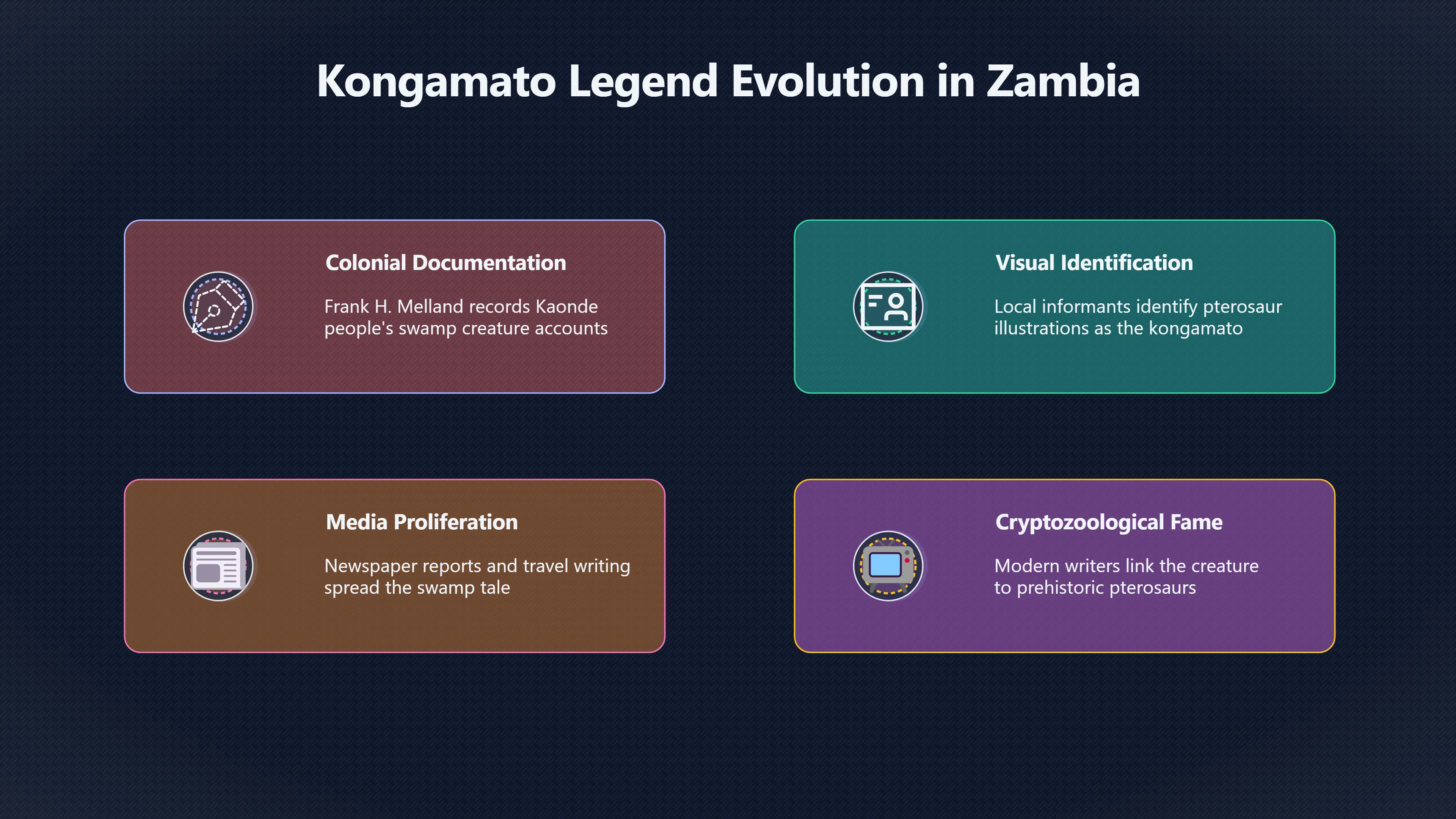
The modern history of the kongamato largely begins with British colonial administrator Frank H. Melland. In his 1923 book In Witch-Bound Africa, he recorded accounts from Kaonde-speaking people in what is now Zambia. They described a dangerous flying creature associated with rivers and swamps, reddish in colour and possessing bat-like wings rather than feathers. According to Melland’s account, when he showed illustrations of prehistoric flying reptiles, local informants identified the picture as resembling the creature they called the kongamato.[Wikipedia]WikipediaOpen source on wikipedia.org.
This moment became the foundation of nearly every later claim. What is often forgotten is that the evidence was not a captured animal or even a direct sighting by Melland. It was a report about how people interpreted an illustration. Later writers repeated the story so often that the identification itself began to be treated as evidence for a surviving pterosaur.[Wikipedia]WikipediaOpen source on wikipedia.org.
The tale gained further publicity through newspaper reports and travel writing during the colonial era. Stories circulated of wounded travellers, mysterious attacks in swamps and witnesses who supposedly reacted with alarm when shown pictures of pterosaurs. Each retelling added dramatic detail, but the underlying evidence remained anecdotal. No physical specimen accompanied the stories.[Wikipedia]WikipediaOpen source on wikipedia.org.
Why the Pterosaur Comparison Is Weak
The most famous claim about the kongamato is that it represents a surviving pterosaur, a group of flying reptiles believed to have disappeared about 66 million years ago. At first glance, some witness descriptions seem suggestive: leathery wings, a long beak and an apparent lack of feathers. Yet these similarities are far weaker than they first appear.[Wikipedia]WikipediaOpen source on wikipedia.org.
Descriptions of unusual animals are heavily shaped by culture and expectation. Once a witness is shown an image of a pterosaur and asked whether it resembles a mysterious creature, the answer does not necessarily establish a zoological connection. It merely shows that the picture matches a rough mental image. This is particularly important because many reported kongamato features vary between accounts, including colour, size and behaviour.[Wikipedia]WikipediaOpen source on wikipedia.org.
There are also biological problems. A breeding population of large flying reptiles would require food, habitat and sufficient numbers to avoid extinction. Such animals would be expected to leave physical traces: bodies, bones, nests, droppings, clear photographs or repeated observations by trained biologists. None have been produced despite decades of attention from cryptozoologists and wildlife researchers.[SpookySight]thehorrorcollection.comSpooky Sight What Is the Kongamato?Africa's Mysterious Winged Creature3 Jun 2025 — Challenges: Pterosaurs are believed to have gone extinct 66 million years ago, and no fos…
The fossil record creates another obstacle. While the fossil record is incomplete, there is no evidence that pterosaurs survived into recent geological times. Claims that one still exists in modern Africa therefore require extraordinary evidence, yet the kongamato case remains built almost entirely on stories and recollections.[SpookySight]thehorrorcollection.comSpooky Sight What Is the Kongamato?Africa's Mysterious Winged Creature3 Jun 2025 — Challenges: Pterosaurs are believed to have gone extinct 66 million years ago, and no fos…

What Investigators Actually Found
Supporters of the kongamato often point to reports of injuries or startling encounters. One frequently repeated story concerns a man allegedly treated after an attack by a strange flying animal, who supposedly drew something resembling a pterosaur. Another concerns later explorers who reported seeing large, unfamiliar creatures in remote wetlands.[Wikipedia]WikipediaOpen source on wikipedia.org.
The difficulty is that such reports are difficult to verify and often passed through several layers of retelling before reaching print. The original witnesses are frequently unavailable, the dates uncertain and the descriptions inconsistent. In historical terms, these are interesting folklore records, but they do not meet the standards normally used to establish the existence of an unknown species.[Wikipedia]WikipediaOpen source on wikipedia.org.
Even purported photographic evidence has failed to deliver. A photograph promoted in the twentieth century as evidence of a giant flying reptile was later identified as a fake, removing one of the few pieces of allegedly visual proof associated with the legend.[Wikipedia]WikipediaOpen source on wikipedia.org.
As a result, investigators repeatedly returned to the same position: intriguing stories exist, but reliable physical evidence does not.
Folklore, Misidentification and Later Fakes
A more plausible explanation is that the kongamato belongs to the broad category of folklore shaped by encounters with real animals. Large birds, storks, herons and other unusual wetland species can appear startling when seen briefly, at dusk or under stressful conditions. Giant bats have also been suggested as possible sources for some descriptions.[Wikipedia]WikipediaOpen source on wikipedia.org.
Folklore should not be dismissed as meaningless invention. Traditional stories often encode observations about dangerous places, animal behaviour and local landscapes. A creature associated with swamps, rivers and boating hazards may preserve cultural memories of genuine risks even if the creature itself is not a biological species. Research on folk-zoological traditions has shown that stories frequently transmit environmental knowledge alongside mythic elements.[arXiv]arxiv.orgSystematic quantitative analyses reveal the folk-zoological knowledge embedded in folktalesJuly 9, 2019…
The modern version of the kongamato was further transformed by cryptozoology. Writers searching for living dinosaurs and surviving prehistoric creatures found the story irresistible. Once linked to pterosaurs, the legend spread far beyond Zambia and began appearing in books, television programmes and internet discussions. In many retellings, uncertainty was gradually replaced by confidence, making tentative reports seem stronger than they really were.[dokumen.pub]dokumen.pubOn The Track Of Unknown Animals [1 ed.] 0710304986…Yet the mere suggestion that a dinosaur, a flying reptile or an apeman might survi…
The appearance of fabricated photographs and exaggerated claims illustrates a recurring pattern in monster lore. Weak evidence creates a demand for stronger evidence, and that demand can encourage embellishment, selective reporting or outright fakery. The kongamato story sits on the boundary between folklore, sincere eyewitness testimony, cryptozoological speculation and occasional deception.[Wikipedia]WikipediaOpen source on wikipedia.org.

Why the Story Endures
The kongamato survives because it offers something many mystery-animal stories lack: a specific location, a long history and a creature that appears to connect the modern world with deep prehistory. The image of a pterosaur-like animal gliding above remote African wetlands is memorable and dramatic.
Yet the search for evidence has consistently produced the same result. There are reports, traditions and stories, but no verified zoological proof. For that reason, the kongamato is best understood not as a confirmed hidden animal but as a case study in how legends evolve. Local testimony entered colonial literature, was reframed through prehistoric imagery and later became part of a global network of “living fossil” claims. The enduring mystery lies less in the existence of a flying reptile than in the way people interpret uncertain evidence and transform it into a modern legend.[wikipedia.org]WikipediaOpen source on wikipedia.org.
Amazon book picks
Further Reading
Books and field guides related to Did a Flying Reptile Haunt Western Zambia?. Use these as the next step if you want deeper reading beyond the article.
The Beasts That Hide from Man
Covers reports of unknown animals and their interpretations.
eBay marketplace picks
Marketplace Samples
Live-tested eBay searches with available results related to this page.



Endnotes
1.
Source: Wikipedia
Link:https://en.wikipedia.org/wiki/Kongamato
2.
Source: Wikipedia
Link:https://fr.wikipedia.org/wiki/Kongamato
3.
Source: Wikipedia
Link:https://es.wikipedia.org/wiki/Kongamato
4.
Source: dokumen.pub
Link:https://dokumen.pub/on-the-track-of-unknown-animals-1nbsped-0710304986-9780710304988.html
Source snippet
On The Track Of Unknown Animals [1 ed.] 0710304986...Yet the mere suggestion that a dinosaur, a flying reptile or an apeman might survi...
5.
Source: Wikipedia
Link:https://zh.wikipedia.org/wiki/%E5%BA%B7%E5%8A%A0%E7%91%AA%E6%89%98
6.
Source: arxiv.org
Link:https://arxiv.org/abs/1907.03969
Source snippet
Systematic quantitative analyses reveal the folk-zoological knowledge embedded in folktalesJuly 9, 2019...
Published: July 9, 2019
7.
Source: youtube.com
Link:https://www.youtube.com/watch?v=X-lWVqX_tHo
Source snippet
"5 Kongamato: Prehistoric Jungle Cryptid?[https://www.youtube.com/watch?v=jq_-Al5pZv4..."](https://www.youtube.com/watch?v=jq_-Al5pZv4...")...
8.
Source: thehorrorcollection.com
Title: Spooky Sight What Is the Kongamato?
Link:https://thehorrorcollection.com/what-is-the-kongamato/
Source snippet
Africa's Mysterious Winged Creature3 Jun 2025 — Challenges: Pterosaurs are believed to have gone extinct 66 million years ago, and no fos...
9.
Source: cryptidz.fandom.com
Link:https://cryptidz.fandom.com/wiki/Kongamato
10.
Source: monster.fandom.com
Link:https://monster.fandom.com/wiki/Kongamato
11.
Source: cryptidarchives.fandom.com
Link:https://cryptidarchives.fandom.com/wiki/Kongamato
12.
Source: abookofcreatures.com
Link:https://abookofcreatures.com/2019/05/20/kongamato/
Additional References
13.
Source: facebook.com
Link:https://www.facebook.com/100088901093279/posts/the-kongamato-such-as-a-modern-ancient-flying-reptiles/562743300032368/
14.
Source: facebook.com
Link:https://www.facebook.com/groups/487648871307669/posts/6744716172267543/
Source snippet
Who here believes or doesn't that the “living pterosaurs”...They have seen the Kongamato, the flying reptile nicknamed "the breaker of b...
15.
Source: youtube.com
Title: Kongamato: Africa’s Flying Prehistoric-Looking Reptilian Cryptid
Link:https://www.youtube.com/watch?v=ueg8astigKo
Source snippet
3 Living Pterosaur Caught on Camera? - real or fake...
16.
Source: youtube.com
Title: Living Pterosaur Caught on Camera?
Link:https://www.youtube.com/watch?v=d2A7TxiOl3E
Source snippet
4 Kongamato - The Winged Dinosaur of African Rivers - African Creatures...
17.
Source: researchgate.net
Link:https://www.researchgate.net/publication/393019365_Thought_Experiment_Extrapolation_of_the_Reverse_Bionic_Mechanisms_in_the_Reconstruction_of_the_Anatomy_and_Biology_of_a_Hypothetical_Dragon
18.
Source: reddit.com
Link:https://www.reddit.com/r/Cryptozoology/comments/1ju5pgx/a_painting_of_a_kongamato_a_pterosaur_or_flying/
19.
Source: facebook.com
Link:https://www.facebook.com/groups/149844915349213/posts/2496908903976124/
20.
Source: reddit.com
Link:https://www.reddit.com/r/Cryptozoology/comments/1one51p/frank_melland_the_man_who_first_collected/
21.
Source: archive.org
Link:https://archive.org/stream/Cryptozoology_201608/Cryptozoology_djvu.txt
22.
Source: lemon8-app.com
Link:https://www.lemon8-app.com/%40cryptidencyclopedia/7454305486037369386?region=us
Topic Tree