Within North Macedonia Hoaxes
Why Fake Political News Paid So Well in Veles
Publishers in Veles turned American political outrage into advertising income by copying, distorting and inventing viral stories.
On this page
- How the publishing network worked
- Why American audiences and Facebook amplified it
- What the episode did and did not prove
Page outline Jump by section
Introduction
The story of Veles became one of the most revealing examples of how online misinformation can be driven by economics rather than ideology. During the 2016 United States presidential election, dozens—and by some estimates hundreds—of websites linked to the North Macedonian town of Veles published sensational political stories aimed primarily at American readers. Many articles were copied, distorted or entirely fabricated. Their creators were not necessarily trying to influence voters. Instead, they were exploiting a simple business model: attract clicks, generate advertising impressions and earn money. Investigations by journalists and later academic research found that Veles developed into a local centre of expertise for viral publishing, where young website operators shared techniques for finding traffic and monetising attention.[Cambridge University Press & Assessment]cambridge.orgCambridge University Press & AssessmentThe Macedonian Fake News Industry and the 2016 US…by HC Hughes · 2021 · Cited by 106 — Many of…

The episode matters because it demonstrated how false information could become profitable on a global scale. Rather than a centrally directed propaganda campaign, much of the activity emerging from Veles resembled an entrepreneurial industry built around Facebook engagement, online advertising networks and highly polarised audiences.[cambridge.org]cambridge.orgCambridge University Press & AssessmentThe Macedonian Fake News Industry and the 2016 US…by HC Hughes · 2021 · Cited by 106 — Many of…
How the Publishing Network Worked
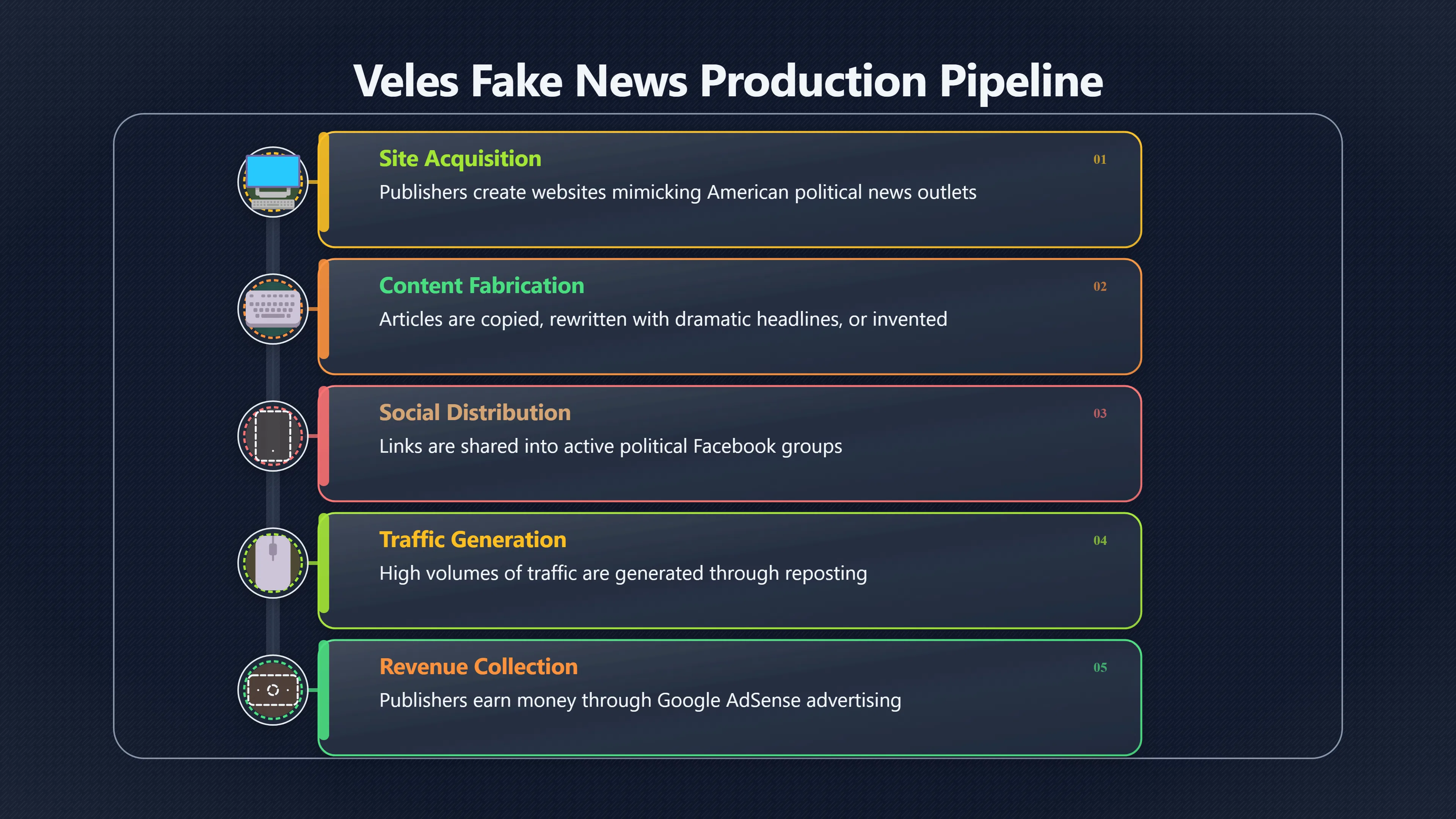
At the heart of the Veles phenomenon was a straightforward commercial mechanism. Publishers created websites that looked like American political news outlets, often using domain names and layouts designed to appear familiar or trustworthy. Content was gathered from partisan websites, copied from elsewhere on the internet, rewritten with more dramatic headlines, or invented outright.[WIRED]wired.comveles macedonia fake newsWIREDInside the Macedonian Fake-News Complex15 Feb 2017 — The sites' ample traffic was rewarded handsomely by automated advertising engin…
The process typically followed a predictable sequence:
- Create or acquire a website that appeared to cover American politics.
- Publish highly emotional stories, often favouring one political side because those stories attracted greater engagement.
- Share links into Facebook groups and pages where politically committed users were already active.
- Generate large volumes of traffic through sharing and reposting.

- Collect advertising revenue through services such as Google AdSense. WIRED+2WIRED
Researchers studying the phenomenon later found that Veles was not simply a collection of isolated teenagers acting independently. Local knowledge networks emerged in which successful operators taught others how to register domains, optimise headlines, manage Facebook distribution and maximise advertising returns. Academic fieldwork identified social-media trainer Mirko Ceselkoski as a significant influence within this ecosystem, helping spread technical knowledge about viral publishing and online monetisation. Cambridge University Press & Assessment
What made the model attractive was the economic context. Veles had limited opportunities for well-paid work, particularly for younger people. The prospect of earning in a few months what might otherwise take years in local employment made website publishing highly appealing. Journalistic investigations documented operators who earned sums vastly above average local wages during the election period. ETUI
Why American Audiences and Facebook Amplified It
The success of the Veles publishers depended less on North Macedonia than on conditions inside the American media environment.
Facebook’s algorithms rewarded content that generated strong reactions. Stories that provoked anger, fear, outrage or excitement were more likely to be shared. Publishers quickly learned that dramatic political claims performed better than careful reporting. A fabricated story could often attract more engagement than a verified one because novelty and emotion encouraged users to pass it along. WIRED+2arXiv
Many operators discovered that pro-Trump stories were particularly profitable. This did not necessarily indicate political commitment. Investigations repeatedly found publishers describing audience behaviour in commercial terms: certain topics simply produced more clicks. One teenager interviewed by journalists argued that false stories were more lucrative because genuinely reported news appeared everywhere, while fabricated stories were unique and therefore attracted attention. CBS News
The audience effectively became part of the production process. Publishers supplied provocative content, but readers supplied distribution. Sharing within Facebook groups allowed articles from obscure websites in North Macedonia to reach millions of Americans with little or no marketing budget. Researchers examining misinformation generally note that false political stories often spread rapidly because they exploit existing partisan identities and emotional reactions. arXiv+2arXiv
This created a feedback loop:
- Emotional stories attracted clicks.
- Clicks generated advertising revenue.
- Revenue encouraged more publishers to enter the market.
- Competition pushed headlines toward greater sensationalism.
- Increased sensationalism generated more engagement. WIRED+2WIRED
In this sense, the real engine of the Veles industry was not the production of misinformation alone but the combination of platform incentives, advertising systems and audience behaviour.
The Human Scale of the Digital Gold Rush
The image of a small Balkan town influencing a major American election attracted enormous media attention, but life inside Veles often looked far less dramatic. Reports from the town described teenagers and young adults working from bedrooms, cafés and small offices, experimenting with websites in much the same way others might experiment with online gaming, affiliate marketing or cryptocurrency. WIRED
Some operators treated the activity as a temporary opportunity rather than a political mission. Wired documented one publisher who earned nearly US$16,000 in a few months from pro-Trump websites, an extraordinary sum compared with local income levels. Others openly acknowledged that they had little interest in American politics and were simply following whichever topics generated the most traffic. WIRED
The town consequently became a symbol of a broader shift in the internet economy. Information itself was not necessarily the product. Attention was the product. Political stories happened to be among the most profitable ways to capture it.
What the Episode Did and Did Not Prove
One of the most persistent misunderstandings is that Veles demonstrated a single organised foreign operation designed to determine the outcome of the 2016 US election. The available evidence supports a more complicated picture.
Research and reporting clearly show that many highly successful false stories originated from websites linked to Veles and that their creators earned money through online advertising. They also show that local publishers developed techniques for exploiting Facebook’s distribution systems and politically engaged audiences. Cambridge University Press & Assessment+2WIRED
However, the evidence does not support the idea that all Veles publishers formed a unified political movement. Academic fieldwork found strong commercial motivations and a loose network of entrepreneurs rather than a disciplined propaganda organisation. Many participants appeared motivated primarily by income rather than ideology. Cambridge University Press & Assessment
Nor does the Veles story prove that misinformation succeeds only because it is created. The episode highlighted the importance of demand. False stories spread because readers shared them, algorithms promoted them and advertising systems rewarded them. Without those supporting structures, the websites would have attracted little attention. arXiv+2arXiv
Why Veles Remains a Landmark Case
The significance of Veles lies less in any individual fake story than in the mechanism it revealed. The town became an unusually visible example of a wider internet economy in which publishers could profit from attention regardless of accuracy. Its operators exposed weaknesses in social-media distribution, digital advertising and online news consumption that existed far beyond North Macedonia. Cambridge University Press & Assessment+2WIRED
The episode also helped trigger responses from technology companies. As scrutiny increased after the election, Facebook and other platforms introduced measures intended to reduce the reach and profitability of false news pages, acknowledging that financial incentives had played a major role in the problem. Axios
Within the broader history of hoaxes and manufactured information associated with North Macedonia, Veles stands out because it was neither an ancient legend nor a single forgery. It was an industrialised system for turning attention into money. The deception lay not only in individual false stories but in a business model that rewarded publishers whenever readers chose outrage, confirmation and spectacle over verification. Cambridge University Press & Assessment+2WIRED
Amazon book picks
Further Reading
Books and field guides related to Why Fake Political News Paid So Well in Veles. Use these as the next step if you want deeper reading beyond the article.

Trust Me, I'm Lying
Closely matches the economics of attention behind Veles fake-news sites.

eBay marketplace picks
Marketplace Samples
Live-tested eBay searches with available results related to this page.




Endnotes
1.
Source: cambridge.org
Link:https://www.cambridge.org/core/journals/ps-political-science-and-politics/article/macedonian-fake-news-industry-and-the-2016-us-election/79F67A4F23148D230F120A3BD7E3384F
Source snippet
Cambridge University Press & AssessmentThe Macedonian Fake News Industry and the 2016 US...by HC Hughes · 2021 · Cited by 106 — Many of...
3.
Source: wired.com
Link:https://www.wired.com/story/fake-news-macedonia/
Source snippet
Monetising misinformation: inside the fake news capital of...May 7, 2017 — The first article about Donald Trump that Boris ever pub...
Published: May 7, 2017
4.
Source: wired.com
Title: here s how fake news works and how the internet can stop it
Link:https://www.wired.com/video/watch/here-s-how-fake-news-works-and-how-the-internet-can-stop-it
Source snippet
The most popular stories were pro-Trump. but that's not because Boris and his fake news publishers.Read more...
5.
Source: etui.org
Link:https://www.etui.org/topics/health-safety-working-conditions/hesamag/the-future-of-work-in-the-digital-era/in-veles-meeting-the-producers-of-fake-news
Source snippet
In Veles, meeting the producers of fake newsIn Veles, a run-down city in Macedonia, a discrete but prosperous sector is booming – the...
7.
Source: arxiv.org
Title: arXiv The science of fake news
Link:https://arxiv.org/abs/2307.07903
8.
Source: arxiv.org
Link:https://arxiv.org/abs/1804.03461
9.
Source: arxiv.org
Title: arXiv Prevalence and Propagation of Fake News
Link:https://arxiv.org/abs/2106.09586
10.
Source: arxiv.org
Title: arXiv The Fake News Spreading Plague: Was it Preventable?
Link:https://arxiv.org/abs/1703.06988
11.
Source: axios.com
Title: Facebook cracks down on pages that post fake news to make money
Link:https://www.axios.com/2017/12/15/facebook-cracks-down-on-pages-that-post-fake-news-to-make-money-1513305124
12.
Source: wired.com
Title: inside facebook mark zuckerberg 2 years of hell
Link:https://www.wired.com/story/inside-facebook-mark-zuckerberg-2-years-of-hell
13.
Source: wired.com
Link:https://www.wired.com/video/watch/inside-the-fake-news-factory-of-macedonia
14.
Source: cambridge.org
Title: the macedonian fake news industry and the 2016 us election
Link:https://www.cambridge.org/core/services/aop-cambridge-core/content/view/79F67A4F23148D230F120A3BD7E3384F/S1049096520000992a.pdf/the-macedonian-fake-news-industry-and-the-2016-us-election.pdf
15.
Source: cambridge.org
Title: most cited
Link:https://www.cambridge.org/core/journals/ps-political-science-and-politics/most-cited?pageNum=12
16.
Source: cambridge.org
Link:https://www.cambridge.org/core/journals/ps-political-science-and-politics/volume/DC7D2B03AF6B6AE479C0368D4EE8AEA8
17.
Source: facebook.com
Link:https://www.facebook.com/colbertlateshow/posts/turns-out-100-different-fake-news-sites-came-from-teenagers-in-one-small-macedon/986013131543438/
18.
Source: facebook.com
Title: buzzfeed news identified more than 100 pro trump websites being run from a singl
Link:https://www.facebook.com/TheDemocraticCoalition/posts/buzzfeed-news-identified-more-than-100-pro-trump-websites-being-run-from-a-singl/560607010809345/
19.
Source: cris.haifa.ac.il
Title: the macedonian fake news industry and the 2016 us election 2
Link:https://cris.haifa.ac.il/en/publications/the-macedonian-fake-news-industry-and-the-2016-us-election-2/
Source snippet
University of HaifaThe Macedonian Fake News Industry and the 2016 US...During fieldwork in Veles, where we interviewed several residents...
20.
Source: cbsnews.com
Title: fake news macedonia teen shows how its done
Link:https://www.cbsnews.com/news/fake-news-macedonia-teen-shows-how-its-done/
Source snippet
CBS NewsIn Macedonia's fake news hub, this teen shows how it's done2 Dec 2016 — VELES, Macedonia -- On the second floor of a noisy sports...
21.
Source: youtube.com
Link:https://www.youtube.com/watch?v=EZNQlCjC6T4
Additional References
22.
Source: youtube.com
Link:https://www.youtube.com/watch?v=mLu0ze5L-6E
Source snippet
Election info changes quickly. Verify responses with official sources...
23.
Source: youtube.com
Title: Heather Hughes: the Fake News industry in North Macedonia
Link:https://www.youtube.com/watch?v=wDM2RFtGQyw
Source snippet
65 - Jonas Bendiksen - THE BOOK OF VELES...
24.
Source: apsanet.org
Link:https://apsanet.org/membership/organized-sections/organized-section-awards/past-awards/section-18/
25.
Source: wgbh.org
Link:https://www.wgbh.org/news/2016-11-16/kids-in-macedonia-made-up-and-circulated-many-false-news-stories-in-the-us-election
26.
Source: youtube.com
Title: Macedonia’s Fake News Factories | AJ+
Link:https://www.youtube.com/watch?v=qjnsV8MhVK8
Source snippet
Heather Hughes: the Fake News industry in North Macedonia...
27.
Source: youtube.com
Link:https://www.youtube.com/watch?v=V9oLp-RnoLk
Source snippet
2022 Contest | Show & Tell: Jonas Bendiksen...
28.
Source: youtube.com
Link:https://www.youtube.com/watch?v=ZusqgWUNFG4
29.
Source: researchgate.net
Title: 343860333 The Macedonian Fake News Industry and the 2016 US Election
Link:https://www.researchgate.net/publication/343860333_The_Macedonian_Fake_News_Industry_and_the_2016_US_Election
30.
Source: youtube.com
Title: The Town Of Fake News Trolls Who Helped Shape a US Election
Link:https://www.youtube.com/watch?v=rqWW208m-V0
Source snippet
Macedonia's Fake News Factories | AJ+...
31.
Source: culanth.org
Title: the fake news mills of macedonia and other liberal panics 1
Link:https://www.culanth.org/fieldsights/the-fake-news-mills-of-macedonia-and-other-liberal-panics-1
Topic Tree