Within Moroccan Hoaxes
How a Fake Prince Built Real Power
Bou Hmara turned a borrowed princely identity into a powerful rebellion by joining royal symbolism to real political grievances.
On this page
- The identity Bou Hmara claimed
- Why the imposture gained support
- How military power and foreign concessions ended it
Page outline Jump by section
Introduction
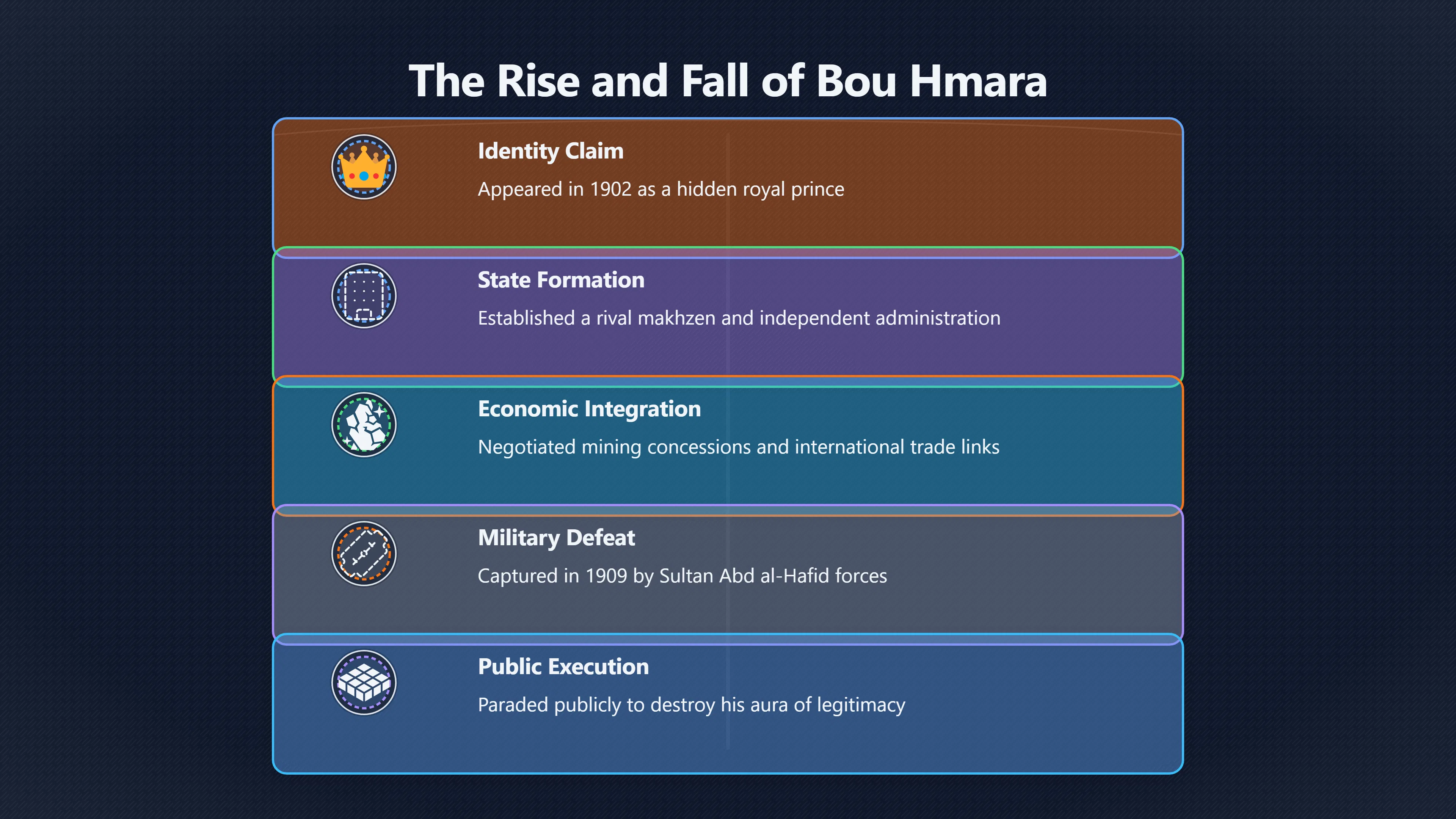
Bou Hmara is one of the most remarkable impostors in Moroccan history because his deception did not remain a personal fraud. By claiming to be a hidden prince of the ruling Alaouite dynasty, he transformed a false identity into a functioning rebel state that controlled large parts of north-eastern Morocco for years. Between 1902 and 1909, he raised armies, collected taxes, negotiated with foreign businesses, granted mining concessions and repeatedly defeated forces sent by the sultan. His story shows how an imposture can become politically powerful when it taps into genuine grievances and institutional weakness rather than relying on deception alone.[wikipedia.org]WikipediaBou HmaraBou Hmara
In the wider history of Moroccan hoaxes and contested claims, Bou Hmara stands out because the central falsehood was clear: he was not the royal prince he claimed to be. Yet the political movement built around that claim became real enough to challenge the state itself.[Wikipedia]WikipediaBou HmaraBou Hmara
The Identity Bou Hmara Claimed
Bou Hmara was born Jilali ibn Idris al-Zarhuni, a man with enough education and administrative experience to understand how the Moroccan state operated. He had studied in Fez, served in minor government roles and was familiar with the language of royal authority. Before launching his rebellion, he had even been imprisoned on charges connected to forgery, a detail that later reinforced his reputation as a skilled deceiver.[Wikipedia]WikipediaBou HmaraBou Hmara
Around 1902 he appeared in north-eastern Morocco claiming to be Mawlay Muhammad, a brother of Sultan Abd al-Aziz and, according to his supporters, the rightful heir to the throne. The claim was unusually plausible because the real prince was rarely seen in public. Most Moroccans had no practical way to compare the claimant with the genuine royal figure. In an age without mass photography, national broadcasting or rapid communication, personal identity could be difficult to verify across large distances.[Wikipedia]WikipediaBou HmaraBou Hmara
Bou Hmara did not simply announce himself as a prince. He wrapped the claim in religious symbolism, stories of special powers and predictions that enhanced his image as a divinely favoured ruler. Colonial-era observers often emphasised these tales, but historians generally regard them as only one part of a much larger political strategy.[Wikipedia]WikipediaBou HmaraBou Hmara
Why the Imposture Gained Support
The success of Bou Hmara’s claim cannot be explained by gullibility. Morocco at the start of the twentieth century was experiencing severe political tensions. The authority of the central government was under pressure, regional leaders possessed substantial autonomy, and European powers were increasing their influence in Moroccan affairs. Many communities were already dissatisfied with existing arrangements.[JSTOR]jstor.orgThe government failed to capture him or to reoccupy Taza. From 1903 until the summer of 1909 the…
Bou Hmara offered something more attractive than a simple rebellion. He claimed legitimacy. By presenting himself as a member of the royal family rather than an ordinary insurgent, he could frame opposition to the sultan as loyalty to the “correct” ruler. This gave tribal allies and local elites a political justification for supporting him.[Wikipedia]WikipediaBou HmaraBou Hmara
Several factors helped the imposture spread:
- Limited ability to verify identity: Most people never saw members of the royal family in person.[Wikipedia]WikipediaBou HmaraBou Hmara
- Existing dissatisfaction with government: Supporters often had political or economic grievances independent of the identity claim.[JSTOR]jstor.orgThe government failed to capture him or to reoccupy Taza. From 1903 until the summer of 1909 the…
- Military success: Each victory against government forces made his claim appear more credible. Success itself became evidence in the eyes of many followers.[JSTOR]jstor.orgThe government failed to capture him or to reoccupy Taza. From 1903 until the summer of 1909 the…
- Religious and charismatic authority: Stories of miracles and divine favour strengthened his public image.[Wikipedia]WikipediaBou HmaraBou Hmara
The result was that many supporters may have cared less about proving his genealogy than about the political alternative he represented.
When the Pretender Built a Rival State
One reason Bou Hmara remains historically important is that he moved beyond rebellion and created something resembling an alternative government. Historians describe him as establishing a rival makhzen—a competing state apparatus operating outside the authority of the sultan.[dokumen.pub]dokumen.pubThe Berbers of Morocco: A History of Resistance…This was the turmoil that paved the way for rogui (“pretender”) Bou Hmara (“the man on…
From bases around Taza and neighbouring regions, he exercised control over territory, maintained armed forces and managed revenue streams. He collected customs duties, supervised trade routes and governed populations under his authority. Government expeditions repeatedly failed to eliminate him, allowing his administration to survive far longer than many contemporary observers expected.[JSTOR]jstor.orgThe government failed to capture him or to reoccupy Taza. From 1903 until the summer of 1909 the…
This is the crucial distinction between Bou Hmara and many royal pretenders elsewhere. The false identity was only the starting point. What sustained his power was the creation of institutions, alliances and military capabilities that gave practical force to the claim.[JSTOR]jstor.orgThe government failed to capture him or to reoccupy Taza. From 1903 until the summer of 1909 the…
How Foreign Commerce Helped Sustain the Rebellion
Bou Hmara’s state survived not only because of local support but also because it became connected to wider commercial networks. Research by historian Ross Dunn argues that these external links were central to the durability of his regime.[Cambridge University Press & Assessment]cambridge.orgCambridge University Press & AssessmentBū Himāra's European connexion: the commercial…by RE Dunn · 1980 · Cited by 18 — This paper arg…
His administration developed economic relationships that generated income and supplied military resources. These included:
- Trade with European and Algerian commercial interests.
- Collection of customs revenues from commerce passing through territories he controlled.
- Importation of firearms and other supplies.
- Negotiation of mining concessions with foreign companies.[Cambridge University Press & Assessment]cambridge.orgCambridge University Press & AssessmentBū Himāra's European connexion: the commercial…by RE Dunn · 1980 · Cited by 18 — This paper arg…
These arrangements helped transform a regional uprising into a semi-independent political entity capable of resisting the Moroccan state for years. Rather than operating as an isolated warlord, Bou Hmara became integrated into international economic networks.[Cambridge University Press & Assessment]cambridge.orgCambridge University Press & AssessmentBū Himāra's European connexion: the commercial…by RE Dunn · 1980 · Cited by 18 — This paper arg…
How Military Power and Foreign Concessions Ended It
The same mechanisms that strengthened Bou Hmara eventually contributed to his downfall.
As his territory expanded, maintaining loyalty among different tribal groups became increasingly difficult. His decision to grant mining rights and concessions to foreign interests proved particularly controversial. Supporters who had tolerated or embraced his rebellion began to view these arrangements as a betrayal of local interests. Opposition grew among influential groups in the Rif and surrounding regions.[wikipedia.org]WikipediaBou HmaraBou Hmara
At the same time, Morocco’s political situation changed. Sultan Abd al-Aziz was replaced by Abd al-Hafid, who proved more determined and effective in confronting the pretender. Government forces, supported by improved military resources, launched new campaigns against Bou Hmara. After years of resistance, he was captured in 1909 when government troops finally overcame his strongholds.[Wikipedia]WikipediaBou HmaraBou Hmara
His punishment was deliberately theatrical. Contemporary accounts describe him being paraded publicly before execution, a spectacle intended to destroy the aura of legitimacy that had sustained the imposture. The message was clear: the supposed prince was neither royal nor invincible.[Wikipedia]WikipediaBou HmaraBou Hmara
Was It a Hoax or a Political Movement?
Bou Hmara occupies an unusual place in the history of deception because the answer is both.
As a matter of identity, the claim was fraudulent. He was not the royal prince he pretended to be. In that sense, the episode belongs alongside famous impostures in world history.[Wikipedia]WikipediaBou HmaraBou Hmara
Yet reducing the story to a successful impersonation misses why it mattered. His movement endured because it addressed real political frustrations, mobilised genuine military support and built functioning structures of rule. Historians studying the rebellion therefore treat it not merely as a hoax but as a serious challenge to the Moroccan state during a period of profound instability.[jstor.org]jstor.orgThe government failed to capture him or to reoccupy Taza. From 1903 until the summer of 1909 the…
The episode illustrates a broader lesson about impostures in politics. False identities rarely gain lasting power through deception alone. They succeed when they attach themselves to existing social tensions, unmet demands and credible institutions. Bou Hmara’s claim to be a prince was false, but the power he accumulated was very real.
Why claims about Bou Hmara remained persuasive
More than a century later, Bou Hmara remains one of Morocco’s most memorable pretenders. His rise demonstrates how legitimacy can be constructed from a mixture of symbolism, military success and political opportunity. It also shows the limits of imposture: once military victories faded and support networks fractured, the borrowed identity could no longer sustain the regime.[wikipedia.org]WikipediaBou HmaraBou Hmara
For readers interested in the history of hoaxes, the case is especially revealing because it blurs the line between fraud and state-building. A fake prince created a real government, and for several years much of north-eastern Morocco lived under its authority. That combination of deception and genuine political power makes Bou Hmara one of the most consequential impostors in modern North African history.[jstor.org]jstor.orgThe government failed to capture him or to reoccupy Taza. From 1903 until the summer of 1909 the…
Amazon book picks
Further Reading
Books and field guides related to How a Fake Prince Built Real Power. Use these as the next step if you want deeper reading beyond the article.
A History of Modern Morocco
Covers the political environment in which Bou Hmara emerged.
eBay marketplace picks
Marketplace Samples
Live-tested eBay searches with available results related to this page.



Endnotes
1.
Source: Wikipedia
Title: Bou Hmara
Link:https://en.wikipedia.org/wiki/Bou_Hmara
2.
Source: jstor.org
Link:https://www.jstor.org/stable/4282815
Source snippet
The government failed to capture him or to reoccupy Taza. From 1903 until the summer of 1909 the...
3.
Source: cambridge.org
Link:https://www.cambridge.org/core/journals/journal-of-african-history/article/bu-himaras-european-connexion-the-commercial-relations-of-a-moroccan-warlord/2D52AC9A483C7D5B42AE6476898484EA
Source snippet
Cambridge University Press & AssessmentBū Himāra's European connexion: the commercial...by RE Dunn · 1980 · Cited by 18 — This paper arg...
4.
Source: Wikipedia
Title: Abdelaziz of Morocco
Link:https://en.wikipedia.org/wiki/Abdelaziz_of_Morocco
5.
Source: dokumen.pub
Link:https://dokumen.pub/the-berbers-of-morocco-a-history-of-resistance-1838600469-9781838600464.html
Source snippet
The Berbers of Morocco: A History of Resistance...This was the turmoil that paved the way for rogui (“pretender”) Bou Hmara (“the man on...
6.
Source: jstor.org
Link:https://www.jstor.org/stable/182137
7.
Source: Wikipedia
Title: Mohammed Ameziane
Link:https://en.wikipedia.org/wiki/Mohammed_Ameziane
8.
Source: Wikipedia
Title: Abd al-Hafid of Morocco
Link:https://en.wikipedia.org/wiki/Abd_al-Hafid_of_Morocco
9.
Source: 2009-2017.state.gov
Link:https://2009-2017.state.gov/outofdate/bgn/morocco/74209.htm
10.
Source: Wikipedia
Title: Rogui Bou Hmara
Link:https://fr.wikipedia.org/wiki/Rogui_Bou_Hmara
Additional References
11.
Source: youtube.com
Title: The History of the Alaouite Dynasty: From Its Foundation to King Mohammed VI
Link:https://www.youtube.com/watch?v=-FL77Oy84YY
Source snippet
31st March 1905: Kaiser Wilhelm II provokes the First Moroccan Crisis...
Published: March 1905
12.
Source: youtube.com
Link:https://www.youtube.com/watch?v=fHK3QLQZEdQ
Source snippet
The Moroccan Crises | The British Empire | AQA A Level History...
Published: March 1905
13.
Source: instagram.com
Link:https://www.instagram.com/p/Css9LjvKro9/
Source snippet
September 2, 1909 in Fez) was a Moroccan rebel and...On September 2, 1909, Jilali Ben Driss Zerhouni El Youssefi nicknamed Rogui Bou Hma...
Published: September 2, 1909
14.
Source: upload.wikimedia.org
Link:https://upload.wikimedia.org/wikipedia/commons/a/ab/A_bibliography_of_Morocco%2C_from_the_earliest_times_to_the_end_of_1891_%28IA_bibliographyofmo00play%29.pdf
15.
Source: roughguides.com
Link:https://www.roughguides.com/morocco/history/
16.
Source: catalogue.leidenuniv.nl
Link:https://catalogue.leidenuniv.nl/permalink/31UKB_LEU/s5ab2f/alma9939085895902711
17.
Source: opac.feb.uinjkt.ac.id
Link:https://opac.feb.uinjkt.ac.id/repository/f6949d527815bbac74337119b028cd42.pdf
18.
Source: youtube.com
Title: The Sultan Who Broke the System
Link:https://www.youtube.com/watch?v=MxU2LiaK1nw
Source snippet
The History of the Alaouite Dynasty: From Its Foundation to King Mohammed VI...
19.
Source: iai.it
Link:https://www.iai.it/en/publications/c41/eu-morocco-trade-and-western-sahara-prolonged-struggle-between-law-and-realpolitik
20.
Source: the197initiative.org
Title: beyond trade the economic and social dimensions of moroccan european relations
Link:https://www.the197initiative.org/post/beyond-trade-the-economic-and-social-dimensions-of-moroccan-european-relations
Topic Tree