Within PNG Hoaxes
Were the Asaro Mudmen Really an Ancient Tradition?
The famous Mudmen performance grew through shows, tourism and local adaptation without becoming merely fake.
On this page
- How the familiar performance emerged in the 1950 s
- What older local practices contributed to it
- Why invention does not automatically mean fraud
Page outline Jump by section
Introduction
Were the Asaro Mudmen really an ancient tradition? The short answer is both yes and no. The famous image recognised around the world today—the towering clay masks, ghostly white bodies and slow, eerie movements—appears to be a relatively recent creation that took shape in the late 1950s. Yet it was not invented from nothing. It drew on older local practices of disguise, warfare, body covering and storytelling that already existed in the Eastern Highlands of Papua New Guinea. The result was a new cultural performance that became so successful that many outsiders came to assume it had existed unchanged for centuries. Anthropologists who investigated its history found a more complex story: one of creativity, tourism, local pride and competing claims about ownership rather than simple fakery.[core.ac.uk]core.ac.ukCOREThe Asaro Mudmen: Local Property, Public Culture?May 15, 2009 — by T Otto · 1996 · Cited by 29 — Asaro villagers marched into Goroka that year, The Goroka Show, where several new creatio…
The Asaro Mudmen therefore occupy an unusual place in the history of contested traditions. They are often cited as an example of an “invented tradition”, but that phrase can be misleading if it suggests deliberate fraud. The evidence points instead to a community adapting older ideas into a powerful new public symbol that eventually became one of the best-known cultural images of Papua New Guinea.[hawaii.edu]scholarspace.manoa.hawaii.eduThe Asaro Mudmen: Local Property, Public Culture?by T Otto · 1996 · Cited by 29 — The mudmen tradition of the Asaro people in…
How the Familiar Performance Emerged in the 1950s
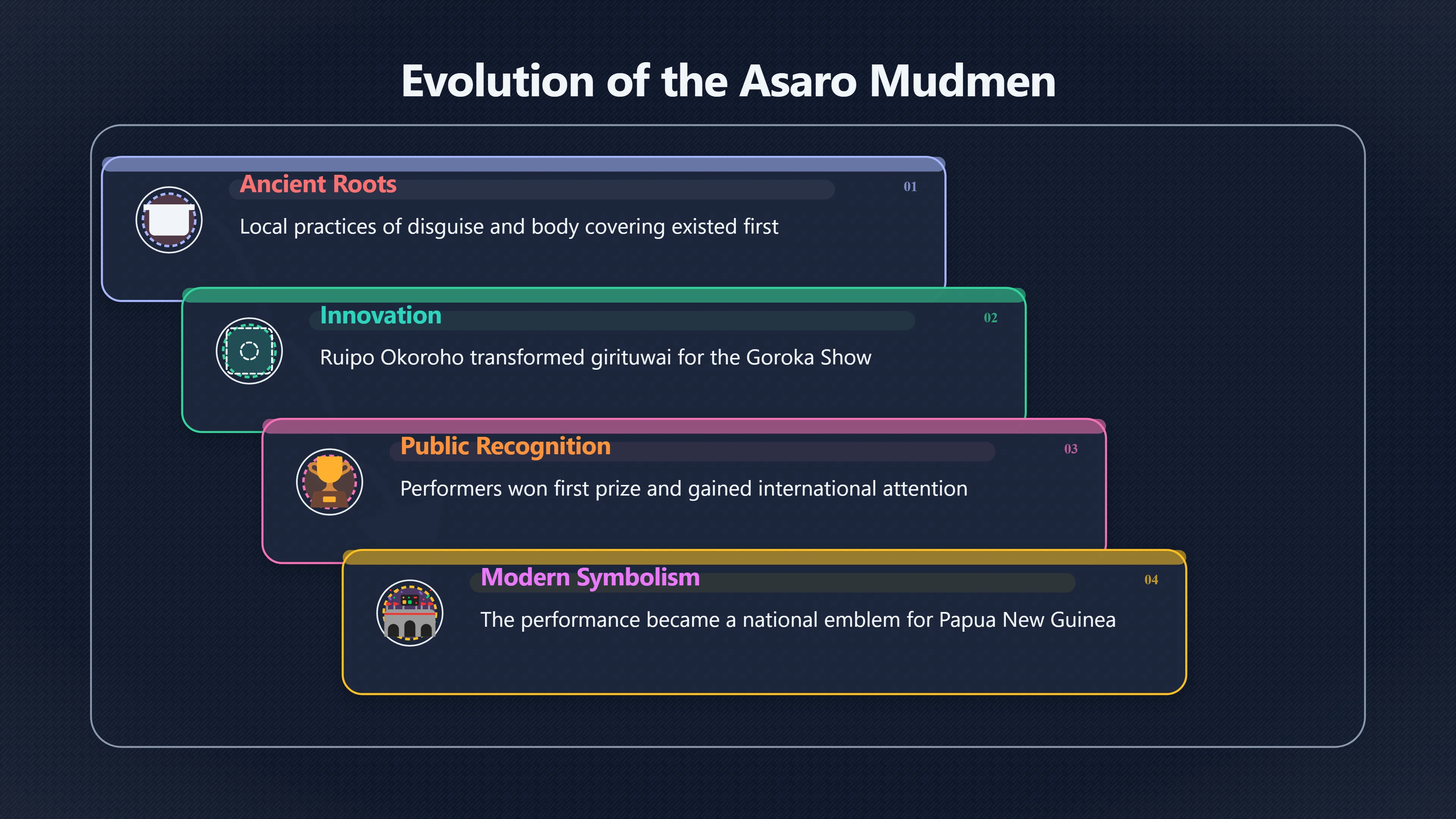
The modern Mudmen performance is closely linked to the first Eastern Highlands Agricultural Show, better known today as the Goroka Show. Researchers Ton Otto and Robert Verloop traced the public emergence of the Mudmen to 1957, when communities were encouraged to present distinctive cultural displays in a competitive festival setting. The show became a laboratory for cultural innovation, with groups creating dramatic performances designed to stand out before large audiences.[core.ac.uk]core.ac.ukCOREThe Asaro Mudmen: Local Property, Public Culture?May 15, 2009 — by T Otto · 1996 · Cited by 29 — Asaro villagers marched into Goroka that year, The Goroka Show, where several new creatio…
According to accounts collected by Otto and Verloop, a local figure named Ruipo Okoroho revived and transformed an older practice known as girituwai for the show. Masks became larger and more elaborate, bodies were coated in white clay, and a distinctive style of movement was developed. Around 200 performers reportedly appeared in the new costume and won first prize. The performance attracted attention precisely because it looked unlike anything else at the event.[Wikipedia]WikipediaAsaro MudmenAsaro Mudmen
This matters because it challenges a popular assumption. The widespread belief that today’s Mudmen costume and performance are direct survivals from a distant pre-colonial past is difficult to reconcile with the historical evidence. The public form that became famous appears to have crystallised during a specific moment of cultural presentation in the late colonial period rather than emerging unchanged from centuries of tradition.[core.ac.uk]core.ac.ukCOREThe Asaro Mudmen: Local Property, Public Culture?May 15, 2009 — by T Otto · 1996 · Cited by 29 — Asaro villagers marched into Goroka that year, The Goroka Show, where several new creatio…
What Older Local Practices Contributed to It
Rejecting the idea of an ancient costume does not mean rejecting deeper local roots. Researchers found evidence that the Mudmen drew on older practices involving concealment, disguise and ritualised intimidation. One tradition, known as bakime, involved covering the body with substances such as sap, mud or clay to hide a person’s identity during raids or acts of revenge. Another practice, girituwai, used mud-covered head structures as a form of disguise.[wikipedia.org]WikipediaAsaro MudmenAsaro Mudmen
These earlier customs were not identical to the giant masks familiar today. Rather, they provided a foundation from which the modern performance developed. Anthropologists argue that the famous masks, choreography and dramatic visual style were products of adaptation and elaboration. The old practices supplied raw materials; the public festival environment encouraged performers to reshape them into something more spectacular.[core.ac.uk]core.ac.ukCOREThe Asaro Mudmen: Local Property, Public Culture?May 15, 2009 — by T Otto · 1996 · Cited by 29 — Asaro villagers marched into Goroka that year, The Goroka Show, where several new creatio…
The origin stories attached to the Mudmen also seem to have evolved over time. The most famous tale describes defeated warriors hiding in the Asaro River, emerging coated in pale mud and frightening their enemies into believing that ghosts had returned. Researchers recorded multiple versions of this story rather than a single agreed account. Some narratives emphasise warfare, others disguise, and others accidental discoveries. The variety of versions suggests that the legend itself developed alongside the performance instead of preserving one fixed historical memory.[Wikipedia]WikipediaAsaro MudmenAsaro Mudmen

Why So Many People Believed the Ancient-Origin Story
The ancient-origin narrative spread because it was simple, memorable and visually convincing. Visitors encountering the Mudmen saw what appeared to be a highly distinctive ritual unlike anything familiar from Europe, Australia or North America. The masks looked old, mysterious and deeply rooted in local culture. A dramatic story about warriors disguised as spirits naturally accompanied the spectacle.[Wikipedia]WikipediaAsaro MudmenAsaro Mudmen
Tourism amplified the process. After the Goroka Show, photographers, travel writers and filmmakers helped transform the Mudmen into an internationally recognised image. Famous photographs published in the 1960s and 1970s brought the masks to audiences who had little reason to question the age of the tradition. As the images circulated, the distinction between older local customs and the newer public performance often disappeared.[Wikipedia]WikipediaAsaro MudmenAsaro Mudmen
The story also fit broader expectations about remote cultures. Tourists frequently seek encounters with what they imagine to be untouched traditions. A neat origin legend is easier to market than a complicated history involving cultural festivals, innovation and adaptation. As a result, simplified accounts often proved more durable than the messier historical record.[National Geographic]nationalgeographic.comauthentic staged or somewhere in betweenNational GeographicAuthentic, Staged, or Somewhere in Between?29 Oct 2013 — Papua New Guinea isn't exactly a wildly popular destination f…
Why Invention Does Not Automatically Mean Fraud
The Mudmen are frequently discussed alongside the concept of “invented tradition”, a term popularised by historians studying customs that claim great antiquity but were actually formalised more recently. However, invented traditions are not necessarily hoaxes. Many national ceremonies, folk costumes and heritage festivals around the world have surprisingly modern origins. Their cultural importance comes from how communities adopt and value them, not simply from their age.[ScholarSpace]scholarspace.manoa.hawaii.eduThe Asaro Mudmen: Local Property, Public Culture?by T Otto · 1996 · Cited by 29 — The mudmen tradition of the Asaro people in…
The key distinction is intention. A hoax aims to deceive. The available evidence suggests that the Asaro performers were creating a compelling representation of local identity rather than carrying out a long-term fraud. They adapted existing ideas, developed new artistic forms and presented them publicly. Over time those performances acquired genuine meaning within the community itself.[CORE]core.ac.ukCOREThe Asaro Mudmen: Local Property, Public Culture?May 15, 2009 — by T Otto · 1996 · Cited by 29 — Asaro villagers marched into Goroka that year, The Goroka Show, where several new creatio…
Anthropologists studying the Mudmen found that local debates were often less about whether the tradition was “real” and more about who had created it, who owned it and who should benefit from it. As tourism expanded, questions of cultural property and economic reward became increasingly important. The dispute was therefore not mainly about exposure of a fake, but about control of a successful cultural symbol.[CORE]core.ac.ukCOREThe Asaro Mudmen: Local Property, Public Culture?May 15, 2009 — by T Otto · 1996 · Cited by 29 — Asaro villagers marched into Goroka that year, The Goroka Show, where several new creatio…

From Local Innovation to National Symbol
One of the most remarkable aspects of the Mudmen story is how rapidly a local performance became a national emblem. Images of Mudmen appeared in advertising, tourism campaigns, festivals and international representations of Papua New Guinea. In a country with extraordinary cultural diversity and hundreds of languages, the Mudmen became one of the few visual symbols recognised both domestically and abroad.[scispace.com]scispace.comOpen source on scispace.com.
That success created new tensions. Other groups began performing versions of the Mudmen act, sometimes provoking concerns within the Asaro area that outsiders were appropriating or diluting their heritage. At the same time, the tradition’s popularity helped bring visitors and income to the region and encouraged continued performance and adaptation.[Wikipedia]WikipediaAsaro MudmenAsaro Mudmen
The history of the Asaro Mudmen therefore resists simple labels. The familiar performance is not an untouched relic from the distant past, yet neither is it a fabricated deception. It is a striking example of how traditions are made: drawing on older practices, reshaped by public performance, strengthened by tourism and eventually accepted as part of a community’s cultural identity. In the context of Papua New Guinea’s history of contested stories and apparent mysteries, the Mudmen demonstrate that authenticity and invention are not always opposites.[hawaii.edu]scholarspace.manoa.hawaii.eduThe Asaro Mudmen: Local Property, Public Culture?by T Otto · 1996 · Cited by 29 — The mudmen tradition of the Asaro people in…
Amazon book picks
Further Reading
Books and field guides related to Were the Asaro Mudmen Really an Ancient Tradition?. Use these as the next step if you want deeper reading beyond the article.
The Invention of Tradition
Directly addresses how traditions can be recent creations while still becoming culturally meaningful.
eBay marketplace picks
Marketplace Samples
Example marketplace items related to this page. Use the search link to explore similar finds on eBay.




Endnotes
1.
Source: core.ac.uk
Title: COREThe Asaro Mudmen: Local Property, Public Culture?
Link:https://core.ac.uk/download/pdf/5102342.pdf
Source snippet
May 15, 2009 — by T Otto · 1996 · Cited by 29 — Asaro villagers marched into Goroka that year, The Goroka Show, where several new creatio...
Published: May 15, 2009
2.
Source: researchgate.net
Title: 38406125 The Asaro Mudmen Local Property Public Culture
Link:https://www.researchgate.net/publication/38406125_The_Asaro_Mudmen_Local_Property_Public_Culture
Source snippet
ResearchGate(PDF) The Asaro Mudmen: Local Property, Public Culture?17 Aug 2015 — the phenomenon of the mudmen began its existence during...
3.
Source: Wikipedia
Title: Asaro Mudmen
Link:https://en.wikipedia.org/wiki/Asaro_Mudmen
4.
Source: Wikipedia
Title: Goroka Show
Link:https://en.wikipedia.org/wiki/Goroka_Show
5.
Source: Wikipedia
Title: Asaro Mudmen
Link:https://de.wikipedia.org/wiki/Asaro_Mudmen
6.
Source: scispace.com
Link:https://scispace.com/pdf/the-asaro-mudmen-local-property-public-culture-7s26ul1ldv.pdf
7.
Source: scholarspace.manoa.hawaii.edu
Link:https://scholarspace.manoa.hawaii.edu/items/f29bacee-f0f5-4295-9d2b-60a19d1f743d
Source snippet
The Asaro Mudmen: Local Property, Public Culture?by T Otto · 1996 · Cited by 29 — The mudmen tradition of the Asaro people in...
8.
Source: ursulasweeklywanders.com
Title: the asaro mudmen of papua new guinea paiya village western highlands png
Link:https://www.ursulasweeklywanders.com/travel/the-asaro-mudmen-of-papua-new-guinea-paiya-village-western-highlands-png/
Source snippet
Verloop make the case for a much more modern design of the Mudman costume, claiming that it was invented by Asaro Valley...
9.
Source: nationalgeographic.com
Title: authentic staged or somewhere in between
Link:https://www.nationalgeographic.com/travel/article/authentic-staged-or-somewhere-in-between
Source snippet
National GeographicAuthentic, Staged, or Somewhere in Between?29 Oct 2013 — Papua New Guinea isn't exactly a wildly popular destination f...
Additional References
10.
Source: soul-o-travels.com
Link:https://soul-o-travels.com/2024/01/26/tribe-profile-the-asaro-mudmen-of-papua-new-guinea/
Source snippet
Tribe Profile: The Asaro Mudmen of Papua New Guinea26 Jan 2024 — Verloop traces the current costume back to more recent times...
11.
Source: youtube.com
Title: Worlds Scariest Tribe
Link:https://www.youtube.com/watch?v=hoyuFQvvTqI
Source snippet
Papua New Guinea (Pt. 4) Highlands, Tribes, the Goroka Show, and Birds-of-Paradise...
12.
Source: youtube.com
Title: Asaro Mud Men bring their Holosa masks to the Australian Museum
Link:https://www.youtube.com/watch?v=VFAyuHMOck8
Source snippet
Worlds Scariest Tribe - Asaro Mudmen Papua New Guinea 2021...
13.
Source: facebook.com
Link:https://www.facebook.com/theindotrekkerr/posts/asaro-mud-man-tribe-of-papua-new-guinea/771720349070818/
14.
Source: facebook.com
Link:https://www.facebook.com/groups/309364629155920/posts/24597109806621397/
15.
Source: facebook.com
Link:https://www.facebook.com/LukeDamantt/posts/i-became-a-mud-man-in-papua-new-guinea-/1354075506541407/
16.
Source: instagram.com
Link:https://www.instagram.com/p/DUU9en6Ez6P/
17.
Source: semanticscholar.org
Link:https://www.semanticscholar.org/paper/The-Asaro-Mudmen%3A-Local-Property%2C-Public-Culture-Otto-Verloop/a6e712332af746f12cb801edb76814d5ca8d99a1
18.
Source: facebook.com
Link:https://www.facebook.com/61555920213781/posts/the-asaro-mudmen-of-papua-new-guinea-are-among-the-most-recognizable-cultural-fi/122301241280197340/
19.
Source: facebook.com
Link:https://www.facebook.com/alisonadventure/posts/what-would-you-do-if-you-came-across-the-asaro-mudmen-tribe-in-papua-new-guinea/1588271399332275/
Topic Tree