When Sudan's Real History Became Hard to Believe
Sudan does not have a tidy catalogue of famous theatrical hoaxes comparable with the Cardiff Giant or the Cottingley Fairies.
Page outline Jump by section
Introduction
Three patterns recur. First, unfamiliar evidence is sometimes rejected because it does not fit outsiders’ assumptions, as happened when European experts suspected that magnificent jewellery looted from Meroë was forged. Second, genuine photographs and videos are repeatedly given false dates, locations or captions. Third, organised political actors exploit weak media institutions, internet shutdowns and public fear to make partisan narratives appear spontaneous or authoritative.[jstor.org]jstor.orging the authenticity of the treasure was related to Ferlini's account of his discovery. memorial built after the death of Queen Amanishak…
This distinction matters. Not every false Sudan story is a deliberate hoax. Some are propaganda, some are careless mistakes, some are ancient-history myths, and some are genuine evidence circulated with an invented explanation. Understanding who created the claim, who amplified it and how investigators tested it is therefore more useful than simply labelling everything “fake”.
When a real treasure looked too good to be true
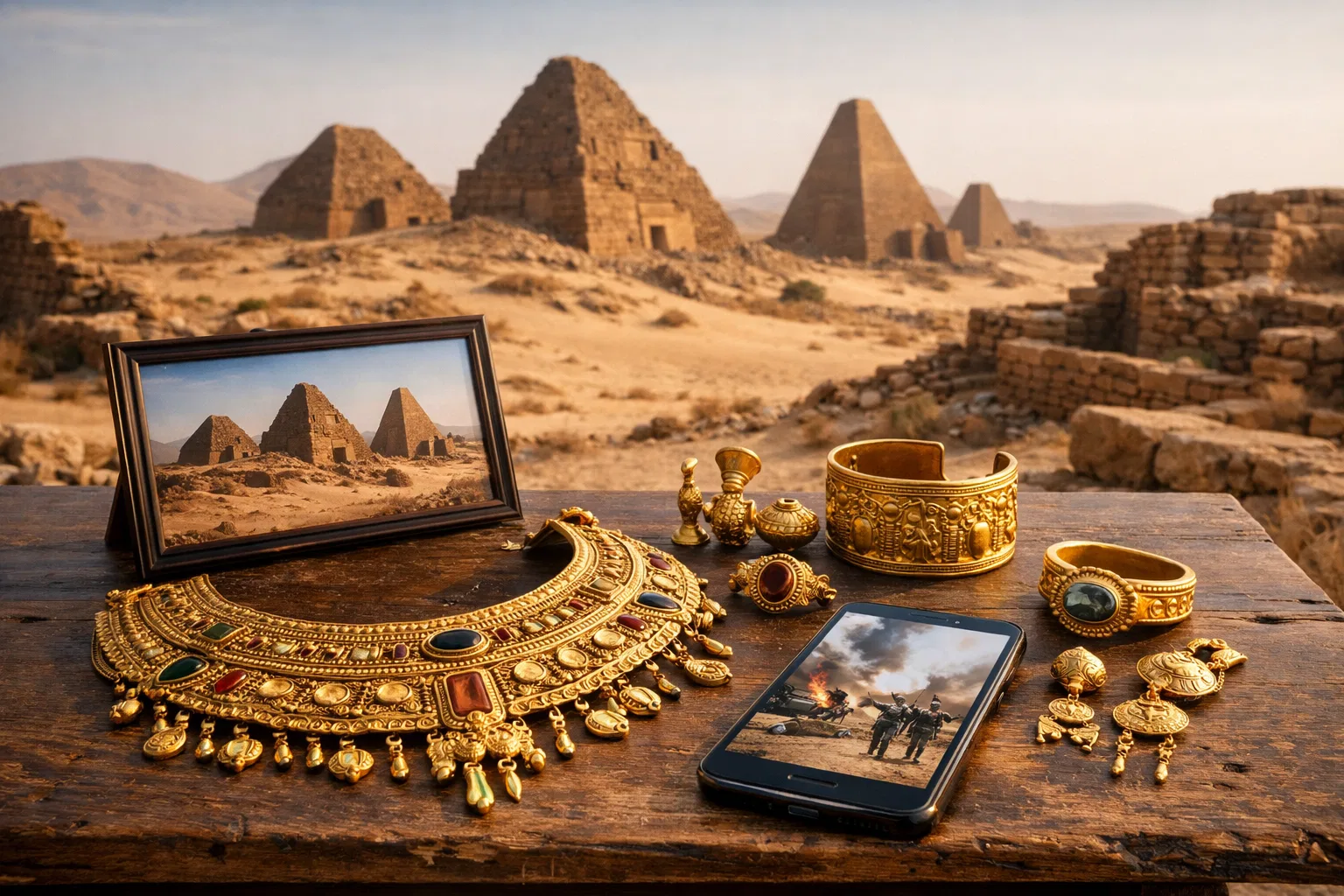
One of Sudan’s most revealing deception stories concerns objects that were not fake at all. In 1834, the Italian physician and treasure hunter Giuseppe Ferlini attacked the royal pyramid cemetery at Meroë. His methods were destructive rather than archaeological: he dismantled structures from the top and is widely held responsible for ruining numerous pyramids while searching for valuables. In the pyramid associated with Queen Amanishakheto, he found an extraordinary collection of gold jewellery.[majalla.com]en.majalla.comAlmajallaLooting Sudan: From an ancient queen's jewels to present…20 Oct 2024 — This was Great Pyramid N6 of Queen Amanishakheto, one…
When Ferlini tried to sell the treasure in Europe, experts had understandable reasons for caution. His account of the discovery was poorly documented, his excavation had destroyed much of the archaeological context, and treasure hunters commonly exaggerated or fabricated provenances. Yet another prejudice also shaped the reception: some European observers found it difficult to believe that such sophisticated goldwork could have originated in ancient Sudan. The British Museum declined to buy the collection after advisers reportedly judged it fraudulent, while substantial parts were eventually acquired in Berlin and Munich.[egyptian-museum-berlin.com]egyptian-museum-berlin.comThe Ancient SudanEgyptian Museum BerlinThe altar from Wad Ban Naga and the gold jewellery of Queen Amanishakheto (1st century AD), which is on display in…
Later archaeological work established the wider artistic and historical setting of Meroitic jewellery, and the treasure became one of the best-known surviving groups of objects from the Kingdom of Kush. The episode is therefore the reverse of a normal antiquities hoax. A treasure hunter with an untrustworthy method produced genuine objects, while experts’ suspicion—partly rooted in missing evidence and partly in misconceptions about African craftsmanship—made the authentic material look counterfeit.
The case also demonstrates why provenance, meaning an object’s documented history and archaeological origin, matters so much. An artefact removed without proper records can be genuine yet still become difficult to authenticate, date or interpret. Ferlini found valuable objects, but his destruction of the pyramid erased evidence that could have answered questions about their original arrangement, ownership and ritual use. Modern scholarship can study the jewellery, but it cannot reconstruct everything that was lost.[JSTOR]jstor.orging the authenticity of the treasure was related to Ferlini's account of his discovery. memorial built after the death of Queen Amanishak…
How Sudan’s ancient past attracts invented claims
Sudan’s pyramids provide ideal material for internet exaggeration because the underlying history is already surprising. The country contains numerous Nubian pyramid fields at places including Meroë, Nuri and El-Kurru. These monuments belonged to the Kushite kingdoms and were built in a different period, style and political setting from Egypt’s best-known Old Kingdom pyramids.
Popular posts often begin with a broadly defensible observation—that Sudan has more surviving pyramidal structures than Egypt—and then add unsupported claims. Dates are pushed back by centuries or millennia; Kushite monuments are described as the original prototypes for all Egyptian pyramids; or the sites are presented as proof of lost global civilisations and suppressed technologies. Real neglect of Sudanese history becomes the bait for a second, invented history.
The chronology does not support claims that the Meroitic pyramids pre-date the great Egyptian pyramids. Egypt’s pyramid-building tradition began in the third millennium BC, while the Sudanese royal pyramid cemeteries principally belong to much later Napatan and Meroitic periods. Sudan’s monuments remain historically important without needing to be made older, larger or more mysterious than the evidence allows. The more interesting story is how Kushite rulers adopted and transformed a long-standing regional architectural form to express their own monarchy and religious culture.
A related genre inserts Sudan into the recurring online myth of excavated giant humans. Images of enormous skeletons beside tiny archaeologists have circulated for years under changing captions that place the “discovery” in Sudan, India, Saudi Arabia or elsewhere. Investigations have traced prominent examples to digitally altered photographs, sculptures or art projects rather than archaeological excavations. The caption changes, but the visual trick remains the same: familiar excavation equipment supplies scale and authority, while the supposed institution, scientist or location is difficult to verify.[nationalgeographic.com]nationalgeographic.comskeleton giant photo hoaxskeleton giant photo hoax
These tales persist because they combine several persuasive elements: authentic-looking dig photographs, religious or mythological traditions about giants, distrust of museums and the promise that experts are concealing a world-changing discovery. Sudan’s genuine archaeological richness makes it an especially plausible-sounding setting. Yet no credible excavation record, museum inventory, osteological report or peer-reviewed analysis supports the giant-skeleton stories.

The revolution’s battle over images and identities
During Sudan’s 2018–19 uprising, social media helped protesters document demonstrations, organise activity and attract international attention. It also created opportunities for miscaptioned images, false accusations and manufactured identities. Authentic material circulated beside recycled footage and claims that could spread widely before reporters or activists had time to verify them.
One particularly damaging tactic involved supposed “confessions” and allegations against demonstrators. Individuals could be presented online as criminals, foreign agents or members of violent groups, helping opponents portray a largely civilian protest movement as dangerous or manipulated. The purpose was not always to make readers believe every detail. Repeated accusations could create enough uncertainty to weaken sympathy for protesters and make repression appear defensible.
At the same time, genuine images could acquire simplified or romanticised explanations. The famous photograph of Alaa Salah, dressed in white and leading chants from the roof of a car in April 2019, was real and became an international symbol of women’s participation in the revolution. But its global circulation also showed how one dramatic picture can come to stand for a complicated national movement. Authenticity of the photograph did not guarantee that every caption, historical comparison or political interpretation attached to it was accurate.[Wikipedia]WikipediaKandake of the Sudanese RevolutionKandake of the Sudanese Revolution
The post-revolutionary period produced more systematic manipulation. Research into Sudan’s information environment between the October 2021 military coup and the end of 2022 documented narratives designed to legitimise military power, rehabilitate institutions accused of abuses, discourage demonstrations and attack civilian, feminist or secular groups. These efforts operated alongside censorship, pressure on journalists and interruptions to internet access.[Freedom House]freedomhouse.orgFreedom HouseSudan: Freedom on the Net 2024 Country ReportPrior to the outbreak of the civil war, common disinformation narratives…
The persuasive mechanism was cumulative. A false post did not need to remain credible for months. It only needed to influence the first hours of reaction, reinforce an existing prejudice or give partisan accounts material to repeat. By the time a correction appeared, screenshots and paraphrases had often escaped into private messaging groups where the original source was no longer visible.
The 2023 war turned social media into a second battlefield
When fighting erupted between the Sudanese Armed Forces and the Rapid Support Forces in April 2023, access to reliable information deteriorated sharply. Journalists faced danger and displacement, communications failed in contested areas, and much of the public depended on Facebook, X, WhatsApp, Telegram and livestreams for immediate reports. Both organised propagandists and opportunistic users filled the gaps.
False war imagery commonly used one of four methods:
- Recycling: footage from older conflicts, military exercises or accidents was relabelled as a new event in Khartoum or Darfur.
- Relocation: a genuine Sudanese video was assigned to the wrong city, date or armed group.
- Simulation: material from military video games or computer-generated sequences was presented as battlefield footage.
- Fabrication: altered photographs, cloned voices and synthetic images were used to depict statements or attacks that had not occurred.
One widely noted pattern was the reuse of material from games such as Arma 3, whose distant night-time explosions and anti-aircraft fire can resemble low-quality phone footage. Such clips had already appeared in misinformation about other wars, making them readily available for recaptioning when Sudan’s conflict began. The deception worked especially well when videos were compressed, stripped of audio or shared by accounts displaying flags and military insignia.[Wikipedia]WikipediaSudanese civil war (2023–presentSudanese civil war (2023–present
Artificial intelligence added another layer. Researchers and journalists have documented manipulated audio, synthetic political statements and fabricated scenes connected to Sudan’s war. Some early examples were technically crude, particularly where generated speech failed to reproduce Sudanese accents convincingly. Nevertheless, they could still travel quickly when they confirmed what supporters already expected to hear. A fabricated image purporting to show bomb damage at Al-Jazeera University in Wad Madani, for example, circulated as evidence in the competing accusations between the armed factions.[incidentdatabase.ai]incidentdatabase.aiOpen source on incidentdatabase.ai.
The danger is not confined to people believing an entirely invented event. False material can obscure genuine crimes by making every photograph seem questionable. Conversely, real footage can be dismissed as fabricated simply because synthetic images are common. This “liar’s dividend” benefits perpetrators: once audiences know that convincing fakes exist, those accused of violence can claim that authentic evidence is artificial.
Coordinated accounts made propaganda look popular
A hoax traditionally has a recognisable creator and a single false object or story. Sudan’s online influence campaigns often work differently. Networks of accounts repeat the same framing until it appears to be the spontaneous opinion of thousands of independent people.
Digital investigators identified hundreds of apparently hijacked or revived accounts promoting the Rapid Support Forces and its commander, Mohamed Hamdan Dagalo. Many accounts had been inactive for long periods before suddenly returning with coordinated political material. This behaviour gave the campaign the appearance of broad support while concealing how much amplification was organised.[WIRED]wired.comDespite their documented atrocities, RSF uses their X account to present a humanitarian image and engage with an international audience…
The RSF has also used official-looking English-language communications to address international audiences and present itself as a professional political and military institution. The Sudanese Armed Forces and their supporters have operated their own propaganda ecosystem, circulating morale-building claims, denials and accusations against their opponents. The result is not a simple contest between truth and one dishonest faction, but an information environment in which rival armed groups, sympathetic influencers and diaspora networks compete to define every event.[timep.org]timep.orgTahrir Institute Beyond the Battlefield: Sudan's Virtual Propaganda WarzoneTahrir Institute Beyond the Battlefield: Sudan's Virtual Propaganda Warzone
This strategy benefits from platform design. Verification badges, large follower counts and coordinated reposting can make a claim appear authoritative before its underlying evidence has been checked. Posts in English may target diplomats and foreign journalists, while material aimed at Sudanese audiences can use locally resonant rumours, insults or accusations. Different audiences therefore encounter different versions of the same propaganda campaign.
Falsehood and genuine atrocity footage can coexist
A crucial mistake is to assume that widespread misinformation means all shocking Sudan footage is unreliable. Investigators have verified large quantities of genuine visual evidence, including material apparently recorded and uploaded by fighters themselves. The Centre for Information Resilience and other open-source investigators have examined videos showing burning buildings, abused prisoners, ethnic insults and bodies in locations affected by RSF operations. Geolocation, landmarks, shadows, upload histories and comparison with satellite imagery help establish where and when material was recorded.[The Guardian]theguardian.comOpen source on theguardian.com.
Some perpetrator-filmed videos appear intended as intimidation rather than deception. Fighters display violence openly because the images can frighten communities and demonstrate control. Such footage may simultaneously function as propaganda and as potential evidence of crimes. Its maker may lie about why an attack occurred while accidentally documenting who was present, which vehicles were used or what buildings had been destroyed.
Satellite analysis creates similar challenges. A single low-resolution image cannot automatically prove who killed whom, and analysts must avoid claiming more than the pixels show. Yet comparisons across dates can reveal new graves, fires, roadblocks, damaged settlements or groups of objects consistent with bodies. In investigations of violence around El Fasher, analysts compared imagery from different commercial providers with videos, witness accounts and known site layouts rather than treating one dramatic image as self-explanatory.[AP News]apnews.comOpen source on apnews.com.
The best verification therefore combines sources. A video becomes stronger evidence when its buildings match satellite imagery, its weather fits the claimed date, earlier versions cannot be found elsewhere, and independent witnesses describe the same event. A false caption usually breaks at least one link in that chain.

Why corrections struggle to catch up
Sudan’s misinformation problem is intensified by conditions that make rapid verification unusually difficult. Power failures and internet shutdowns restrict access to original files. Newsrooms have lost staff and equipment. Reporters cannot safely enter many contested areas. Diaspora communities may receive urgent voice notes from relatives but have no reliable way to test them. Meanwhile, frightened audiences understandably share warnings before checking whether they are true.
Emotion also determines which claims travel. A post promising victory, announcing a commander’s death or accusing an enemy of a shocking atrocity provides immediate psychological certainty. A careful correction explaining that a clip is old, its location is unknown or responsibility remains unproven is less satisfying. False reports can therefore thrive without being technically sophisticated.
Corrections face another structural disadvantage: they address individual claims, while propaganda campaigns produce narratives. Debunking one photograph does not necessarily change a person’s broader belief that every atrocity was committed by one side or that all foreign reporting is conspiratorial. Effective investigation must show not only that an image is false, but how it was recycled, which accounts promoted it and what political story it was designed to support.

How to judge a Sudan claim
No single test can establish authenticity, but several checks expose many recurring Sudan hoaxes and miscaptioned posts.
Find the earliest available version. Reverse-image searches, key-frame searches and archived posts can reveal that supposed footage from Khartoum appeared years earlier in Libya, Ukraine or a video-game channel.
Separate the image from the caption. A photograph may be genuine while its location, date, victim count or identification of the armed group is false.
Look for accountable sourcing. Named reporters, identifiable witnesses, established fact-checkers, humanitarian organisations and investigators who explain their method are more useful than anonymous “breaking news” accounts.
Check whether the claim exceeds the evidence. Satellite imagery may show disturbed earth or burned buildings; it does not necessarily reveal the perpetrators or exact number of victims. A responsible analysis states those limits.
Beware of copied authority. Logos, verification symbols, military insignia and television-style graphics are easy to imitate. The claim should appear on the organisation’s genuine website or established account.
Do not treat every correction as proof that nothing happened. A fake photograph of an air strike does not establish that the strike itself was invented. It establishes only that the particular photograph is not valid evidence for it.
What Sudan’s hoax history reveals
Sudan’s most instructive deception stories are not primarily jokes played on a credulous public. They concern control over knowledge: who is believed, which institutions appear trustworthy and whose account of history or violence becomes visible.
The Meroë treasure shows that scepticism can itself be distorted. Experts correctly questioned a destructive treasure hunter’s story, but some also underestimated the abilities of an ancient African civilisation. Modern pyramid myths reverse that error by exaggerating Sudan’s past into unsupported claims, as though its real archaeological achievements were not remarkable enough.
The revolution and civil war show a different transformation. Falsehood is no longer necessarily packaged as a single elaborate hoax. It is distributed through coordinated accounts, recycled clips, synthetic voices and partisan captions. The objective may be to create belief, but it may equally be to exhaust attention, delay accountability or make the truth appear permanently unknowable.
That is why the strongest response is neither automatic belief nor automatic cynicism. Sudan’s information history rewards patient comparison: preserving original files, tracing earlier uploads, checking physical landmarks, consulting archaeological context and distinguishing what the evidence proves from what a persuasive caption merely asks the viewer to assume.
Amazon book picks
Further Reading
Books and field guides related to When Sudan's Real History Became Hard to Believe. Use these as the next step if you want deeper reading beyond the article.
The Rise and Fall of Ancient Egypt
Provides context for Sudanese and Egyptian archaeological narratives.
The Misinformation Age
Matches the page's focus on contested truth and deceptive claims.
The Kingdom of Kush
Explains the real history behind many Sudan-related myths and misunderstandings.
eBay marketplace picks
Marketplace Samples
Live-tested eBay searches with available results related to this page.
Endnotes
1.
Source: jstor.org
Link:https://www.jstor.org/stable/40000601
Source snippet
ing the authenticity of the treasure was related to Ferlini's account of his discovery. memorial built after the death of Queen Amanishak...
2.
Source: dfrlab.org
Title: democracy derailed
Link:https://dfrlab.org/2023/08/08/democracy-derailed/
Source snippet
Sudan's precarious information environment and the fight...8 Aug 2023 — A report on the information ecosystem, disinformation camp...
3.
Source: Wikipedia
Title: Giuseppe Ferlini
Link:https://en.wikipedia.org/wiki/Giuseppe_Ferlini
4.
Source: egyptian-museum-berlin.com
Title: The Ancient Sudan
Link:https://www.egyptian-museum-berlin.com/c33.php
Source snippet
Egyptian Museum BerlinThe altar from Wad Ban Naga and the gold jewellery of Queen Amanishakheto (1st century AD), which is on display in...
5.
Source: reuters.com
Title: giant skeleton is not real but part of an art exhibition id USL2N2OD161
Link:https://www.reuters.com/article/fact-check/giant-skeleton-is-not-real-but-part-of-an-art-exhibition-idUSL2N2OD161/
6.
Source: Wikipedia
Title: Kandake of the Sudanese Revolution
Link:https://en.wikipedia.org/wiki/Kandake_of_the_Sudanese_Revolution
7.
Source: Wikipedia
Title: Sudanese civil war (2023–present)
Link:https://en.wikipedia.org/wiki/Sudanese_civil_war_%282023%E2%80%93present%29
8.
Source: incidentdatabase.ai
Link:https://incidentdatabase.ai/cite/1089/
9.
Source: wired.com
Link:https://www.wired.com/story/sudan-rsf-x-twitter
Source snippet
Despite their documented atrocities, RSF uses their X account to present a humanitarian image and engage with an international audience...
10.
Source: dfrlab.org
Link:https://dfrlab.org/region/sudan/
11.
Source: ifri.org
Title: sudan wartime online propaganda
Link:https://www.ifri.org/en/studies/sudan-wartime-online-propaganda
12.
Source: facebook.com
Link:https://www.facebook.com/TheFolklorePodcast/posts/the-lau-is-a-creature-reported-from-the-south-of-sudan-particularly-in-the-area-/1466371225503793/
13.
Source: facebook.com
Title: in 1869 george hull secretly hired stonecutters to carve a 10 foot stone figure
Link:https://www.facebook.com/thewittyhistorian/posts/in-1869-george-hull-secretly-hired-stonecutters-to-carve-a-10-foot-stone-figure-/837481115993044/
14.
Source: facebook.com
Link:https://www.facebook.com/hotinjuba/posts/a-sponsored-facebook-post-on-a-fake-account-of-the-ministry-of-finance-and-plann/4943390712394236/
15.
Source: facebook.com
Link:https://www.facebook.com/ExpeditionUnknownTV/posts/is-this-mythic-sea-monster-more-than-just-a-fantasy-find-out-on-expeditionfiles-/1468957701694111/
16.
Source: facebook.com
Link:https://www.facebook.com/groups/149844915349213/posts/2169507620049589/
17.
Source: facebook.com
Link:https://www.facebook.com/HealthZA/posts/this-is-disinformation-intended-to-undermine-public-trust-by-spreading-fake-news/1490505123122556/
18.
Source: facebook.com
Link:https://www.facebook.com/groups/827611048652074/posts/1458079665605206/
19.
Source: facebook.com
Link:https://www.facebook.com/USEmbassySouthSudan/posts/do-you-know-how-to-spot-fake-news-join-our-facebook-live-event-fact-or-fiction-f/239123411731137/
20.
Source: facebook.com
Link:https://www.facebook.com/lara.owoeyewise/posts/to-all-the-fake-news-peddlers-what-you-are-sharing-is-not-truethere-is-a-big-dif/10239029989240616/
21.
Source: facebook.com
Link:https://www.facebook.com/Insideafricas/posts/sudan-has-more-than-200-pyramids-double-the-number-found-in-egypt-the-meroe-pyra/676333957841902/
22.
Source: facebook.com
Link:https://www.facebook.com/groups/1660866237657971/posts/2109605449450712/
23.
Source: facebook.com
Link:https://www.facebook.com/Khabyahom/posts/journalistic-investigation-tracks-digital-networks-spreading-ikhwan-rumors-and-i/1529994195830260/
24.
Source: facebook.com
Link:https://www.facebook.com/theprogressivemindsshow/posts/did-you-know-sudan-has-more-pyramids-than-egypt-%EF%B8%8Fa-reminder-that-africas-ancient/1124862719807855/
25.
Source: facebook.com
Link:https://www.facebook.com/emceerumaz/posts/the-over-200-nubian-pyramids-of-sudan-stood-for-several-millenia-before-they-wer/1156049056535845/
26.
Source: facebook.com
Link:https://www.facebook.com/groups/933187425485125/posts/1158313122972553/
27.
Source: facebook.com
Link:https://www.facebook.com/groups/1519103878311682/posts/3239239932964726/
28.
Source: facebook.com
Link:https://www.facebook.com/USAfrika.gov/posts/queen-kandake-amanishaketoby-kweku-oforiher-pyramid-was-pillaged-and-destroyed-b/2159801867490281/
29.
Source: facebook.com
Link:https://www.facebook.com/BBCnewsafrica/posts/what-has-ai-got-to-do-with-sudans-civil-wara-campaign-using-artificial-intellige/871288291022242/
30.
Source: facebook.com
Link:https://www.facebook.com/rtenews/posts/from-ai-generated-visuals-to-video-game-footage-dressed-up-as-war-clarity-corres/1314128324073202/
31.
Source: facebook.com
Link:https://www.facebook.com/AFPFactCheck/?locale=en_GB
32.
Source: facebook.com
Link:https://www.facebook.com/EastleighVoiceKe/posts/fact-check-how-fake-content-about-the-sudan-war-spreads/1352907856527765/
33.
Source: facebook.com
Title: The Observers
Link:https://www.facebook.com/FRANCE24.Observers/
34.
Source: reuters.com
Link:https://www.reuters.com/fact-check/altered-video-shows-liberias-president-criticising-trump-praising-his-beautiful-2025-07-28/
35.
Source: reuters.com
Link:https://www.reuters.com/fact-check/
36.
Source: reuters.com
Title: cristiano ronaldo interview altered show support palestinians 2025 04 23
Link:https://www.reuters.com/fact-check/cristiano-ronaldo-interview-altered-show-support-palestinians-2025-04-23/
37.
Source: reuters.com
Title: anti immigration activist incorrectly identified belfast knife victim 2026 06 11
Link:https://www.reuters.com/fact-check/anti-immigration-activist-incorrectly-identified-belfast-knife-victim-2026-06-11/
38.
Source: reuters.com
Title: video shows people cooking pig not dog ireland 2023 10 05
Link:https://www.reuters.com/fact-check/video-shows-people-cooking-pig-not-dog-ireland-2023-10-05/
39.
Source: reuters.com
Link:https://www.reuters.com/fact-check/fire-hit-irish-property-earmarked-local-social-housing-applicants-not-migrants-2025-08-05/
40.
Source: reuters.com
Title: minnesota flag redesign inspired by state specific symbols 2024 08 20
Link:https://www.reuters.com/fact-check/minnesota-flag-redesign-inspired-by-state-specific-symbols-2024-08-20/
41.
Source: reuters.com
Title: obama did not resettle 70000 somalis minnesota 2024 11 22
Link:https://www.reuters.com/fact-check/obama-did-not-resettle-70000-somalis-minnesota-2024-11-22/
42.
Source: Wikipedia
Title: Hobby Lobby smuggling scandal
Link:https://en.wikipedia.org/wiki/Hobby_Lobby_smuggling_scandal
43.
Source: Wikipedia
Title: Giant human skeletons
Link:https://en.wikipedia.org/wiki/Giant_human_skeletons
44.
Source: freedomhouse.org
Link:https://freedomhouse.org/country/sudan/freedom-net/2024
Source snippet
Freedom HouseSudan: Freedom on the Net 2024 Country ReportPrior to the outbreak of the civil war, common disinformation narratives...
45.
Source: en.majalla.com
Link:https://en.majalla.com/node/322700/culture-social-affairs/looting-sudan-ancient-queen%E2%80%99s-jewels-present-day
Source snippet
AlmajallaLooting Sudan: From an ancient queen's jewels to present...20 Oct 2024 — This was Great Pyramid N6 of Queen Amanishakheto, one...
46.
Source: shs.hal.science
Link:https://shs.hal.science/halshs-03941996/document
Source snippet
The Goddess and the Queenby C Labia · 2018 — The treasure of queen Amanishakheto is probably the most famous ensemble of Meroitic jewelle...
47.
Source: nationalgeographic.com
Title: skeleton giant photo hoax
Link:https://www.nationalgeographic.com/history/article/skeleton-giant-photo-hoax
48.
Source: apnews.com
Link:https://apnews.com/article/e829d1dddcc2dad0f5f99cf62ef353ad
49.
Source: timep.org
Title: Tahrir Institute Beyond the Battlefield: Sudan’s Virtual Propaganda Warzone
Link:https://timep.org/2025/01/14/beyond-the-battlefield-sudans-virtual-propaganda-warzone/
50.
Source: theguardian.com
Link:https://www.theguardian.com/global-development/article/2024/sep/11/videos-rebels-sudan-footage-courts
51.
Source: apnews.com
Link:https://apnews.com/article/181c12ded100933c2ec9ce23a89f97b5
52.
Source: apnews.com
Link:https://apnews.com/article/e1f5a14c8cfdf0efab2c295a81a5a7b6
Source snippet
The RSF's control of el-Fasher follows an 18-month siege, with over 81,000 people displaced since October 26. Reports highlight widesprea...
53.
Source: afrolegends.com
Title: Giuseppe Ferlini
Link:https://afrolegends.com/tag/giuseppe-ferlini/
Additional References
54.
Source: youtube.com
Link:https://www.youtube.com/watch?v=C8VfU4RN-eI
Source snippet
Nubia: The Kingdom of Warrior Queens. Amanishakheto, Meroe, and the Secrets of the Sudanese Desert...
55.
Source: youtube.com
Link:https://www.youtube.com/watch?v=xqz1qwGXvDg
Source snippet
The information war in Sudan | The Listening Post...
56.
Source: youtube.com
Title: How journalists get the news right
Link:https://www.youtube.com/watch?v=yAKGBj9QIe4
Source snippet
Is Sudan 'too complicated' for your newsfeed? | Khalid Albaih | Real Talk...
57.
Source: instagram.com
Link:https://www.instagram.com/afpfactcheck/?hl=en
58.
Source: afp.com
Link:https://www.afp.com/en/our-offer/afp-fact-check
59.
Source: x.com
Link:https://x.com/AFPFactCheck?lang=en
60.
Source: kemetklub.co.uk
Link:https://kemetklub.co.uk/product/ancient-falsehood-fakes-and-forgeries/
61.
Source: instagram.com
Link:https://www.instagram.com/reel/DVcGBRzDGFp/?hl=en
62.
Source: africacheck.org
Link:https://africacheck.org/fr/search?f%5B0%5D=article_type%3Ablog&f%5B1%5D=article_type%3Ameta-programme-fact-checks&f%5B2%5D=article_type%3Aspot_checks&page=51&search_api_fulltext=s%C3%A9n%C3%A9gal&sort_bef_combine=created_DESC
63.
Source: ishwarsharan.com
Link:https://ishwarsharan.com/features/christianitys-fraudulent-legacy-michael-paulkovich/
Topic Tree
Follow this branch
Related pages 192
- Albanian Hoaxes
- Algerian Hoaxes
- Antigua Deceptions
- Argentina Hoaxes
- Armenian Hoaxes
- +187 more in sidebar