When Did Colombia's Most Famous Falsehoods Take Hold?
Colombia’s history of hoaxes and contested truths is not a catalogue of people being easily fooled.
Page outline Jump by section
Introduction
The most important distinction is between different kinds of falsehood. El Dorado was not simply a calculated confidence trick. The supposed “Quimbaya aeroplanes” are genuine ancient objects wrapped in a modern pseudoscientific interpretation. Forged antiquities are deliberate commercial deceptions. The army’s “false positives” were lethal fabrications designed to make murdered civilians appear to be combatants. During the 2016 peace referendum, misleading claims turned complex legal language into memorable threats. Each case shows how a story can survive after its original evidence has collapsed.
How El Dorado became a city that never existed
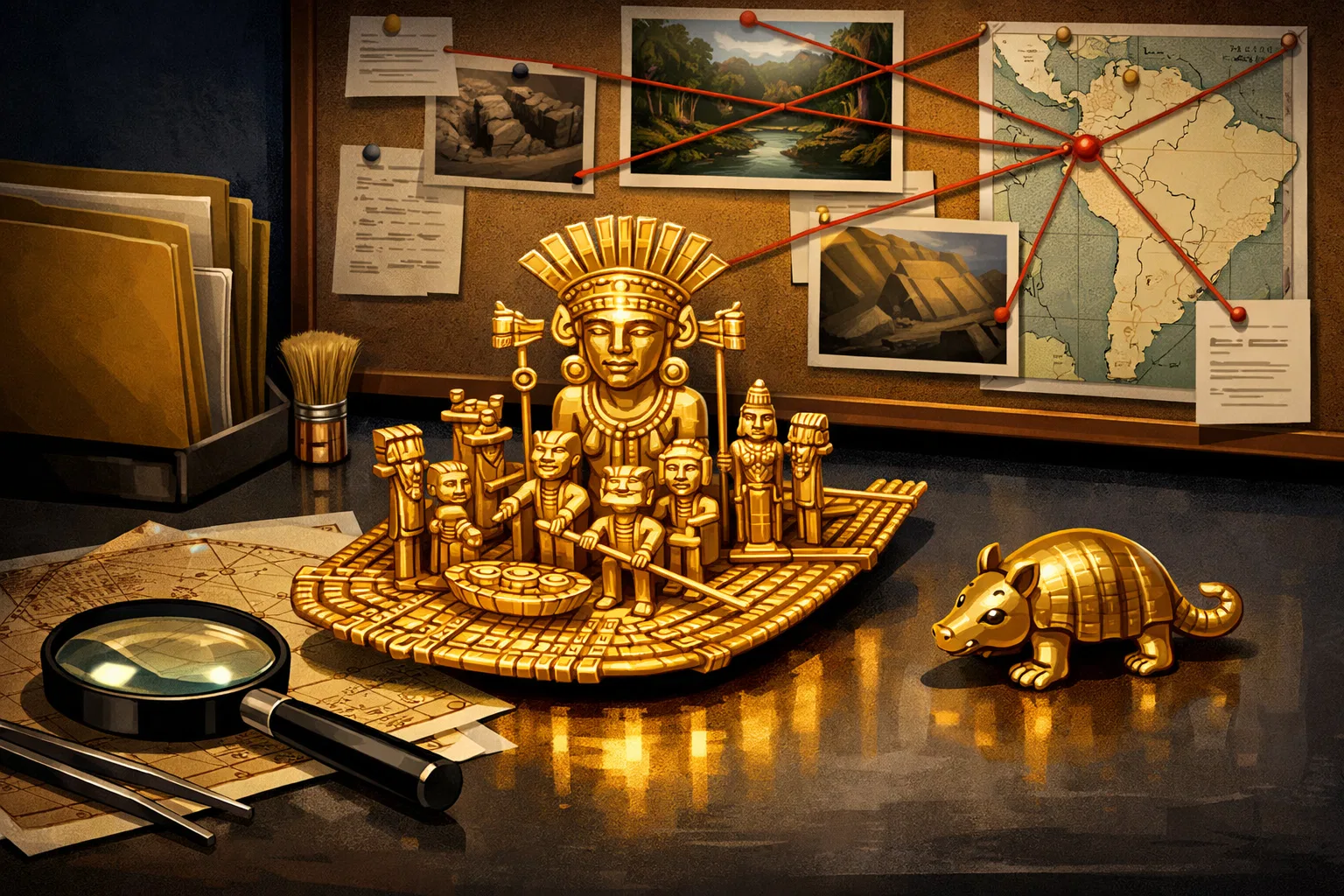
The familiar version of El Dorado describes a fabulous city—or sometimes an entire kingdom—overflowing with gold somewhere in the Colombian interior. Expeditions searched for it, maps appeared to locate it, and the legend expanded far beyond Colombia. Yet the earliest form of the story concerned neither a city nor a civilisation made rich by limitless mines. It referred to a “gilded” ruler and was eventually associated with a ceremony at Lake Guatavita, in Muisca territory near present-day Bogotá.[Wikipedia]WikipediaEl DoradoEl Dorado
Later chroniclers described a ruler who covered himself with gold dust, travelled on a raft and cast valuable offerings into the water. Historians disagree over how faithfully these accounts preserved an actual Muisca ceremony. Some believe the Spanish heard a genuine Indigenous tradition; others argue that conquistadors combined scattered information, misunderstanding and wishful thinking into a much grander story. What is well established is that lakes were sacred in Muisca religion and that gold and other objects were deposited as offerings.[Wikipedia]WikipediaEl DoradoEl Dorado
The famous Muisca raft, discovered near Pasca in 1969, gives the legend a real archaeological anchor. The gold object depicts an important figure surrounded by attendants on a raft, apparently during a ritual. It supports the existence of ceremonies resembling parts of the colonial story, but it does not prove that a golden city ever existed. The deception lay less in inventing every detail than in converting a limited religious practice into a geographical promise of almost unlimited wealth.[Wikipedia]WikipediaEl DoradoEl Dorado
That transformation was persuasive because Europeans were already finding and melting impressive goldwork. They frequently treated sacred or political objects as evidence of vast bullion reserves rather than products of highly skilled metalworking societies. Many Colombian objects were made from alloys of gold, copper and sometimes silver, with surfaces treated to create a rich golden appearance. Their splendour was real, but European observers drew conclusions about quantities of obtainable treasure that the objects could not justify.[Torch Oxford]torch.ox.ac.ukTorch OxfordFake Gold? Tumbaga | TORCHby TA Cummins — Today this alloy is known as tumbaga, in reference to pre-Columbian objects made us…
El Dorado therefore sits on the boundary between legend, misunderstanding and opportunistic promotion. Indigenous ritual contributed something genuine; colonial chroniclers added narrative detail; explorers and sponsors benefited from maintaining belief in another discovery just beyond the known frontier. The city survived because every failed expedition could be explained by moving it elsewhere. Failure did not disprove the claim—it merely relocated the prize.

When collectors created the antiquities they expected to find
Colombia’s pre-Hispanic metalwork and ceramics became desirable international commodities during the nineteenth and twentieth centuries. Looting destroyed archaeological contexts, while collectors and museums often bought objects with little reliable information about where they had been found. That combination created ideal conditions for forgery: strong demand, high prices and an evidential record already damaged by illicit excavation.
Pre-Columbian fakes were often designed to satisfy outside expectations of what ancient American art ought to look like. Modern makers could combine authentic-looking motifs, exaggerated exotic features and artificial ageing into objects attractive to tourists, dealers and institutions. Scholarship on the wider Latin American market shows that such pieces were shaped by collectors’ ideas about Indigenous peoples as timeless, mysterious or instinctively artistic. The forgery succeeded not only by imitating old objects, but by imitating the buyer’s fantasy of the past.[Cambridge University Press & Assessment]cambridge.orgCambridge University Press & AssessmentThe Racial Myth of the Natural Man and Its Mise-en-Scèneby L Balán · 2024 · Cited by 4 — This arti…
Authentication is difficult because a plausible object may be made with traditional materials and techniques. An unusual piece without a documented excavation history can be either a rare masterpiece or a modern invention. Conservators therefore examine metal composition, tool marks, corrosion, manufacturing methods and similarities to securely excavated material. Even then, disagreements can remain, particularly where museums accepted spectacular pieces decades before systematic scientific testing became common.[Unframed]unframed.lacma.orgUnframed Evaluating the Authenticity of Ancient ArtworksEvaluating the Authenticity of Ancient ArtworksFebruary 8, 2024 — 7 Feb 2024 — Some pieces may be obviously forged by creators wi…
This market also distorts knowledge when a fake is eventually exposed. Scholars may have used it to define an artistic style, religious practice or supposed technological achievement. Removing it from the evidence does not merely lower a collection’s financial value; it may require an entire historical interpretation to be reconsidered.
The Colombian case is particularly sensitive because genuine objects were also melted, trafficked or separated from their original burial sites. A weak provenance does not automatically mean an artefact is false. It means the evidence needed to distinguish a forgery from a looted original has often been lost. Commercial fraud and cultural destruction reinforce one another.
The ancient “aeroplanes” that prove much less than they seem
Among the most persistent modern claims about Colombian archaeology is that small gold animal figures represent advanced aircraft. Often called “Quimbaya aeroplanes”, “golden flyers” or “Tolima jets”, the objects are repeatedly presented in paranormal books, television programmes and online videos as evidence that ancient Colombians possessed knowledge of aviation—or copied machines belonging to extraterrestrial visitors.
The underlying artefacts are real, although the convenient label “Quimbaya” has been applied too broadly to objects from different periods and regions. Archaeologists interpret the figures as stylised or composite animals, including fish, birds, reptiles, amphibians and insects. Some have fins or upright tails that resemble parts of a modern aircraft when viewed in isolation. The aeroplane interpretation depends on selecting those resemblances while discounting eyes, mouths, legs and other animal features.[Wikipedia]WikipediaQuimbaya artifactsQuimbaya artifacts
Supporters frequently point to flying scale models constructed in Germany in the 1990s. The replicas were enlarged, equipped with engines and altered into workable model aircraft. Demonstrating that a modern powered object inspired by an ancient ornament can fly does not establish that the ornament was intended as an engineering plan. Many shapes can be adapted into airworthy models once motors, aerofoils, controls and modern materials are added.[Wikipedia]WikipediaArtefactos quimbayaArtefactos quimbaya
The claim remains persuasive because it offers an apparently visual proof. A viewer does not need to understand metallurgy or archaeological context; the object simply “looks like” a jet. Television graphics and photographs often strengthen the resemblance by choosing favourable angles or placing the figure beside a modern aircraft silhouette.
This is not a hoax attributable to one identifiable inventor. It is better understood as pseudoarchaeology: genuine evidence is removed from its cultural setting and made to answer a modern mystery. The people who created the objects are treated as supporting characters in a story about lost technology, while the ordinary but remarkable achievement—the sophisticated casting of complex animal forms—is made to seem insufficiently exciting.
The “false positives”: murder turned into battlefield success
Colombia’s most consequential episode of fabricated evidence was not a harmless media stunt. In the scandal known as the “false positives”, members of the armed forces killed civilians and presented them as guerrillas or other combatants killed in action. Bodies could be dressed in military clothing, supplied with weapons or transported away from their homes so that the victims would be difficult to identify. The supposed combat deaths were then entered into official measures of military success.
Colombia’s Special Jurisdiction for Peace, the transitional-justice tribunal created after the peace agreement, has established a provisional total of at least 6,402 people unlawfully killed and presented as battlefield casualties between 2002 and 2008. Its investigations describe recurring patterns across several regions rather than a few unrelated acts by isolated soldiers.[JEP]jep.gov.coOpen source on jep.gov.co.
The deception worked because the armed conflict rewarded visible results. Units faced pressure to demonstrate that they were defeating guerrilla organisations, while reported enemy deaths could bring recognition, leave, promotions or other benefits. Poor and socially marginalised young men were particularly vulnerable. Some were lured away with promises of employment before being killed and falsely classified as fighters.[The Guardian]theguardian.comOpen source on theguardian.com.
Families, human-rights organisations and whistleblowers challenged the official accounts. A crucial turning point came in 2008, when young men who had disappeared from Soacha, near Bogotá, were found dead far away and reported as combatants. The distances, recruitment stories and victims’ civilian lives made the official version increasingly impossible to sustain. Investigations then exposed similar cases extending across units and regions.
The phrase “false positive” can sound bureaucratic, as though the scandal concerned inaccurate statistics. In reality, the false record was an essential part of the crime. The killings were made useful by turning victims into evidence of victory. Photographs, uniforms, weapons, operational reports and institutional authority combined to manufacture a believable battlefield scene.
The case also demonstrates why exposure rarely happens through one dramatic revelation. Families had disputed individual accounts for years, and non-governmental organisations had reported suspicious killings before the scandal received wide recognition. Their claims were often dismissed as politically motivated. Only when multiple cases formed a visible pattern did the public narrative begin to change.[The Guardian]theguardian.comOpen source on theguardian.com.
How misleading claims shaped the 2016 peace vote
On 2 October 2016, Colombian voters narrowly rejected the first version of a peace agreement between the government and the Revolutionary Armed Forces of Colombia, commonly known as the FARC. There were legitimate reasons to oppose or criticise the agreement, particularly its transitional-justice provisions and the political participation offered to former guerrillas. The campaign, however, also became a major episode in the political use of distorted and emotionally charged claims.[europa.eu]europarl.europa.euEPRS BRI(2016)589827EPRS BRI(2016)589827
One influential narrative claimed that the agreement would impose a threatening “gender ideology” on Colombian society. The document included measures recognising that women and lesbian, gay, bisexual and transgender people had experienced particular forms of violence during the conflict. Opponents recast those provisions as an attack on religion, children and the traditional family. Claims circulated that approving the agreement would advance same-sex marriage or a form of “homosexual colonisation”, although the agreement did not establish such policies.[lse.ac.uk]blogs.lse.ac.ukOpen source on lse.ac.uk.
The message gained force because it entered an existing dispute over education, sexuality and family policy. Religious activists, conservative politicians and sections of the media had already popularised the idea that “gender ideology” concealed a broad programme of social engineering. Research into press coverage argues that major newspapers often repeated the framing without investigating its factual basis rigorously enough, helping the allegation travel beyond its original political networks.[UDSpace]udspace.udel.eduOpen source on udel.edu.
Other campaign messages suggested that former FARC members would receive lavish payments or that the agreement guaranteed impunity in a simple, unconditional sense. The actual arrangements were more complicated, involving reintegration support and a transitional system in which reduced or alternative sentences depended on acknowledgement, truth-telling and compliance. The misleading versions succeeded because they converted hundreds of pages of legal provisions into vivid moral claims: criminals would be rewarded, families would be threatened and the country would be handed to an ideological enemy.
It would be wrong to say that misinformation alone determined the referendum. The margin was extremely narrow, turnout was low, severe weather affected parts of the Caribbean coast, President Juan Manuel Santos was unpopular, and many voters sincerely believed that the agreement was too lenient. The disinformation mattered because it attached the peace settlement to fears that were easier to understand and repeat than its technical contents.[Time]time.comOpen source on time.com.
The episode marks a change in the mechanics of Colombian deception. El Dorado spread through travellers, manuscripts and maps; the peace referendum was fought through speeches, churches, newspapers, television, Facebook, Twitter and private messaging. Yet the underlying method remained familiar: take a small or complicated truth, enlarge its most emotionally useful feature, and allow repetition to make the interpretation feel self-evident.
Why the exposed stories continue to circulate
Colombia’s famous falsehoods survive for different reasons, but several mechanisms recur.
A real object supports an unreal conclusion. Muisca gold offerings help keep the golden-city version of El Dorado alive. Genuine animal ornaments provide the visual raw material for ancient-aircraft claims. The presence of authentic evidence makes it harder to notice when the argument has moved far beyond what that evidence proves.
Institutions lend credibility. Colonial chroniclers, museums, television channels, political leaders and military reports all carry authority. Once an assertion enters an official catalogue, news report or operational record, later corrections must overcome the credibility granted to its first presentation.
The false version is easier to remember. “A city made of gold”, “ancient jet aircraft” and “criminals rewarded for war” are more portable than nuanced explanations of Muisca ritual, iconography or transitional law. A correction usually requires more words than the original claim.
People benefit without inventing the entire story. Explorers gained funding from El Dorado; dealers gained money from questionable antiquities; paranormal media gained compelling content; soldiers gained apparent operational success; political campaigners gained votes or influence. A deception can grow through many small acts of exaggeration rather than a single mastermind.
Exposure does not erase cultural value. El Dorado remains an important legend even though the golden city was imaginary. The so-called aeroplanes remain extraordinary works of metal art when the aviation claim is removed. Studying a fabrication does not require treating everything around it as worthless.
What Colombia’s hoax history reveals
The strongest Colombian cases are not isolated practical jokes. They concern control over evidence: who interprets an artefact, who writes the official report, who turns a ritual into a map, and who condenses a complicated political document into a frightening slogan.
They also show why the label “hoax” must be used carefully. El Dorado grew from disputed traditions, colonial appetites and repeated embellishment. The ancient-aircraft claim is a modern misinterpretation rather than a fake artefact. Antiquities forgery is deliberate commercial fraud. The “false positives” were organised acts of lethal concealment. Peace-referendum disinformation mixed valid political disagreement with demonstrably distorted claims.
What unites them is not Colombian credulity, but a wider human tendency to trust stories that fit existing expectations. Gold-seekers saw riches, collectors saw exotic authenticity, television producers saw lost technology, military institutions saw measurable success, and political audiences saw confirmation of fears they already held. The eventual correction came from restoring what the persuasive story had removed: archaeological context, material testing, victims’ identities, legal detail and documentary evidence.
Amazon book picks
Further Reading
Books and field guides related to When Did Colombia's Most Famous Falsehoods Take Hold?. Use these as the next step if you want deeper reading beyond the article.
Open Veins of Latin America
Provides broad context for myths, power, politics and historical narratives across the region including Colombia.
The Map That Changed the World
Useful for understanding how persuasive narratives can outlive weak evidence.
Colombia
Explains major Colombian historical developments behind many contested public stories.
The Invention of Tradition
Shows how societies construct and preserve influential narratives.
eBay marketplace picks
Marketplace Samples
Live-tested eBay searches with available results related to this page.
Endnotes
1.
Source: Wikipedia
Title: El Dorado
Link:https://en.wikipedia.org/wiki/El_Dorado
2.
Source: cambridge.org
Link:https://www.cambridge.org/core/journals/latin-american-research-review/article/key-to-authentic-precolumbian-fakes-the-racial-myth-of-the-natural-man-and-its-miseenscene/F82C7CF24C92B6B0A90E8253D220FF41
Source snippet
Cambridge University Press & AssessmentThe Racial Myth of the Natural Man and Its Mise-en-Scèneby L Balán · 2024 · Cited by 4 — This arti...
3.
Source: Wikipedia
Title: Quimbaya artifacts
Link:https://en.wikipedia.org/wiki/Quimbaya_artifacts
4.
Source: Wikipedia
Title: Artefactos quimbaya
Link:https://es.wikipedia.org/wiki/Artefactos_quimbaya
5.
Source: Wikipedia
Title: Artefatos quimbaya
Link:https://pt.wikipedia.org/wiki/Artefatos_quimbaya
6.
Source: jep.gov.co
Link:https://www.jep.gov.co/Sala-de-Prensa/Paginas/La-JEP-hace-p%C3%BAblica-la-estrategia-de-priorizaci%C3%B3n-dentro-del-Caso-03%2C-conocido-como-el-de-falsos-positivos.aspx
7.
Source: jep.gov.co
Title: la jep rinde homenaje a las victimas de falsos positivos y a sus familias.aspx
Link:https://www.jep.gov.co/Sala-de-Prensa/Paginas/la-jep-rinde-homenaje-a-las-victimas-de-falsos-positivos-y-a-sus-familias.aspx
8.
Source: jep.gov.co
Link:https://www.jep.gov.co/macrocasos/caso03.html
9.
Source: jep.gov.co
Link:https://www.jep.gov.co/Sala-de-Prensa/Paginas/-la-jep-sigue-encontrando-verdades-sobre-falsos-positivos-en-regiones-adicionales-a-las-abordadas-en-el-caso-03.aspx
10.
Source: time.com
Link:https://time.com/4516337/colombians-reject-peace-deal/
11.
Source: cambridge.org
Link:https://www.cambridge.org/core/journals/latin-american-politics-and-society/article/on-the-strategic-uses-of-womens-rights-backlash-rightsbased-framing-and-antigender-campaigns-in-colombias-2016-peace-agreement/6CDFA703DD46B92F411D022EEBCED7F1
12.
Source: facebook.com
Title: on 21 april 1934 the british newspaper the daily mail published what became one
Link:https://www.facebook.com/HistoryInPictures/posts/on-21-april-1934-the-british-newspaper-the-daily-mail-published-what-became-one-/1423314789827923/
Published: april 1934
13.
Source: facebook.com
Link:https://www.facebook.com/groups/ancientartifactsinformation/posts/24729764406640976/
14.
Source: facebook.com
Link:https://www.facebook.com/groups/149844915349213/posts/2215941858739498/
15.
Source: facebook.com
Link:https://www.facebook.com/groups/archeologyandcivilizations/posts/8997956046964506/
16.
Source: facebook.com
Link:https://www.facebook.com/engineeringpost1/posts/the-quimbaya-jet-the-mysterious-aerodynamic-gold-artifactthe-quimbaya-jet-often-/1625644662895147/
17.
Source: facebook.com
Link:https://www.facebook.com/mysteries.knowledge/videos/the-quimbaya-artifact-bird-or-ancient-flying-machine-its-craftsmanship-hints-at-/1442779476807119/
18.
Source: facebook.com
Link:https://www.facebook.com/LiveQurious/posts/the-muisca-civilization-of-colombia-the-legend-of-el-dorado-and-the-search-for-g/995869879220055/
19.
Source: facebook.com
Link:https://www.facebook.com/groups/1331722814218106/posts/1396139234443130/
20.
Source: hoaxes.org
Link:https://hoaxes.org/archive/display/P288
21.
Source: cambridge.org
Link:https://www.cambridge.org/core/journals/latin-american-antiquity/article/el-dorado-offerings-in-lake-guatavita-a-muisca-ritual-archaeological-site/CCCA4FF23E90BA66FD0A1353C353434F
22.
Source: Wikipedia
Title: Art forgery
Link:https://en.wikipedia.org/wiki/Art_forgery
23.
Source: torch.ox.ac.uk
Link:https://www.torch.ox.ac.uk/article/fake-gold-tumbaga
Source snippet
Torch OxfordFake Gold? Tumbaga | TORCHby TA Cummins — Today this alloy is known as tumbaga, in reference to pre-Columbian objects made us...
24.
Source: unframed.lacma.org
Title: Unframed Evaluating the Authenticity of Ancient Artworks
Link:https://unframed.lacma.org/2024/02/07/evaluating-authenticity-ancient-artworks
Source snippet
Evaluating the Authenticity of Ancient ArtworksFebruary 8, 2024 — 7 Feb 2024 — Some pieces may be obviously forged by creators wi...
Published: February 8, 2024
25.
Source: theguardian.com
Link:https://www.theguardian.com/world/2020/nov/19/colombia-false-positives-killings-general-mario-montoya-trial
26.
Source: europarl.europa.eu
Title: EPRS BRI(2016)589827
Link:https://www.europarl.europa.eu/thinktank/en/document/EPRS_BRI%282016%29589827
27.
Source: newyorker.com
Link:https://www.newyorker.com/news/daily-comment/how-colombias-voters-rejected-peace
28.
Source: blogs.lse.ac.uk
Link:https://blogs.lse.ac.uk/wps/2016/12/19/did-sexual-orientation-and-gender-identity-play-a-role-in-the-rejection-of-the-colombian-peace-deal/
29.
Source: udspace.udel.edu
Link:https://udspace.udel.edu/items/d6bb5924-7d61-42f4-ba3a-659c10919789
30.
Source: ebsco.com
Link:https://www.ebsco.com/research-starters/communication-and-mass-media/hoax
31.
Source: jep.gov.co
Link:https://www.jep.gov.co/Sala-de-Prensa/Paginas/la-jep-resuelve-de-forma-definitiva-la-situacion-juridica-de-133-comparecientes-vinculados-a-falsos-positivos-cometidos-en-.aspx
32.
Source: jep.gov.co
Link:https://www.jep.gov.co/Paginas/inicio.aspx
33.
Source: jep.gov.co
Link:https://www.jep.gov.co/notaviso/202101015689.pdf
34.
Source: jep.gov.co
Title: 20260205 Informe estadístico RC 2025
Link:https://www.jep.gov.co/rendiciondecuentas/2025/docs/20260205%20Informe%20estadi%CC%81stico%20RC%202025_.pdf
35.
Source: jep.gov.co
Title: Estado No.1014.2023 SRVR Caso 03 Auto SUB D SUBCASO ANTIOQUIA 062 de 2023
Link:https://www.jep.gov.co/Notificaciones/Estado%20No.1014.2023%20SRVR%20Caso%2003%20Auto%20SUB%20D-SUBCASO%20ANTIOQUIA-062%20de%202023.pdf
36.
Source: jep.gov.co
Link:https://www.jep.gov.co/Sala-de-Prensa/Paginas/La-JEP-establece-que-al-menos-18.667-ni%C3%B1os-y-ni%C3%B1as-fueron-reclutados-por-las-Farc-EP.aspx
37.
Source: theguardian.com
Title: venezuela election maduro analysis
Link:https://www.theguardian.com/world/article/2024/aug/06/venezuela-election-maduro-analysis
38.
Source: theguardian.com
Title: peace deal rejection returns alvaro uribe to political limelight
Link:https://www.theguardian.com/world/2016/oct/07/peace-deal-rejection-returns-alvaro-uribe-to-political-limelight
Additional References
39.
Source: arxiv.org
Title: arXiv Depletion Gilding: An Ancient Method for Surface Enrichment of Gold Alloys
Link:https://arxiv.org/abs/1601.00845
40.
Source: youtube.com
Title: Exposing Colombia’s Dark Military Past: A Colonel’s Confession
Link:https://www.youtube.com/watch?v=SR8FZw_ZkrY
Source snippet
Confessed Killings From Colombia's Former Soldiers...
41.
Source: resources.culturalheritage.org
Title: osg014 09
Link:https://resources.culturalheritage.org/osg-postprints/wp-content/uploads/sites/8/2015/02/osg014-09.pdf
Source snippet
Faking pre-Columbian artifactsby C Sease · 2007 · Cited by 11 — One ironic twist of their status in museums was that the critical eye of...
42.
Source: researchgate.net
Link:https://www.researchgate.net/publication/387443963A_Political_Opportunity_The_Build-Up_of_the_Colombian_Campaign_against%27Gender_Ideology%27_in_the_2016_Peace_Plebiscite
43.
Source: instagram.com
Link:https://www.instagram.com/p/DSH6bs5DHgj/?hl=en
44.
Source: reddit.com
Link:https://www.reddit.com/r/artcollecting/comments/1fseuqn/are_the_precolumbian_artworks_shown_in_this/
45.
Source: thedecisionlab.com
Link:https://thedecisionlab.com/reference-guide/psychology/fake-news
46.
Source: mimshousebooks.com
Link:https://mimshousebooks.com/blogs/books/fake-news?srsltid=AfmBOooLpnqZXhiVoWXBIUpRtJ3P0MEh8M6of0MfHuaCS0Rq_en6WtVU
47.
Source: academia.edu
Link:https://www.academia.edu/40968762/Fakes_Hoaxes_Counterfeits_and_Deception_in_Early_Modern_Science
48.
Source: ebay.com
Link:https://www.ebay.com/itm/397890735014?mkevt=1&mkcid=1&mkrid=710-53481-19255-0&campid=5339151051&customid=endnote-source&toolid=10001
Topic Tree
Follow this branch
Related pages 192
- Albanian Hoaxes
- Algerian Hoaxes
- Antigua Deceptions
- Argentina Hoaxes
- Armenian Hoaxes
- +187 more in sidebar