Within Oman Hoaxes
How Did an Omani Anklet Become a Giant's Ring?
A genuine piece of Omani jewellery became pseudohistory when copied photographs falsely described it as a giant's finger ring.
On this page
- What the object really is
- How missing scale created the illusion
- Why false captions outlast museum records
Page outline Jump by section
Introduction
One of the most persistent Oman-related internet myths began not with a forged artefact but with a real one. For years, photographs of a large silver ornament circulated online with captions claiming that archaeologists had discovered a gigantic finger ring belonging to an ancient giant. In some versions, the object was presented as evidence for biblical giants, lost civilisations, or prehistoric superhuman races. The photographs were genuine, but the story attached to them was not.
The object is not a giant’s ring at all. It is an authentic piece of traditional Omani jewellery: a heavy silver anklet worn by women in Oman and, through Omani trade networks, in parts of East Africa. Once the original museum context disappeared and the object was shown without any familiar reference for size, viewers began interpreting it as something entirely different. The case is a striking example of how a genuine historical artefact can become pseudohistory simply through mislabelling.
How Did an Omani Anklet Become a Giant’s Ring?
The photographs that fuelled the story usually show a large circular silver ornament resting on a hand or displayed against a plain background. Without a visible wearer, ruler, or museum label, many viewers assumed they were looking at an oversized finger ring.
The false captions varied, but they generally followed the same pattern. The object was described as a ring belonging to a giant, sometimes allegedly excavated from an ancient tomb and sometimes linked to scriptural or mythical races. As the image spread across social media, blogs and chain messages, the original identification was stripped away and replaced by increasingly dramatic claims.[Facebook]facebook.comDebunking fraudulent giant ring or anklet claimCommenters identify the item as a late 19th-century Omani silver anklet, not a gia…
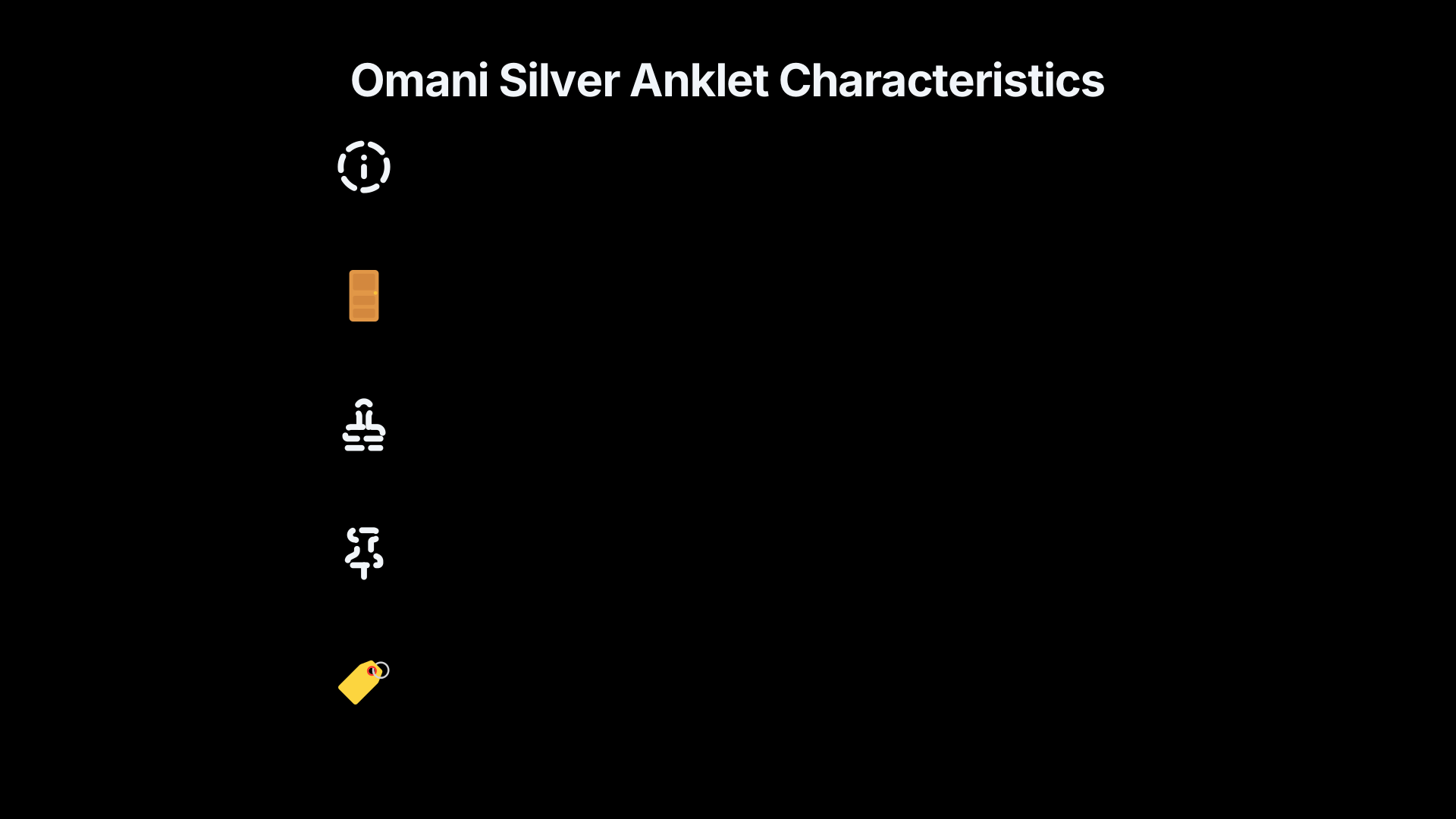
What made the story persuasive was that the object really is unusually large. Traditional Omani silver anklets can be heavy, thick and hollow, with hinged openings and decorative pins. Some surviving examples weigh hundreds of grams and have an external diameter far larger than a modern finger ring. Museum collections and specialist dealers describe such pieces as anklets, not rings, and document their use in Oman and related Indian Ocean trading communities.[British Museum]britishmuseum.orgBritish MuseumankletPair of silver hinged anklets (mutal or natal) in the style of 'Sur anklets' from northern Oman; hollow and tubular w…
What the Object Really Is
The jewellery in question belongs to a well-documented tradition of Omani silver adornment. Anklets of this type were worn by women, especially in northern Oman, and often formed part of ceremonial or wedding dress. Many examples were made from high-grade silver and decorated with chasing, stamping and engraved floral or geometric designs.[omanisilver.com]omanisilver.comAntique Omani silver AnkletOmani silver anklets Anklets were commonly worn in the North of Oman by married women. This is confirmed by ph…
Museum catalogues identify related examples as hinged silver anklets known by names such as mutal, natal or hajul. They were designed to open and close around the ankle using a removable pin or clasp. The British Museum’s collection includes several examples from Oman dating to the twentieth century, showing the same basic form seen in the viral photographs.[British Museum]britishmuseum.orgBritish MuseumankletPair of silver hinged anklets (mutal or natal) in the style of 'Sur anklets' from northern Oman; hollow and tubular w…
Specialist research on Omani jewellery also notes the close relationship between Omani and East African silver traditions. Oman’s long historical connections with Zanzibar and the Swahili Coast helped spread particular jewellery styles across the western Indian Ocean. Some large anklets are therefore found in both Oman and East Africa, further complicating attempts to identify them once their documentation is lost.[michaelbackmanltd.com]michaelbackmanltd.comOpen source on michaelbackmanltd.com.
How Missing Scale Created the Illusion
The giant-ring story demonstrates a common weakness in photographic evidence: objects are often interpreted through assumptions about scale.
A viewer seeing a circular metal ornament naturally asks what familiar category it belongs to. If a photograph lacks contextual clues, the brain searches for the closest match. Because many people are more familiar with rings than with traditional Omani anklets, some interpreted the object as an enormous ring rather than an item of leg jewellery.
Several features reinforced the mistake:
- Circular shape: The object resembles a ring when photographed from certain angles.
- Lack of context: Viral copies usually removed museum labels, captions and provenance.
- Unfamiliar design: Many viewers had never encountered traditional Omani silver anklets.
- Appeal of extraordinary explanations: A giant’s ring is more memorable than a piece of regional jewellery.
The result was not a sophisticated forgery. The image itself was real; the falsehood lay entirely in the caption.
Why False Captions Outlast Museum Records
The anklet’s transformation into a giant’s ring illustrates a broader problem in the digital age. Authentic artefacts often acquire new identities once they become detached from the institutions that preserve their history.
Museum records, catalogues and specialist studies contain detailed information about provenance, manufacture and use. Yet these sources travel much more slowly than a striking image. A photograph copied from a collection can circulate thousands of times while its documentation disappears after a single repost.[British Museum]britishmuseum.orgBritish MuseumankletPair of silver hinged anklets (mutal or natal) in the style of 'Sur anklets' from northern Oman; hollow and tubular w…
Online audiences are also more likely to share a sensational claim than a routine description of jewellery. The idea that a photograph proves the existence of giants offers a dramatic narrative. The explanation that it shows a traditional Omani anklet is historically accurate but less emotionally compelling.
This imbalance helps explain why debunked stories continue to circulate. Even after collectors, museum specialists and jewellery historians identified the object correctly, the giant-ring caption remained widespread because new users encountered the image without seeing the correction.[Facebook]facebook.comDebunking fraudulent giant ring or anklet claimCommenters identify the item as a late 19th-century Omani silver anklet, not a gia…

What the Case Reveals About Evidence
Unlike forged relics or deliberate archaeological frauds, the Omani giant-ring story is primarily a case of misidentification. No fake artefact had to be manufactured. A genuine historical object was enough.
The episode highlights several useful lessons for evaluating extraordinary claims:
- Provenance matters as much as the object itself.
- Photographs without scale can be misleading.
- Genuine artefacts can support false narratives when removed from context.
- Museum catalogues and collection records are often more reliable than viral captions.
- Extraordinary interpretations require independent evidence, not merely an unusual image.
In the context of Oman-related hoaxes and misconceptions, the anklet is a reminder that misinformation does not always begin with a fake object. Sometimes a real piece of cultural heritage becomes the raw material for a completely invented story. The silver anklet survived from a genuine tradition of Omani jewellery; the giant’s ring existed only in the caption.
Amazon book picks
Further Reading
Books and field guides related to How Did an Omani Anklet Become a Giant's Ring?. Use these as the next step if you want deeper reading beyond the article.
Frauds, Myths, and Mysteries: Science and Pseudoscience in Ar...
Directly addresses misidentified artifacts and pseudoarchaeology.
The First Fossil Hunters
Shows how unusual objects become stories about giants and legends.
The Oxford Handbook of the Archaeology of Ritual and Religion
Provides context for interpreting artifacts within culture.
eBay marketplace picks
Marketplace Samples
Live-tested eBay searches with available results related to this page.



Endnotes
1.
Source: facebook.com
Link:https://www.facebook.com/groups/149844915349213/posts/2223496457984038/
Source snippet
Debunking fraudulent giant ring or anklet claimCommenters identify the item as a late 19th-century Omani silver anklet, not a gia...
2.
Source: michaelbackmanltd.com
Link:https://www.michaelbackmanltd.com/object/omani-zanzibar-silver-anklets/
3.
Source: omanisilver.com
Link:https://omanisilver.com/contents/en-us/d367_Antique_Omani_silver_Anklet.html
Source snippet
Antique Omani silver AnkletOmani silver anklets Anklets were commonly worn in the North of Oman by married women. This is confirmed by ph...
4.
Source: omanisilver.com
Link:https://omanisilver.com/contents/en-us/d312.html
Source snippet
rom East Africa before the first World-war but most probably was made in Oman...
5.
Source: facebook.com
Title: Oman, Zar rings. From the book Oman Adorned
Link:https://www.facebook.com/lena.young.549/posts/oman-zar-rings-from-the-book-oman-adorned-a-portrait-in-silver-1997-miranda-morr/36927079906879178/
6.
Source: facebook.com
Link:https://www.facebook.com/museumofsomerset/videos/south-west-heritage-trust-hasacquired-the-stunning-ilminster-ring-and-hoardthis-/1385832970274279/
7.
Source: facebook.com
Link:https://www.facebook.com/groups/1033803409974413/posts/6439941939360506/
8.
Source: britishmuseum.org
Link:https://www.britishmuseum.org/collection/object/W
Source snippet
British MuseumankletPair of silver hinged anklets (mutal or natal) in the style of 'Sur anklets' from northern Oman; hollow and tubular w...
9.
Source: britishmuseum.org
Link:https://www.britishmuseum.org/collection/object/W
Source snippet
British MuseumankletDescription: Pair of heavy silver hinged anklets (mutal or natal); hollow and tubular with a wide rectangular front s...
10.
Source: britishmuseum.org
Link:https://www.britishmuseum.org/collection/object/W
Source snippet
British MuseumankletPair of silver crescent-shaped anklets (hajul); tubular and hollow with floral stamped and chased decoration. Made in...
Additional References
11.
Source: instagram.com
Link:https://www.instagram.com/p/BugrrDKn3vs/
Source snippet
y this platinum and diamond ring with American provenance...
12.
Source: youtube.com
Title: Omani jewelry with a marketing vision / Grade 6 / Visual Arts
Link:https://www.youtube.com/watch?v=pnj21zI8nso
Source snippet
MUTRAH CORNICHE & SOUK | OMAN MUSCAT | OMAN ATTRACTIONS | PLACES TO VISIT IN OMAN...
13.
Source: youtube.com
Title: Purchase the Omani Silver Necklace (Muttrah Souk, Oman)
Link:https://www.youtube.com/watch?v=VUCbR6DZYKk
Source snippet
Omani jewelry with a marketing vision / Grade 6 / Visual Arts...
14.
Source: youtube.com
Title: Adornment and identity: jewellery and costume from Oman
Link:https://www.youtube.com/watch?v=nY2yMDju17g
Source snippet
Purchase the Omani Silver Necklace (Muttrah Souk, Oman)...
15.
Source: archive.org
Link:https://archive.org/download/bub_gb_LaUnOztbkP4C/bub_gb_LaUnOztbkP4C.pdf
16.
Source: instagram.com
Link:https://www.instagram.com/reel/DPKZqWPiQGX/?hl=en
17.
Source: pinterest.com
Link:https://www.pinterest.com/pin/omani-anklets-ethnic-jewels–14847873747636554/
18.
Source: instagram.com
Link:https://www.instagram.com/reel/DZhmlqJsBX2/
19.
Source: youtube.com
Link:https://www.youtube.com/watch?v=xmEjSQpBP7I
20.
Source: now.temple.edu
Title: temple professor discovers 5000 year old silver jewelry oman
Link:https://now.temple.edu/news/2023-02-07/temple-professor-discovers-5000-year-old-silver-jewelry-oman
Topic Tree