When Did Portugal Believe the Unbelievable?
Portugal’s history of deception is not a catalogue of national gullibility. Its best-known cases show something more interesting: falsehood succeeds when it borrows the appearance of legitimate authority, confirms a powerful hope, or compresses a complicated history into a memorable story.
Page outline Jump by section
Introduction
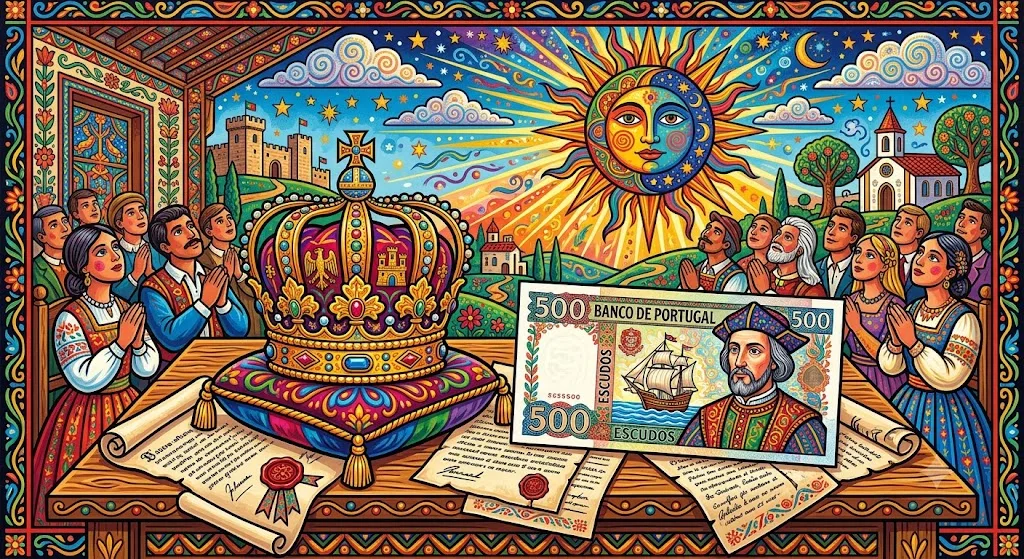
These episodes also require careful labels. Alves Reis committed a calculated fraud. The men who claimed to be King Sebastian were impostors, although they operated inside a wider popular legend. The reported solar spectacle at Fátima remains a religious and historical controversy, not a proven hoax. Estado Novo’s imperial mythology was organised propaganda rather than a single trick. Understanding those differences is central to understanding how contested truth has worked in Portugal.
The kings who returned from the dead
King Sebastian disappeared during Portugal’s disastrous invasion of Morocco in 1578. His body was not immediately available to settle the matter beyond doubt, he left no direct heir, and Portugal soon fell under the Spanish Habsburg monarchy. In that atmosphere, uncertainty about one dead young man became a political resource. The belief later called Sebastianism held that the hidden king might return and restore Portuguese independence and greatness.
Several men attempted to turn that hope into personal authority. False Sebastians appeared in 1584, 1585, 1595 and 1598. The earliest claimants attracted rural followers inside Portugal; later conspiracies became more elaborate and international. Their stories differed, but the mechanism was consistent: a stranger with a vague resemblance or a persuasive manner claimed to be the battle-scarred king, while supporters explained every discrepancy as the result of captivity, suffering or deliberate disguise.[JSTOR]jstor.orgFrom Military Defeat to Immortality: The Birth of Sebastianismby ME Brooks · 1964 · Cited by 11 — decades of the sixteenth century…
The most famous claimant was Gabriel de Espinosa, a baker arrested in the Spanish town of Madrigal in the 1590s. He became the centre of a plot involving a Portuguese friar and Ana of Austria, a noblewoman confined to a convent. Espinosa did not need to prove his identity in the modern forensic sense. He needed to perform enough signs of kingship for people who already found Sebastian’s survival politically or emotionally useful. The conspiracy ended with arrests and executions, but the episode remained compelling because it joined romance, dynastic politics and national loss.[Portuguese American Journal]portuguese-american-journal.comPortuguese American JournalBook: “The Baker Who Pretended Be King of Portugal” by…August 30, 2012 — 30 Aug 2012 — In her book, The Bak…
The impostors were deliberate deceivers, yet Sebastianism itself cannot be reduced to their frauds. It became a flexible tradition expressed through prophecy, literature and political symbolism. In later retellings, the false kings sometimes appear almost as evidence that Sebastian really survived: why, believers ask, would so many claimants appear unless rumours of his escape contained some truth? Historically, the reverse is more convincing. The abundance of impostors demonstrates the value of the identity and the difficulty of disproving a claimant in a society without photographs, fingerprints or rapid communication.
The episode exposes a recurrent feature of successful imposture. The deceiver does not create the desire that sustains him. He steps into a role that an audience has already prepared.
The banknotes that were genuine and fraudulent at once
Portugal’s most spectacular financial deception began not with a counterfeit printing press but with forged paperwork. In 1924 and 1925, Artur Virgílio Alves Reis fabricated contracts and official authorisations suggesting that he had permission to arrange a secret issue of Portuguese currency for economic development in Angola. His documents persuaded intermediaries and, eventually, the British security printer Waterlow & Sons, which legitimately produced notes for the Bank of Portugal.
Waterlow printed the unauthorised 500-escudo notes using the bank’s genuine plates, paper and production methods. The result created an extraordinary investigative problem: the notes were not crude imitations. Physically, they were authentic Bank of Portugal money. What made them fraudulent was the forged authority behind the order and the duplication of serial numbers already in circulation. The Bank of Portugal later described the affair as Portugal’s most famous case of currency falsification and emphasised the unusual use of fraudulent means to obtain officially manufactured notes.[Bank of Portugal]bportugal.ptboletim notas e moedas 11Bank of PortugalOutubro 2010 ÍndiceEm 1925 deu-se o caso de falsificação mais famoso em Portugal, Alves dos Reis e os seus cúmplices cons…
Reis and his associates released the money through the Banco Angola e Metrópole, a bank they had established partly to make their sudden access to capital appear plausible. Depositors saw confident expansion, attractive terms and a seemingly successful financial institution. Reis used the proceeds to buy businesses, property and shares in the Bank of Portugal itself, apparently hoping to secure enough influence to protect or legitimise the scheme.
The fraud worked because each participant saw only a convincing fragment. Printers saw documents that resembled official authorisations. Financial intermediaries saw respectable contacts and legal-looking contracts. Customers saw a bank with plentiful cash. The Portuguese notes passing from hand to hand looked exactly as they should because they had been manufactured exactly as genuine notes were. Reis had counterfeited the chain of command rather than the product.[LSE]lse.ac.ukThe Effects Of The 1925 Portuguese Bank Note Crisisby H Wigan · 2004 · Cited by 11 — The article describes how twenty-eight year old w…
The operation collapsed in December 1925 after duplicated serial numbers drew attention and the Lisbon newspaper O Século publicised the scandal. Investigators traced the notes through the new bank and back to Waterlow. The exposure caused a crisis of confidence, litigation between the Bank of Portugal and the printer, and a public spectacle that intensified existing distrust in the unstable First Republic. Historians debate how much the affair directly contributed to the military coup of 1926, but claims that Reis alone brought down Portuguese democracy overstate a crisis whose political causes were much broader.[LSE]lse.ac.ukThe Effects Of The 1925 Portuguese Bank Note Crisisby H Wigan · 2004 · Cited by 11 — The article describes how twenty-eight year old w…
Its continuing appeal lies in the paradox. Reis did not merely make fake money that looked real. He induced the official manufacturer to make real-looking money under a fake mandate. The case remains a model of institutional fraud: forged procedure can be more powerful than forged material.
Fátima and the danger of calling every disputed claim a hoax
On 13 October 1917, a large crowd gathered near Fátima after three shepherd children said that the Virgin Mary had promised a public sign. Many witnesses later reported unusual visual effects involving the sun: spinning, changing colours, descending towards the earth or appearing through the clouds. The event became known as the Miracle of the Sun and helped transform Fátima into one of the world’s major Catholic pilgrimage sites.
A sceptical history must distinguish between three possible claims. The first is that the sun physically moved. That cannot be reconciled with astronomy: an actual movement of the sun visible from central Portugal would not have been a local event. The second is that people experienced striking visual effects, which is supported by numerous reports, although the descriptions vary substantially. The third is that the children or church authorities deliberately staged a fraud. The surviving evidence does not establish that conclusion.[Wikipedia]WikipediaMiracle of the SunMiracle of the Sun
Natural and psychological explanations include staring at a bright sun through shifting cloud, retinal after-images, expectation, crowd influence and selective later reporting. Witnesses did not all describe the same phenomenon, and some people present reported seeing nothing unusual. Contemporary newspaper coverage is important, but it proves that observers reported an extraordinary experience, not that a celestial object departed from its normal course.
Religious interpretations emphasise the advance prediction of a sign, the size and diversity of the crowd and testimony from sceptical or secular observers. Catholic authorities investigated the apparitions and in 1930 declared them worthy of belief, a theological judgement permitting devotion rather than a scientific finding that the sun had physically moved.[Wikipedia]WikipediaMiracle of the SunMiracle of the Sun
Fátima belongs in a history of contested truth because later retellings frequently flatten its ambiguities. Devotional accounts may merge conflicting testimonies into one uniform spectacle. Dismissive accounts may call the entire event a hoax without demonstrating a conspiratorial mechanism, fabricated witnesses or deliberate staging. A more defensible conclusion is narrower: something was reported and experienced by many observers, the literal astronomical interpretation is untenable, and the evidence does not prove an organised fraud.
That distinction matters well beyond religion. A mistaken interpretation is not automatically a lie; a shared expectation is not necessarily a conspiracy; and an unexplained subjective experience is not evidence that the strongest supernatural explanation is true.
How dictatorship manufactured a flattering national past
Under António de Oliveira Salazar, the Estado Novo dictatorship did not depend on one spectacular fake. It created a controlled national picture through censorship, ceremonies, exhibitions, school material, monuments and carefully staged visual culture. Portugal was represented as orderly, rural, Catholic, historically continuous and naturally suited to rule a far-reaching overseas empire.
The 1940 Portuguese World Exhibition in Lisbon was the regime’s grandest production of this story. Organised around anniversaries of the kingdom’s foundation and the restoration of independence, it transformed selective history into architecture and spectacle. Medieval monarchy, maritime expansion and contemporary dictatorship were presented as chapters of one coherent national mission. Scholars describe the exhibition as a major exercise in political legitimation and imperial mystification rather than a neutral commemoration.[E-Space]e-space.mmu.ac.ukE-Spacecommemoration and propaganda in salazar's portugalE-Spacecommemoration and propaganda in salazar's portugal
After the Second World War, when colonial empires faced mounting international opposition, the regime increasingly adopted a simplified version of the Brazilian thinker Gilberto Freyre’s ideas about Portuguese adaptation to tropical societies. Official rhetoric suggested that Portuguese colonialism was unusually tolerant, culturally flexible and non-racist. Portugal’s African territories were redesignated as overseas provinces, allowing the government to claim that it possessed no colonies at all, merely parts of one nation spread across continents.[Cambridge University Press & Assessment]resolve.cambridge.orgOpen source on cambridge.org.
This was persuasive partly because it mixed observable facts with strategic omissions. Portuguese imperial societies did produce cultural exchange, mixed communities and complicated identities. But those realities did not cancel forced labour, legal inequality, coercive administration, racial hierarchy, political repression or wars fought to prevent independence. The propaganda converted evidence of contact and mixture into proof of benevolent rule.
The myth also benefited identifiable interests. It defended the regime against pressure from the United Nations and anticolonial movements, encouraged metropolitan citizens to see imperial possession as part of their own identity, and characterised opponents of Portuguese rule as threats to an organic multiracial nation. Visual propaganda made those arguments appear ordinary and self-evident: maps, films, exhibitions and photographs repeatedly showed harmony while excluding violence and resistance.[impactum-journals.uc.pt]impactum-journals.uc.ptPolitics and Practices of visual propaganda in PortuguesePolitics and Practices of visual propaganda in Portuguese
This case illustrates why propaganda should not always be treated as a collection of individually false sentences. Its power often comes from framing: choosing which people are visible, which events form the national timeline and which experiences are left outside the picture. The resulting story can contain many accurate details while remaining fundamentally deceptive.
From forged papers to fabricated screenshots
Modern Portuguese misinformation still relies on old mechanisms: impersonated authority, emotional timing and stories tailored to existing fears. The difference is speed. During the Iberian electricity blackout of 28 April 2025, false explanations circulated before investigators had established the cause. Posts blamed sanctions against Russia, invented a Russian cyberattack and copied the names or visual styles of established news organisations. Fabricated satellite images and a text falsely attributed to CNN gained large audiences while public uncertainty was at its highest.[iberifier.eu]iberifier.euFact-checking: Disinformation about the blackout in SpainFact-checking: Disinformation about the blackout in Spain
The blackout rumours demonstrate the value of an information vacuum. A complex technical failure takes time to investigate; a conspiratorial explanation can be written immediately. False reports also travel well across borders because the event affected both Portugal and Spain, allowing content to be translated, recycled and detached from its original source.
Election monitoring in Portugal has identified similarly adaptable narratives involving immigration, invented political endorsements, manipulated media content and claims of hidden electoral misconduct. Researchers studying Portuguese disinformation describe a mixture of domestic political incentives and narratives imported from larger international networks. Recent fact-checking reports have repeatedly found misleading claims linking immigrants or Muslim communities to crime, preferential treatment or fictitious state projects.[iberifier.eu]iberifier.euImmigration-related disinformation leads misleadingImmigration-related disinformation leads misleading
Not every false post is a planned political operation. Some begin as jokes, misunderstandings, edited clips or opportunistic attempts to attract advertising revenue. The decisive change occurs when context disappears. A satirical image is reposted as evidence; an old video is assigned a new location; an unverified message is dressed in the colours of a recognised broadcaster. As with Alves Reis’s forged contracts, appearance supplies borrowed credibility.
The most useful questions are therefore practical rather than ideological. Does the alleged news organisation carry the report on its own site? Is the image older than the event it supposedly depicts? Does the claim cite a named investigation, document or accountable official? Are several posts merely repeating one anonymous source? A falsehood’s familiarity, emotional force or professional design does not make its origin independent.
Why Portugal’s hoaxes remain believable
Across these very different episodes, deception succeeds through a small set of recurring advantages.
It enters through a trusted form. A royal claimant adopts dynastic signs; Alves Reis presents contracts and seals; propaganda uses museums, classrooms and official exhibitions; an online fabrication imitates a broadcaster’s design.
It offers a satisfying explanation. Sebastian is not dead but waiting to restore the country. An unexplained blackout is not technically complicated but the result of a hostile power. Colonial conflict is not resistance to domination but a misunderstanding inside a harmonious national family.
It benefits from uneven access to evidence. A sixteenth-century village cannot quickly compare an impostor with a verified portrait. A bank customer cannot inspect international printing contracts. A social-media user sees a dramatic screenshot before a technical investigation has begun.
It survives by changing category. Exposed fraud becomes folklore; propaganda becomes nostalgia; a disputed experience becomes either unquestionable proof or a supposed conspiracy. Later storytellers often remove the qualifications that made the original evidence difficult.
Portugal’s most revealing deception stories are consequently not those in which everyone believed an absurd claim. They are those in which institutions, hopes and familiar symbols made the false or exaggerated account easier to accept than the complicated truth. The impostor, fraudster and propagandist all succeed by understanding what their audience already recognises—and what it wants the evidence to mean.
Amazon book picks
Further Reading
Books and field guides related to When Did Portugal Believe the Unbelievable?. Use these as the next step if you want deeper reading beyond the article.
The Demon-Haunted World
Rating: 4.5/5 from 43 Google Books ratings
Useful framework for evaluating extraordinary claims.
Extraordinary Popular Delusions and the Madness of Crowds
Rating: 4.0/5 from 5 Google Books ratings
Shows how societies can embrace unlikely stories.
A Concise History of Portugal
Provides context for several Portuguese deception narratives.
eBay marketplace picks
Marketplace Samples
Live-tested eBay searches with available results related to this page.


Endnotes
1.
Source: jstor.org
Link:https://www.jstor.org/stable/3512796
Source snippet
From Military Defeat to Immortality: The Birth of Sebastianismby ME Brooks · 1964 · Cited by 11 — decades of the sixteenth century...
2.
Source: portuguese-american-journal.com
Link:https://portuguese-american-journal.com/book-the-baker-who-pretended-be-king-of-portugal-by-ruth-mackay-editors-note/
Source snippet
Portuguese American JournalBook: “The Baker Who Pretended Be King of Portugal” by...August 30, 2012 — 30 Aug 2012 — In her book, The Bak...
Published: August 30, 2012
3.
Source: lse.ac.uk
Link:https://www.lse.ac.uk/asset-library/information/wp8204.pdf
Source snippet
The Effects Of The 1925 Portuguese Bank Note Crisisby H Wigan · 2004 · Cited by 11 — The article describes how twenty-eight year old w...
4.
Source: Wikipedia
Title: Miracle of the Sun
Link:https://en.wikipedia.org/wiki/Miracle_of_the_Sun
5.
Source: resolve.cambridge.org
Link:https://resolve.cambridge.org/core/services/aop-cambridge-core/content/view/72C8A66537670140303007767D990F6A/9781781384633c9_p157-174_CBO.pdf/on_being_portuguese_lusotropicalism_migrations_and_the_politics_of_citizenship.pdf
6.
Source: impactum-journals.uc.pt
Title: Politics and Practices of visual propaganda in Portuguese
Link:https://impactum-journals.uc.pt/rph/article/download/13844/9986/65935
7.
Source: iberifier.eu
Title: Fact-checking: Disinformation about the blackout in Spain
Link:https://iberifier.eu/2025/05/02/fact-checking-disinformation-about-the-blackout-in-spain-and-portugal/
8.
Source: edmo.eu
Link:https://edmo.eu/publications/disinformation-about-the-blackout-went-around-the-world-impersonated-media-rare-atmospheric-phenomenon-and-russian-networks/
9.
Source: edmo.eu
Title: ENG General elections 2025 Portugal 3July FINAL20 1
Link:https://edmo.eu/wp-content/uploads/2025/07/ENG_General-elections-2025_Portugal_3July_FINAL20-1.pdf
10.
Source: iberifier.eu
Title: Immigration-related disinformation leads misleading
Link:https://iberifier.eu/2026/01/19/immigration-related-disinformation-leads-misleading-content-during-portugals-2026-presidential-election-period/
11.
Source: iberifier.eu
Link:https://iberifier.eu/2026/06/03/fake-political-endorsements-immigration-and-artificial-intelligence-shape-a-quarter-marked-by-disinformation-in-portugal-and-spain/
12.
Source: iberifier.eu
Link:https://iberifier.eu/app/uploads/2025/11/Iberifier-ReportQ3.pdf
13.
Source: Wikipedia
Title: Out of place artifact
Link:https://en.wikipedia.org/wiki/Out-of-place_artifact
14.
Source: Wikipedia
Link:https://en.wikipedia.org/wiki/Listenbourg
15.
Source: Wikipedia
Title: Alves dos Reis
Link:https://en.wikipedia.org/wiki/Alves_dos_Reis
16.
Source: Wikipedia
Title: Estado Novo (Portugal)
Link:https://en.wikipedia.org/wiki/Estado_Novo_%28Portugal%29
17.
Source: iberifier.eu
Title: spain portugal fact checking brief
Link:https://iberifier.eu/2025/01/26/spain-portugal-fact-checking-brief/
18.
Source: iberifier.eu
Link:https://iberifier.eu/app/uploads/2026/03/Iberifier-ReportQ4_25.pdf
19.
Source: iberifier.eu
Link:https://iberifier.eu/app/uploads/2024/11/Iberifier-ReportQ1-24_pdfversion-1.pdf
20.
Source: iberifier.eu
Title: report spain portugal fact checking brief 2
Link:https://iberifier.eu/2026/06/03/report-spain-portugal-fact-checking-brief-2/
21.
Source: iberifier.eu
Title: spain portugal fact checking brief 2
Link:https://iberifier.eu/2025/10/18/spain-portugal-fact-checking-brief-2/
22.
Source: iberifier.eu
Link:https://iberifier.eu/app/uploads/2024/03/IBERIFIER_FactChekingReport_2023_Q3.pdf
23.
Source: iberifier.eu
Title: Fact checking brief IBERIFIER 2023 Q1 Jan Mar EN
Link:https://iberifier.eu/app/uploads/2023/05/Fact-checking-brief-IBERIFIER-2023-Q1-Jan-Mar-EN.pdf
24.
Source: iberifier.eu
Title: Report Q4
Link:https://iberifier.eu/app/uploads/2025/01/Iberifier-ReportQ4.pdf
25.
Source: edmo.eu
Title: eu elections disinfo bulletin
Link:https://edmo.eu/thematic-areas/elections/european-elections/eu-elections-disinfo-bulletin/
26.
Source: jstor.org
Link:https://www.jstor.org/stable/26740774
27.
Source: portugal.com
Title: the portuguese scandal that changed the country forever
Link:https://www.portugal.com/history-and-culture/the-portuguese-scandal-that-changed-the-country-forever/
28.
Source: interacoes-ismt.com
Link:https://interacoes-ismt.com/index.php/revista/article/download/123/127
Source snippet
Sebastião e as Máscarasby JH Dias · 2004 — 8 Garrett chegou a admitir que este falso rei podia ser verdadeiro. F.M. Bordalo, em 1884, pub...
29.
Source: bportugal.pt
Title: boletim notas e moedas 11
Link:https://www.bportugal.pt/publicacao/boletim-notas-e-moedas-11
Source snippet
Bank of PortugalOutubro 2010 ÍndiceEm 1925 deu-se o caso de falsificação mais famoso em Portugal, Alves dos Reis e os seus cúmplices cons...
30.
Source: e-space.mmu.ac.uk
Title: E-Spacecommemoration and propaganda in salazar’s portugal
Link:https://e-space.mmu.ac.uk/14342/2/COMMPROPAGFV.pdf
31.
Source: e-archivo.uc3m.es
Link:https://e-archivo.uc3m.es/bitstreams/2f40c032-ee6b-4efc-ab39-236355cc47c4/download
32.
Source: obercom.pt
Link:https://obercom.pt/wp-content/uploads/2024/05/Fact-checking_trends_FINAL_21Maio.pdf
33.
Source: pt.scribd.com
Link:https://pt.scribd.com/document/681435010/222222222222222222222222
Additional References
34.
Source: brewminate.com
Title: sebastianism the calabrian charlatan and medieval messianic nationalism
Link:https://brewminate.com/sebastianism-the-calabrian-charlatan-and-medieval-messianic-nationalism/
Source snippet
In the time of Habsburg rule (1580-1640), impostors claimed to be King Sebastian in 1584, 1585, 1595 and 1598.Read more...
35.
Source: bhsportugal.org
Title: alves reis and the portuguese bank note scandal of 1925
Link:https://www.bhsportugal.org/library/articles/alves-reis-and-the-portuguese-bank-note-scandal-of-1925
Source snippet
In 1925 in London, the printing company Waterlow and Sons was persuaded to print Portuguese banknotes using the official plates it had.Re...
36.
Source: youtube.com
Link:https://www.youtube.com/watch?v=stnTkOfMQz0
Source snippet
Did Mary Appear to 100,000 People? Fatima Myths & Mysteries Explained...
37.
Source: youtube.com
Title: Man Prints $100 Million, Almost Buys Portugal’s Central Bank
Link:https://www.youtube.com/watch?v=ExDua0LIrZw
Source snippet
History of Portugal: Reign of Sebastian (1557–1578) | Educational Audiobook...
38.
Source: youtube.com
Title: Ocean’s Portugal: The Heist That Ruined A Country
Link:https://www.youtube.com/watch?v=cgxz8a3Igpg
Source snippet
Man Prints $100 Million, Almost Buys Portugal's Central Bank...
39.
Source: youtube.com
Link:https://www.youtube.com/watch?v=e-B19fq7V5s
Source snippet
Ocean's Portugal: The Heist That Ruined A Country...
40.
Source: researchgate.net
Link:https://www.researchgate.net/publication/364296622_Fake_news_and_its_impact_on_trust_in_the_news_Using_the_Portuguese_case_to_establish_lines_of_differentiation
41.
Source: researchgate.net
Link:https://www.researchgate.net/publication/391245213_Disinformation_Dynamics_and_Regulation_in_Portugal_Insights_from_a_Qualitative_Study
42.
Source: instagram.com
Link:https://www.instagram.com/reel/Cz3nUnmoajv/
43.
Source: instagram.com
Link:https://www.instagram.com/reel/C5QVGTNhfd6/
Topic Tree
Follow this branch
Related pages 192
- Albanian Hoaxes
- Algerian Hoaxes
- Antigua Deceptions
- Argentina Hoaxes
- Armenian Hoaxes
- +187 more in sidebar