Within Sudan Hoaxes
Why Experts Doubted Meroe's Real Royal Gold
Ferlini's destructive search produced real royal jewellery, but poor provenance and colonial prejudice made experts doubt its authenticity.
On this page
- Ferlini's destructive search at Meroe
- Why European experts suspected a forgery
- How provenance changed the verdict
Page outline Jump by section
Introduction
The story of the Meroe treasure is unusual because it reverses the pattern of a classic forgery scandal. Instead of fake artefacts fooling experts, genuine royal jewellery from ancient Sudan was dismissed as fake by many of the people most qualified to judge it. When the Italian treasure hunter Giuseppe Ferlini uncovered a spectacular cache of gold ornaments in 1834 from the pyramid of the Kushite queen Amanishakheto at Meroe, European museums and scholars often reacted with suspicion rather than excitement. The treasure seemed too refined, too elaborate and, in the eyes of some nineteenth-century observers, too sophisticated to have come from ancient Sudan. Combined with Ferlini’s destructive methods and poor documentation, those assumptions led many experts to suspect a forgery. Only later did archaeological research confirm that the jewellery was authentic and represented one of the finest surviving collections from the Kingdom of Kush.[Wikipedia]WikipediaGiuseppe FerliniGiuseppe Ferlini
Ferlini’s Destructive Search at Meroe
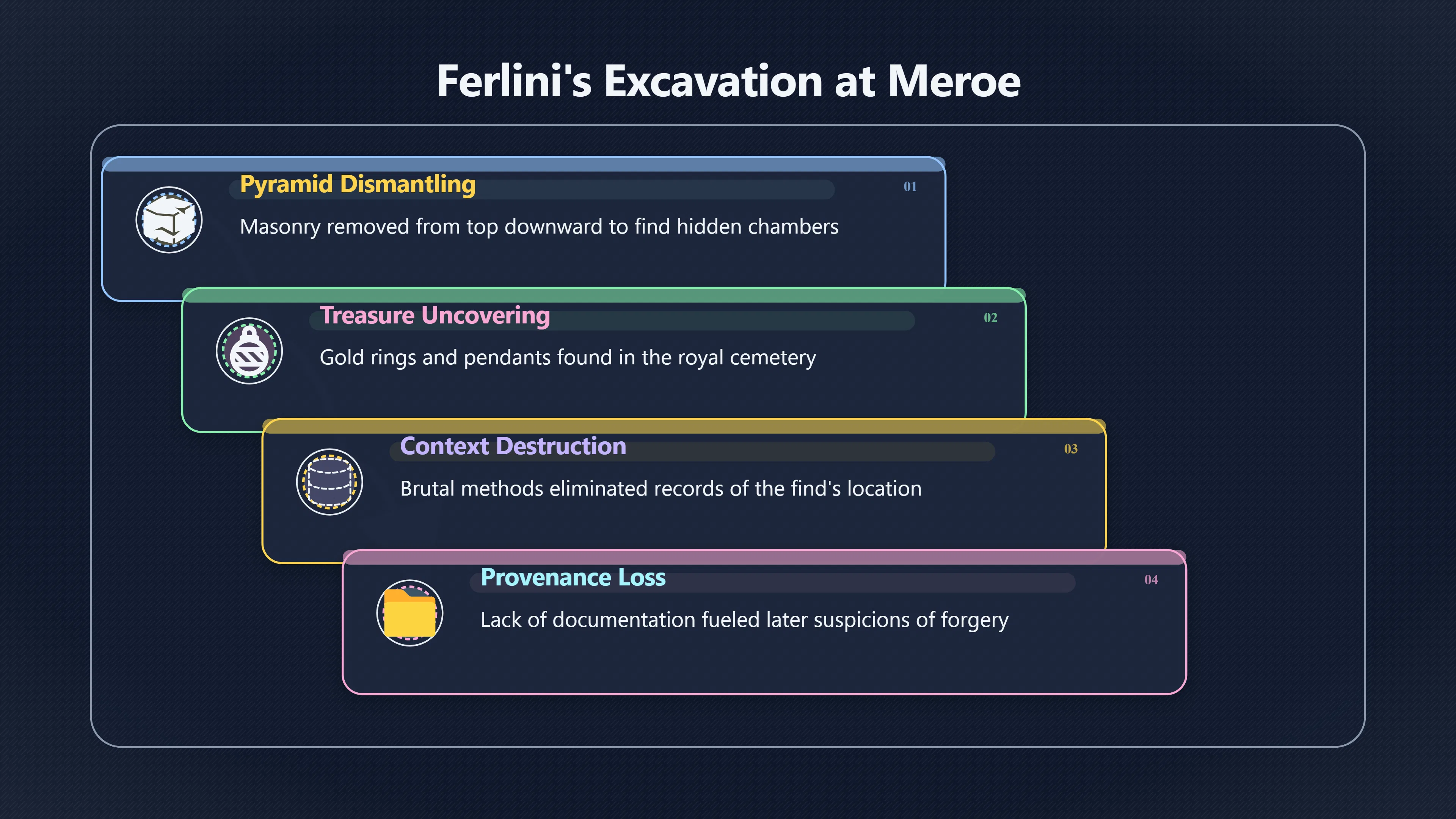
Giuseppe Ferlini arrived in Sudan not as a trained archaeologist in the modern sense but as an adventurer seeking treasure. In 1834 he began dismantling pyramids at the royal cemetery of Meroe, a major centre of the ancient Kushite kingdom. His approach was brutally simple: remove masonry from the top downward until hidden chambers or valuables appeared.[Wikipedia]WikipediaGiuseppe FerliniGiuseppe Ferlini
His most famous discovery came in the pyramid associated with Queen Amanishakheto, a ruler of Kush who reigned in the early first century CE. Inside, Ferlini uncovered an extraordinary group of objects including rings, bracelets, pendants and other gold ornaments decorated with coloured inlays and intricate imagery. The treasure appears to have survived largely undisturbed since antiquity, making the find exceptionally important.[Wikipedia]WikipediaGiuseppe FerliniGiuseppe Ferlini
Yet the way the treasure was recovered immediately created problems. Ferlini destroyed much of the archaeological context that would normally help establish authenticity. Modern archaeologists rely not only on objects themselves but also on careful records showing exactly where and how they were found. By tearing apart the pyramid in search of valuables, Ferlini eliminated much of that evidence.[Wikipedia]WikipediaGiuseppe FerliniGiuseppe Ferlini
This loss of provenance—the documented history and excavation context of an artefact—would later become one of the main reasons experts doubted the treasure.
Why European Experts Suspected a Forgery
When Ferlini attempted to sell the jewellery in Europe, he encountered scepticism almost everywhere he went. Museums, governments and scholars examined the objects, but many were unconvinced by his story.[Wikipedia]WikipediaGiuseppe FerliniGiuseppe Ferlini
Part of that scepticism was reasonable. Treasure hunters frequently exaggerated discoveries, fabricated findspots or mixed objects from different sources to increase their value. Ferlini’s excavation records were limited, and his reputation as a fortune-seeker did not inspire confidence. From the perspective of a museum curator, caution was understandable.[Wikipedia]WikipediaGiuseppe FerliniGiuseppe Ferlini
However, another factor was equally important: prejudice about what ancient African civilisations were thought capable of producing.
The jewellery displayed remarkably sophisticated goldworking techniques. Many European observers struggled to believe that such workmanship could have originated in the ancient kingdom of Kush. Instead of treating the objects as evidence of a highly developed Sudanese civilisation, some experts assumed they must be modern creations or altered pieces. According to accounts of the period, the British Museum ultimately declined to purchase the collection after advisers concluded it was probably fraudulent.[wikipedia.org]WikipediaGiuseppe FerliniGiuseppe Ferlini
The irony is striking. The objects looked so impressive that some specialists regarded their quality as evidence against authenticity rather than evidence for it.
How Provenance Changed the Verdict
The turning point came not through a dramatic exposure of fraud but through accumulating evidence that placed the treasure within a broader Kushite cultural context.
In the 1840s, the Prussian scholar Karl Richard Lepsius visited the Sudanese sites of Nubia and Meroe. His observations, together with later archaeological work, confirmed the existence of a rich Meroitic artistic tradition consistent with the jewellery’s style and workmanship. As knowledge of Kushite civilisation expanded, the supposed anomalies that had made the treasure seem suspicious began to disappear.[Egyptian Museum Berlin]egyptian-museum-berlin.comEgyptian Museum BerlinThe Ancient Sudan - Egyptian Museum BerlinThe delicate objects made mostly of gold and inlayed with fused glass wer…
The jewellery could now be compared with inscriptions, monuments, royal iconography and other artefacts from the kingdom. Rather than appearing as isolated curiosities, the pieces fit into a recognisable artistic and historical tradition. Lepsius helped establish their authenticity, and major portions of the treasure were eventually acquired by museums in Berlin and Munich, where they remain today.[Egyptian Museum Berlin]egyptian-museum-berlin.comEgyptian Museum BerlinThe Ancient Sudan - Egyptian Museum BerlinThe delicate objects made mostly of gold and inlayed with fused glass wer…
The episode demonstrates a central principle of archaeology: provenance matters. An artefact can be completely genuine yet become difficult to authenticate if its discovery is poorly documented. Ferlini’s actions created uncertainty that took decades to overcome.[Wikipedia]WikipediaGiuseppe FerliniGiuseppe Ferlini
What the Case Reveals About Knowledge and Bias
The Meroe treasure occupies a distinctive place in the history of mistaken authenticity judgments. Most famous forgery stories involve experts accepting fake objects as real. Here the opposite happened: authentic objects were treated as suspect.
Several forces combined to produce that error:
- Destructive excavation practices left crucial contextual evidence missing.
- Commercial incentives encouraged suspicion of treasure hunters and dealers.
- Limited knowledge of Kushite civilisation made the jewellery appear unfamiliar.
- Colonial-era assumptions about Africa influenced judgments about artistic sophistication and technological skill.[Wikipedia]WikipediaGiuseppe FerliniGiuseppe Ferlini
Because all of these factors pointed in the same direction, many observers concluded that the treasure was too extraordinary to be genuine.
The eventual acceptance of the jewellery therefore became more than a question of authentication. It helped reveal how archaeological interpretation can be shaped not only by evidence but also by expectations about who could have created that evidence.

The wider consequences of Meroe Treasure
Within Sudan’s wider history of disputed artefacts and misunderstood evidence, the Meroe treasure stands as a cautionary tale about both looting and prejudice. Ferlini uncovered something real, but his treasure-hunting methods destroyed information that scholars can never recover. At the same time, the sceptical reaction in Europe showed how deeply assumptions about African history influenced judgments about authenticity.[Wikipedia]WikipediaGiuseppe FerliniGiuseppe Ferlini
Today the jewellery of Queen Amanishakheto is recognised as one of the most important surviving artistic achievements of the Kingdom of Kush. The objects are no longer viewed as suspicious curiosities but as evidence of a sophisticated royal culture that flourished in what is now Sudan. The lasting lesson is that genuine discoveries can be doubted for the wrong reasons, especially when poor documentation and cultural bias combine to obscure the truth.[egyptian-museum-berlin.com]egyptian-museum-berlin.comEgyptian Museum BerlinThe Ancient Sudan - Egyptian Museum BerlinThe delicate objects made mostly of gold and inlayed with fused glass wer…
Amazon book picks
Further Reading
Books and field guides related to Why Experts Doubted Meroe's Real Royal Gold. Use these as the next step if you want deeper reading beyond the article.
Lives of the Ancient Egyptians
Helps readers compare Nile civilizations and elite material culture.
Archaeology : theories, methods, and practice
Useful for understanding provenance and artifact authentication.
eBay marketplace picks
Marketplace Samples
Live-tested eBay searches with available results related to this page.
Endnotes
1.
Source: Wikipedia
Title: Giuseppe Ferlini
Link:https://en.wikipedia.org/wiki/Giuseppe_Ferlini
2.
Source: egyptian-museum-berlin.com
Link:https://www.egyptian-museum-berlin.com/c33.php
Source snippet
Egyptian Museum BerlinThe Ancient Sudan - Egyptian Museum BerlinThe delicate objects made mostly of gold and inlayed with fused glass wer...
3.
Source: Wikipedia
Title: Pyramids of Meroë
Link:https://en.wikipedia.org/wiki/Pyramids_of_Mero%C3%AB
4.
Source: Wikipedia
Link:https://en.wikipedia.org/wiki/Amanishakheto
5.
Source: researchgate.net
Link:https://www.researchgate.net/publication/357469726_Ancient_Egypt_Magazine_The_sacred_treasure_of_Queen_Amanishakheto
Source snippet
Berlin, this treasure takes visitors back pharaonic Egypt met...
Additional References
6.
Source: facebook.com
Link:https://www.facebook.com/USAfrika.gov/posts/queen-kandake-amanishaketoby-kweku-oforiher-pyramid-was-pillaged-and-destroyed-b/2159801867490281/
Source snippet
Amanishaketo's pyramid destroyed by Italian treasure hunterThe British museum, convinced the loot was a forgery or at best low qu...
7.
Source: academia.edu
Title: Following the footprints of a jackal from Meroe to London
Link:https://www.academia.edu/114825598/Following_the_footprints_of_a_jackal_from_Meroe_to_London_The_origin_of_British_Museum_EA68502
Source snippet
The provenance relies solely on a handwritten note in the museum's register, which is often unreliable. This raises questions about the a...
8.
Source: en.majalla.com
Title: looting sudan ancient queen’s jewels present day
Link:https://en.majalla.com/node/322700/culture-social-affairs/looting-sudan-ancient-queen%E2%80%99s-jewels-present-day
Source snippet
Sudan: From an ancient queen's jewels to present...20 Oct 2024 — Ferlini reached Meroë, Ferlini found the treasure hidden among the ston...
9.
Source: youtube.com
Link:https://www.youtube.com/watch?v=C8VfU4RN-eI
Source snippet
Forgotten PYRAMIDS OF SUDAN Survived 2500 Years (Better Than Egyptian)...
10.
Source: youtube.com
Title: Sudan Has More Pyramids Than Egypt The Forgotten Ancient Civilization
Link:https://www.youtube.com/watch?v=B69njMIiVOE
Source snippet
Reconstructing Queen Amanishakheto's Musical Instruments...
11.
Source: facebook.com
Link:https://www.facebook.com/groups/953280683280342/posts/1081419240466485/
12.
Source: instagram.com
Link:https://www.instagram.com/reel/DPvhmfwjuD2/?hl=en
13.
Source: instagram.com
Link:https://www.instagram.com/p/DQbuxX-DEsC/
14.
Source: instagram.com
Link:https://www.instagram.com/p/B9oy5gbB6xN/?hl=en
15.
Source: iheart.com
Link:https://www.iheart.com/podcast/1333-the-kingdom-of-kush-afric-331381753/episode/kushite-kandake-amanishakhetos-treasures-from-meroe-338511225/
Topic Tree