How Belize Became a Stage for Deception
Belize’s best-known hoax is the Mitchell-Hedges crystal skull, supposedly discovered beneath a Maya altar at Lubaantun in the 1920s.
Page outline Jump by section
Introduction
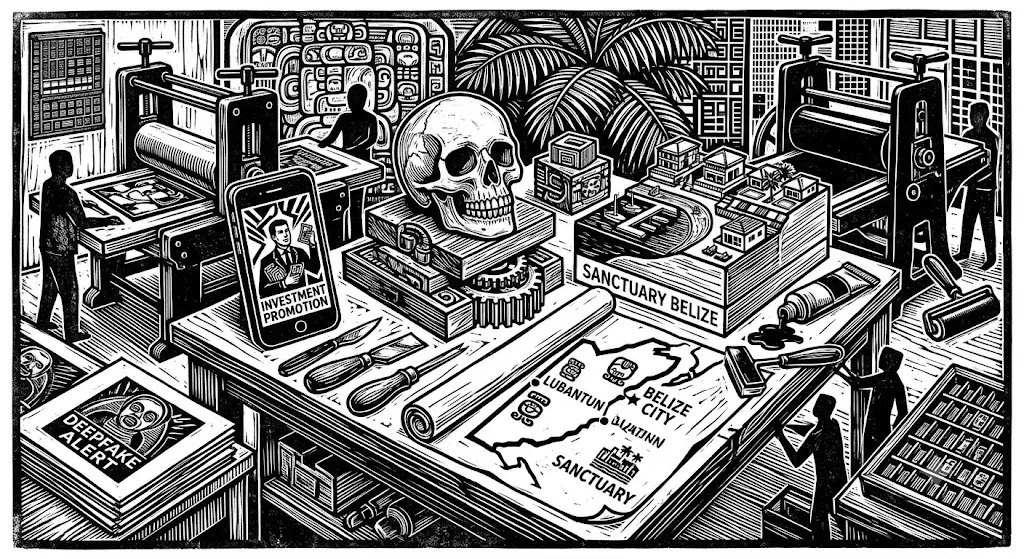
Belize’s best-known hoax is the Mitchell-Hedges crystal skull, supposedly discovered beneath a Maya altar at Lubaantun in the 1920s. The dramatic story does not survive scrutiny: contemporary excavation records do not mention the object, archival evidence places it in a London collector’s hands, and microscopic examination found marks left by modern jewellery-making equipment. Yet the skull remains attached to Belize through books, documentaries, tourism writing and popular culture.
Belize has also lent its name and scenery to more practical deceptions. The Sanctuary Belize property scheme sold overseas buyers a vision of a luxurious, debt-free Caribbean development that regulators later found could not be completed as promised. More recently, artificial-intelligence-generated investment promotions have borrowed recognisable Belizean faces and public authority.
These episodes are quite different. One turned an archaeological site into an adventure legend; another sold speculative land; newer scams manufacture false endorsements. Together they show how credibility can be built from location, celebrity, institutional language and a story that audiences already want to believe.
The crystal skull that was not found at Lubaantun
The Mitchell-Hedges skull is a remarkably lifelike carving made from clear quartz, complete with a detachable lower jaw. Its fame rests on a discovery story associated with Lubaantun, a genuine ancient Maya city in southern Belize.
Anna Mitchell-Hedges, adopted daughter of British adventurer Frederick Albert Mitchell-Hedges, said that she found the skull during an expedition, often dating the discovery to her seventeenth birthday in 1924 or 1927. Later retellings placed it beneath a collapsed altar or inside a pyramid. Her father eventually described it as the “Skull of Doom” and claimed that Maya priests had used it in rituals to bring about death.
The story combined several elements almost perfectly designed for popular success: an apparently impossible object, a ruined city in the jungle, a young discoverer and a self-promoting explorer who understood the value of mystery. It also appeared during an era when European and North American audiences readily accepted extravagant claims about supposedly lost civilisations and ancient supernatural knowledge.
The central problem is that no contemporary archaeological evidence supports the claimed discovery. The skull does not appear in expedition reports, photographs or accounts written when the excavations took place. Researchers have also found no convincing evidence that Anna was present at the relevant dig. Frederick Mitchell-Hedges, despite his appetite for publicity, did not announce such an extraordinary find at the time.[Archaeology Magazine]archive.archaeology.orgMagazine Archaeology MagazineIt was probably made in Europe in the 20th century, and was not polished for five…Read more…
There is, however, a documented history for the object outside Belize. It was described in the British anthropological journal Man in 1936 as belonging to the London art dealer Sydney Burney. Records subsequently showed that Mitchell-Hedges acquired it from Burney at a Sotheby’s auction in 1943. That evidence reverses the direction of the story: rather than travelling from a Maya excavation to Britain, the skull appears to have moved from the London antiquities market into an invented Belizean provenance.[Archaeology Magazine]archive.archaeology.orgMagazine Archaeology MagazineIt was probably made in Europe in the 20th century, and was not polished for five…Read more…
What the tool marks revealed
Quartz itself cannot be dated in the way that organic archaeological material can. Investigators therefore examined how the skull had been shaped and polished.
Research associated with the Smithsonian Institution and Archaeology magazine identified marks consistent with high-speed rotary tools and diamond-coated abrasives. Such equipment belongs to modern lapidary work, not to ancient Maya stone-working practice. The skull’s form also closely resembles other crystal skulls that appeared in European collections during the nineteenth and early twentieth centuries.[Smithsonian Magazine]smithsonianmag.comSmithsonian MagazineWhy the Smithsonian Has a Fake Crystal SkullMay 30, 2008 — 29 May 2008 — Today, the skull that launched Walsh's sleut…
The most defensible conclusion is that the Mitchell-Hedges skull was made in Europe during the twentieth century, possibly modelled on an earlier skull displayed by the British Museum. Scientific examination has therefore addressed two separate claims:
- It was not excavated at Lubaantun as described.
- Its manufacture is inconsistent with a pre-Columbian Maya origin.
This does not mean that the object itself is imaginary. It is a real and highly accomplished quartz carving. The deception lies in its claimed age, provenance and supernatural history.
Why the legend kept growing
Exposure did not end the skull’s career. Instead, the legend adapted.[academia.edu]academia.eduSource details in endnotes.
Anna Mitchell-Hedges displayed the object publicly, gave interviews and attributed visions, healing powers and other paranormal effects to it. By the 1970s and 1980s, crystal skulls had entered New Age writing, where they were connected with Atlantis, psychic energy, extraterrestrials and a supposed set of thirteen ancient skulls whose reunion would transform humanity. Researchers have found no basis for this tradition in documented ancient Maya belief. It is a modern spiritual mythology built around objects of uncertain or demonstrably recent origin.[Wikipedia]WikipediaCrystal skullCrystal skull
Popular entertainment strengthened the association. Crystal skulls appeared in novels, television programmes, documentaries and eventually Indiana Jones and the Kingdom of the Crystal Skull. Each retelling made the basic image more familiar even when the details changed.
Belize consequently inherited a peculiar relationship with the object. The country’s name and the real site of Lubaantun supplied the skull with authenticity, yet the people and archaeological institutions of Belize did not create the original deception. The story was largely constructed and marketed abroad.
That distinction matters. Treating the episode simply as a “Belizean legend” risks obscuring the colonial structure behind it: a British adventurer attached a spectacular object from the European antiquities market to a Maya site, while Maya civilisation became scenery for his personal mythology.
A disputed claim of ownership
The skull’s doubtful authenticity has not prevented arguments about whether it should be returned to Belize. In 2005, Belizean archaeologist Jaime Awe described its origin as dubious but argued that, if its holders maintained that it came from Belize, the country could reasonably demand its return. His position highlighted an awkward point: someone should not be able to exploit a Belizean provenance commercially and then deny that provenance when questions of ownership arise.[7 News Belize]7newsbelize.com7 News BelizeThe Crystal Skull: The Real Thing or A Hoax?13 Oct 2005 — But it is not a fake, it is a real pre-Hispanic or pre-historic ob…
A later lawsuit sought the skull’s return and connected it with profits from the Indiana Jones film, although the claim was unsuccessful. The episode illustrates how a false provenance can acquire real legal and cultural consequences. Once an invented discovery becomes famous, museums, governments, collectors and media companies may all have interests in deciding which parts of the story to accept.
Sanctuary Belize sold a Caribbean future
The crystal skull offered mystery. Sanctuary Belize offered certainty: valuable property, impressive facilities and a carefully planned resort community on Belize’s coast.
Beginning in the mid-2000s, marketers sold residential lots in a development also promoted under names including Sanctuary Bay and Sanctuary Belize. Prospective buyers, many of them in the United States, were shown polished promotional material and told that the project would include amenities such as a marina, hotel, hospital, golf course and other infrastructure. Sales representatives presented the development as financially secure and claimed that revenue from lot sales would be used to complete it.
According to the United States Federal Trade Commission, those representations were deceptive. The agency said that the promoters collected more than US$100 million while making claims about financing, construction and development progress that were not true. In 2018, a court temporarily shut down what the FTC described as the largest overseas real-estate investment scheme it had ever targeted.[Federal Trade Commission]ftc.govFederal Trade CommissionCourt Halts Massive “Sanctuary Belize” Real Estate…Serial scammer Andris Pukke and others are charged with dec…
The sales pitch worked because it joined a desirable place to an apparently low-risk investment. Belize provided several persuasive ingredients:
- English is widely used, making the country seem accessible to North American buyers.
- Caribbean scenery made resort projections visually convincing.
- Foreign ownership could be presented as both an investment and an escape from ordinary life.
- Buyers were shown plans and promised amenities whose completion lay years in the future.
The deception therefore did not require the land itself to be fictitious. Buyers could receive genuine lots while still being misled about the surrounding development, the use of their money and the likelihood that promised infrastructure would appear. This is a common strength of sophisticated property fraud: enough of the transaction is real to make the larger fiction believable.

Who benefited and what investigators found
The FTC’s case identified Andris Pukke as the scheme’s principal organiser, working with companies and sales operations that marketed the Belize development. Following litigation, courts imposed restrictions on the defendants and entered a judgment exceeding US$120 million. The FTC began distributing approximately US$10 million in refunds in 2023 and announced a further redress payment of nearly US$23 million in February 2026.[Federal Trade Commission]ftc.govconsumer protectionFederal Trade CommissionConsumer ProtectionIn August 2023, the FTC sent approximately $10 million to consumer defrauded by the Sanctuary…
A separate criminal prosecution focused on money diverted from the project. In September 2025, a United States court sentenced Pukke to eight years in prison for leading a fraud in which hundreds of victims were found to have lost approximately US$77 million. Prosecutors said that he misappropriated development funds while buyers waited for facilities that were never delivered as promised.[Department of Justice]justice.govOpen source on justice.gov.
The case should not be read as evidence that buying land in Belize is inherently fraudulent. The relevant warning is narrower: overseas property promotions become dangerous when buyers must rely on the seller’s claims about future construction, financing and local approvals. A picturesque location cannot verify a balance sheet.
Sanctuary Belize also demonstrates how a country’s identity can be used as part of a commercial script. “Belize” was not merely the address of the development. It was a marketing asset suggesting tranquillity, exclusivity and escape. The fraud depended partly on selling an imagined national landscape along with the lots.
When self-created myth becomes news
Some Belize-linked deceptions sit less neatly between deliberate hoax, performance and personal mythology. The most conspicuous example is John McAfee, the antivirus-software entrepreneur who lived in Belize and became the subject of international attention in 2012.
McAfee repeatedly issued dramatic accounts about drugs, police persecution, disguises, decoys and his flight from Belize after authorities sought to question him about the killing of his neighbour Gregory Faull. He was not charged with that killing, and claims about his conduct must therefore be separated carefully from the fact that police wanted to interview him.
What is relevant to hoax history is McAfee’s own admission that he had staged false online drug material. In a televised interview after leaving Central America, he described a supposed “bath salts” episode as a hoax. He had posted extensively on a drug-discussion forum under a pseudonym, presenting elaborate claims about chemical experimentation and a supposedly improved stimulant.[The Atlantic]theatlantic.comThe Atlantic John Mc Afee Unleashes the Full CrazyThe Atlantic John Mc Afee Unleashes the Full Crazy
The affair was persuasive because it mixed fiction with verifiable biography. McAfee really was a wealthy technologist living on a guarded property in Belize. Police really had raided premises connected with him, and he really did possess enough technical knowledge to sound authoritative. Against that background, even implausible claims could appear to be privileged glimpses into a secretive laboratory.
His behaviour also exposed a recurring weakness in personality-driven journalism. Outlandish statements generated headlines even when reporters could not verify them, while contradictions became further content rather than reasons to withdraw attention. McAfee’s public identity functioned like an evolving media stunt: the uncertainty over what was true made the story more marketable.
This case differs from the crystal skull and Sanctuary Belize because the deception was not one stable claim. It was a continuous blurring of confession, fabrication, provocation and self-promotion. The most accurate label is therefore not a single grand hoax, but a campaign of unreliable performance in which Belize became the dramatic stage.
Deepfakes borrow trusted Belizean faces
The latest form of Belize-related fakery is less romantic and more easily replicated. In October 2025, Belizean authorities warned about an artificial-intelligence-generated video that used images of recognisable public figures to promote a fraudulent investment opportunity promising rapid returns.
The footage was presented in Spanish and made to resemble an authentic endorsement, but officials said it was fabricated. The mechanism is familiar from deepfake scams elsewhere: combine a trusted face, the visual language of news or government communication, and an urgent financial promise. The victim is encouraged to transfer money or provide personal information before checking the original source.[GBM]greaterbelize.comGBMGOB Warns of Fake AI Video Promising Quick ReturnsGBMGOB Warns of Fake AI Video Promising Quick Returns
Such videos represent an important change from older hoaxes. A crystal skull required a skilled craftsperson, an object and decades of storytelling. A property scheme required sales teams, land and glossy marketing. A deepfake can be produced cheaply, altered rapidly and redistributed through private messaging networks faster than officials can correct it.
Yet the underlying method remains similar. The fraud borrows credibility rather than creating it from nothing. The skull borrowed Lubaantun’s archaeological authority. Sanctuary Belize borrowed the appeal of a Caribbean destination. The fabricated investment video borrowed the faces and reputations of real Belizeans.
What Belize’s hoaxes have in common
The strongest documented cases associated with Belize are unusually dependent on place. In each, the country does more than provide a geographical setting.
The exotic-location effect. Distant ruins and tropical coastlines encourage audiences to accept stories they might question in more familiar surroundings. A jungle archaeological site makes a mysterious artefact seem plausible; a Caribbean shoreline makes an unfinished resort feel inevitable.
Authority by association. Promoters attach claims to something already respected: Maya civilisation, professional-looking development plans, a famous entrepreneur or a recognisable public figure.
A delayed test. The decisive evidence is often unavailable at the moment belief is requested. The skull’s excavation could not be independently reconstructed. Resort buyers were asked to trust promises about future amenities. Deepfake viewers may act before locating the original speaker or recording.
A profitable emotional promise. Each deception offers more than information. The skull promises access to ancient secrets. Sanctuary Belize promises wealth and escape. Investment deepfakes promise effortless returns. The emotional reward helps suppress ordinary scepticism.
Repetition after exposure. Debunking does not necessarily erase a compelling story. Tourism sites and popular media still repeat romantic versions of the crystal-skull tale. Fraudulent development names and sales claims can be rebranded. Digital fabrications can reappear with new faces and slightly altered scripts.
What should count as a Belizean hoax?
The evidence supports a focused rather than inflated history. Belize does not have a large, well-documented catalogue of nationally famous newspaper hoaxes, monster photographs or spiritualist frauds comparable with those recorded in some larger media markets. The available record is dominated by a few internationally amplified cases.
It is also important not to classify every Belizean legend as a hoax. Folklore may be told for entertainment, cultural instruction or community identity without anyone deliberately attempting to establish it as verified fact. A mistaken sighting is not automatically fraud, and a tourism anecdote may be embellishment rather than a calculated deception.
A useful test is to ask four questions:
- Was a factual claim knowingly or recklessly presented as true?
- Did someone gain money, publicity, authority or influence from it?
- Can the claim be tested against documents, physical evidence or independent testimony?
- Did later promoters continue repeating it after substantial contrary evidence emerged?
By those standards, the Mitchell-Hedges provenance story and Sanctuary Belize clearly belong in the history of deception. McAfee’s performances occupy a more unstable boundary between hoax and cultivated unreliability. Traditional supernatural stories generally do not belong in the same category unless a promoter fabricates evidence and markets the result as fact.
The lasting lesson
Belize’s most memorable hoaxes were persuasive not because people in Belize were unusually credulous, but because outsiders projected powerful fantasies onto the country. Adventurers saw a setting for lost-civilisation stories. Property marketers sold an uncomplicated tropical future. Media audiences treated an expatriate millionaire’s increasingly theatrical claims as entertainment, while online scammers now imitate trusted local personalities.
The crystal skull provides the clearest historical pattern. A real archaeological landscape was attached to an object with no documented excavation history. Repetition supplied the missing provenance, publicity supplied cultural importance, and popular entertainment preserved the story after laboratory evidence had undermined it.
Sanctuary Belize translated the same structure into commerce. Real land and real scenery gave substance to promises about a development whose finances and progress buyers could not readily inspect. Modern deepfakes complete the progression by removing the need for either a mysterious object or an elaborate physical sales operation. Credibility itself can now be copied.
The most effective protection in all three settings is provenance: where an object came from, where investment money goes, or where a video first appeared. Belize’s hoax history shows that the more attractive the story, the more important that chain of evidence becomes.
Amazon book picks
Further Reading
Books and field guides related to How Belize Became a Stage for Deception. Use these as the next step if you want deeper reading beyond the article.
Extraordinary Popular Delusions and the Madness of Crowds
Rating: 4.0/5 from 5 Google Books ratings
Explores why implausible stories attract believers.
The Demon-Haunted World
Rating: 4.5/5 from 43 Google Books ratings
Useful for understanding extraordinary claims such as crystal skull legends.
eBay marketplace picks
Marketplace Samples
Live-tested eBay searches with available results related to this page.

Endnotes
1.
Source: archive.archaeology.org
Title: Magazine Archaeology Magazine
Link:https://archive.archaeology.org/online/features/mitchell_hedges/
Source snippet
It was probably made in Europe in the 20th century, and was not polished for five...Read more...
2.
Source: archive.archaeology.org
Title: Magazine The Skull of Doom
Link:https://archive.archaeology.org/online/features/mitchell_hedges/index_BCKUP.html
Source snippet
Mitchell-Hedges, who claimed to have found it somewhere in Central America in the...Read more...
3.
Source: Wikipedia
Title: Crystal skull
Link:https://en.wikipedia.org/wiki/Crystal_skull
4.
Source: 7newsbelize.com
Link:https://www.7newsbelize.com/sstory.php?frmsrch=1&nid=293
Source snippet
7 News BelizeThe Crystal Skull: The Real Thing or A Hoax?13 Oct 2005 — But it is not a fake, it is a real pre-Hispanic or pre-historic ob...
5.
Source: ftc.gov
Link:https://www.ftc.gov/media/71286
Source snippet
Federal Trade CommissionCourt Halts Massive “Sanctuary Belize” Real Estate...Serial scammer Andris Pukke and others are charged with dec...
6.
Source: ftc.gov
Link:https://www.ftc.gov/bureau-consumer-protection?page=6
Source snippet
In November 2018, the FTC announced that a federal district court in Maryland issued an order temporarily shutting down the...Read more...
Published: November 2018
7.
Source: ftc.gov
Title: consumer protection
Link:https://www.ftc.gov/consumer-protection?page=7&ref=dbbnwa.com
Source snippet
Federal Trade CommissionConsumer ProtectionIn August 2023, the FTC sent approximately $10 million to consumer defrauded by the Sanctuary...
Published: August 2023
8.
Source: ftc.gov
Link:https://www.ftc.gov/industry/real-estate-mortgages?page=2
9.
Source: ftc.gov
Link:https://www.ftc.gov/consumer-protection?mission=All&page=6
10.
Source: justice.gov
Link:https://www.justice.gov/usao-sdny/pr/repeat-fraudster-sentenced-eight-years-prison-massive-belize-real-estate-fraud
11.
Source: archive.archaeology.org
Title: of crystal skulls and pyramids
Link:https://archive.archaeology.org/blog/of-crystal-skulls-and-pyramids/
12.
Source: ftc.gov
Title: franchises business opportunities investments
Link:https://www.ftc.gov/industry/franchises-business-opportunities-investments
13.
Source: ftc.gov
Title: deceptivemisleading conduct
Link:https://www.ftc.gov/terms/deceptivemisleading-conduct?page=2
14.
Source: ftc.gov
Title: day pacer ftc response brief ca7
Link:https://www.ftc.gov/system/files/ftc_gov/pdf/day_pacer_-_ftc_response_brief_ca7.pdf
15.
Source: ftc.gov
Link:https://www.ftc.gov/investment
16.
Source: ftc.gov
Title: cases proceedings
Link:https://www.ftc.gov/legal-library/browse/cases-proceedings?page=4
17.
Source: ftc.gov
Link:https://www.ftc.gov/es/taxonomy/term/5?page=4
18.
Source: justice.gov
Link:https://www.justice.gov/usao-sdny/press-release/file/1578301/dl
19.
Source: justice.gov
Title: belize real estate developer charged embezzling investor funds
Link:https://www.justice.gov/usao-sdny/pr/belize-real-estate-developer-charged-embezzling-investor-funds
20.
Source: smithsonianmag.com
Link:https://www.smithsonianmag.com/history/the-smithsonians-crystal-skull-51638609/
Source snippet
Smithsonian MagazineWhy the Smithsonian Has a Fake Crystal SkullMay 30, 2008 — 29 May 2008 — Today, the skull that launched Walsh's sleut...
Published: May 30, 2008
21.
Source: theatlantic.com
Title: The Atlantic John Mc Afee Unleashes the Full Crazy
Link:https://www.theatlantic.com/technology/2012/12/john-mcafee-cnbc-interview/320486/
22.
Source: greaterbelize.com
Title: GBMGOB Warns of Fake AI Video Promising Quick Returns
Link:https://www.greaterbelize.com/gob-warns-of-fake-ai-video-promising-quick-returns/
23.
Source: timetravelturtle.com
Link:https://www.timetravelturtle.com/belize/lubaantun/
Additional References
24.
Source: youtube.com
Title: The Crystal Skulls: The Receipt That Destroyed 100 Years of Mystery
Link:https://www.youtube.com/watch?v=pPcWXuW5h8U
Source snippet
A $100,000,000 Scam is Becoming A Belize Real Estate Gold Mine...
25.
Source: youtube.com
Title: A $100,000,000 Scam is Becoming A Belize Real Estate Gold Mine
Link:https://www.youtube.com/watch?v=uX1THrs2_c8
Source snippet
The Crystal Skull and Anna MItchell-Hedges - One Minute History...
26.
Source: youtube.com
Title: The Crystal Skull and Anna MItchell-Hedges
Link:https://www.youtube.com/watch?v=704bYbUuI68
Source snippet
The Legend Of The Ancient Crystal Skulls | Myth Hunters...
27.
Source: youtube.com
Title: The Legend Of The Ancient Crystal Skulls | Myth Hunters
Link:https://www.youtube.com/watch?v=CgczRKNTnOg
Source snippet
The 13 Crystal Skulls Said To Bestow Mystical Powers...
28.
Source: academia.edu
Link:https://www.academia.edu/37120752/The_Fourth_Skull_A_Tale_of_Authenticity_and_Fraud
29.
Source: facebook.com
Link:https://www.facebook.com/lovefmbelize/videos/catchitfirstonlovepolice-to-establish-a-fraud-unit-amid-an-uptick-in-land-frauda/1603569967106290/
30.
Source: facebook.com
Link:https://www.facebook.com/News5Live/posts/chinese-businessman-charged-with-obtaining-property-by-deceptiona-chinese-busine/848899243949458/
31.
Source: picclick.co.uk
Link:https://picclick.co.uk/Cryptid-Pin-Badge-Loch-Ness-Monster-Abominable-Snow-366324833622.html
32.
Source: hangar1publishing.com
Link:https://hangar1publishing.com/blogs/cryptids/famous-cryptid-hoaxes?srsltid=AfmBOooV0rtaUXgSOLOE_It2nzjM32h9Z_YwqYydlRSFoo2a25-HezYK
33.
Source: facebook.com
Link:https://www.facebook.com/breakingbelizenews/photos/scam-alert-fake-ai-video-circulating-on-social-media-targets-belizeansa-fraudule/1241447611347171/
Topic Tree
Follow this branch
Related pages 192
- Albanian Hoaxes
- Algerian Hoaxes
- Antigua Deceptions
- Argentina Hoaxes
- Armenian Hoaxes
- +187 more in sidebar