Which Congo Hoaxes Fooled the World?
Congo’s best-known hoax stories are not a single tradition of trickery. They range from colonial propaganda and doctored monster photographs to sincere folklore recast as zoological evidence.
Page outline Jump by section
Introduction
The crucial distinction is between a deliberate fake and a story that changed as it travelled. The “Kasai rex” photographs are straightforward fabrications. The huge Katanga snake may be an ordinary animal made enormous by an unsupported estimate. Mokele-mbembe is more complicated: local traditions, outside misunderstanding, cryptozoological enthusiasm and creationist campaigning became entangled until a varied body of stories was presented as one coherent dinosaur mystery.[New Lines Magazine]newlinesmag.comNew Lines Magazine The Congo's Dinosaur of DiscordNew Lines MagazineThe Congo's Dinosaur of DiscordApril 21, 2025 — 21 Apr 2025 — Once a subject of Victorian fascination, the mokele-mbemb…
The Congo that was sold as a humanitarian state
The largest and most consequential deception associated with Congo was not a monster tale. It was the public image constructed around the Congo Free State, the enormous Central African territory controlled personally by Belgium’s King Leopold II from 1885 to 1908.
Leopold presented his enterprise to European governments and the American public in the language of philanthropy, free trade and opposition to the slave trade. In practice, his administration seized land and labour while using armed force to extract ivory and wild rubber. Punishments, hostage-taking, village destruction and mutilation became closely associated with the system. Disease, famine, displacement and falling birth rates also contributed to a catastrophic population decline, although historians continue to dispute the precise death toll because reliable demographic records do not exist.[jstor.org]jstor.orgThe heated debate that followed pro-. 8 Leopold to Brialmont, December 16, 1861, in ibid., 419; Leopold to Brialmont.Read more…
This was propaganda rather than a simple one-off lie. Leopold supported favourable articles, cultivated influential allies and attacked the character of critics. When the Black American historian George Washington Williams visited Congo in 1890, he concluded that the supposed civilising mission concealed land seizure, forced labour and lethal violence. His open letter accused Leopold’s government of systematically misleading the world. Leopold’s defenders responded partly by trying to discredit Williams personally rather than answering the substance of his findings.[blackpast.org]blackpast.orggeorge washington williams open letter king leopold congo 1890BlackPast(1890) George Washington Williams's Open Letter to King…George Washington Williams, “An Open Letter to His Serene Majesty Leo…
How the official story unravelled
The deception became harder to sustain because its opponents combined several kinds of evidence. The campaigner E. D. Morel noticed that ships travelling from Europe to Congo carried officials, guns and ammunition, while returning vessels brought valuable commodities. That pattern contradicted the image of an ordinary philanthropic and commercial exchange. Missionaries and other witnesses supplied testimony, documents and photographs.
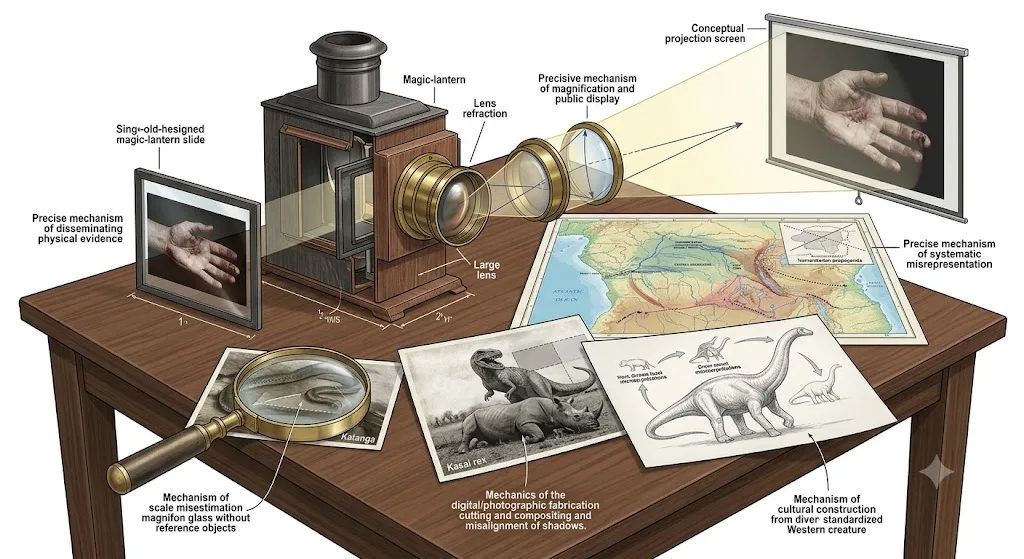
Alice Seeley Harris’s images of Congolese victims were particularly influential. They were shown at public lectures with magic-lantern projectors, allowing distant audiences to see evidence that official denials could not easily explain away. The photographs were not neutral windows onto events: like later humanitarian imagery, they were carefully selected and presented to provoke judgement. Even so, the injuries and bereavements they documented were real, and their basic evidential force has survived later historical scrutiny.[ieg-mainz.de]hhr-atlas.ieg-mainz.dede laat congoCongo Free State, 1904: Humanitarian PhotographsKing Leopold II of Belgium surreptitiously acquired a great proportion of the Congo River…
British consul Roger Casement conducted an official investigation, while Leopold eventually appointed his own commission of inquiry. Instead of clearing the administration, the evidence confirmed serious abuses. International pressure helped force the transfer of the territory from Leopold’s personal control to the Belgian state in 1908. Colonial exploitation did not end, but the original claim that the Congo Free State was essentially a benevolent venture had collapsed.[Wikipedia]WikipediaCongo Free State propaganda warCongo Free State propaganda war
This episode remains important to the history of hoaxes because it shows what institutional deception looks like. It did not depend on a single forged document. It worked through respectable organisations, repeated claims, controlled access, friendly journalism and attacks on witnesses. Its exposure likewise required more than one dramatic revelation: shipping records, eyewitness accounts, photographs, official inquiries and sustained public campaigning reinforced one another.

How Mokele-mbembe became a living dinosaur
Mokele-mbembe is commonly described in Western media as a long-necked dinosaur supposedly living in the swamps and waterways of the Congo Basin, especially around the Republic of the Congo. No body, bone, unambiguous photograph, reliable film or genetic sample has established the existence of such an animal. Numerous searches have produced stories, disputed tracks and recordings, but no physical evidence that can be independently tested.[skepticalinquirer.org]skepticalinquirer.orgOpen source on skepticalinquirer.org.
Calling the whole tradition a Congolese hoax would be misleading. Accounts gathered under the name have described different things: a dangerous river creature, an animal comparable to a rhinoceros or elephant, a reptile and, in some interpretations, a spiritual presence rather than an ordinary biological species. The familiar image of a small-headed, long-necked sauropod owes much to European and North American ideas about dinosaurs. Early twentieth-century popular culture often depicted sauropods as swamp-dwelling animals, making Central African wetlands seem like a plausible refuge for a supposed prehistoric survivor.[newlinesmag.com]newlinesmag.comNew Lines Magazine The Congo's Dinosaur of DiscordNew Lines MagazineThe Congo's Dinosaur of DiscordApril 21, 2025 — 21 Apr 2025 — Once a subject of Victorian fascination, the mokele-mbemb…
One frequently cited milestone is Carl Hagenbeck’s 1909 speculation that an African story about a “half elephant, half dragon” might point to a surviving dinosaur. Later writers joined geographically separated reports and names into an increasingly standardised cryptozoological narrative. The story thus became more consistent in books and television than it necessarily was among the communities from whom explorers claimed to collect it.[Wikipedia]WikipediaOpen source on wikipedia.org.
Expeditions that encouraged the answer they expected
From the late twentieth century, expeditions led by enthusiasts such as Roy Mackal helped popularise the modern dinosaur interpretation. Investigators interviewed residents, compared descriptions and sometimes showed witnesses pictures of known and extinct animals. This creates an obvious risk of suggestion: once a visitor announces that they are seeking a dinosaur and supplies dinosaur images, later identifications cannot be treated like spontaneous testimony.
Reports also suffered from disappearing or unusable evidence. A claimed photograph was too indistinct; a film allegedly failed to develop; recordings were inconclusive; tracks could not be securely tied to an unknown species. Such evidence is impossible to retest and tends to become more impressive in retelling than it was at the time. Even sympathetic investigators failed to obtain the specimen-quality material needed for zoological recognition.[wikipedia.org]WikipediaOpen source on wikipedia.org.
Young-Earth creationists later became prominent promoters of the search. Some hoped that finding a living dinosaur would undermine evolutionary science. It would not: the survival of a lineage thought extinct would be an extraordinary zoological discovery, but it would not overturn evolution, just as the survival of the coelacanth did not do so. Nevertheless, the promise of an anti-evolutionary “living fossil” supplied money, publicity and a ready audience for weak evidence.[newlinesmag.com]newlinesmag.comNew Lines Magazine The Congo's Dinosaur of DiscordNew Lines MagazineThe Congo's Dinosaur of DiscordApril 21, 2025 — 21 Apr 2025 — Once a subject of Victorian fascination, the mokele-mbemb…
Mokele-mbembe is therefore best understood not as a proven animal or a simple invented prank, but as a layered legend. Local belief, imperfect translation, misidentification, commercial storytelling, religious advocacy and the romance of exploration have all shaped it. Treating Congolese witnesses as either infallible custodians of secret zoology or gullible fabricators misses the real mechanism: interviewers, publishers and viewers helped construct the creature they expected to find.
The Kasai rex and its fabricated photographs
The “Kasai rex” is supposedly a huge meat-eating dinosaur encountered in the Kasai region of what is now the Democratic Republic of the Congo. The standard account says that a Swedish plantation owner or hunter, usually called John Johnson or Johanson, watched the animal attack a rhinoceros in 1932. He supposedly fainted and awoke to see the predator feeding.
Unlike Mokele-mbembe, this story has almost no dependable historical foundation. The witness’s identity varies, no secure contemporary report is routinely produced, and the name “Kasai rex” appears to have become prominent much later in cryptozoological and internet culture. A recent attempt to trace the story found that its recognisable modern form may have emerged online, where copying and embellishment obscured whatever earlier source may have existed.[Modern Cryptozoology]moderncryptozoology.wordpress.comthe messy embellished history of kasai rexthe messy embellished history of kasai rex
The associated images are not persuasive evidence. One widely circulated picture shows a lizard-like animal awkwardly placed over a dead rhinoceros or hippopotamus, with visual signs of cutting and compositing. Another version uses a cinematic or model dinosaur. Different “photographs of the same encounter” depict incompatible creatures and have no trustworthy photographic history. Although many websites repeat that the images were formally “proved” fraudulent, the more fundamental point is simpler: there is no verifiable original negative, photographer, publication trail or consistent scene from which authenticity could be established.[fandom.com]cryptidarchives.fandom.comCryptid Archives Kasai rex | Encyclopaedia of CryptozoologyCryptid Archives Kasai rex | Encyclopaedia of Cryptozoology
Kasai rex survives because its flaws help it travel. A dramatic photograph can circulate without its source; a detailed witness story can be copied without checking whether the witness existed; and a vague Central African location makes missing documentation seem like a product of remoteness. In reality, remoteness does not explain why the monster changes appearance from one composite image to another.

Did a photograph really show a 15-metre snake?
In 1959, Belgian airmen flying over Katanga, in the present-day Democratic Republic of the Congo, photographed a snake on the ground. The image became associated with decorated pilot Rémy Van Lierde, who said the animal was approximately 14 or 15 metres long and had raised its head towards the helicopter.
This case is subtler than an obvious composite. A genuine photograph can still support a false conclusion. The central problem is scale. The snake appears alone on uneven terrain, without a person, vehicle or other object of known size beside it. Later claims that nearby features were full-sized termite mounds depend on correctly identifying those features and knowing their dimensions. Perspective, altitude, camera angle and the absence of precise flight records make a confident measurement impossible.[Cryptid Archives]cryptidarchives.fandom.comOpen source on fandom.com.
There are also discrepancies in the remembered colour and circumstances. The photograph’s supporters often state that unnamed experts authenticated it, but confirming that an image contains a real snake is not the same as proving that the snake was 15 metres long. No corresponding skin, skeleton, trackway or population of comparably enormous snakes has been documented. Modern reviews therefore treat the exceptional size as unsupported, even when they do not accuse the airmen of deliberately staging a fake.[Cryptid Archives]cryptidarchives.fandom.comOpen source on fandom.com.
The likely failure here is estimation rather than photographic forgery. People are poor at judging size from the air, particularly over unfamiliar ground with no dependable reference. Once a famous pilot supplied a dramatic measurement, later retellings treated it as though it had been extracted scientifically from the photograph.
Why Congo attracts lost-world stories
Congo’s association with mystery was not created by Congolese people alone. European colonial writing repeatedly portrayed the region as remote, timeless and only partly knowable. That picture helped justify outside control while also creating an ideal setting for stories about prehistoric survivors, hidden tribes and landscapes untouched by history.
The Congo Basin is genuinely vast and biologically rich, and scientists continue to document species that were previously unknown to formal science. That does not make every monster claim equally plausible. A new frog, insect, fish or small mammal can remain undetected with little ecological trace. A breeding population of multi-tonne dinosaurs or 15-metre snakes would require food, territory and enough individuals to reproduce, while leaving remains, droppings, tracks, environmental DNA or clear observations. Repeated failure to find such traces matters.[Skeptical Inquirer]skepticalinquirer.orgOpen source on skepticalinquirer.org.
Lost-world stories also benefit from an unequal standard of credibility. A second-hand claim made in Europe would normally require documentation. When attached to a distant African forest, the absence of records is sometimes treated as proof that the place is mysterious. Local testimony may then be selectively accepted when it supports the monster and ignored when residents deny the creature exists, describe it as spiritual or identify it with an ordinary animal.
The better approach is neither automatic belief nor ridicule. It asks where an account was recorded, what question prompted it, whether the witness had been shown pictures, whether the name referred to the same being in different communities and whether any physical evidence can be tested independently. Those questions preserve the value of folklore while preventing outsiders from converting it into counterfeit science.

What these stories reveal about contested truth
Congo’s famous deceptions fall into three broad patterns.
Power can manufacture respectability. Leopold’s regime used diplomatic recognition, humanitarian language and media influence to conceal an extractive system. The deception was broken by accumulated records and testimony, not by one sensational anecdote.
Images can be real while their interpretation is false. The Katanga snake photograph may show an actual snake, yet it cannot establish the claimed length. Authenticity of the picture and accuracy of the caption are separate questions.
Folklore can be remade into evidence for someone else’s theory. Mokele-mbembe became a dinosaur partly because explorers, publishers and religious campaigners wanted a dinosaur. The resulting story says as much about Western expectations as it does about traditions in the Congo Basin.
Kasai rex presents the clearest conventional hoax: an unstable story attached to crudely fabricated images. Mokele-mbembe belongs in a more ambiguous category of folklore, suggestion and pseudoscientific promotion. The giant snake is best treated as an unverified size claim. The Congo Free State’s benevolent image, by contrast, was a sustained political falsehood with enormous human consequences.
Taken together, the cases show why “hoax” should be used carefully. Some false stories are manufactured for profit or power. Some begin as mistakes. Others emerge when legends are stripped of their original setting and forced into a modern claim about dinosaurs, monsters or hidden scientific proof. The most useful scepticism does not mock belief; it follows the chain by which a claim acquired authority, asks who shaped it, and checks whether the surviving evidence can bear the weight later storytellers placed upon it.
Amazon book picks
Further Reading
Books and field guides related to Which Congo Hoaxes Fooled the World?. Use these as the next step if you want deeper reading beyond the article.
The Congo from Leopold to Kabila
Provides broad context for political myths, propaganda and historical narratives.
King Leopold's Ghost
Explains the largest documented Congo deception: the Congo Free State's humanitarian image.
eBay marketplace picks
Marketplace Samples
Live-tested eBay searches with available results related to this page.


Endnotes
1.
Source: jstor.org
Link:https://www.jstor.org/stable/10.1086/591110
Source snippet
The heated debate that followed pro-. 8 Leopold to Brialmont, December 16, 1861, in ibid., 419; Leopold to Brialmont.Read more...
Published: December 16, 1861
2.
Source: Wikipedia
Title: Atrocities in the Congo Free State
Link:https://en.wikipedia.org/wiki/Atrocities_in_the_Congo_Free_State
3.
Source: Wikipedia
Title: Congo Free State
Link:https://en.wikipedia.org/wiki/Congo_Free_State
4.
Source: blackpast.org
Title: george washington williams open letter king leopold congo 1890
Link:https://blackpast.org/global-african-history/george-washington-williams-open-letter-king-leopold-congo-1890/
Source snippet
BlackPast(1890) George Washington Williams's Open Letter to King...George Washington Williams, “An Open Letter to His Serene Majesty Leo...
5.
Source: Wikipedia
Title: George Washington Williams
Link:https://en.wikipedia.org/wiki/George_Washington_Williams
6.
Source: Wikipedia
Title: Congo Free State propaganda war
Link:https://en.wikipedia.org/wiki/Congo_Free_State_propaganda_war
7.
Source: hhr-atlas.ieg-mainz.de
Title: de laat congo
Link:https://hhr-atlas.ieg-mainz.de/articles/de_laat-congo
Source snippet
Congo Free State, 1904: Humanitarian PhotographsKing Leopold II of Belgium surreptitiously acquired a great proportion of the Congo River...
8.
Source: autograph.org.uk
Title: congo dialogues
Link:https://autograph.org.uk/exhibitions/congo-dialogues
9.
Source: ebsco.com
Link:https://www.ebsco.com/research-starters/science/mokele-mbembe-cryptozoology
10.
Source: Wikipedia
Link:https://en.wikipedia.org/wiki/Mokele-mbembe
11.
Source: jstor.org
Link:https://www.jstor.org/stable/2784166
12.
Source: creation.com
Link:https://creation.com/index.php?id=326&option=com_content&view=article
13.
Source: Wikipedia
Title: Remy Van Lierde
Link:https://en.wikipedia.org/wiki/Remy_Van_Lierde
14.
Source: newlinesmag.com
Title: New Lines Magazine The Congo’s Dinosaur of Discord
Link:https://newlinesmag.com/reportage/the-congos-dinosaur-of-discord/
Source snippet
New Lines MagazineThe Congo's Dinosaur of DiscordApril 21, 2025 — 21 Apr 2025 — Once a subject of Victorian fascination, the mokele-mbemb...
Published: April 21, 2025
15.
Source: skepticalinquirer.org
Link:https://skepticalinquirer.org/2024/12/fringe-zoology-the-inconvenience-of-disappearing-evidence/
16.
Source: mag.uchicago.edu
Link:https://mag.uchicago.edu/science-medicine/roy-mackals-wild-speculation
17.
Source: icr.org
Title: search congo dinosaur
Link:https://www.icr.org/content/search-congo-dinosaur
18.
Source: moderncryptozoology.wordpress.com
Title: the messy embellished history of kasai rex
Link:https://moderncryptozoology.wordpress.com/2026/06/07/the-messy-embellished-history-of-kasai-rex/
19.
Source: cryptidarchives.fandom.com
Title: Cryptid Archives Kasai rex | Encyclopaedia of Cryptozoology
Link:https://cryptidarchives.fandom.com/wiki/Kasai_rex
20.
Source: mythus.fandom.com
Title: Myth and Folklore Wiki Kasai Rex
Link:https://mythus.fandom.com/wiki/Kasai_Rex
21.
Source: cryptidarchives.fandom.com
Link:https://cryptidarchives.fandom.com/wiki/Katanga_giant_snake_photo
22.
Source: cryptozoologycryptids.fandom.com
Title: Kasai Rex
Link:https://cryptozoologycryptids.fandom.com/wiki/Kasai_Rex
23.
Source: villains.fandom.com
Title: Kasai Rex
Link:https://villains.fandom.com/wiki/Kasai_Rex
24.
Source: cryptidz.fandom.com
Title: Kasai Rex
Link:https://cryptidz.fandom.com/wiki/Kasai_Rex
25.
Source: cryptidarchives.fandom.com
Title: Mokele mbembe
Link:https://cryptidarchives.fandom.com/wiki/Mokele-mbembe
26.
Source: cryptozoology.fandom.com
Title: Kasai Rex
Link:https://cryptozoology.fandom.com/wiki/Kasai_Rex
27.
Source: itsmth.fandom.com
Title: Kasai Rex
Link:https://itsmth.fandom.com/wiki/Kasai_Rex
28.
Source: deviantart.com
Title: Kasai Rex
Link:https://www.deviantart.com/slade824/art/Kasai-Rex-885297134
29.
Source: illuminatingthefoolsmirror.wordpress.com
Title: questioning fossils problems with cryptid dinosaurs in africa
Link:https://illuminatingthefoolsmirror.wordpress.com/2020/08/24/questioning-fossils-problems-with-cryptid-dinosaurs-in-africa/
Additional References
30.
Source: discovermagazine.com
Link:https://www.discovermagazine.com/is-the-50-foot-congo-snake-fact-or-fiction-45781
Source snippet
Discover MagazineIs the 50-Foot Congo Snake Fact or Fiction?16 Jan 2024 — According to experts, there's no scientific evidence that a 50...
31.
Source: youtube.com
Title: Is There A Living Dinosaur In Africa?
Link:https://www.youtube.com/watch?v=MORAeV-Hnpw
Source snippet
Cryptid Profile: Mokele-mbembe and the “Lost” Dinosaurs of the Congo...
32.
Source: youtube.com
Title: Cryptid Profile: Mokele-mbembe and the “Lost” Dinosaurs of the Congo
Link:https://www.youtube.com/watch?v=TI_9mN8JzpI
Source snippet
KASAI REX: The Tyrant-King Dinosaur Cryptid From CONGO...
33.
Source: youtube.com
Title: KASAI REX: The Tyrant-King Dinosaur Cryptid From CONGO
Link:https://www.youtube.com/watch?v=r7hUWV9oBtg
Source snippet
King Leopold II & Colonialism in the Congo Documentary...
34.
Source: youtube.com
Title: King Leopold II & Colonialism in the Congo Documentary
Link:https://www.youtube.com/watch?v=pYprPGkwG08
Source snippet
King Leopold II & the Congo Free State (1885-1908)...
35.
Source: facebook.com
Link:https://www.facebook.com/WIONews/posts/gravitas-belgian-king-refused-to-apologise-for-his-countrys-colonial-atrocities-/2072098333000791/
36.
Source: facebook.com
Link:https://www.facebook.com/100064415032446/photos/alice-seeley-harris-documented-the-genocidal-atrocities-belgium-committed-in-the/1289354933221662/
37.
Source: lowellmilkencenter.org
Link:https://www.lowellmilkencenter.org/programs/projects/view/alice-seeley-harris/hero
38.
Source: reddit.com
Link:https://www.reddit.com/r/AfricanHistory/comments/12aoe4r/an_audio_reading_of_george_washington_williamss/
39.
Source: facebook.com
Link:https://www.facebook.com/groups/220453400194433/posts/311275404445565/
Topic Tree
Follow this branch
Related pages 192
- Albanian Hoaxes
- Algerian Hoaxes
- Antigua Deceptions
- Argentina Hoaxes
- Armenian Hoaxes
- +187 more in sidebar