Within Portugal Deceptions
Why Did Portugal Keep Finding King Sebastian?
Portugal's false Sebastians succeeded because they stepped into a royal role that grief, prophecy and political longing had already prepared.
On this page
- The disappearance that created a political vacancy
- How impostors performed the signs of kingship
- Why Sebastianism outlived the failed claimants
Page outline Jump by section
Introduction
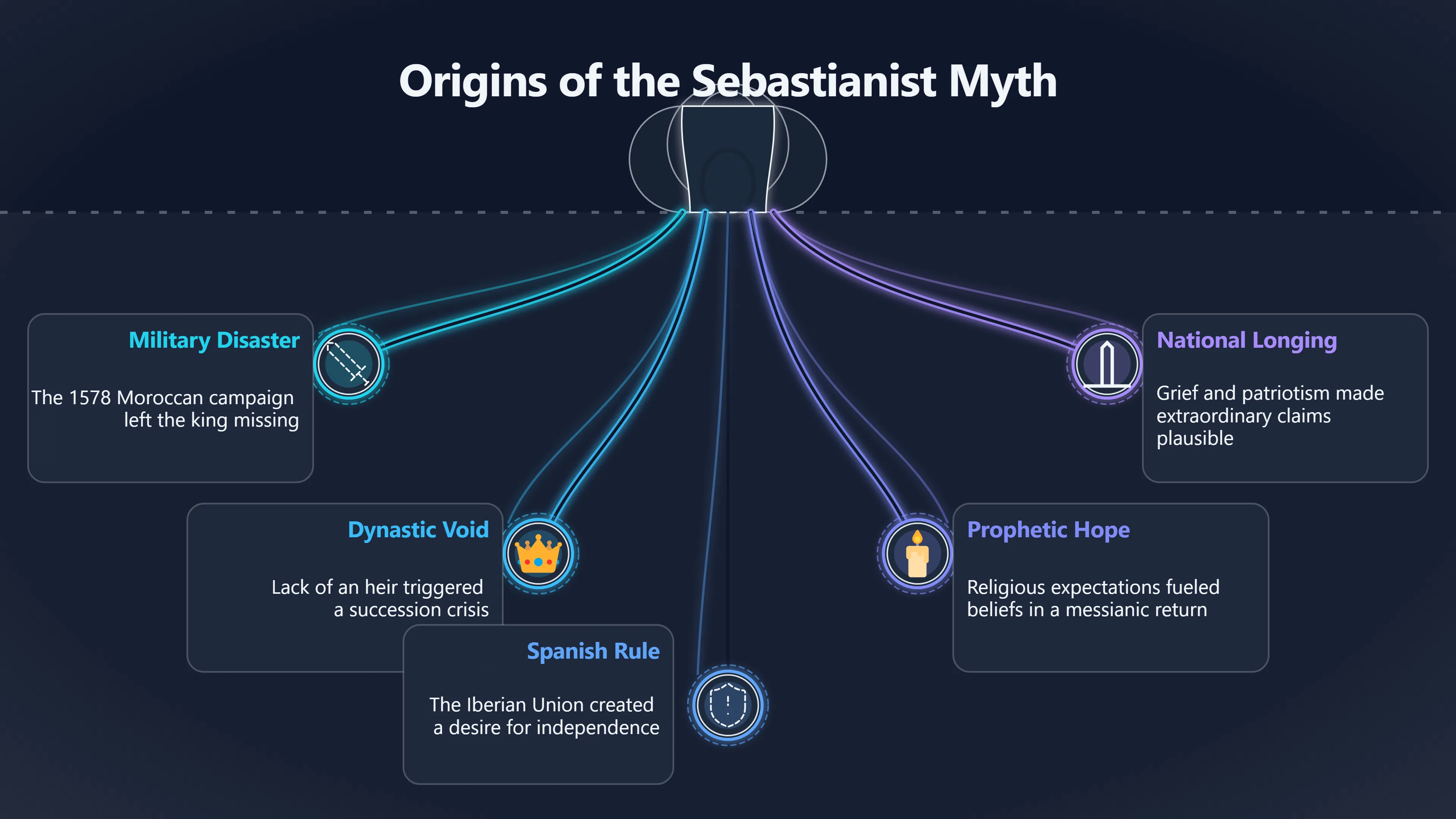
Why did Portugal keep finding King Sebastian long after he had vanished? The short answer is that the claimants arrived to fill a role that already existed in the public imagination. After King Sebastian disappeared at the Battle of Alcácer Quibir in 1578, Portugal faced a dynastic crisis and eventually lost its independence to the Spanish Habsburg monarchy. In that atmosphere, rumours of the king’s survival became politically useful and emotionally reassuring. The men who later claimed to be Sebastian did not create this hope; they exploited it. Their success reveals less about individual deception than about the power of national longing, uncertain evidence and the desire for political restoration. The repeated appearance of false Sebastians became one of the most remarkable families of imposture in Portuguese history, showing how grief and patriotism can make extraordinary claims appear plausible.[Wikipedia]WikipediaOpen source on wikipedia.org.
The disappearance that created a political vacancy
The false Sebastians emerged because Sebastian’s disappearance left an unusually large void. The young king vanished during Portugal’s disastrous Moroccan campaign in 1578. Although he was widely believed to have died in battle, the confusion surrounding the defeat and the difficulty of identifying bodies meant that certainty never fully settled the matter. Survivors returned from captivity, stories circulated, and many Portuguese concluded that their king might still be alive somewhere.[Wikipedia]WikipediaGabriel de EspinosaGabriel de Espinosa
The political situation made such hopes especially attractive. Sebastian left no heir. Within two years, the Portuguese crown passed to Philip II of Spain, beginning the Iberian Union. For many Portuguese, belief in Sebastian’s return was not simply nostalgia for a lost monarch. It represented a possible route back to national independence. A living Sebastian would solve both the dynastic problem and the political problem in a single stroke.[Wikipedia]WikipediaGabriel de EspinosaGabriel de Espinosa
This is what made the impostors dangerous. They were not merely claiming a royal identity. They were presenting themselves as potential answers to a national crisis.
How impostors performed the signs of kingship
The various pretenders differed in background and ambition, but they relied on similar methods. None could prove he was Sebastian in a modern sense. Instead, they performed kingship.
Supporters explained away inconsistencies and highlighted supposed signs of authenticity:
- Physical resemblances to the missing king.
- Stories of captivity, exile or secret survival.
- Claims that years of hardship had changed the king’s appearance.
- Appeals to prophecy and popular expectations.
- Testimony from sympathisers who insisted they recognised him.
The first major pretenders appeared in the 1580s. One was a commoner from Alcobaça. Another was an ascetic figure whose reputation for suffering encouraged villagers to see him as a king doing penance for his people. Both attracted followers before being arrested and punished.[Wikipedia]WikipediaOpen source on wikipedia.org.
What mattered was not the strength of the evidence but the flexibility of the legend. Every discrepancy could become proof. If the claimant looked different, captivity had altered him. If he lacked royal splendour, he was travelling in disguise. If he had been absent for years, that merely confirmed the mystery surrounding his survival.
The process resembles many later imposture cases. Successful claimants often inherit an existing narrative rather than inventing one. The audience supplies part of the story themselves.
Gabriel de Espinosa and the most famous false Sebastian
The best-known case centred on Gabriel de Espinosa, a Spanish baker whose story became known as the “Baker of Madrigal” affair. In the mid-1590s he became the focus of a conspiracy that attempted to present him as the missing Portuguese king.[Wikipedia]WikipediaGabriel de EspinosaGabriel de Espinosa
Espinosa’s appeal lay partly in his unexpected qualities. Contemporaries noted that he appeared more accomplished than an ordinary baker. He spoke foreign languages, rode horses well and carried himself with unusual confidence. These traits helped supporters imagine that he might be a disguised monarch rather than a tradesman.[Wikipedia]WikipediaGabriel de EspinosaGabriel de Espinosa
The plot gained credibility because influential people became involved. Friar Miguel de los Santos, who had connections to Sebastian’s former court and opposed Spanish rule, promoted the claim. Ana of Austria, a noblewoman living in a convent and related to royal circles, also became entangled in the scheme. The involvement of respected figures gave the imposture a legitimacy that a lone claimant could never have achieved.[Wikipedia]WikipediaGabriel de EspinosaGabriel de Espinosa
Ultimately the conspiracy collapsed under investigation. Espinosa was arrested, interrogated and executed in 1595. Miguel de los Santos met a similar fate. Yet the significance of the affair lies not in its failure but in the fact that such a scheme could attract serious support in the first place.[Wikipedia]WikipediaGabriel de EspinosaGabriel de Espinosa

Why people wanted to believe
The persistence of Sebastian claimants cannot be explained by deception alone. The deeper explanation lies in the emotional and political needs of the period.
Several factors encouraged belief:
National disappointment. Portugal’s military disaster and loss of independence created a longing for reversal.
Uncertainty. In an age without photography, fingerprints or rapid communications, verifying identity was difficult. A determined claimant could operate for months or years before being exposed.
Religious expectation. Many believers interpreted prophecies as signs that Sebastian would return in a moment of national need.
Political opposition. Supporters of Portuguese autonomy could use the king’s memory as a symbolic challenge to Spanish rule.
The result was a self-reinforcing cycle. Every new pretender demonstrated that belief remained alive. Every failed claimant could be dismissed as the wrong man while preserving faith that the real Sebastian would eventually appear.[Wikipedia]WikipediaOpen source on wikipedia.org.
Why Sebastianism outlived the failed claimants
The impostors disappeared, but Sebastianism survived. By the early seventeenth century the belief had expanded beyond specific claimants into a broader cultural and political tradition. Writers such as João de Castro argued that Sebastian was a hidden ruler destined to return and lead Portugal to a renewed age of greatness. Prophecies and religious interpretations transformed the missing king from a historical figure into a messianic symbol.[Wikipedia]WikipediaOpen source on wikipedia.org.
This shift is crucial. Once Sebastian became a symbol rather than merely a missing monarch, evidence mattered less. The movement no longer depended on proving that a particular man was the king. Instead, it expressed hopes about Portugal’s future.
That helps explain why the legend endured for centuries after every known claimant had failed. The false Sebastians lost because investigators could expose individual impostors. Sebastianism endured because it answered a larger emotional question. It offered a vision that national decline was temporary and that restoration remained possible.
In that sense, the repeated discovery of “King Sebastian” tells us less about successful fraud than about the power of collective hope. The impostors stepped into a role created by political uncertainty, cultural memory and the desire for redemption. Their stories ended on scaffolds and gallows, but the dream that made them possible survived long after they were gone.[Wikipedia]WikipediaOpen source on wikipedia.org.

Amazon book picks
Further Reading
Books and field guides related to Why Did Portugal Keep Finding King Sebastian?. Use these as the next step if you want deeper reading beyond the article.
Extraordinary Popular Delusions and the Madness of Crowds
Rating: 4.0/5 from 5 Google Books ratings
Shows how societies can embrace unlikely stories.
eBay marketplace picks
Marketplace Samples
Live-tested eBay searches with available results related to this page.




Endnotes
1.
Source: Wikipedia
Link:https://en.wikipedia.org/wiki/Sebastianism
2.
Source: Wikipedia
Title: Sebastian, King of Portugal
Link:https://en.wikipedia.org/wiki/Sebastian%2C_King_of_Portugal
3.
Source: Wikipedia
Title: Gabriel de Espinosa
Link:https://en.wikipedia.org/wiki/Gabriel_de_Espinosa
4.
Source: Wikipedia
Title: Gabriel de Espinosa
Link:https://es.wikipedia.org/wiki/Gabriel_de_Espinosa
5.
Source: Wikipedia
Title: Portuguese succession crisis of 1580
Link:https://en.wikipedia.org/wiki/Portuguese_succession_crisis_of_1580
6.
Source: Wikipedia
Link:https://pt.wikipedia.org/wiki/Sebastianismo
7.
Source: youtube.com
Title: “THE BATTLE THAT RUINED Portugal | ALCÁCER QUIBIR
Link:https://www.youtube.com/watch?v=CiBAYZyUBwk
Source snippet
ALCÁCER QUIBIR | The fall of a KING...
8.
Source: youtube.com
Title: ALCÁCER QUIBIR | The fall of a KING
Link:https://www.youtube.com/watch?v=bzBX4ZNgmKo
Source snippet
Sebastian I of Portugal and the False Kings...
9.
Source: executedtoday.com
Link:https://www.executedtoday.com/tag/sebastianism/
10.
Source: lettersfromlisbon.substack.com
Link:https://lettersfromlisbon.substack.com/p/sebastianism
11.
Source: ebsco.com
Link:https://www.ebsco.com/research-starters/history/sebastian
Additional References
12.
Source: portuguese-american-journal.com
Title: book the baker who pretended be king of portugal by ruth mackay editors note
Link:https://portuguese-american-journal.com/book-the-baker-who-pretended-be-king-of-portugal-by-ruth-mackay-editors-note/
Source snippet
Portuguese American JournalBook: “The Baker Who Pretended Be King of Portugal” by...Aug 30, 2012 — In her book, The Baker Who Pretended...
13.
Source: executedtoday.com
Title: 1595 gabriel de espinosa the confectioner of madrigal
Link:https://www.executedtoday.com/2016/08/01/1595-gabriel-de-espinosa-the-confectioner-of-madrigal/
Source snippet
1595: Gabriel de Espinosa, the confectioner of MadrigalAug 1, 2016 — On this date in 1595, Gabriel de Espinosa the “confectioner of Madri...
14.
Source: instagram.com
Link:https://www.instagram.com/reel/DSgDO_5DG2Z/
Source snippet
, despair into identity. Under occupation, believing in Sebastian...
15.
Source: instagram.com
Title: DYv RYli Rvl G
Link:https://www.instagram.com/reel/DYvRYliRvlG/
Source snippet
The King Who Was Declared Dead — Then Returned Again...1594 - Gabriel de Espinosa, a Spanish pastry cook, convinced nobles and even a ro...
16.
Source: researchgate.net
Link:https://www.researchgate.net/publication/342167542_From_King_Sebastian_of_Portugal_to_Miguel_de_Cervantes_and_don_Quijote_A_Genealogy_of_Myth_and_Influence
17.
Source: reddit.com
Link:https://www.reddit.com/r/todayilearned/comments/w282gs/til_about_sebastianism_a_cult_which_believes/
18.
Source: dokumen.pub
Link:https://dokumen.pub/the-baker-who-pretended-to-be-king-of-portugal-9780226501109.html
19.
Source: youtube.com
Title: The King Who Never Died
Link:https://www.youtube.com/watch?v=joG4wgZW3tg
Source snippet
"THE BATTLE THAT RUINED Portugal | ALCÁCER QUIBIR...
20.
Source: brewminate.com
Title: sebastianism the calabrian charlatan and medieval messianic nationalism
Link:https://brewminate.com/sebastianism-the-calabrian-charlatan-and-medieval-messianic-nationalism/
21.
Source: alternatehistory.com
Title: wi sebastian of portugal returns no iberian union.505111
Link:https://www.alternatehistory.com/forum/threads/wi-sebastian-of-portugal-returns-no-iberian-union.505111/
Topic Tree