Within Vietnam Hoaxes
How Did a Doubtful Attack Change a War?
A confused naval report became political certainty, helping justify a major expansion of the Vietnam War before the evidence could be tested publicly.
On this page
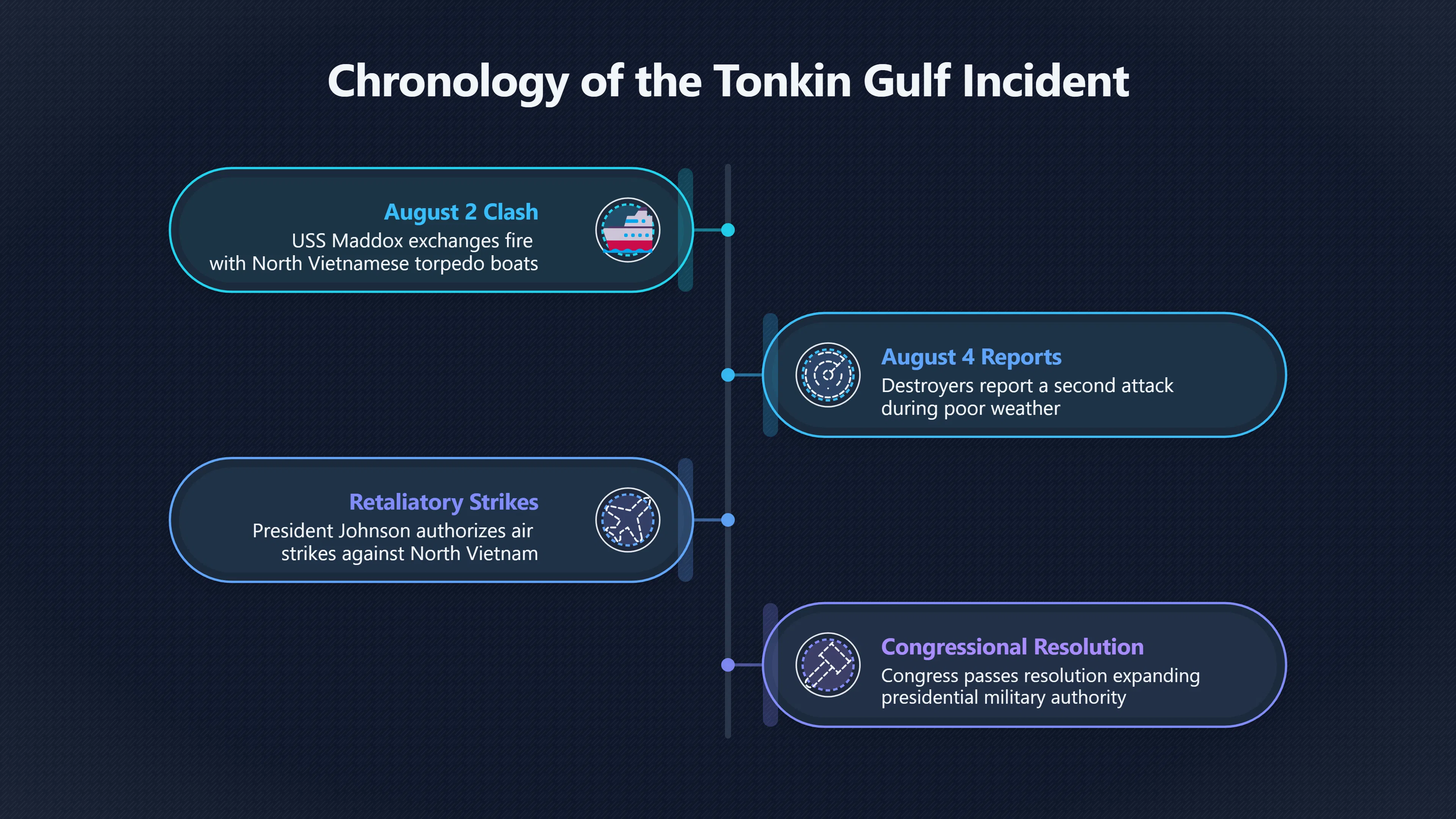
- What happened on 2 and 4 August 1964
- How intelligence was selected and presented
- Why the false account proved politically useful
Page outline Jump by section
Introduction
The Gulf of Tonkin incident is often remembered as the event that opened the door to large-scale American involvement in the Vietnam War. Yet the most controversial part of the story is not the genuine naval clash of 2 August 1964, but the alleged second attack on 4 August. What was initially presented as a clear act of North Vietnamese aggression later emerged as a far more doubtful episode, shaped by confused military reports, misinterpreted intelligence and selective presentation of evidence. The case has become one of the most studied examples of how uncertain information can harden into political certainty before it has been fully tested. In the history of contested truth connected to Vietnam, it stands as a warning about the power of official narratives during moments of crisis.[National Archives]archives.govtonkin gulf resolutionNational ArchivesTonkin Gulf Resolution (1964)9 Apr 2024 — (A 2002 National Security Agency report made available in 2007 confirmed the A…
How Did a Doubtful Attack Change a War?
On 2 August 1964, the American destroyer USS Maddox exchanged fire with North Vietnamese torpedo boats in the Gulf of Tonkin. That encounter was real and is not seriously disputed. The controversy centres on what happened two days later.[National Archives]archives.govtonkin gulf resolutionNational ArchivesTonkin Gulf Resolution (1964)9 Apr 2024 — (A 2002 National Security Agency report made available in 2007 confirmed the A…
During the night of 4 August, the USS Maddox and USS Turner Joy reported what appeared to be another attack. Radar operators, sonar crews and ship commanders believed they were detecting incoming torpedoes and hostile vessels. The destroyers manoeuvred aggressively and fired at what they thought were attackers. Reports quickly moved up the chain of command and reached Washington.[Miller Center]millercenter.orgMiller CenterThe Tonkin Gulf ResolutionOn August 4, two American destroyers, the USS Maddox and C. Turner Joy, reported being attacked by…
The problem was that the evidence was confused almost from the beginning. Weather conditions were poor, visibility was limited and electronic equipment produced uncertain readings. As the night progressed, officers aboard the Maddox began expressing doubts. Captain John Herrick sent messages suggesting that “freak weather effects on radar” and overenthusiastic sonar interpretations might explain many of the reported contacts.[National Archives]archives.govtonkin gulf resolutionNational ArchivesTonkin Gulf Resolution (1964)9 Apr 2024 — (A 2002 National Security Agency report made available in 2007 confirmed the A…
Despite those doubts, the attack narrative rapidly became the dominant interpretation. Within hours, President Lyndon B. Johnson authorised retaliatory air strikes against North Vietnam and moved forward with a congressional resolution that would dramatically expand presidential authority in the conflict.[Miller Center]millercenter.orgMiller CenterThe Tonkin Gulf ResolutionOn August 4, two American destroyers, the USS Maddox and C. Turner Joy, reported being attacked by…
Why Did So Many People Believe It?
The claim was persuasive because it appeared to come from multiple independent sources. Naval commanders were reporting hostile action. Signals intelligence specialists believed they were intercepting communications connected to an attack. Senior officials received information that seemed to confirm a coherent story. In a Cold War atmosphere where military planners already expected further confrontation, ambiguous signals were easily interpreted as evidence of enemy intent.[nsarchive2.gwu.edu]nsarchive2.gwu.eduno second attack on U.S. ships in Tonkin on August 4, 1964. According to National Security Archive research fellow John Prados, "the…
Another factor was timing. Decision-makers had only hours to respond. Waiting for complete certainty risked appearing weak if an attack had genuinely occurred. The pressure to act encouraged officials to favour reports that supported the conclusion that American ships had been attacked.[nsarchive2.gwu.edu]nsarchive2.gwu.eduOpen source on gwu.edu.
What later investigators found is that many of the supposedly confirming intelligence reports were either misunderstood, taken out of context or linked to the earlier clash on 2 August rather than a new attack on 4 August. Signals intercepts that seemed decisive at the time looked far less convincing when reviewed alongside the full documentary record.[nsarchive2.gwu.edu]nsarchive2.gwu.eduThe Gulf of Tonkin Incident, 40 Years Later4 Aug 2004 — Forty years ago today, President Johnson and top US officials chose to believe th…
How Intelligence Was Selected and Presented
The most damaging revelations emerged decades later when classified material was declassified and historians gained access to intelligence records.
A major National Security Agency (NSA) historical study concluded that no North Vietnamese attack occurred on 4 August. The study found that intelligence reporting had been distorted by analytical errors and by the selective use of evidence. Material that appeared to support the attack narrative was highlighted, while contradictory information was often excluded from reports reaching senior policymakers.[gwu.edu]nsarchive2.gwu.eduno second attack on U.S. ships in Tonkin on August 4, 1964. According to National Security Archive research fellow John Prados, "the…
According to the declassified analysis, intelligence personnel became convinced an attack was imminent and interpreted incoming information through that expectation. Later reviews found that much of the available signals intelligence did not support the conclusion that North Vietnamese boats were attacking the destroyers. Nevertheless, the reports ultimately presented to decision-makers conveyed a far greater level of certainty than the underlying evidence justified.[nsarchive2.gwu.edu]nsarchive2.gwu.eduno second attack on U.S. ships in Tonkin on August 4, 1964. According to National Security Archive research fellow John Prados, "the…
The controversy is important because it occupies a grey area between deliberate deception and institutional failure. Some historians argue that officials consciously emphasised the most useful interpretation. Others stress that many participants genuinely believed an attack had occurred and only later discovered how unreliable the evidence was. What is clear is that uncertainty was not communicated with the same force as the accusation itself.[U.S. Naval Institute]usni.orgOpen source on usni.org.
Why the False Account Proved Politically Useful
The doubtful second attack arrived at a moment when the Johnson administration was already wrestling with how far to deepen American involvement in Vietnam.
The alleged attack provided a powerful public justification for stronger action. Rather than appearing to expand the war by choice, the administration could present itself as responding to aggression. Congress quickly passed the Gulf of Tonkin Resolution, granting the president broad authority to use military force in Southeast Asia without a formal declaration of war.[archives.gov]archives.govtonkin gulf resolutionNational ArchivesTonkin Gulf Resolution (1964)9 Apr 2024 — (A 2002 National Security Agency report made available in 2007 confirmed the A…
The resolution became one of the most consequential documents of the Vietnam War. It was later used to justify a dramatic escalation of American military operations, including the deployment of large numbers of combat troops and an expanded bombing campaign. Although the resolution did not itself create the war, it removed many of the political obstacles that might otherwise have slowed escalation.[EBSCO]ebsco.comGulf of Tonkin Resolution | History | Research StartersThe Gulf of Tonkin Resolution, passed by the U.S. Congress on August 7, 1964…
For critics, the episode became a classic example of how governments can transform uncertain intelligence into persuasive political evidence. Even if many officials acted in good faith, the public presentation left little room for doubt at a moment when doubt was arguably the most important fact.[U.S. Naval Institute]usni.orgOpen source on usni.org.
What Later Investigations Revealed
Over the following decades, journalists, historians, former officials and government investigators repeatedly revisited the incident.
Robert McNamara, the US Secretary of Defense during the crisis, later acknowledged that the second attack had not occurred. Declassified recordings, internal memoranda and intelligence reviews revealed a much more complicated picture than the public had seen in August 1964.[Wikipedia]WikipediaGulf of Tonkin incidentGulf of Tonkin incident
The NSA’s declassified historical work was particularly influential because it came from within the intelligence system itself. Its conclusion was blunt: the available evidence did not support the claim that North Vietnam attacked the destroyers on 4 August.[nsarchive2.gwu.edu]nsarchive2.gwu.eduno second attack on U.S. ships in Tonkin on August 4, 1964. According to National Security Archive research fellow John Prados, "the…
The National Archives now notes that the 2 August clash occurred but that later intelligence reviews concluded the 4 August attack never happened. It also highlights the fact that doubts expressed by commanders in the field were not fully reflected in the information passed to political leaders.[National Archives]archives.govtonkin gulf resolutionNational ArchivesTonkin Gulf Resolution (1964)9 Apr 2024 — (A 2002 National Security Agency report made available in 2007 confirmed the A…

A Lesson in Contested Truth
The doubtful second Gulf of Tonkin attack occupies an unusual place in the history of deception connected to Vietnam. It was not a simple hoax invented by a single fraudster, nor was it merely a fabricated rumour. Instead, it was a case in which uncertainty, expectation, institutional pressure and selective reporting combined to produce a story that became accepted as fact before it could be properly verified.[nsarchive2.gwu.edu]nsarchive2.gwu.eduno second attack on U.S. ships in Tonkin on August 4, 1964. According to National Security Archive research fellow John Prados, "the…
Its enduring significance lies in the gap between what was known privately and what was presented publicly. The episode demonstrates how intelligence can be shaped by assumptions, how ambiguous evidence can acquire an unwarranted aura of certainty, and how decisions made during a few hours of confusion can alter the course of a war. In the broader history of Vietnam’s contested narratives, few examples better illustrate the consequences of treating a doubtful claim as an established truth.[usni.org]usni.orgOpen source on usni.org.
Amazon book picks
Further Reading
Books and field guides related to How Did a Doubtful Attack Change a War?. Use these as the next step if you want deeper reading beyond the article.
The Pentagon Papers
Contains material relevant to official representations of the war.
Vietnam: an Epic Tragedy: 1945-1975
Places the incident in the larger Vietnam conflict.
eBay marketplace picks
Marketplace Samples
Live-tested eBay searches with available results related to this page.

Endnotes
1.
Source: archives.gov
Title: tonkin gulf resolution
Link:https://www.archives.gov/milestone-documents/tonkin-gulf-resolution
Source snippet
National ArchivesTonkin Gulf Resolution (1964)9 Apr 2024 — (A 2002 National Security Agency report made available in 2007 confirmed the A...
2.
Source: nsarchive2.gwu.edu
Link:https://nsarchive2.gwu.edu/NSAEBB/NSAEBB132/press20051201.htm
Source snippet
no second attack on U.S. ships in Tonkin on August 4, 1964. According to National Security Archive research fellow John Prados, "the...
Published: August 4, 1964
3.
Source: nsarchive2.gwu.edu
Link:https://nsarchive2.gwu.edu/NSAEBB/NSAEBB132/tapes.htm
Source snippet
LBJ Tapes on the Gulf of Tonkin IncidentThe Maddox did not expect any attack-the action against North Vietnam no attack has yet occurred...
4.
Source: ebsco.com
Link:https://www.ebsco.com/research-starters/history/gulf-tonkin-resolution
Source snippet
Gulf of Tonkin Resolution | History | Research StartersThe Gulf of Tonkin Resolution, passed by the U.S. Congress on August 7, 1964...
Published: August 7, 1964
5.
Source: nsarchive2.gwu.edu
Link:https://nsarchive2.gwu.edu/NSAEBB/NSAEBB132/index.htm
Source snippet
The Gulf of Tonkin Incident, 40 Years Later4 Aug 2004 — Forty years ago today, President Johnson and top US officials chose to believe th...
6.
Source: nsarchive2.gwu.edu
Link:https://nsarchive2.gwu.edu/coldwar/interviews/episode-11/mcnamara4.html
7.
Source: nsa.gov
Title: rel1 skunks bogies
Link:https://www.nsa.gov/portals/75/documents/news-features/declassified-documents/gulf-of-tonkin/articles/release-1/rel1_skunks_bogies.pdf
8.
Source: Wikipedia
Title: Gulf of Tonkin incident
Link:https://en.wikipedia.org/wiki/Gulf_of_Tonkin_incident
9.
Source: nsarchive.gwu.edu
Title: intelligence espionage
Link:https://nsarchive.gwu.edu/subjects/intelligence-espionage?page=17
10.
Source: Wikipedia
Title: Persian Gulf
Link:https://en.wikipedia.org/wiki/Persian_Gulf
11.
Source: archives.gov
Title: Vietnam War
Link:https://www.archives.gov/research/vietnam-war
12.
Source: history.state.gov
Title: gulf of tonkin
Link:https://history.state.gov/milestones/1961-1968/gulf-of-tonkin
Source snippet
Office of the HistorianUS Involvement in the Vietnam War: the Gulf of TonkinIn early August 1964, two US destroyers stationed in the Gulf...
Published: August 1964
13.
Source: millercenter.org
Link:https://millercenter.org/the-presidency/educational-resources/tonkin-gulf
Source snippet
Miller CenterThe Tonkin Gulf ResolutionOn August 4, two American destroyers, the USS Maddox and C. Turner Joy, reported being attacked by...
14.
Source: usni.org
Link:https://www.usni.org/magazines/naval-history-magazine/2008/february/truth-about-tonkin
15.
Source: dictionary.cambridge.org
Link:https://dictionary.cambridge.org/dictionary/english/gulf
16.
Source: cfr.org
Title: Gulf of Tonkin Resolution
Link:https://www.cfr.org/ten-best-ten-worst-us-foreign-policy-decisions/gulf-of-tonkin-resolution/
17.
Source: docsteach.org
Title: tonkin resolution
Link:https://docsteach.org/document/tonkin-resolution/
18.
Source: edmoise.sites.clemson.edu
Link:https://edmoise.sites.clemson.edu/tonkin.html
Additional References
19.
Source: docsteach.org
Link:https://docsteach.org/lesson/analyzing-the-gulf-of-tonkin-resolution-original-draft-resolution/
Source snippet
Analyzing the Gulf of Tonkin Resolution (Original Draft...On August 4, 1964 the USS Maddox captain reported that he was “under...
Published: August 4, 1964
20.
Source: youtube.com
Title: Did the US Government Lie About the Gulf of Tonkin?
Link:https://www.youtube.com/watch?v=h2Eeq7OWSFw
Source snippet
What is a "false flag" and why is it important for us to understand the historical background of...
21.
Source: youtube.com
Title: TRUTH about the Gulf of Tonkin Incident
Link:https://www.youtube.com/watch?v=-_r1uPWIBLQ
Source snippet
Our Government Lied About Tonkin. See Them Doing It & Debating It...
22.
Source: youtube.com
Title: Our Government Lied About Tonkin. See Them Doing It & Debating It
Link:https://www.youtube.com/watch?v=N1sgnWBAnCE
Source snippet
The Most Dangerous Man to the Vietnam War...
23.
Source: docsteach.org
Link:https://docsteach.org/activity/events-leading-to-the-gulf-of-tonkin-resolution/
24.
Source: gulfair.com
Link:https://www.gulfair.com/
25.
Source: gulfnews.com
Link:https://gulfnews.com/
26.
Source: gulfoilltd.com
Link:https://www.gulfoilltd.com/
27.
Source: thenationalnews.com
Link:https://www.thenationalnews.com/news/gulf/
28.
Source: youtube.com
Title: The Most Dangerous Man to the Vietnam War
Link:https://www.youtube.com/watch?v=arRos-Fbr8g
Source snippet
Did the US Government Lie About the Gulf of Tonkin?...
Topic Tree