Within Tunisia
Who Was Really Behind Tunisia's Election News?
Anonymous pages, dubious polling and accounts posing as news outlets blurred the line between political reporting and covert campaigning.
On this page
- How Anonymous Pages Claimed Public Trust
- Why Fake Polls Looked Convincing
- What Platform Takedowns Revealed
Page outline Jump by section
Introduction
Tunisia’s post-revolution elections were often celebrated as one of the Arab world’s most important democratic experiments. Yet the same online environment that enabled political mobilisation after 2011 also created opportunities for a different kind of deception. During successive election campaigns, anonymous Facebook pages, websites masquerading as news organisations, and dubious opinion polls blurred the line between journalism, political advertising and covert campaigning.

Unlike a single famous hoax with a clear author and exposure, Tunisia’s election misinformation problem emerged through networks of accounts and media brands that claimed independence while quietly promoting political interests. Investigations by researchers, election observers and social media platforms revealed how fabricated polling numbers, disguised news outlets and coordinated online influence operations could create an illusion of public support without voters knowing who was actually behind the messages.[demtech.oii.ox.ac.uk]demtech.oii.ox.ac.ukTunisian civil society groups raised alarms about the spread of disinformation and hate speech during the 2019 elections.Read more…
Who Was Really Behind Tunisia’s Election News?
The most significant concern was not necessarily completely invented stories. It was the difficulty of identifying who was speaking.
Following the 2011 revolution, Facebook became a central arena of political communication in Tunisia. By the 2019 presidential and parliamentary elections, political information circulated through thousands of pages that often appeared to be independent news sources, civic initiatives or entertainment channels. Researchers and civil-society groups warned that many pages lacked transparent ownership and could be repurposed rapidly for political messaging.[idea.int]idea.intprotecting tunisian elections digital threatsInternational IDEAProtecting Tunisian elections from digital threats10 May 2019 — If one country can globally exemplify the power of soci…
Digital investigators found examples of websites and social-media pages presenting themselves as ordinary news organisations while promoting particular political narratives. The problem was not always outright falsehood. Often the deception lay in the hidden relationship between supposedly independent media and political actors.
One of the best-known cases emerged during the 2019 election cycle. Investigators from the Atlantic Council’s Digital Forensic Research Lab uncovered a Tunisia-linked influence operation that used websites, Facebook pages and social-media accounts designed to resemble legitimate news outlets. The network promoted political content while obscuring who controlled it. Researchers linked many of the assets to a Tunisian communications company and described the effort as a coordinated attempt to influence political opinion during the presidential election.[Medium]medium.comDFRLab uncovers Tunisia-based political influence…A Tunisia-based company operated a sophisticated digital campaign involving mu…
The operation became notable because it relied less on dramatic fake stories than on imitation credibility. Readers encountering a professional-looking article or a page styled like a news service could easily assume they were consuming journalism rather than campaign material.
How Anonymous Pages Claimed Public Trust
Anonymous political pages succeeded because they borrowed the visual language of trusted media.
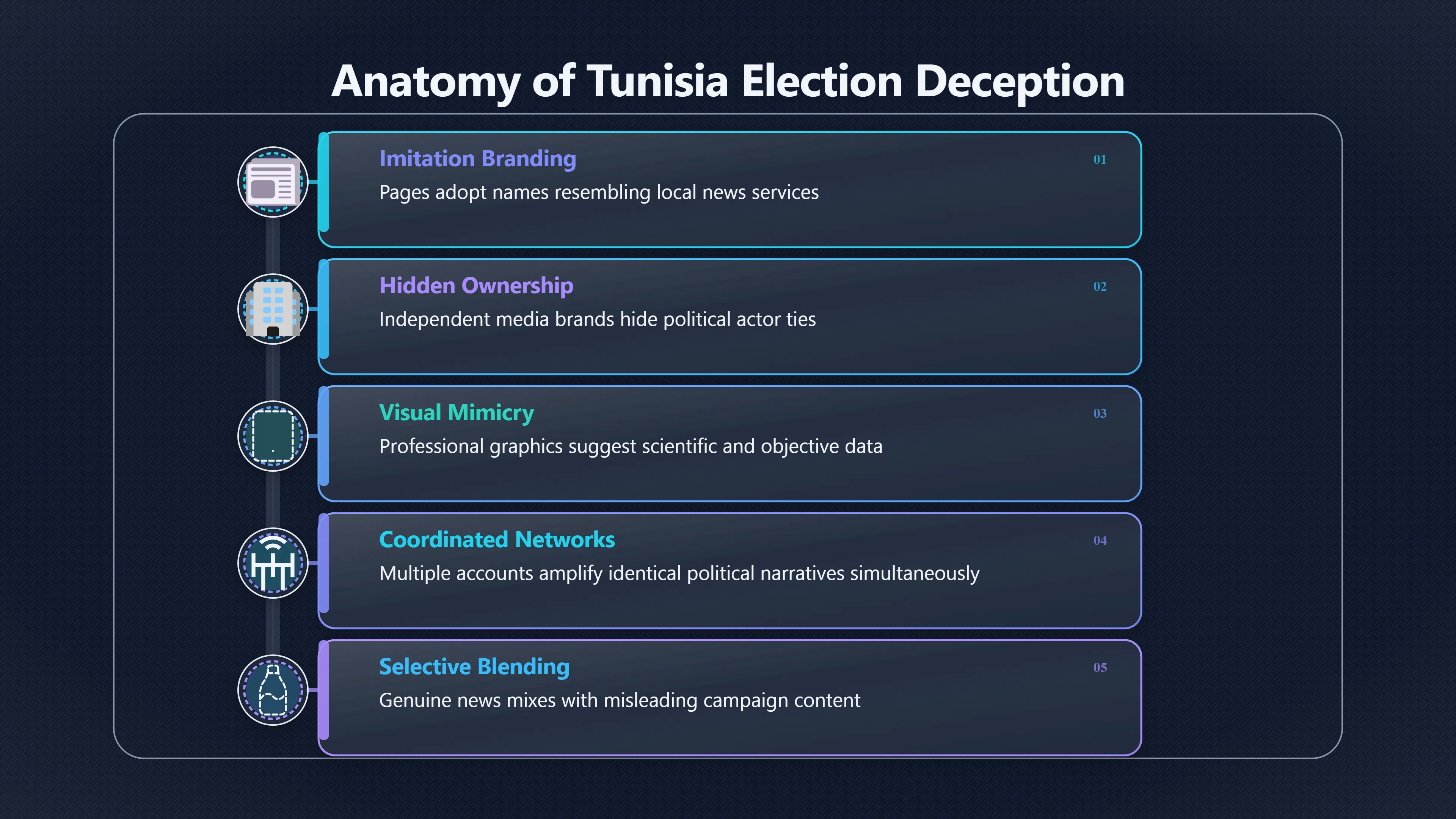
Many adopted names that sounded like local newspapers, regional news services or public-interest information portals. Others accumulated followers through non-political content before shifting toward electoral messaging. Once audiences had been built, political narratives could be introduced into feeds that users already regarded as familiar and trustworthy.[Medium]medium.comDFRLab uncovers Tunisia-based political influence…A Tunisia-based company operated a sophisticated digital campaign involving mu…
Several factors made this especially effective in Tunisia:
- Social media had become a primary source of political information for many voters.
- Independent journalism was expanding rapidly after decades of authoritarian control, making it difficult for audiences to distinguish new legitimate outlets from fabricated ones.
- Online advertising rules and disclosure systems were still developing.
- Election observers often lacked access to the platform data needed to track coordinated behaviour.[idea.int]idea.intprotecting tunisian elections digital threatsInternational IDEAProtecting Tunisian elections from digital threats10 May 2019 — If one country can globally exemplify the power of soci…
Researchers studying the 2019 elections reported that Tunisian civil-society organisations were concerned about online disinformation but struggled to monitor it effectively because of technical and legal barriers. The result was an information environment in which hidden political messaging could spread faster than independent verification.[demtech.oii.ox.ac.uk]demtech.oii.ox.ac.ukTunisian civil society groups raised alarms about the spread of disinformation and hate speech during the 2019 elections.Read more…
Why Fake Polls Looked Convincing
Election polling carries special authority because it appears scientific. A chart, percentage figure or ranking can look objective even when its methodology is unclear.
During Tunisian election campaigns, social media users regularly encountered graphics claiming to show candidate popularity, projected results or public opinion trends. Some originated from recognised polling firms, but others circulated without transparent methodology, sample information or identifiable sponsors. Critics warned that unverified polling figures could create a bandwagon effect by making certain candidates appear stronger than they actually were.[Medium]medium.comSorting fact from fiction in Tunisia's presidential electionSorting fact from fiction in Tunisia's presidential electionOctober 11, 2019 — As Tunisia approaches its presidential runoff, truth…
The persuasive power of these polls came from presentation rather than evidence. Many imitated the visual style of professional survey organisations, using percentages, maps and statistical language that suggested scientific legitimacy. Once shared by popular pages, the numbers could acquire credibility simply through repetition.
This did not mean every disputed poll was fabricated. Tunisia has legitimate polling organisations, and genuine polling played an important role in several elections. The problem arose when social-media graphics detached polling claims from verifiable methods, making it difficult for ordinary users to distinguish professional surveys from political messaging disguised as research.[Brookings]brookings.eduPolitical outsiders sweep Tunisia's presidential electionsPolitical outsiders sweep Tunisia's presidential elections
The wider phenomenon mirrors findings from international research showing that social-media polls and election-related polling content can be highly vulnerable to manipulation, selective amplification and misleading interpretation.[arXiv]arxiv.orgOpen source on arxiv.org.
What Platform Takedowns Revealed
The most revealing moments often came after investigations by researchers and technology companies.
In late 2019 and early 2020, Facebook removed networks connected to what it described as coordinated inauthentic behaviour. The Tunisia-linked operation uncovered by digital investigators relied on clusters of accounts, pages and websites that worked together while concealing their common management. The assets presented themselves as independent voices but were linked behind the scenes.[Medium]medium.comDFRLab uncovers Tunisia-based political influence…A Tunisia-based company operated a sophisticated digital campaign involving mu…
These investigations revealed several recurring tactics:
- Creating media brands with unclear ownership.
- Operating multiple pages that amplified the same narratives.
- Using apparently independent websites to reinforce social-media claims.
- Promoting political messages through assets that did not openly identify themselves as campaign organisations.
- Blending genuine news with selective or misleading political content.[Medium]medium.comDFRLab uncovers Tunisia-based political influence…A Tunisia-based company operated a sophisticated digital campaign involving mu…
Importantly, the takedowns did not prove that every message distributed by these networks was false. Instead, the violation centred on deception about identity and coordination. Users were misled about who was speaking and how widespread support for a particular narrative really was.[Medium]medium.comDFRLab uncovers Tunisia-based political influence…A Tunisia-based company operated a sophisticated digital campaign involving mu…

Why the Story Matters Beyond One Election
The Tunisian case illustrates a broader shift in political deception. Traditional propaganda often relied on controlling newspapers or broadcasters. Modern influence campaigns can achieve similar goals by creating the appearance of independent public opinion.
Fake polls and disguised media exploit a basic democratic assumption: that voters can evaluate competing arguments if they know who is making them. When political advertising masquerades as journalism, or when polling claims circulate without transparent methods, that assumption becomes harder to sustain.
Election observers and researchers repeatedly noted that the challenge was not simply the existence of false information. It was the opacity of the information ecosystem itself. Citizens could no longer easily tell whether they were reading news, marketing, activism, or coordinated political persuasion.[ox.ac.uk]demtech.oii.ox.ac.ukTunisian civil society groups raised alarms about the spread of disinformation and hate speech during the 2019 elections.Read more…
Within Tunisia’s wider history of contested truth, these election-era information campaigns stand out because they were not based on forged artefacts, mythical creatures or sensational rumours. Their central trick was far subtler: convincing people that political messages were coming from neutral observers, independent journalists or objective measurements of public opinion when they were often something else entirely.[Medium]medium.comDFRLab uncovers Tunisia-based political influence…A Tunisia-based company operated a sophisticated digital campaign involving mu…
Amazon book picks
Further Reading
Books and field guides related to Who Was Really Behind Tunisia's Election News?. Use these as the next step if you want deeper reading beyond the article.
The Age of Surveillance Capitalism
Provides context for digitally mediated political communication.
eBay marketplace picks
Marketplace Samples
Live-tested eBay searches with available results related to this page.



Endnotes
1.
Source: demtech.oii.ox.ac.uk
Link:https://demtech.oii.ox.ac.uk/wp-content/uploads/sites/12/2020/03/Tunisia-memo-English.pdf
Source snippet
Tunisian civil society groups raised alarms about the spread of disinformation and hate speech during the 2019 elections.Read more...
2.
Source: medium.com
Link:https://medium.com/dfrlab/dfrlab-uncovers-tunisia-based-political-influence-operation-on-facebook-8c4d16b90744
Source snippet
DFRLab uncovers Tunisia-based political influence...A Tunisia-based company operated a sophisticated digital campaign involving mu...
3.
Source: idea.int
Title: protecting tunisian elections digital threats
Link:https://www.idea.int/news/protecting-tunisian-elections-digital-threats
Source snippet
International IDEAProtecting Tunisian elections from digital threats10 May 2019 — If one country can globally exemplify the power of soci...
Published: May 2019
4.
Source: oii.ox.ac.uk
Link:https://www.oii.ox.ac.uk/civil-society-leaders-struggled-to-curb-tide-of-disinformation-during-2019-tunisian-elections-and-demand-greater-transparency-from-social-media-platforms/
Source snippet
ford Internet InstituteCivil society leaders struggled to curb tide of disinformation...23 Mar 2020 — New analysis shows civil society...
5.
Source: medium.com
Title: Sorting fact from fiction in Tunisia’s presidential election
Link:https://medium.com/dfrlab/sorting-fact-from-fiction-in-tunisias-presidential-election-862bcc05bdaf
Source snippet
Sorting fact from fiction in Tunisia's presidential electionOctober 11, 2019 — As Tunisia approaches its presidential runoff, truth...
Published: October 11, 2019
6.
Source: arabcenterdc.org
Title: disinformation as a tool of regime survival in tunisia
Link:https://arabcenterdc.org/resource/disinformation-as-a-tool-of-regime-survival-in-tunisia/
Source snippet
Arab Center Washington DCDisinformation as a Tool of Regime Survival in Tunisia21 Jul 2023 — Disinformation—false information created wit...
7.
Source: brookings.edu
Title: Political outsiders sweep Tunisia’s presidential elections
Link:https://www.brookings.edu/articles/political-outsiders-sweep-tunisias-presidential-elections/
8.
Source: arxiv.org
Link:https://arxiv.org/abs/2405.11146
9.
Source: facebook.com
Link:https://www.facebook.com/groups/177316605639857/posts/7695552940482815/
10.
Source: facebook.com
Link:https://www.facebook.com/deutschewellenews/posts/in-tunisia-young-people-have-taken-to-the-streets-amid-a-crackdown-on-political-/935897748565540/
Additional References
11.
Source: youtube.com
Link:https://www.youtube.com/watch?v=GDwpZP42O3I
Source snippet
Tunisia election disinformation 2019 Tunisia elections: 'Whoever runs Tunisia is going to be faced with problems with reforms' FRANCE 24...
12.
Source: cartercentee50c07c05.blob.core.windows.net
Title: tunisia 2019 final report
Link:https://cartercentee50c07c05.blob.core.windows.net/blobcartercentee50c07c05/wp-content/uploads/2020/05/tunisia-2019-final-report.pdf
Source snippet
2019 Presidential and Parliamentary Elections in Tunisia• Social media monitoring: The Carter Center's monitoring of the Facebook pages o...
13.
Source: youtube.com
Title: Press freedom in Tunisia: From censorship to speaking out
Link:https://www.youtube.com/watch?v=UceE9h2q-ZA
Source snippet
Tunisia: The success of civil society in taking action against the draft False News Act...
14.
Source: youtube.com
Title: Tunisia Cracks Down on Social Media 10 Years after Arab Spring
Link:https://www.youtube.com/watch?v=t1BBTxXyF0Y
Source snippet
FRANCE 24 report: Tunisian authorities ramp up media crackdown ahead of vote...
15.
Source: youtube.com
Title: FRANCE 24 report: Tunisian authorities ramp up media crackdown ahead of vote
Link:https://www.youtube.com/watch?v=KoKkcTXRB6U
Source snippet
Tunisian authorities crack down on dissenting voices...
16.
Source: youtube.com
Title: Tunisian authorities crack down on dissenting voices
Link:https://www.youtube.com/watch?v=6AIO0DWz_54
Source snippet
Press freedom in Tunisia: From censorship to speaking out...
17.
Source: icj.org
Link:https://www.icj.org/tunisia-unfair-presidential-election-undermines-human-rights-and-deepens-political-crisis/
18.
Source: theguardian.com
Title: tunisia election exit polls point to landslide win for robocop kais saied
Link:https://www.theguardian.com/world/2019/oct/14/tunisia-election-exit-polls-point-to-landslide-win-for-robocop-kais-saied
19.
Source: arab-reform.net
Title: online narratives and manipulations tunisian and regional panorama
Link:https://www.arab-reform.net/publication/online-narratives-and-manipulations-tunisian-and-regional-panorama/
20.
Source: reuters.com
Title: polls open tunisian vote boycotted by opposition 2022 12 17
Link:https://www.reuters.com/world/africa/polls-open-tunisian-vote-boycotted-by-opposition-2022-12-17/
Topic Tree