Within Liechtenstein Deceptions
How Liechtenstein Manufactured Its Own Stamp Rarities
Official stamps became deceptive collectibles when an authorised consortium deliberately manufactured errors and scarce-looking variants.
On this page
- The consortium and its government contract
- How deliberate errors created false scarcity
- Investigation, collapse and lasting damage
Page outline Jump by section
Introduction
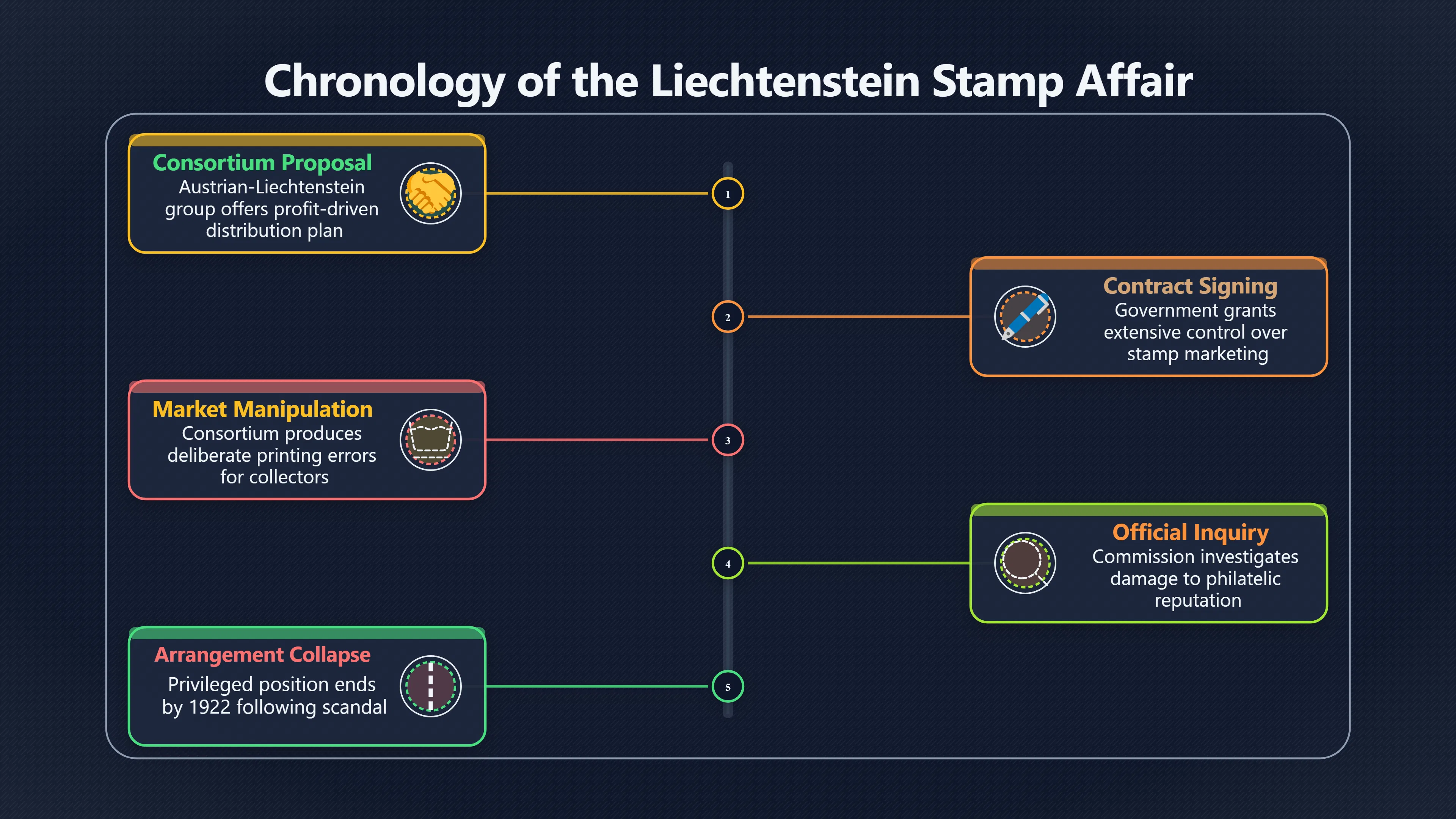
The Liechtenstein stamp affair of 1919–1922 was not a case of counterfeit stamps flooding the market. The stamps involved were official, authorised issues. The scandal arose because a government-backed distribution arrangement allowed a private consortium to manufacture the appearance of rarity by producing large numbers of deliberate printing errors, unusual varieties and supposedly scarce stamp forms for collectors. What looked like accidental mistakes became a commercial strategy. The affair damaged confidence in Liechtenstein’s young postal administration, triggered official investigations and remains one of the clearest examples of how a collecting market can be manipulated without forging a single stamp.[historisches-lexikon.li]historisches-lexikon.liIm Oktober 1919 versprach ein liechtensteinisch-österreichisches Konsortium, bestehend aus Eugen Nipp, Ferdinand Nigg, Luigi Kasimir und…
For a small country emerging from the economic turmoil that followed the First World War, stamp sales promised valuable revenue. The controversy revealed the risks of turning rarity itself into a product.
The Consortium and Its Government Contract
After the collapse of Austria-Hungary, Liechtenstein was searching for new economic opportunities and greater administrative independence. Postage stamps appeared to offer both. Collectors around the world were increasingly interested in the issues of small states, and philately had become an international business.[stamps.postmuseum.li]stamps.postmuseum.liThe postal stamps and postal history of LiechtensteinThe government transfers by contract the production, issue and distribution of stamp…
In October 1919, a Liechtenstein-Austrian consortium approached the government with promises of substantial profits from stamp sales. The group included Eugen Nipp, Ferdinand Nigg, Luigi Kasimir and Gustav von Flesch-Bruningen. A contract was signed on 27 November 1919 granting the consortium extensive control over the distribution and marketing of Liechtenstein stamps. To handle operations, the partners established a commercial organisation in Vaduz known as the “Philatelistische Verschleißstelle der fürstlich liechtensteinischen Postwertzeichen”, effectively a specialised sales agency for official stamps.[historisches-lexikon.li]historisches-lexikon.liIm Oktober 1919 versprach ein liechtensteinisch-österreichisches Konsortium, bestehend aus Eugen Nipp, Ferdinand Nigg, Luigi Kasimir und…
The arrangement looked attractive on paper. Liechtenstein would receive income without having to build a large international sales network itself. The consortium, meanwhile, gained access to a product whose value depended heavily on collector demand rather than postal necessity.[historisches-lexikon.li]historisches-lexikon.liIm Oktober 1919 versprach ein liechtensteinisch-österreichisches Konsortium, bestehend aus Eugen Nipp, Ferdinand Nigg, Luigi Kasimir und…
That incentive structure proved dangerous. The more unusual and desirable the stamps appeared, the more money could be made from collectors.
How Deliberate Errors Created False Scarcity
The key mechanism of the affair was the transformation of official stamps into manufactured rarities.
In normal philately, printing mistakes can become valuable because they are accidental and genuinely scarce. A misplaced colour, missing perforation or design flaw may survive in only a handful of copies. Collectors often pay high prices because such errors are unexpected by-products of production.[Wikipedia]WikipediaErrors, freaks, and odditiesErrors, freaks, and oddities
According to Liechtenstein’s Historical Lexicon, the consortium violated the spirit and terms of its agreement by producing large quantities of printing errors and special varieties. Rather than allowing mistakes to occur naturally, it encouraged or arranged the creation of unusual versions specifically for the collector market. These items were then presented as exceptional and scarce, even though their scarcity had effectively been engineered.[historisches-lexikon.li]historisches-lexikon.liIm Oktober 1919 versprach ein liechtensteinisch-österreichisches Konsortium, bestehend aus Eugen Nipp, Ferdinand Nigg, Luigi Kasimir und…
This distinction is crucial. The deception was not that the stamps were fake. They were genuine postal products. The misleading element lay in the narrative attached to them:
- Collectors assumed unusual varieties represented accidental production anomalies.
- The consortium benefited when those varieties appeared rare.
- The rarity was partly artificial because the unusual forms had been deliberately created.
- Buyers could not easily distinguish between genuine accidents and manufactured curiosities.[historisches-lexikon.li]historisches-lexikon.liIm Oktober 1919 versprach ein liechtensteinisch-österreichisches Konsortium, bestehend aus Eugen Nipp, Ferdinand Nigg, Luigi Kasimir und…
The affair exposed a weakness common to many collecting markets. Value often depends less on the physical object than on a story about its origin. Once producers can control that story, they can create scarcity without creating authenticity.
Why Collectors Believed the Rarities
The scheme worked because it exploited assumptions already embedded in philatelic culture.
At the time, collectors across Europe were eager to acquire stamps from newly independent or politically transformed states. Liechtenstein had only recently gained postal autonomy, and its issues attracted international interest. Unusual varieties from a tiny Alpine principality seemed plausible because many postal systems of the era genuinely produced occasional errors during periods of administrative change.[stamps.postmuseum.li]stamps.postmuseum.liThe postal stamps and postal history of LiechtensteinThe government transfers by contract the production, issue and distribution of stamp…
The stamps also carried the authority of official issuance. Collectors were not dealing with anonymous forgers operating outside the system. The material originated from channels connected to the state itself. That official status gave the products credibility and made scepticism less likely.[historisches-lexikon.li]historisches-lexikon.liIm Oktober 1919 versprach ein liechtensteinisch-österreichisches Konsortium, bestehend aus Eugen Nipp, Ferdinand Nigg, Luigi Kasimir und…
In effect, the consortium exploited a paradox. The very fact that the stamps were authentic made the manipulation harder to detect.
Investigation, Exposure and Collapse
Criticism of the arrangement grew as concerns emerged about how the stamp business was being conducted. The issue developed into a domestic political controversy rather than remaining a specialised dispute among collectors. Questions were raised about contracts, oversight and the damage being done to the reputation of Liechtenstein’s postal issues.[historisches-lexikon.li]historisches-lexikon.liIm Oktober 1919 versprach ein liechtensteinisch-österreichisches Konsortium, bestehend aus Eugen Nipp, Ferdinand Nigg, Luigi Kasimir und…
An investigative commission was established to examine the transactions. Historical accounts note that Gustav Schädler and Franz Xaver Gassner participated in the inquiry. Their investigation identified significant deficiencies in the stamp operations and concluded that the affair had harmed confidence in Liechtenstein’s philatelic reputation.[Wikipedia]WikipediaGustav SchädlerGustav Schädler
The scandal eventually led to the collapse of the arrangement. By 1922 the consortium’s privileged position had ended, bringing the episode to a close. Although the immediate financial consequences were limited compared with later political or banking scandals in Liechtenstein, the reputational consequences were substantial.[historisches-lexikon.li]historisches-lexikon.liIm Oktober 1919 versprach ein liechtensteinisch-österreichisches Konsortium, bestehend aus Eugen Nipp, Ferdinand Nigg, Luigi Kasimir und…
The country had hoped to use stamps as a symbol of national legitimacy and an export product. Instead, the affair created doubts about the integrity of the very market it was trying to cultivate.

The Lasting Damage to Liechtenstein’s Philatelic Reputation
The stamp affair mattered because philately was unusually important to Liechtenstein.
Unlike larger countries, the principality could generate meaningful income and international visibility through stamp sales. Collectors abroad encountered Liechtenstein through its stamps long before they encountered its tourism industry or financial sector. Postal issues therefore functioned as both commercial products and national ambassadors.[stamps.postmuseum.li]stamps.postmuseum.liThe postal stamps and postal history of LiechtensteinThe government transfers by contract the production, issue and distribution of stamp…
When confidence in the authenticity of rarities was damaged, the consequences extended beyond individual collectors. The credibility of future issues came into question. If unusual varieties might have been manufactured intentionally, then rarity itself became suspect.[historisches-lexikon.li]historisches-lexikon.liIm Oktober 1919 versprach ein liechtensteinisch-österreichisches Konsortium, bestehend aus Eugen Nipp, Ferdinand Nigg, Luigi Kasimir und…
The episode helped shape a more cautious approach to philatelic administration in later decades. Modern Liechtenstein philately has generally emphasised quality, artistic design and transparent issuance rather than speculative rarity. The country ultimately rebuilt a strong reputation among collectors, but the affair remained a warning about the dangers of mixing public authority with private speculation.[stamps.postmuseum.li]stamps.postmuseum.liThe postal stamps and postal history of LiechtensteinThe government transfers by contract the production, issue and distribution of stamp…
What the Stamp Affair Reveals About Manufactured Scarcity
The lasting significance of the stamp affair lies in the mechanism it exposed.
Many famous frauds involve fake objects. Liechtenstein’s stamp controversy was subtler. The objects were real. The scarcity was the illusion. By deliberately creating errors and special varieties, authorised operators blurred the line between genuine rarity and manufactured demand.[historisches-lexikon.li]historisches-lexikon.liIm Oktober 1919 versprach ein liechtensteinisch-österreichisches Konsortium, bestehend aus Eugen Nipp, Ferdinand Nigg, Luigi Kasimir und…
That makes the affair relevant far beyond philately. It illustrates a recurring pattern in collectible markets, from coins and trading cards to limited-edition merchandise: when the same people who profit from rarity can also create rarity, incentives for manipulation emerge. The Liechtenstein case showed this dynamic unusually clearly and unusually early.
For historians of deception, the affair is therefore less a story about forged stamps than a lesson in how official legitimacy can be used to manufacture value itself.[historisches-lexikon.li]historisches-lexikon.liIm Oktober 1919 versprach ein liechtensteinisch-österreichisches Konsortium, bestehend aus Eugen Nipp, Ferdinand Nigg, Luigi Kasimir und…
Amazon book picks
Further Reading
Books and field guides related to How Liechtenstein Manufactured Its Own Stamp Rarities. Use these as the next step if you want deeper reading beyond the article.
Extraordinary Popular Delusions and the Madness of Crowds
Rating: 4.0/5 from 5 Google Books ratings
Explores speculative markets and manufactured enthusiasm.
Fundamentals of Philately
Explains how rarity, errors and collecting markets function.
The Encyclopedia of Rare and Famous Stamps
Directly addresses stamp rarities and their market significance.
eBay marketplace picks
Marketplace Samples
Live-tested eBay searches with available results related to this page.
Endnotes
1.
Source: historisches-lexikon.li
Link:https://historisches-lexikon.li/Briefmarkenaff%C3%A4re
Source snippet
Im Oktober 1919 versprach ein liechtensteinisch-österreichisches Konsortium, bestehend aus Eugen Nipp, Ferdinand Nigg, Luigi Kasimir und...
2.
Source: stamps.postmuseum.li
Link:https://stamps.postmuseum.li/history
Source snippet
The postal stamps and postal history of LiechtensteinThe government transfers by contract the production, issue and distribution of stamp...
3.
Source: Wikipedia
Title: Postage stamps and postal history of Liechtenstein
Link:https://en.wikipedia.org/wiki/Postage_stamps_and_postal_history_of_Liechtenstein
Source snippet
Postage stamps and postal history of LiechtensteinFollowing the collapse of Habsburg Austria in 1918, Liechtenstein secured postal ind...
4.
Source: Wikipedia
Title: Errors, freaks, and oddities
Link:https://en.wikipedia.org/wiki/Errors%2C_freaks%2C_and_oddities
5.
Source: Wikipedia
Title: Gustav Schädler
Link:https://en.wikipedia.org/wiki/Gustav_Sch%C3%A4dler
6.
Source: freestampcatalogue.com
Link:https://www.freestampcatalogue.com/stamps/country/liechtenstein
Source snippet
Stamps from LiechtensteinPostage stamps have existed since 1840. All countries issue stamps and many of them use stamps as a way to publi...
Additional References
7.
Source: philatelie.li
Link:https://www.philatelie.li/index.php?lang=en
Source snippet
echtensteinPhilatelie LiechtensteinIn our online shop you will find a large selection of stamps, philatelic products, numismatics and acc...
8.
Source: swiss-philately.co.uk
Link:https://swiss-philately.co.uk/wp-content/uploads/2017/02/liechtenstein-old.pdf
Source snippet
THE ISSUES DESIGNED BY EUGEN VERLINGEugen Verling, the son of a Vaduz family, trained as a lace designer in St. Gallen, where he then rem...
9.
Source: liechtensteinsammler.de
Link:https://www.liechtensteinsammler.de/files/200808-Liechtenstein-EFO.pdf
Source snippet
s during this period are referred to as “Vorlaufers” or “Forerunners” to...Read more...
10.
Source: thestampforum.boards.net
Title: liechtenstein stamps covers
Link:https://thestampforum.boards.net/thread/1116/liechtenstein-stamps-covers
Source snippet
boards.netLiechtenstein: Stamps & CoversMost of Liechtenstein's stamps were produced in either Switzerland or Austria. These two engraved...
11.
Source: philatelicfoundation.org
Title: alfred f lichtenstein
Link:https://www.philatelicfoundation.org/about/history-of-the-philatelic-foundation/alfred-f-lichtenstein/
Source snippet
Alfred F. LichtensteinAlfred F. Lichtenstein (1876-1947) grew up in Brooklyn and as a boy got interested in stamp collecting. Lichtenstei...
12.
Source: oesvlph.at
Title: september 2025 new issues of liechtenstein philately
Link:https://www.oesvlph.at/en/september-2025-new-issues-of-liechtenstein-philately/
Source snippet
Only when the eye opens does reality emerge.Read more...
Published: september 2025
13.
Source: youtube.com
Link:https://www.youtube.com/watch?v=a7u0ZmlJ9Ds
Source snippet
Errors, Freaks and Oddities...
14.
Source: youtube.com
Title: Errors, Freaks and Oddities
Link:https://www.youtube.com/watch?v=XT7klMJbRFI
Source snippet
These Changed Postal History | 60 Hidden Philatelic Collectibles...
15.
Source: youtube.com
Title: These Changed Postal History | 60 Hidden Philatelic Collectibles
Link:https://www.youtube.com/watch?v=qys4JZjX6C4
Source snippet
Postmuseum Liechtenstein...
16.
Source: youtube.com
Link:https://www.youtube.com/watch?v=NuiIH5Zkf2M
Source snippet
"MOST VALUABLE RARE LIECHTENSTEIN STAMPS of values...[https://www.youtube.com/watch?v=a7u0ZmlJ9Ds..."](https://www.youtube.com/watch?v=a7u0ZmlJ9Ds...")...
Topic Tree