Within Uruguay Deceptions
Were They Really the Last Charruas?
The claim that Uruguay's Indigenous people vanished was weakened by family histories, census data, activism and genetic research.
On this page
- Salsipuedes and the four captives taken to France
- How extinction became a national story
- The evidence for Indigenous survival in Uruguay
Page outline Jump by section
Introduction
For much of the twentieth century, Uruguay was often described as the Latin American nation that had no surviving Indigenous population. The most powerful symbol of that belief was the story of “the last Charrúas”: four Indigenous people—Vaimaca Pirú, Senaqué, Guyunusa and Tacuabé—who were taken to France in 1833 and exhibited before paying audiences. Their fate became so famous that many Uruguayans grew up hearing that they were literally the final representatives of their people.
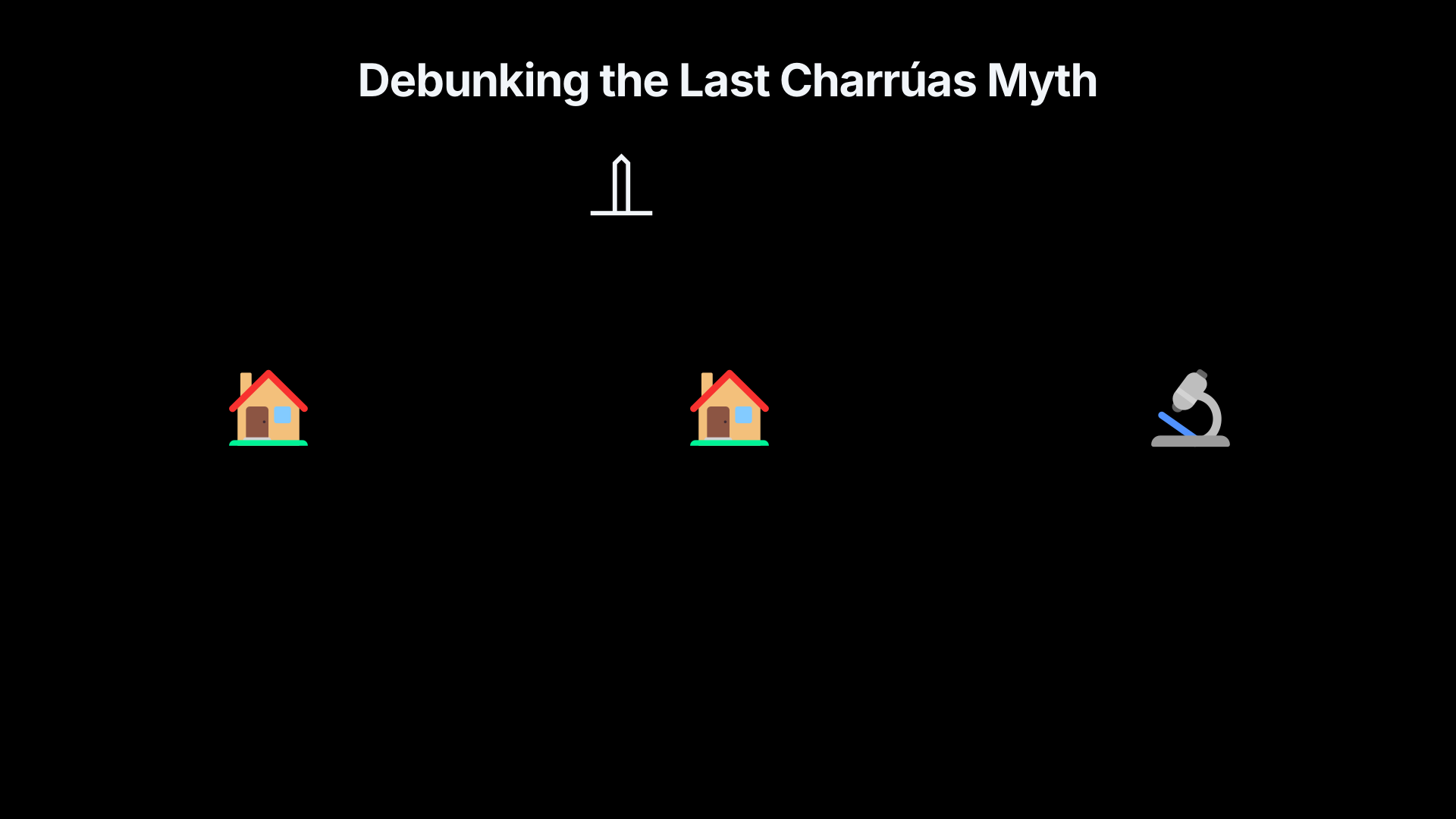
Today, that claim is widely regarded as a national myth rather than a historical fact. The destruction of Charrúa communities in the nineteenth century was real, but extinction was not. Family histories, demographic research, Indigenous activism and modern genetic studies have all shown that Indigenous ancestry and identity survived in Uruguay despite generations of official and cultural narratives that suggested otherwise. The story is important not only because it corrects a historical error, but because it reveals how a nation can mistake cultural invisibility for disappearance.[PMC]pmc.ncbi.nlm.nih.govPMCIndigenous Ancestry and Admixture in the Uruguayanby L Spangenberg · 2021 · Cited by 19 — We detect chromosomal segments of Amerindian ancestry supporting the presence of indigenous ge…
Salsipuedes and the Four Captives Taken to France
The roots of the “last Charrúas” story lie in the events surrounding Salsipuedes in 1831. President Fructuoso Rivera invited Charrúa leaders to what was presented as a meeting to discuss frontier defence. According to contemporary accounts, the gathering was a trap. Government forces attacked, killing many people and capturing hundreds more. Survivors were dispersed, forced into labour, absorbed into other communities or driven from the region.[Wikipedia]WikipediaMassacre of SalsipuedesMassacre of Salsipuedes
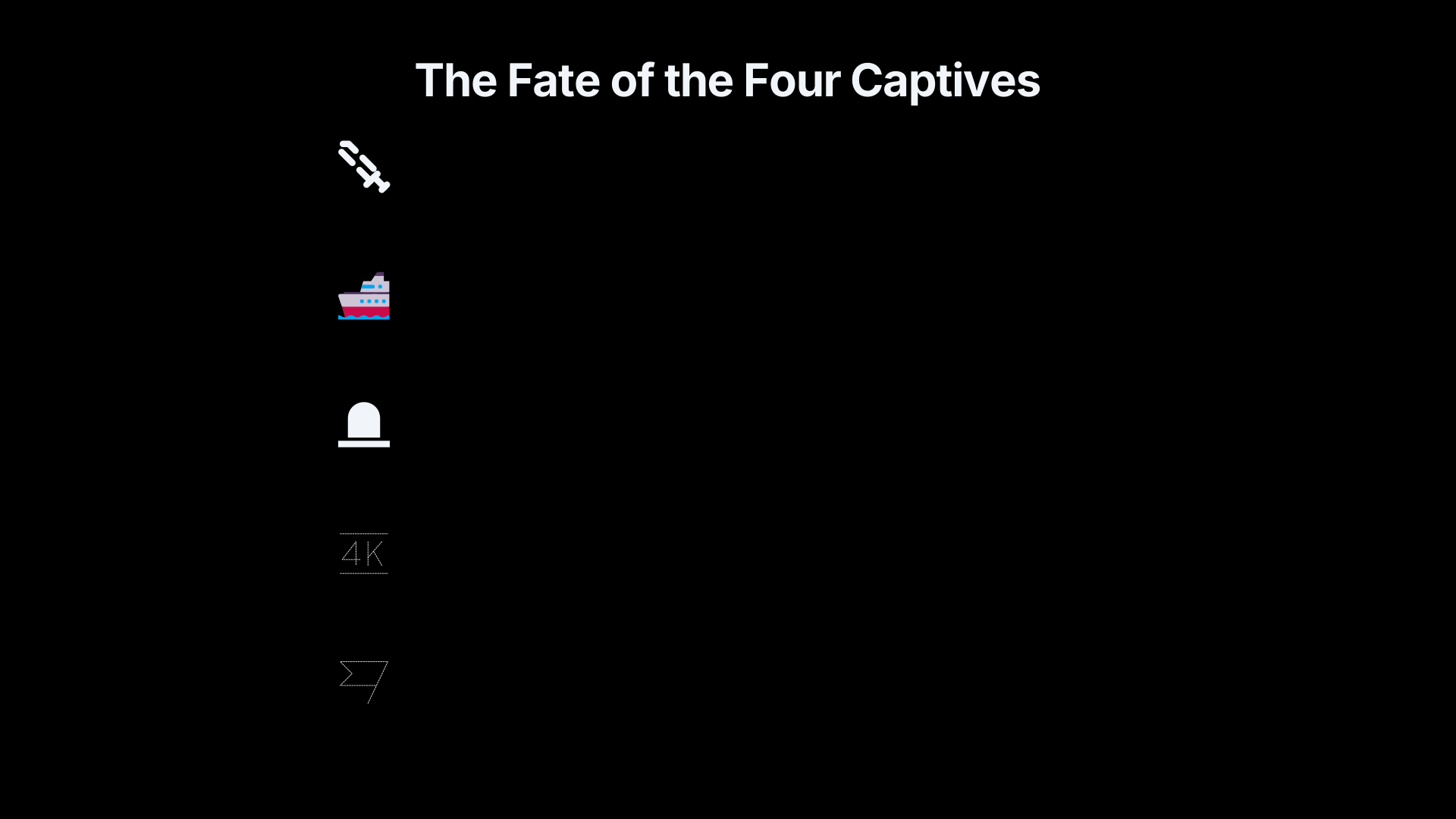
Two years later, four survivors—Vaimaca Pirú, Senaqué, Guyunusa and Tacuabé—were transported to France by entrepreneurs who intended to display them as exotic curiosities. They were exhibited before crowds and studied by European observers interested in racial classification and human difference. The venture ended tragically. Guyunusa died in France, as did Vaimaca Pirú and Senaqué. The later fate of Tacuabé remains uncertain, although some researchers believe he escaped the exhibition circuit and lived for years afterwards.[hemisphericinstitute.org]hemisphericinstitute.orgAscendencia CharrúaThis historical event is known as the slaughter of Salsipuedes, in which more than 40 Charrúas were killed and another…
Because these four individuals became internationally known, they were gradually transformed into symbols. By the twentieth century, monuments, textbooks and popular retellings often referred to them as “the last Charrúas”. A famous monument in Montevideo, inaugurated in 1938, reinforced this image in public memory. What began as a description of four celebrated captives slowly evolved into a broader claim that the entire people had vanished.[Wikipedia]WikipediaLos últimos charrúasLos últimos charrúas
How Extinction Became a National Story
The enduring power of the extinction narrative came from its simplicity. Uruguay developed a national identity that emphasised European immigration and modern republican institutions. Within that framework, Indigenous people were frequently treated as figures belonging to the distant past rather than as members of living communities.[ResearchGate]researchgate.netResearchGate(Uruguay): analysis of the remains of Chief Vaimaca Perú.May 5, 2010 — 15 Apr 2016 — Charra Indians, In 1833, four survivors…
The claim was persuasive because it contained an important truth. The nineteenth-century campaigns against Indigenous groups were devastating. Communities were broken apart, languages disappeared, and many descendants concealed their origins to avoid discrimination. To outside observers, the absence of visible Indigenous villages or legally recognised Indigenous nations appeared to confirm extinction.[Wikipedia]WikipediaMassacre of SalsipuedesMassacre of Salsipuedes
Yet the leap from destruction to total disappearance was never fully supported by evidence. Survivors remained in Uruguay and neighbouring regions. Women and children captured after Salsipuedes entered rural and urban households. Families passed on stories of Indigenous ancestors even when public discussion of that heritage became uncommon. Over time, the narrative of extinction became a national shorthand that obscured these continuities.[hemisphericinstitute.org]hemisphericinstitute.orgAscendencia CharrúaThis historical event is known as the slaughter of Salsipuedes, in which more than 40 Charrúas were killed and another…
This makes the story an unusual example within Uruguay’s history of contested truths. It was not primarily a deliberate hoax in the conventional sense. Rather, it was a powerful simplification that became accepted as common knowledge and repeated so often that it acquired the authority of fact.
The Evidence for Indigenous Survival in Uruguay
Challenges to the extinction story emerged from several directions.
Family memory and community organisation
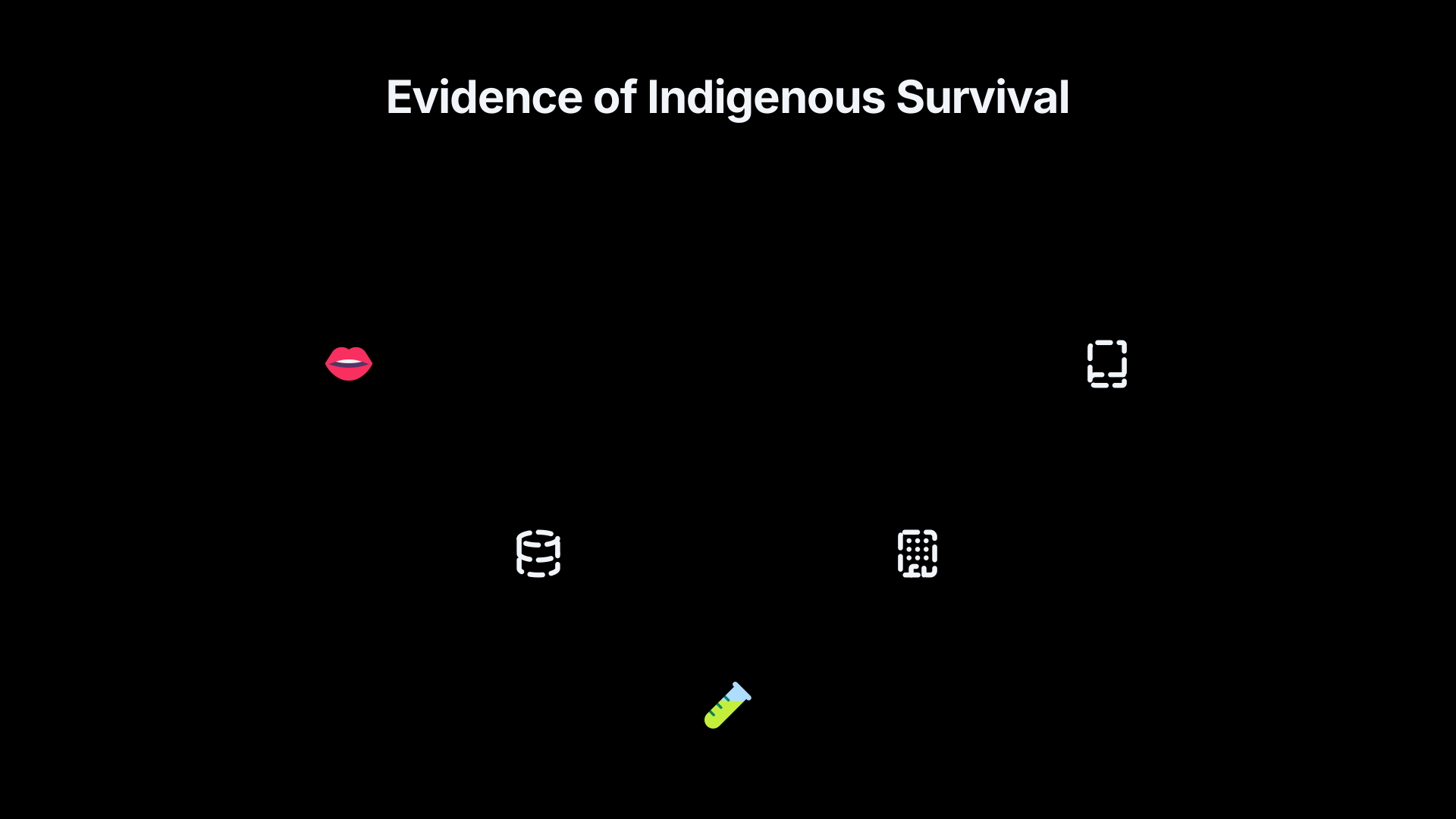
Long before genetic studies attracted attention, many Uruguayans maintained family traditions describing Indigenous ancestry. During the late twentieth century, descendants began organising publicly and demanding recognition. Groups such as the Association of Descendants of the Charrúa Nation and later the Council of the Charrúa Nation argued that the official story ignored living descendants and surviving cultural traditions.[Wikipedia]WikipediaMassacre of SalsipuedesMassacre of Salsipuedes
These organisations did more than preserve memory. They encouraged people to identify Indigenous ancestry openly, challenged school narratives and pushed for greater recognition of Indigenous history in public life. Their activism helped move the debate from folklore into mainstream historical discussion.[EL PAÍS English]english.elpais.comEL PAÍS English Where did Uruguay's indigenous population go?InternationalNov 10, 2017 — CONACHA is also encouraging people to claim their indigenous heritage while calling for the massacre at Sal…
Census and demographic evidence
Official data also complicated the old story. In modern censuses and surveys, significant numbers of Uruguayans have reported Indigenous ancestry. The precise figures vary according to methodology and the wording of questions, but the results consistently contradict the notion of complete disappearance.[Reddit]reddit.comCharrúa, Indigenous People of present-day UruguayCharrúa, Indigenous People of present-day Uruguay
These findings highlighted a crucial distinction: a population can lose political recognition, territory or language without all descendants vanishing. The extinction narrative tended to blur that difference.
Genetic research
Perhaps the most widely discussed challenge came from genetics. Studies of mitochondrial DNA and later whole-genome analyses found measurable Indigenous ancestry among contemporary Uruguayans. Research on people with documented Charrúa family traditions identified Indigenous genetic lineages and chromosomal segments consistent with descent from populations that lived in the region before European colonisation.[nih.gov]pmc.ncbi.nlm.nih.govPMCIndigenous Ancestry and Admixture in the Uruguayanby L Spangenberg · 2021 · Cited by 19 — We detect chromosomal segments of Amerindian ancestry supporting the presence of indigenous ge…
Researchers have been careful not to equate genetics with identity. Having Indigenous ancestry does not automatically define a person’s cultural affiliation, and genetic evidence cannot by itself reconstruct a complete community. Nevertheless, these studies demonstrated that the biological descendants of Indigenous peoples survived and remain part of Uruguay’s population.[PMC]pmc.ncbi.nlm.nih.govPMCIndigenous Ancestry and Admixture in the Uruguayanby L Spangenberg · 2021 · Cited by 19 — We detect chromosomal segments of Amerindian ancestry supporting the presence of indigenous ge…
The importance of this evidence was symbolic as well as scientific. It directly contradicted generations of claims that Indigenous people had disappeared entirely.
Why the Myth Still Circulates
The phrase “the last Charrúas” survives because it is attached to a memorable human story. Four named individuals, transported across the Atlantic and displayed in Europe, provide a dramatic narrative that is easy to remember. The more complex reality—that survivors dispersed, intermarried, concealed identities and left descendants—is harder to reduce to a single image.[Wikipedia]WikipediaOpen source on wikipedia.org.
Another reason is that the myth and the reality can coexist in public memory. The four captives genuinely became the last Charrúas many Europeans ever saw. They were among the final publicly visible representatives of Indigenous communities that had been shattered by state violence. Over time, however, “last visible survivors” was transformed into “last survivors”, a much stronger claim that the evidence does not support.[hemisphericinstitute.org]hemisphericinstitute.orgAscendencia CharrúaThis historical event is known as the slaughter of Salsipuedes, in which more than 40 Charrúas were killed and another…
The result is a revealing case of how historical narratives can outlive the evidence that once seemed to support them. The old story offered a neat ending to a difficult chapter of Uruguayan history. The newer picture is less tidy but more accurate: Indigenous communities suffered catastrophic losses, yet they did not vanish. Their descendants remained, and their presence has become increasingly visible as historians, activists and researchers have revisited assumptions that once appeared unquestionable.[nih.gov]pmc.ncbi.nlm.nih.govPMCIndigenous Ancestry and Admixture in the Uruguayanby L Spangenberg · 2021 · Cited by 19 — We detect chromosomal segments of Amerindian ancestry supporting the presence of indigenous ge…
Amazon book picks
Further Reading
Books and field guides related to Were They Really the Last Charruas?. Use these as the next step if you want deeper reading beyond the article.
Open Veins of Latin America
Provides regional historical context for Indigenous experiences.
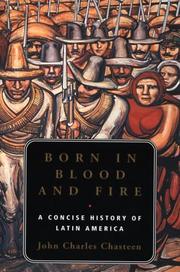
Born in blood and fire
First published 2000. Subjects: Histoire, Geschichte, History, Latin america, history, F1410 .c4397 2006.
eBay marketplace picks
Marketplace Samples
Live-tested eBay searches with available results related to this page.


Endnotes
1.
Source: pmc.ncbi.nlm.nih.gov
Title: PMCIndigenous Ancestry and Admixture in the Uruguayan
Link:https://pmc.ncbi.nlm.nih.gov/articles/PMC8495321/
Source snippet
by L Spangenberg · 2021 · Cited by 19 — We detect chromosomal segments of Amerindian ancestry supporting the presence of indigenous ge...
2.
Source: Wikipedia
Title: Massacre of Salsipuedes
Link:https://en.wikipedia.org/wiki/Massacre_of_Salsipuedes
3.
Source: hemisphericinstitute.org
Link:https://hemisphericinstitute.org/en/hidvl-collections/item/3692-ascendencia-charrua.html
Source snippet
Ascendencia CharrúaThis historical event is known as the slaughter of Salsipuedes, in which more than 40 Charrúas were killed and another...
4.
Source: Wikipedia
Link:https://es.wikipedia.org/wiki/Guyunusa
5.
Source: Wikipedia
Title: Los últimos charrúas
Link:https://es.wikipedia.org/wiki/Los_%C3%BAltimos_charr%C3%BAas
6.
Source: researchgate.net
Link:https://www.researchgate.net/publication/43439825_The_last_Charrua_Indian_Uruguay_analysis_of_the_remains_of_Chief_Vaimaca_Peru
Source snippet
ResearchGate(Uruguay): analysis of the remains of Chief Vaimaca Perú.May 5, 2010 — 15 Apr 2016 — Charra Indians, In 1833, four survivors...
Published: May 5, 2010
7.
Source: reddit.com
Title: Charrúa, Indigenous People of present-day Uruguay
Link:https://www.reddit.com/r/uruguay/comments/kym2gm/charr%C3%BAa_indigenous_people_of_presentday_uruguay/
8.
Source: Wikipedia
Title: Indigenous peoples in Uruguay
Link:https://en.wikipedia.org/wiki/Indigenous_peoples_in_Uruguay
9.
Source: Wikipedia
Link:https://en.wikipedia.org/wiki/Charr%C3%BAa
10.
Source: reddit.com
Link:https://www.reddit.com/r/awfuleverything/comments/j63pvf/the_last_surviving_family_from_the_charrua_people/
11.
Source: english.elpais.com
Title: EL PAÍS English Where did Uruguay’s indigenous population go?
Link:https://english.elpais.com/elpais/2017/11/06/inenglish/1509969553_044435.html
Source snippet
InternationalNov 10, 2017 — CONACHA is also encouraging people to claim their indigenous heritage while calling for the massacre at Sal...
12.
Source: pubmed.ncbi.nlm.nih.gov
Link:https://pubmed.ncbi.nlm.nih.gov/34630523/
13.
Source: alamy.com
Link:https://www.alamy.com/stock-photo/guyunusa.html
Additional References
14.
Source: anthrosource.onlinelibrary.wiley.com
Title: Indigenous population histories and their genetic richness.Read more
Link:https://anthrosource.onlinelibrary.wiley.com/doi/10.1111/aman.13046
Source snippet
From Genetics to Identity and Back Again: Genetic Continuity...May 20, 2018 — In Uruguay, population genetic studies focused...
Published: May 20, 2018
15.
Source: youtube.com
Title: Charrúa Nation Day was celebrated, commemorating the Salsipuedes Massacre
Link:https://www.youtube.com/watch?v=BKLyg2pR19k
Source snippet
Charrua Nation - The Indigenous Peoples of Southern Brazil...
16.
Source: museos.gub.uy
Title: 1719 guyunusa
Link:https://www.museos.gub.uy/index.php/museos/item/1719-guyunusa
Source snippet
Representación escultórica de María Micaela GuyunusaMaría Micaela Guyunusa (1806-1834) fue una mujer indígena perteneciente a la macroetn...
17.
Source: youtube.com
Title: The Charrúas – The saga of the first Gauchos
Link:https://www.youtube.com/watch?v=utZHCcXzWW0
Source snippet
Charrúa Nation Day was celebrated, commemorating the Salsipuedes Massacre...
18.
Source: youtube.com
Title: Charrua Nation
Link:https://www.youtube.com/watch?v=PmIaW_O3p4g
Source snippet
Charruas| Os Grandes Cavaleiros dos Pampas...
19.
Source: academia.edu
Link:https://www.academia.edu/40754768/Uruguay_Native_Peoples_Student_Pages
20.
Source: facebook.com
Link:https://www.facebook.com/100064415032446/posts/ever-heard-of-the-charr%C3%BAa-people-me-neither-i-had-heard-of-the-massive-genocide-/1111882684302222/
21.
Source: gpsmycity.com
Link:https://www.gpsmycity.com/attractions/the-last-charruas-monument-35711.html
22.
Source: youtube.com
Title: What REALLY Happened to the Charrúas?
Link:https://www.youtube.com/watch?v=LqYR5RTh9zM
Source snippet
The Charrúas – The saga of the first Gauchos...
23.
Source: dukevertices.org
Title: migratory routes to uruguay a story of indigenous genomes
Link:https://www.dukevertices.org/blog/migratory-routes-to-uruguay-a-story-of-indigenous-genomes
Topic Tree