Within Guinea Deceptions
Why Did Ebola Conspiracies Gain So Much Power?
False claims about Ebola spread alongside the disease and sometimes proved deadly when communities rejected health measures.
On this page
- Origins of Ebola Mistrust
- The Womey Killings
- Lessons for Public Health Communication
Page outline Jump by section
Introduction
The Ebola epidemic that began in Guinea in late 2013 was a real and devastating public-health emergency. Yet alongside the virus spread a second contagion: rumours. Claims that Ebola had been invented for political or financial reasons, that doctors were deliberately infecting people, that treatment centres were places where patients went to die, or that foreign organisations were harvesting organs competed with official medical explanations. These stories were not merely harmless misunderstandings. In some communities they shaped behaviour, discouraged treatment, triggered violence against health workers and helped prolong the epidemic. Understanding why these rumours gained influence is essential to understanding one of Guinea’s most important modern crises of truth and trust.[JSTOR]jstor.orgBAUSCH D. G. & SCHWARZ L., 2014, “Outbreak…Read more…
Unlike a classic hoax with a clearly identifiable creator, many Ebola rumours emerged from a mixture of fear, uncertainty, historical grievances and mistrust of authority. The result was a powerful example of how false claims can flourish during a genuine emergency and produce consequences almost as dangerous as deliberate deception itself.[JSTOR]jstor.orgBAUSCH D. G. & SCHWARZ L., 2014, “Outbreak…Read more…
Why Did Ebola Conspiracies Gain So Much Power?
The most important fact about Ebola misinformation in Guinea is that it developed in response to a real disease rather than an invented one. When health authorities announced the presence of a frightening virus that many people had never heard of, they were asking communities to accept unfamiliar explanations for sudden deaths, new burial restrictions and intrusive medical interventions. In regions where trust in government was already weak, many people were sceptical from the outset.[World Health Organization]who.intWorld Health OrganizationEbola virus disease in GuineaMar 23, 2014 — As of 22 March 2014, a total of 49 cases including 29 deaths (case f…
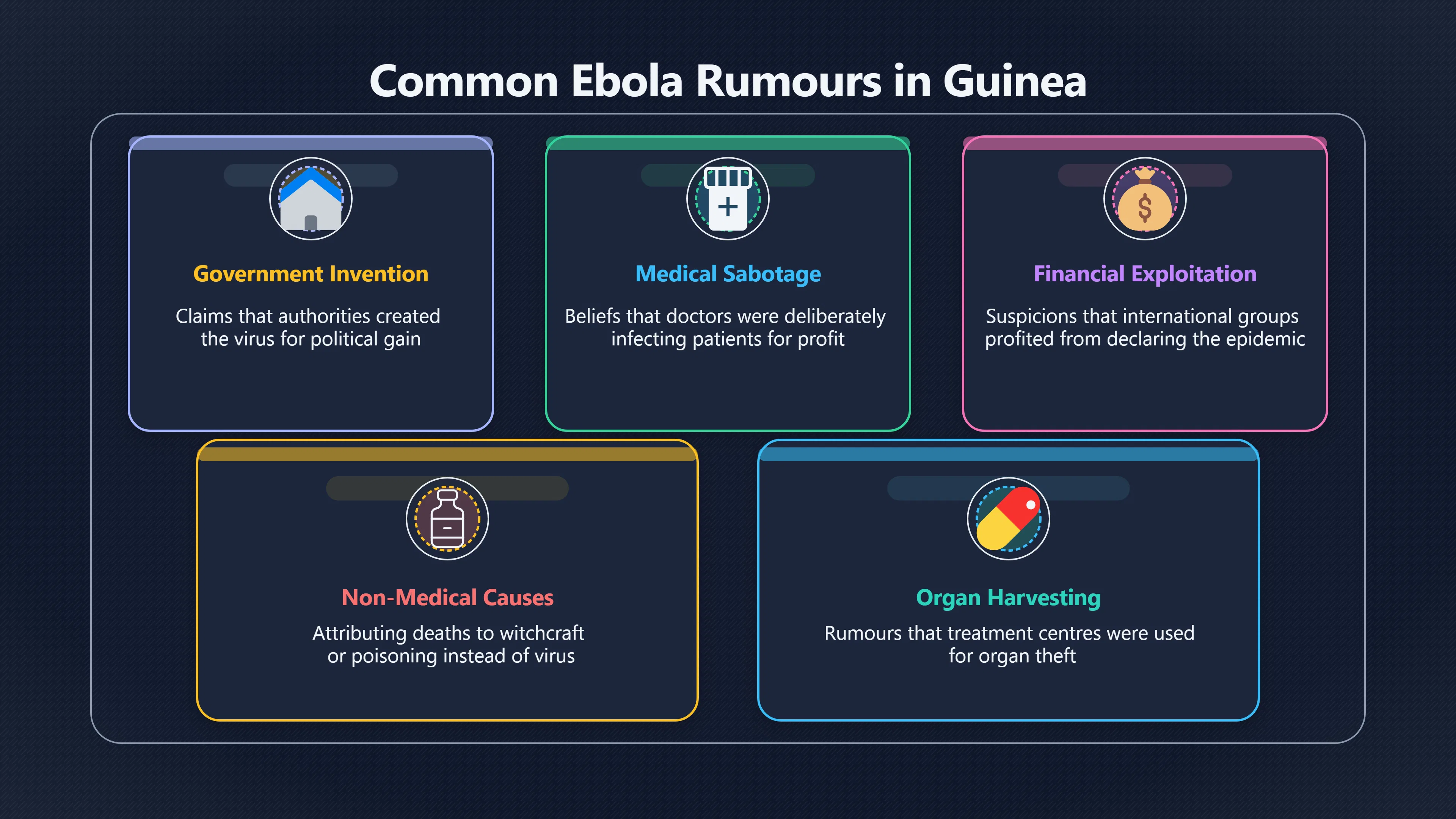
Several recurring claims became especially influential:
- Ebola was an invention created by governments or foreigners.
- Health workers were spreading the disease rather than preventing it.
- Doctors were killing patients for profit.
- International organisations benefited financially from declaring an epidemic.
- Victims had actually been harmed by witchcraft, poisoning or other non-medical causes.[mdpi.com]mdpi.comMisconceptions and Rumors about Ebola Virus Disease in…by BA Muzembo · 2022 · Cited by 27 — Some communities believed that Ebola s…
These beliefs did not appear in a vacuum. Guinea’s Forest Region, where the epidemic began, had a long history of political marginalisation and suspicion towards central authorities. Many residents encountered Ebola response teams before they had encountered convincing local explanations of the disease. Protective suits, disinfection procedures and restrictions on traditional funeral practices could appear threatening rather than reassuring. To outsiders these measures reflected infection control; to some villagers they looked like evidence that something hidden was taking place.[JSTOR]jstor.orgBAUSCH D. G. & SCHWARZ L., 2014, “Outbreak…Read more…
The rumours also drew strength from genuine uncertainties. Early in the epidemic, scientists were still learning about the outbreak, and official messaging sometimes changed as knowledge improved. Although such revisions are normal in science, they can be interpreted by suspicious audiences as proof that authorities are lying. In this way, ordinary scientific uncertainty became fuel for conspiracy thinking.[JSTOR]jstor.orgBAUSCH D. G. & SCHWARZ L., 2014, “Outbreak…Read more…
Origins of Ebola Mistrust
The central question is not why some people believed strange stories, but why official explanations often failed to command confidence.
Many communities had little previous contact with state health systems. Historical experiences with corruption, neglect or political repression encouraged people to judge new government claims cautiously. International responders, meanwhile, often arrived from outside the affected communities and initially struggled to communicate in culturally familiar ways. Researchers studying the epidemic have repeatedly found that resistance was closely linked to trust rather than ignorance alone.[JSTOR]jstor.orgBAUSCH D. G. & SCHWARZ L., 2014, “Outbreak…Read more…
Burial practices became a particularly sensitive issue. Public-health teams urged families to avoid touching bodies because Ebola spreads easily through contact with the dead. Yet funeral rituals carried deep social and religious significance. When authorities restricted these practices, some families interpreted the rules as disrespectful or evidence that officials were concealing the fate of loved ones. Rumours about organ theft or secret experiments found fertile ground in this atmosphere of uncertainty.[MDPI]mdpi.comMisconceptions and Rumors about Ebola Virus Disease in…by BA Muzembo · 2022 · Cited by 27 — Some communities believed that Ebola s…
Information networks also played a role. Rumours spread rapidly through family connections, local conversations, radio discussions and mobile-phone communication. Studies of Ebola misinformation have shown that claims about outsiders creating the disease, profiting from it or exaggerating its danger circulated widely across affected regions.[Wiley Online Library]onlinelibrary.wiley.comWiley Online LibraryRumour spread and control during the West African Ebola…Jun 28, 2022 — Other common rumours included that people a…
What made these stories persuasive was not necessarily their factual strength. They often fit pre-existing expectations about power, inequality and hidden motives better than official explanations did.
The Womey Killings
The most tragic illustration of Ebola-related mistrust occurred in September 2014 in the village of Womey near Nzérékoré.
A delegation consisting of health workers, local officials and journalists travelled to the area to conduct Ebola awareness activities. Instead of being welcomed, they encountered intense hostility. Rumours had circulated that Ebola educators were spreading lies or bringing danger into the community. The delegation disappeared, and investigators later discovered that eight members of the group had been murdered by villagers. Their bodies were found concealed in a septic tank near a school.[voanews.com]voanews.comVoice of AmericaWHO Continues Ebola Fight Despite Murders19 Sept 2014 —… eight missing health workers and journalists were murdered th…
The killings shocked Guinea and attracted international attention because they demonstrated how far mistrust had escalated. The victims were not foreign occupiers or anonymous officials; they included Guinean doctors, local representatives and journalists attempting to communicate public-health information. Yet in the eyes of some residents they had become symbols of a feared and distrusted response effort.[Wikipedia]WikipediaWomey massacreWomey massacre
The Womey attack was not an isolated event. Response teams elsewhere faced stone-throwing, threats and attacks. Some communities refused treatment centres or resisted safe burial teams. Health organisations reported repeated difficulties persuading families to cooperate with contact tracing and isolation measures.[aljazeera.com]aljazeera.comAl Jazeera Guinea residents 'refusing' Ebola treatment | Health NewsAl Jazeera Guinea residents 'refusing' Ebola treatment | Health News
For historians of misinformation, Womey stands as one of the clearest examples of rumours producing direct physical harm. The danger did not arise because the epidemic was fake. It arose because false explanations of a real epidemic became more credible to some people than the official account.
How Investigators and Responders Changed Their Approach
As the epidemic continued, health authorities increasingly recognised that medical expertise alone would not solve the problem. Community engagement became as important as clinical treatment.
Researchers, anthropologists and local leaders worked to understand why people resisted Ebola interventions. Rather than assuming communities simply lacked knowledge, investigators examined local concerns, cultural practices and historical experiences. This led to more emphasis on dialogue, local participation and communication through trusted figures.[Diva Portal]uu.diva-portal.orgResistance also…Read more…
Response teams gradually adapted by involving religious leaders, community representatives and local media. Messages were tailored to local circumstances rather than delivered solely through national campaigns. In many areas this reduced tensions and improved cooperation. The lesson was that trust could not be imposed; it had to be built.[Diva Portal]uu.diva-portal.orgResistance also…Read more…
Research conducted after the epidemic found that rumours often reflected underlying anxieties rather than simple ignorance. Addressing those anxieties directly proved more effective than merely repeating official instructions.[Wiley Online Library]onlinelibrary.wiley.comWiley Online LibraryRumour spread and control during the West African Ebola…Jun 28, 2022 — Other common rumours included that people a…

Lessons for Public Health Communication
The Ebola experience in Guinea remains a powerful case study in the relationship between misinformation and public trust.
First, accurate information is not automatically persuasive. People evaluate claims through existing relationships, experiences and beliefs. Where trust is weak, even true statements may be rejected.[JSTOR]jstor.orgBAUSCH D. G. & SCHWARZ L., 2014, “Outbreak…Read more…
Second, rumours can flourish even during events that are plainly real. Ebola misinformation was not primarily about denying that people were dying. It often involved competing explanations for why deaths were occurring and who was responsible. This distinction helps explain why conspiracy narratives remained influential despite overwhelming evidence of the disease itself.[MDPI]mdpi.comMisconceptions and Rumors about Ebola Virus Disease in…by BA Muzembo · 2022 · Cited by 27 — Some communities believed that Ebola s…
Third, communication failures can become public-health failures. Resistance to treatment, avoidance of clinics and attacks on response teams made controlling the epidemic more difficult and more dangerous. The costs were measured not only in confusion but also in lives.[aljazeera.com]aljazeera.comAl Jazeera Guinea residents 'refusing' Ebola treatment | Health NewsAl Jazeera Guinea residents 'refusing' Ebola treatment | Health News
Within Guinea’s broader history of contested truth, Ebola rumours occupy a distinctive place. They were not a manufactured newspaper hoax, a forged document or a staged fraud. Instead, they reveal how fear, uncertainty and mistrust can create an environment in which false explanations gain extraordinary power. The tragedy of Womey and the wider epidemic demonstrated that during a crisis, public trust can become as essential a resource as medicine itself.[Wikipedia]WikipediaWomey massacreWomey massacre
Amazon book picks
Further Reading
Books and field guides related to Why Did Ebola Conspiracies Gain So Much Power?. Use these as the next step if you want deeper reading beyond the article.
The Misinformation Age
Useful for understanding why Ebola conspiracies gained traction.
eBay marketplace picks
Marketplace Samples
Example marketplace items related to this page. Use the search link to explore similar finds on eBay.




Endnotes
1.
Source: jstor.org
Link:https://www.jstor.org/stable/27126840
Source snippet
BAUSCH D. G. & SCHWARZ L., 2014, “Outbreak...Read more...
2.
Source: onlinelibrary.wiley.com
Link:https://onlinelibrary.wiley.com/doi/10.1111/disa.12552
Source snippet
Wiley Online LibraryRumour spread and control during the West African Ebola...Jun 28, 2022 — Other common rumours included that people a...
3.
Source: pmc.ncbi.nlm.nih.gov
Link:https://pmc.ncbi.nlm.nih.gov/articles/PMC9027331/
Source snippet
Misconceptions and Rumors about Ebola Virus Disease in...by BA Muzembo · 2022 · Cited by 26 — We sought to summarize knowledge, misco...
4.
Source: who.int
Link:https://www.who.int/emergencies/disease-outbreak-news/item/2014_03_23_ebola-en
Source snippet
World Health OrganizationEbola virus disease in GuineaMar 23, 2014 — As of 22 March 2014, a total of 49 cases including 29 deaths (case f...
Published: March 2014
5.
Source: mdpi.com
Link:https://www.mdpi.com/1660-4601/19/8/4714
Source snippet
Misconceptions and Rumors about Ebola Virus Disease in...by BA Muzembo · 2022 · Cited by 27 — Some communities believed that Ebola s...
6.
Source: uu.diva-portal.org
Link:https://uu.diva-portal.org/smash/get/diva2%3A1520162/FULLTEXT01.pdf
Source snippet
Resistance also...Read more...
7.
Source: Wikipedia
Title: Womey massacre
Link:https://en.wikipedia.org/wiki/Womey_massacre
8.
Source: ncbi.nlm.nih.gov
Title: NCBIGlobal Preparedness and Response Efforts
Link:https://www.ncbi.nlm.nih.gov/books/NBK401928/
9.
Source: Wikipedia
Title: The Lancet
Link:https://en.wikipedia.org/wiki/The_Lancet
10.
Source: afro.who.int
Title: joining forces tackle ebola infodemic guinea
Link:https://www.afro.who.int/news/joining-forces-tackle-ebola-infodemic-guinea
11.
Source: voanews.com
Link:https://www.voanews.com/a/sierra-leone-ebola-lockdown/2455178.html
Source snippet
Voice of AmericaWHO Continues Ebola Fight Despite Murders19 Sept 2014 —... eight missing health workers and journalists were murdered th...
12.
Source: aljazeera.com
Title: Al Jazeera Guinea residents ‘refusing’ Ebola treatment | Health News
Link:https://www.aljazeera.com/news/2014/9/27/guinea-residents-refusing-ebola-treatment
13.
Source: aljazeera.com
Title: arrests in guinea over ebola related murders
Link:https://www.aljazeera.com/news/2014/9/25/arrests-in-guinea-over-ebola-related-murders
14.
Source: etdh.resolvetosavelives.org
Link:https://etdh.resolvetosavelives.org/2022/ebola/
15.
Source: frontlinenurses.columbia.edu
Link:https://frontlinenurses.columbia.edu/ebola/history/
Additional References
16.
Source: youtube.com
Link:https://www.youtube.com/watch?v=gfDFfpx0Y8w
Source snippet
Ebola crisis worsens as health officials fight misinformation...
17.
Source: youtube.com
Title: Ebola’s Patient Zero, The Child at the Epidemic’s Start | FRONTLINE
Link:https://www.youtube.com/watch?v=bDCsvuZhnB8
Source snippet
As Ebola's spread outpaces containment, misinformation is making it worse | DW News...
18.
Source: youtube.com
Title: Virus Hunter, Searching for Missing Ebola Patient in West Africa | FRONTLINE
Link:https://www.youtube.com/watch?v=VN280FnQqdU
Source snippet
Ebola's Patient Zero, The Child at the Epidemic's Start | FRONTLINE...
19.
Source: youtube.com
Title: Inside Guinea’s Troubled Early Response to Ebola | FRONTLINE
Link:https://www.youtube.com/watch?v=nW5pFYvot9k
Source snippet
Virus Hunter, Searching for Missing Ebola Patient in West Africa | FRONTLINE...
20.
Source: facebook.com
Link:https://www.facebook.com/AmrefHealthAfrica/posts/misconceptions-arise-when-communities-lack-clear-accurate-information-about-dise/1384539887041840/
21.
Source: archive.ids.ac.uk
Link:https://archive.ids.ac.uk/erap/wp-content/uploads/2014/12/Communicationduring-an-outbreak-of-Ebola-Virus-Disease-with-rebellious-communities-in-Guinea.pdf
22.
Source: socialscienceinaction.org
Link:https://www.socialscienceinaction.org/resources/ebola-traditional-healers-witch-doctors-burial-attendants/
23.
Source: thelancet.com
Link:https://www.thelancet.com/
24.
Source: edepot.wur.nl
Link:https://edepot.wur.nl/376532
25.
Source: youtube.com
Link:https://www.youtube.com/watch?v=FjGct3YDTA4
Topic Tree