How Ireland's Most Persuasive Hoaxes Took Hold
Ireland’s history of hoaxes is not a catalogue of national gullibility. It is a history of persuasive stories meeting favourable conditions: antiquarian enthusiasm, political conflict, religious expectation, commercial opportunity and, more recently, search engines and social media.
Page outline Jump by section
Introduction
The most revealing Irish cases therefore range from fake giants and wartime propaganda to moving statues, invented leprechaun evidence and viral claims about “Irish slaves”. What joins them is not their subject matter but their mechanism. Each borrowed credibility from something already familiar: biblical giants, official-looking documents, Catholic devotional culture, national folklore or the appearance of historical evidence. Their exposure usually required more than simply calling them ridiculous. Investigators had to examine materials, trace provenance, compare records, test perceptions or identify who had repackaged an old story for a new audience.
When forged evidence made a story look historical
The petrified Irish giant
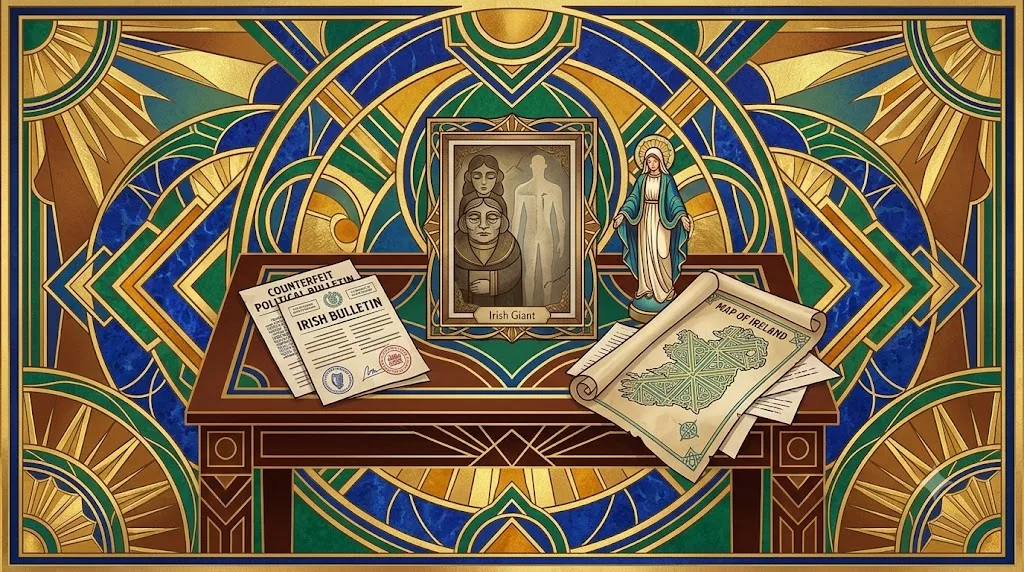
A much-reproduced Victorian photograph appears to show an enormous fossilised man, more than three metres long, lying in a railway goods yard. The figure was promoted in 1895 as a “petrified Irish giant”, supposedly excavated near the Antrim coast. Newspapers and magazines helped turn it into apparent proof that the giants of scripture or Irish legend had once been real.
The object was not a fossil or an archaeological discovery. It belonged to a late nineteenth-century fashion for fabricated giants, encouraged by the spectacular commercial success of America’s Cardiff Giant. That earlier attraction had been carved from gypsum, buried and then “discovered” before paying crowds were admitted to see it. Scientists quickly identified the Cardiff figure as artificial, noting tool marks and geological impossibilities, yet its owners continued to profit from public curiosity. The Irish example followed the same profitable formula: manufacture a body, supply a dramatic discovery story and let photography give the claim an air of mechanical objectivity.[Wikipedia]WikipediaCardiff GiantJuly 30, 2003 — In 1879, the owner of a hotel at what is now Taughannock Falls State Park hired men to create a fake petrified man and pl…
The famous Irish image still circulates online, often detached from the period publications and entertainment culture that explain it. That survival illustrates a recurring problem with photographic hoaxes. A picture can outlive its caption, provenance and debunking. Once reduced to a striking image labelled “giant skeleton found in Ireland”, it becomes easier to recycle as supposed evidence for lost races, biblical literalism or archaeological concealment.
Roger Casement’s disputed diaries
The Black Diaries associated with Roger Casement occupy a more difficult category. This is not a straightforward exposed forgery but a long-running dispute in which accusations of forgery became inseparable from political power, sexuality and martyrdom.
Casement, an Irish nationalist and former British diplomat, was convicted of treason and executed in 1916. During efforts to obtain clemency, British officials privately circulated typescripts said to record his sexual encounters with men. The material discouraged some potential supporters at a time when homosexual acts were criminalised and deeply stigmatised. The surviving collection in Britain’s National Archives comprises three diaries, a notebook and a ledger.[Discovery]discovery.nationalarchives.gov.ukCatalogue description Diaries of Roger CasementThe diaries of Sir Roger Casement, who was executed for high treason in 1916…
Many of Casement’s defenders argued that the documents had been manufactured or altered to destroy his reputation. Later handwriting examinations, comparisons with known writing and research into obscure people and expressions mentioned in the texts have generally strengthened the case for authenticity. A forensic examination commissioned in 2002 concluded that the handwriting was Casement’s. Other specialists, however, criticised the way that examination was framed and argued that its published reasoning was insufficiently transparent. The debate has therefore narrowed without disappearing.[wikipedia.org]WikipediaBlack DiariesBlack Diaries
The important lesson is that an authentic document can still be used deceptively. Even scholars who accept the diaries as genuine can question the secretive circulation of inflammatory extracts to influence a clemency campaign. The controversy is consequently about two different issues that are often confused: whether Casement wrote the diaries, and whether the British state weaponised them politically. The stronger evidence now favours Casement’s authorship, but the circumstances of their use ensured that suspicions of forgery became part of Irish political memory.
How propaganda tried to counterfeit authority
During the Irish War of Independence, both British and republican organisations understood that foreign opinion, newspaper coverage and the language of official reports could influence the conflict. The struggle was therefore fought not only through raids and arrests but through competing accounts of what had happened.
One of the clearest deceptions followed a British raid on the offices of the Irish Bulletin, the publication used by the underground Irish government to circulate reports and counter British statements. In March 1921, British personnel captured typewriters, duplicating equipment and subscription lists. They then produced counterfeit editions designed to resemble the republican paper and posted them to its usual readers.[RTE.ie]rte.ie1119708 censorship and propaganda media in the war of independence1119708 censorship and propaganda media in the war of independence
The imitation succeeded materially but failed editorially. The original was visually simple, so its format could be copied, but the bogus content was crude enough to alert recipients. One British MP who received the counterfeits complained in Parliament and asked that no more of the forgeries be sent to him. The incident showed that appearance alone was insufficient: regular readers recognised the publication’s voice, judgement and political logic.[Wikipedia]WikipediaIrish BulletinIrish Bulletin
British publicity officials were also accused of staging or embellishing military incidents for reporters. One notorious episode, later nicknamed the “Battle of Tralee”, involved a supposed engagement that was reportedly demonstrated or reconstructed for the press far from Tralee, in coastal County Dublin. Contemporary journalists exposed inconsistencies, while other official accounts of escape attempts and clashes were doubted because weapons, locations or sequences of events did not make practical sense.[centenaries.ucd.ie]centenaries.ucd.ieOpen source on ucd.ie.
These operations were not merely newspaper pranks. They attempted to borrow the authority of eyewitness reporting and official documentation during a violent political emergency. Their failure also demonstrates why propaganda works best when it remains close to plausibility. The counterfeit Bulletin was exposed not by a laboratory test but because its authors misunderstood the audience they were impersonating.
Moving statues: deception, illusion or collective expectation?
In the summer of 1985, two observers at a roadside grotto in Ballinspittle, County Cork, reported that a statue of the Virgin Mary appeared to move. Crowds began visiting the site, and similar claims emerged at dozens of locations around Ireland. Witnesses described statues swaying, breathing, changing expression or moving their hands. Ballinspittle became the best-known centre of the phenomenon, drawing large numbers of pilgrims, curious visitors and reporters.[Wikipedia]WikipediaMoving statuesMoving statues
There is little basis for treating the episode as an organised hoax. Many witnesses seem to have reported experiences they sincerely believed had occurred. The Catholic hierarchy was notably cautious rather than promotional, and church figures warned against assuming a miracle. Researchers associated with University College Cork examined the wider outbreak and discussed optical illusion, sustained staring, low evening light, expectation and suggestion as natural explanations.[cora.ucc.ie]cora.ucc.ieOpen source on ucc.ie.
A stationary figure can appear to shift when stared at against a dim or featureless background. Small involuntary eye movements, changing light and visual adaptation can make an object’s edges seem unstable. Once observers have been told that a statue may move, ambiguous visual changes are more likely to be interpreted as purposeful gestures. A crowd can reinforce the effect as people describe what they believe they are seeing.
That does not mean every participant experienced the same thing or that all reports can be reconstructed precisely. Nor does it justify dismissing witnesses as foolish. The phenomenon occurred in a society where Marian devotion, grottoes and stories of apparitions were already meaningful. Economic uncertainty and rapid cultural change may also have increased the appeal of an event that seemed to interrupt ordinary life. Researchers have consequently treated Ballinspittle as a case study in perception and vernacular religion rather than simply branding it a fraud.[Thesis NCAD]thesis.ncad.ieOpen source on ncad.ie.
The episode also had tangible consequences. The statue was attacked by Protestant fundamentalists who regarded its veneration as idolatry, then repaired. Decades later, the grotto remained maintained and visited. Ballinspittle survived because the event was never reducible to a single trickster whose confession could end the story. For some it was a miracle, for others an illusion, and for many it became a memory of the unusual summer when expectation spread from one Irish roadside shrine to another.[The Irish Times]irishtimes.comremembering ballinspittle and the moving statueremembering ballinspittle and the moving statue
Leprechaun remains and the business of playful belief
In 1989, a small green suit, bones and coins were said to have been discovered on Foy Mountain near Carlingford, County Louth. The objects were presented as the remains or possessions of a leprechaun. The story developed into organised leprechaun hunts, local storytelling and a tourist attraction centred on the claim that a surviving population of the beings inhabited the mountain.[The Last Leprechauns of Ireland]thelastleprechaunsofireland.comOpen source on thelastleprechaunsofireland.com.
Unlike a forged archaeological object offered to a museum, the Carlingford material operates in a deliberately theatrical space. Promotional versions describe the suit as authentic and recount supernatural encounters, but the experience is also sold openly as folklore-based entertainment. Its appeal depends less on forcing literal belief than on inviting visitors to suspend disbelief.
This makes it a useful example of the boundary between hoax, performance and invented tradition. A hoax normally conceals its fabrication and expects its audience to accept a false factual claim. A folklore attraction may retain ambiguity as part of the fun. Participants can enjoy the hunt, landscape and storytelling without deciding whether leprechauns exist.
There is still a commercial incentive. The physical “evidence” provides a memorable origin story, gives Carlingford a distinctive tourist identity and turns general Irish folklore into something locally possessable. Yet describing every visitor as deceived would miss how playful belief works. People often participate knowingly in ghost tours, monster hunts and fairy traditions because uncertainty is itself part of the attraction. The Carlingford case is best understood as promotional folklore whose supposed evidence resembles a hoax, rather than as a successful scientific fraud.
National legends that become false history
Saint Patrick and the snakes
The story that Saint Patrick expelled Ireland’s snakes is one of the country’s most recognisable legends. It is not, however, supported by zoological or fossil evidence. Ireland was covered by ice during the last glacial period, and after conditions became suitable for reptiles, rising seas separated it from Britain and continental Europe before snakes could naturally recolonise it. Patrick could not have banished a native snake population that was not there.[HISTORY]history.comDid St. Patrick Really Drive the Snakes Out of Ireland?Did St. Patrick Really Drive the Snakes Out of Ireland?
The tale should not be treated as a deliberate medieval scam. Saints’ lives routinely accumulated miracle stories, and the snake episode may have functioned as a symbol of spiritual victory, danger or the defeat of paganism. Problems arise when later retellings convert symbolic religious folklore into literal natural history.
An additional modern claim holds that the “snakes” were definitely a coded reference to pagans and that Patrick carried out their systematic destruction. That interpretation is also more certain than the evidence permits. It is possible to read the legend symbolically, but a modern metaphor should not be presented as a securely documented historical event. The responsible distinction is simple: Patrick’s mission belongs to history, his serpent-clearing miracle belongs to legend, and confident claims about a concealed pagan genocide are later speculation.

The “Irish slaves” meme
A more consequential false history claims that vast numbers of Irish people were transported to the Caribbean and North America as chattel slaves, sometimes adding that they were treated worse than enslaved Africans. The story combines real suffering with a false equivalence. Irish people were forcibly transported, subjected to brutal colonial policies and employed under harsh systems of indentured or penal labour. But their status was not the same as the racialised, hereditary and lifelong chattel slavery imposed on Africans and their descendants.[apnews.com]apnews.comAP News AP FACT CHECK: Irish "slavery" a St. Patrick's Day mythAP News AP FACT CHECK: Irish "slavery" a St. Patrick's Day myth
The distinction is not an attempt to minimise Irish suffering. Indentured workers could face violence, hunger, sale of their contracts and severe restrictions. The crucial differences concerned permanence, heredity and legal status. African slavery treated people and their descendants as property on a racial basis, while indenture was normally limited by a term of service, however exploitative its enforcement.
Online versions of the myth frequently use unrelated images as supposed proof. Photographs of child labourers, prisoners or people from other periods and countries have been relabelled as Irish slaves. Inflated numerical claims are repeated without traceable records, and the word “slave” is applied indiscriminately to transportation, military prisoners, servants and migrants under contract.[Wikipedia]WikipediaIrish slaves mythIrish slaves myth
The modern narrative became especially visible in social-media arguments about racism and the legacy of Atlantic slavery. Historians and fact-checkers have shown that it is frequently deployed to claim that Irish suffering has been suppressed or to dismiss African-American demands for recognition. It can also obscure the involvement of some Irish merchants, settlers and officials in slave-owning societies.[factchecking.ie]factchecking.iewere irish people really sent to the americas as slaveswere irish people really sent to the americas as slaves
This is not a harmless national legend. It demonstrates how genuine historical trauma can be reorganised into misleading propaganda. The story persuades because its first premise is true—Irish people endured conquest, transportation and exploitation—before it makes an unsupported leap to racial chattel slavery.
When an online error became a public event
On Halloween night in 2024, large crowds gathered along Dublin’s O’Connell Street expecting a parade involving the Galway performance company Macnas. No parade had been scheduled. Gardaí eventually asked those assembled to disperse, while photographs and videos of the waiting crowd spread internationally as evidence of an “AI hoax”.[Sky News]news.sky.comNews Large crowd duped into attending non-existent HalloweenNews Large crowd duped into attending non-existent Halloween
The explanation was less calculated but more instructive. A Halloween-events website had published a listing based on outdated or incorrectly reused information. Its operator apologised and said the event had been posted through human error rather than as an intentional prank. Some artificial-intelligence-generated text reportedly contributed to the page, but accounts differed over how much of the listing was automated. What mattered most was that the unverified page ranked prominently in Google searches and was then repeated across social platforms.[theguardian.com]theguardian.comOpen source on theguardian.com.
The incident exposed a modern credibility chain:
- An events page presented detailed information in the familiar style of a guide.
- Search ranking made the page appear authoritative.
- Social-media repetition created the impression that many independent people had confirmed it.
- Macnas had organised spectacular processions before, making the claim plausible.
- The crowd itself became social proof: newcomers assumed an event must exist because others were already waiting.
Calling the episode a hoax implies an intention that has not been established. It is more accurately described as false information produced by weak verification and amplified by automated discovery systems. Nevertheless, it achieved what many deliberate hoaxes seek: it altered physical behaviour, attracted a crowd and required an official response.
The Dublin parade also reverses an old pattern. Victorian showmen first constructed an object and then persuaded newspapers to publicise it. In 2024, a web page and search result were sufficient to create the event’s apparent reality. There was no fake float, forged ticket or impersonated organiser. The persuasive artefact was the listing itself.
What Ireland’s hoaxes have in common
The strongest Irish examples show that deception rarely succeeds through fabrication alone. It succeeds by attaching fabrication or error to something the audience already regards as credible.
The petrified giant borrowed from archaeology, scripture and photography. Counterfeit wartime publications copied the appearance of political authority. The Black Diaries controversy drew force from official secrecy and the use of sexual stigma. Ballinspittle emerged within a familiar culture of shrines and apparitions. Carlingford turned national folklore into local tourist evidence. The “Irish slaves” meme attaches distortion to genuine historical suffering, while the Dublin Halloween listing exploited search ranking and memories of real parades.
They also reveal why the word “hoax” must be used carefully. Some episodes involved intentional forgery. Others were propaganda, folklore, commercial theatre, optical misperception or unverified online content. Treating them all as identical would hide the very mechanisms that make them worth studying.
The best defence has likewise changed little. Ask where an object or claim came from. Check whether independent records support its story. Separate an image from the caption attached to it. Examine who gains authority, money or political advantage. Consider whether a witness may be sincere but mistaken. Most importantly, distinguish a compelling narrative from evidence that can survive comparison, provenance checks and informed scrutiny.

Amazon book picks
Further Reading
Books and field guides related to How Ireland's Most Persuasive Hoaxes Took Hold. Use these as the next step if you want deeper reading beyond the article.
The Demon-Haunted World
Rating: 4.5/5 from 43 Google Books ratings
Explains how remarkable stories survive despite weak evidence.
The Skeptics' Guide to the Universe
Provides tools for evaluating extraordinary historical and modern claims.

A History of Ireland in 250 Episodes
Provides historical context for many Irish myths and controversies.
eBay marketplace picks
Marketplace Samples
Live-tested eBay searches with available results related to this page.


Endnotes
1.
Source: Wikipedia
Title: Cardiff Giant
Link:https://en.wikipedia.org/wiki/Cardiff_Giant
Source snippet
July 30, 2003 — In 1879, the owner of a hotel at what is now Taughannock Falls State Park hired men to create a fake petrified man and pl...
Published: July 30, 2003
2.
Source: Wikipedia
Title: Black Diaries
Link:https://en.wikipedia.org/wiki/Black_Diaries
3.
Source: rte.ie
Title: 1119708 censorship and propaganda media in the war of independence
Link:https://www.rte.ie/history/hunger-strikes/2020/0302/1119708-censorship-and-propaganda-media-in-the-war-of-independence/
4.
Source: Wikipedia
Title: Irish Bulletin
Link:https://en.wikipedia.org/wiki/Irish_Bulletin
5.
Source: centenaries.ucd.ie
Link:https://centenaries.ucd.ie/wp-content/uploads/2021/06/Fake-news-and-propaganda.pdf
6.
Source: Wikipedia
Title: Moving statues
Link:https://en.wikipedia.org/wiki/Moving_statues
7.
Source: cora.ucc.ie
Link:https://cora.ucc.ie/bitstream/10468/2105/4/William%20Allen%20PhD%20Thesis%202015.pdf
8.
Source: thesis.ncad.ie
Link:https://thesis.ncad.ie/T6426Want%20To%20Believe%20A%20Study%20On%20the%20Moving%20Statue%20Phenomenon%20of%201985%20and%20The%20Human%20Urge%20to%20Believe%20In%20the%20Miraculous%20-%20Focusing%20on%20Folklore%2C%20Superstition%20and%20The%20Supernatural_Wearen_Megan%20AD204-4ME%2022-23.pdf
9.
Source: history.com
Title: Did St. Patrick Really Drive the Snakes Out of Ireland?
Link:https://www.history.com/articles/st-patrick-snakes
10.
Source: factchecking.ie
Title: were irish people really sent to the americas as slaves
Link:https://www.factchecking.ie/articles/were-irish-people-really-sent-to-the-americas-as-slaves
11.
Source: Wikipedia
Title: Irish slaves myth
Link:https://en.wikipedia.org/wiki/Irish_slaves_myth
12.
Source: news.sky.com
Title: News Large crowd duped into attending non-existent Halloween
Link:https://news.sky.com/story/large-crowd-duped-into-attending-non-existent-halloween-parade-in-dublin-13246169
13.
Source: people.com
Link:https://people.com/owner-website-listing-fake-halloween-parade-says-post-was-mistake-8739952
14.
Source: Wikipedia
Title: Ireland Shakespeare forgeries
Link:https://en.wikipedia.org/wiki/Ireland_Shakespeare_forgeries
15.
Source: Wikipedia
Title: Loch Ness Monster
Link:https://en.wikipedia.org/wiki/Loch_Ness_Monster
16.
Source: Wikipedia
Title: Archaeological forgery
Link:https://en.wikipedia.org/wiki/Archaeological_forgery
17.
Source: history.com
Title: 5 myths about slavery
Link:https://www.history.com/articles/5-myths-about-slavery
18.
Source: archive.archaeology.org
Link:https://archive.archaeology.org/online/features/hoaxes/giants.html
19.
Source: hansard.parliament.uk
Title: uk Casement Diaries
Link:https://hansard.parliament.uk/commons/1959-07-27/debates/acc9b15e-0f8a-4a60-a2bd-2e5112c90503/CasementDiaries
20.
Source: people.com
Link:https://people.com/thousands-pack-dublin-streets-for-fake-halloween-parade-listed-on-ai-website-8738653
21.
Source: discovery.nationalarchives.gov.uk
Link:https://discovery.nationalarchives.gov.uk/details/r/C9025
Source snippet
Catalogue description Diaries of Roger CasementThe diaries of Sir Roger Casement, who was executed for high treason in 1916...
22.
Source: theguardian.com
Link:https://www.theguardian.com/books/2016/sep/28/roger-casement-gay-irish-martyr-or-victim-of-a-british-forgery
Source snippet
The GuardianRoger Casement: gay Irish martyr or victim of a British...28 Sept 2016 — In the aftermath of his execution a decades-long de...
23.
Source: historyireland.com
Title: History Ireland REVISION: Casement tried and tested—the Giles Report
Link:https://historyireland.com/revision-casement-tried-tested-giles-report-black-diaries/
Source snippet
Roger Casement's Black Diaries are genuinely written in his hand throughout'. This instruction is fundamentally biased and compromises bo...
24.
Source: irishtimes.com
Title: how the british faked battles during the war of independence 1.3930891
Link:https://www.irishtimes.com/culture/books/how-the-british-faked-battles-during-the-war-of-independence-1.3930891
25.
Source: historyireland.com
Link:https://historyireland.com/fake-news-and-the-irish-war-of-independence/
26.
Source: irishtimes.com
Title: remembering ballinspittle and the moving statue
Link:https://www.irishtimes.com/opinion/an-irish-diary/2025/07/20/remembering-ballinspittle-and-the-moving-statue/
27.
Source: thelastleprechaunsofireland.com
Link:https://www.thelastleprechaunsofireland.com/the-last-leprechauns-of-ireland/
28.
Source: apnews.com
Title: AP News AP FACT CHECK: Irish “slavery” a St. Patrick’s Day myth
Link:https://apnews.com/article/920e1c738df04555bccd56c09770b36d
29.
Source: theguardian.com
Link:https://www.theguardian.com/world/2024/nov/02/pakistan-firm-apologises-for-directing-dubliners-to-nonexistent-halloween-event
30.
Source: historyireland.com
Link:https://historyireland.com/the-casement-black-diaries-debate-the-story-so-far/
31.
Source: x.com
Link:https://x.com/RobLooseCannon/status/1974437377755033774?lang=en
32.
Source: history.ucsd.edu
Title: Slaves To A Myth
Link:https://history.ucsd.edu/_files/undergraduate/honors-theses/Slaves-To-A-Myth.pdf
33.
Source: historyextra.com
Title: greatest hoaxes history pranks
Link:https://www.historyextra.com/period/20th-century/greatest-hoaxes-history-pranks/
34.
Source: allthatsinteresting.com
Title: cardiff giant
Link:https://allthatsinteresting.com/cardiff-giant
Additional References
35.
Source: thevintagenews.com
Title: The incredible tale of The Cardiff Giant
Link:https://www.thevintagenews.com/2016/04/16/incredible-tale-cardiff-giant-historys-weirdest-hoax/
Source snippet
The incredible tale of The Cardiff Giant - History's weirdest...16 Apr 2016 — Archaeological scholars pronounced the giant...
36.
Source: youtube.com
Title: The Cardiff Giant | Everything Everywhere Daily
Link:https://www.youtube.com/watch?v=j7E2hriqLrw
Source snippet
Who Was the Cardiff Giant: History In a Minute (Episode 91)...
37.
Source: facebook.com
Link:https://www.facebook.com/nytimes/posts/the-irish-were-slaves-too-the-memes-often-say-but-they-are-not-true/10151515461529999/
38.
Source: icfj.org
Link:https://www.icfj.org/sites/default/files/2018-07/Short%20Guide%20to%20History%20of%20Fake%20News%20and%20Disinformation_ICFJ.pdf
39.
Source: falsehistory.ie
Link:https://falsehistory.ie/category/fakenews/
40.
Source: facebook.com
Link:https://www.facebook.com/GlobalCrowds/videos/-crowds-duped-by-ai-hoax-halloween-parade-in-dublin-dublin-city-centre-saw-thous/1180084839723613/
41.
Source: instagram.com
Link:https://www.instagram.com/p/DQ17G8sgpAi/
42.
Source: facebook.com
Link:https://www.facebook.com/groups/thearchaeologynewsnetwork/posts/4691720397509468/
43.
Source: shopballinasloe.ie
Link:https://www.shopballinasloe.ie/product/fake-news-and-the-irish-war-of-independence/
44.
Source: amazon.co.uk
Link:https://www.amazon.co.uk/Fake-News-Irish-War-Independence/dp/B0BB5KHSXX?tag=searcht-20
Topic Tree
Follow this branch
Related pages 192
- Albanian Hoaxes
- Algerian Hoaxes
- Antigua Deceptions
- Argentina Hoaxes
- Armenian Hoaxes
- +187 more in sidebar