Within Moroccan Hoaxes
When a Real Fossil Becomes a Fake
Real fossils can become deceptive when hidden restoration, sculpted anatomy and unrelated fragments are sold as untouched discoveries.
On this page
- How genuine fossils are altered
- Trilobite chimeras and sculpted mosasaur jaws
- Warning signs collectors can examine
Page outline Jump by section
Introduction
Morocco is one of the world’s great fossil-producing countries. Its deserts, phosphate mines and ancient rock formations yield genuine trilobites, mosasaurs, ammonites, shark teeth and countless other specimens that are sold to collectors, museums and researchers around the globe. Yet the same trade has also produced a persistent problem: fossils that are real but altered, reconstructed or combined in misleading ways. In Morocco’s fossil markets, the line between restoration and forgery can become surprisingly difficult to see.[Wikipedia]WikipediaMoroccan fossil tradeMoroccan fossil trade

This is not usually a story of entirely invented fossils. More often, genuine pieces are repaired, enhanced or assembled into impressive display items that were never found in that form. A broken trilobite may gain sculpted spines, several specimens may be merged into a single “perfect” fossil, or loose marine reptile teeth may be arranged into an artificial jaw. These practices have made Moroccan fossil composites one of the best-known cautionary tales in the international collecting world.[wikipedia.org]WikipediaMoroccan fossil tradeMoroccan fossil trade
How Genuine Fossils Are Altered
The most important point is that many disputed Moroccan fossils begin with authentic material. Restoration itself is not inherently deceptive. Fossils are often found broken, crushed or incomplete and may require stabilisation, gluing or careful reconstruction before they can be studied or displayed. The problem arises when restoration is hidden or when new features are added that were never present in the original specimen.[Wikipedia]WikipediaMoroccan fossil tradeMoroccan fossil trade
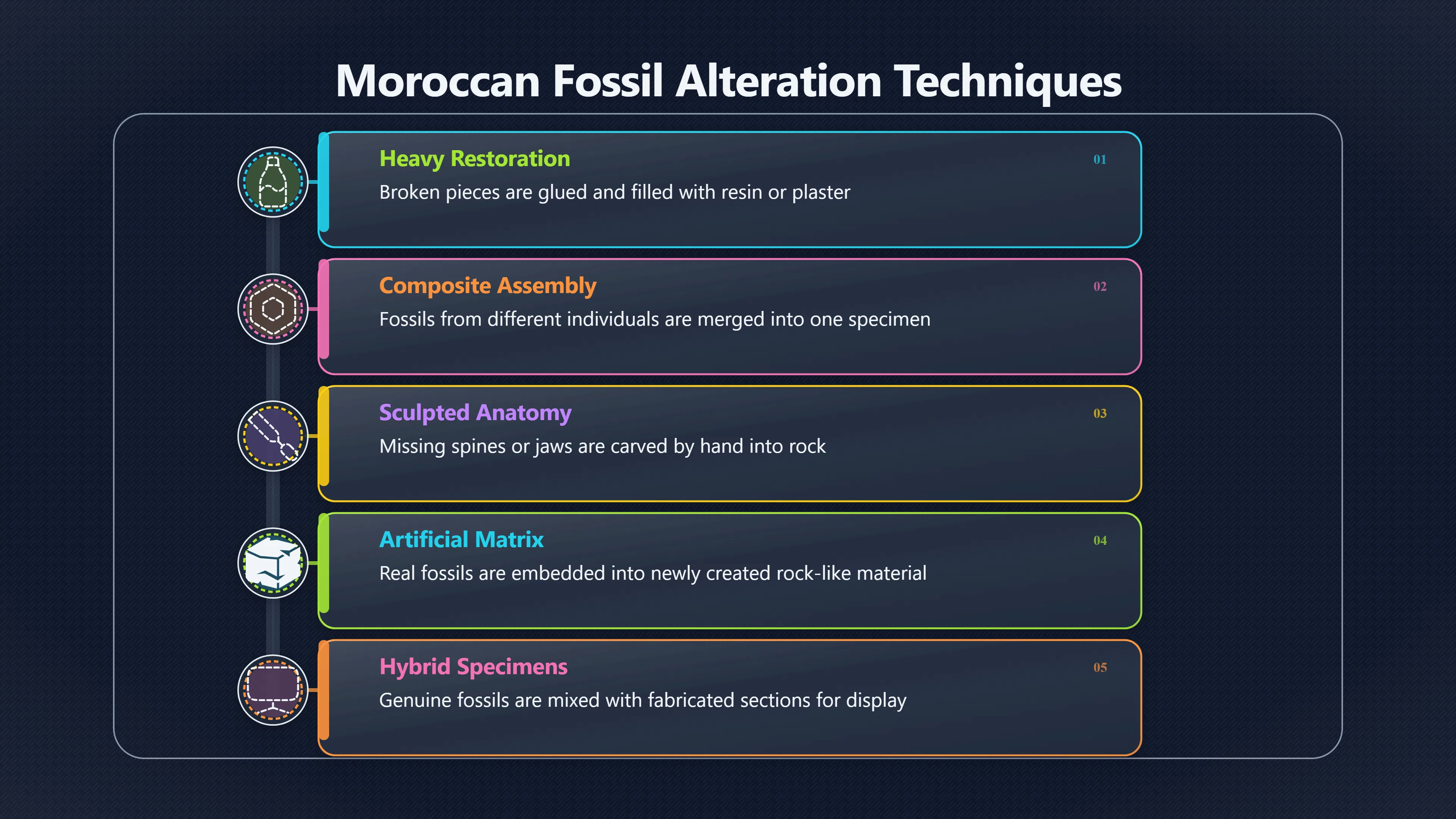
Several techniques appear repeatedly in discussions of Moroccan fossil forgeries:[Wikipedia]WikipediaMoroccan fossil tradeMoroccan fossil trade
- Heavy restoration: Broken pieces are glued together and missing areas are filled with resin, plaster or other modern materials.
- Composite assembly: Fossils from different individuals are combined to create a more complete specimen.
- Sculpted anatomy: Missing spines, tails, jaws or other structures are carved by hand.
- Artificial matrix work: Real fossils are embedded into newly created rock-like material to improve appearance.
- Hybrid specimens: Genuine fossils are mixed with fabricated sections so that only part of the object is authentic.[wikipedia.org]WikipediaMoroccan fossil tradeMoroccan fossil trade
Collectors sometimes describe these objects as “composites” or “chimeras”. The term is appropriate because the finished piece may contain material from multiple animals, multiple localities or even multiple species.[Wikipedia]WikipediaMoroccan fossil tradeMoroccan fossil trade
Trilobite Chimeras and Sculpted Mosasaur Jaws
Two categories have become especially famous.
The Trilobite Problem
Morocco’s Anti-Atlas region produces extraordinary trilobites, extinct marine arthropods that lived hundreds of millions of years ago. Many specimens are genuine and scientifically valuable. However, the market’s appetite for spectacular examples has encouraged extensive modification of damaged fossils.[Wikipedia]WikipediaMoroccan fossil tradeMoroccan fossil trade
Palaeontologists and collectors have documented cases in which broken trilobites were merged together, missing segments rebuilt with resin, or dramatic spines added to increase value. Some specimens are almost entirely moulded from casts of real fossils. Others contain authentic heads and tails but reconstructed body sections. Collectors have even coined terms such as “trilobite pizzas” for slabs carrying multiple fossils arranged together to create a more attractive display.[Wikipedia]WikipediaMoroccan fossil tradeMoroccan fossil trade
The commercial incentive is obvious. Rare, complete and highly ornamented trilobites can command far higher prices than fragmentary specimens. Adding a few impressive-looking spines may transform a modest fossil into something that appears museum quality.[Wikipedia]WikipediaMoroccan fossil tradeMoroccan fossil trade
The Mosasaur Jaw Industry
A second recurring example involves mosasaurs, giant marine reptiles that lived during the Late Cretaceous. Morocco’s phosphate deposits produce enormous numbers of genuine mosasaur teeth, making them among the most common fossils available on the market.[Wikipedia]WikipediaMoroccan fossil tradeMoroccan fossil trade
Because isolated teeth are abundant, sellers can arrange them into reconstructed jaws that appear far more dramatic than the original finds. Experts and experienced collectors have repeatedly described specimens in which authentic teeth were inserted into sculpted jaws, artificial matrix or reconstructed bone. The teeth themselves may be genuine while the jaw that supposedly holds them never existed in nature.[jurassicpartsmuseum.com]jurassicpartsmuseum.comMosasaur Composite Jaw - Jurassic Parts MuseumThe teeth are indeed real (mosasaur teeth are very common fossils in Morocco), and may be f…
These composite jaws are persuasive because they contain real fossil material. To an inexperienced buyer, a row of authentic teeth embedded in convincing-looking rock can appear to be a complete fossil discovery rather than a workshop creation.[jurassicpartsmuseum.com]jurassicpartsmuseum.comMosasaur Composite Jaw - Jurassic Parts MuseumThe teeth are indeed real (mosasaur teeth are very common fossils in Morocco), and may be f…
Why Buyers and Collectors Are Fooled
The success of these specimens does not depend on ignorance alone. Morocco genuinely produces spectacular fossils, and many legitimate examples look almost unbelievable. The abundance of authentic material creates a background of plausibility that makes altered specimens harder to identify.[Wikipedia]WikipediaMoroccan fossil tradeMoroccan fossil trade
Several factors help deceptive composites circulate:
- Genuine fossils are often incomplete, so restoration is expected.
- Buyers may encounter fossils far from the original excavation site.
- Online photographs can hide repairs, glue lines and modern fillers.
- Rare species are unfamiliar even to experienced collectors.
- The most convincing composites contain substantial amounts of real fossil material.[wikipedia.org]WikipediaMoroccan fossil tradeMoroccan fossil trade
Importantly, the existence of forgeries does not mean Moroccan fossils are generally fake. Many palaeontologists continue to study scientifically important specimens from Morocco, and the country remains one of the world’s most productive fossil sources. The challenge is distinguishing authentic specimens from altered ones.[wikipedia.org]WikipediaMoroccan fossil tradeMoroccan fossil trade
When Scientific Questions Reach Beyond the Collectors’ Market
The issue occasionally extends beyond private collecting into scientific debate.
In 2025, researchers raised concerns about whether a remarkable mosasaur fossil from Morocco, previously described as a new species, might include reconstructed or misleading elements. The controversy did not prove fraud, but it illustrated a wider concern: when commercially collected fossils pass through multiple hands before reaching researchers, questions about authenticity and preparation can become scientifically important.[Jerusalem Post]jpost.comarticle 837613article 837613
Such disputes are unusual, but they demonstrate why provenance—the documented history of a fossil’s discovery and preparation—matters so much in palaeontology. A specimen can be visually impressive yet still raise doubts if its reconstruction history is unclear.[Jerusalem Post]jpost.comarticle 837613article 837613
Warning Signs Collectors Can Examine
Experienced fossil buyers often look for clues that suggest excessive reconstruction or fabrication.
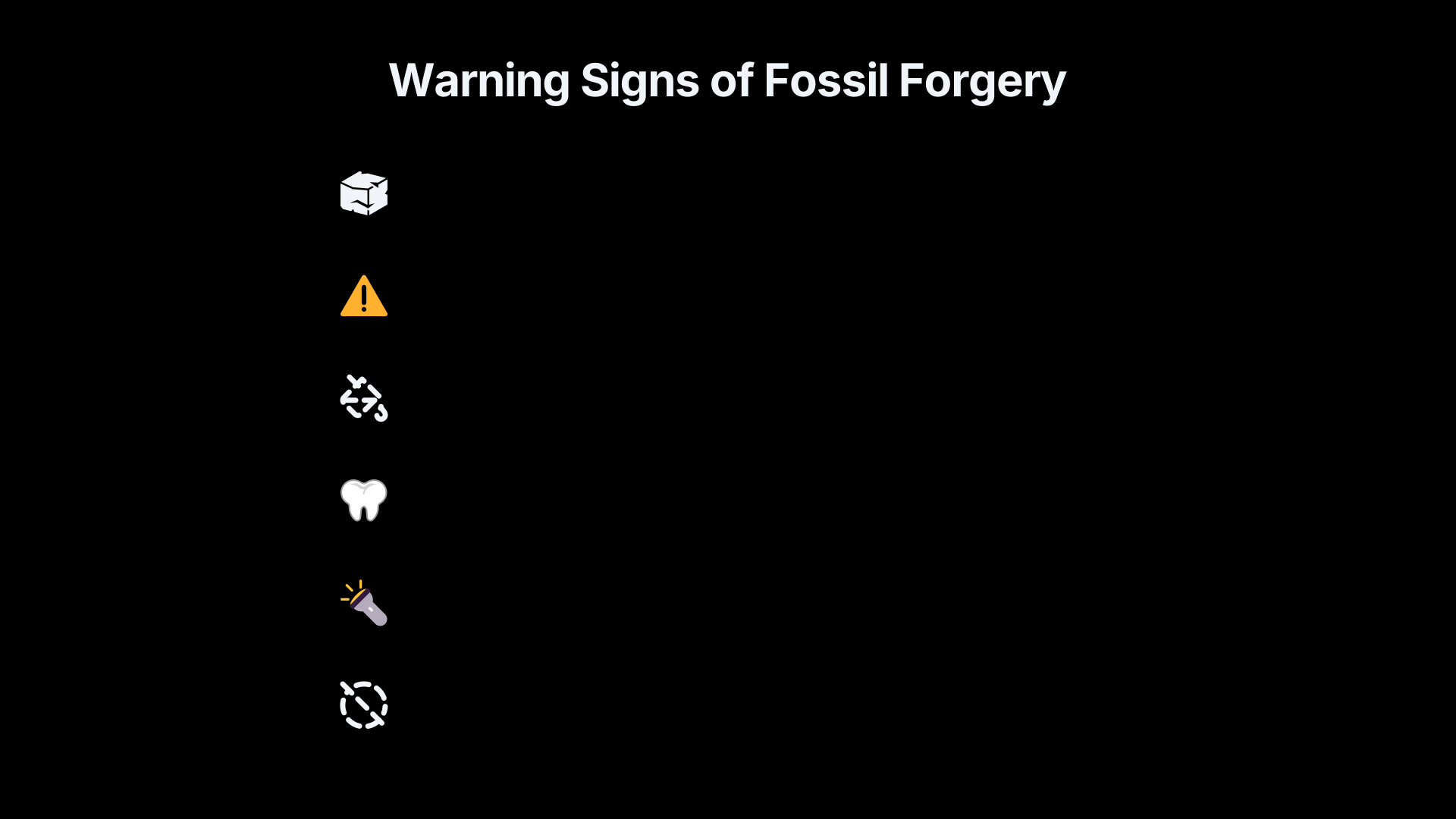
Common warning signs include:
- Identical textures repeated across supposedly natural surfaces.
- Perfectly symmetrical spines or ornamentation.
- Fossils that appear unusually complete compared with known examples.
- Abrupt colour changes between different sections.
- Visible glue seams or filler material.
- Teeth arranged in improbably neat rows.
- Fossils from different species or preservation styles appearing on the same slab.[thefossilforum.com]thefossilforum.comThe Fossil Forum Another Fake Jaw from MoroccoThe Fossil Forum Another Fake Jaw from Morocco
Ultraviolet light is frequently recommended by fossil specialists because adhesives, resins and fillers can fluoresce differently from genuine fossil material. Careful examination under magnification may also reveal air bubbles, carving marks or modern compounds hidden beneath surface colouring.[Wikipedia]WikipediaMoroccan fossil tradeMoroccan fossil trade
The most reliable safeguard remains documentation. Specimens with a clear history of discovery, preparation and ownership are generally easier to evaluate than anonymous pieces sold solely on appearance.[Wikipedia]WikipediaMoroccan fossil tradeMoroccan fossil trade
What These Fossil Fakes Reveal
Moroccan fossil composites occupy an unusual place in the history of deception because they often begin with something real. Unlike a completely invented artefact, a composite trilobite or reconstructed mosasaur jaw may contain authentic fossil material, genuine scientific value and considerable craftsmanship. The deception lies in presenting an altered object as an untouched discovery.[Wikipedia]WikipediaMoroccan fossil tradeMoroccan fossil trade
The story therefore says as much about market incentives as about forgery. Collectors prize rarity, completeness and visual drama. Workshops respond by creating specimens that satisfy those desires. In the process, a real fossil can gradually become a fake—not because the original material is false, but because the final presentation obscures where nature ends and reconstruction begins.[wikipedia.org]WikipediaMoroccan fossil tradeMoroccan fossil trade
Amazon book picks
Further Reading
Books and field guides related to When a Real Fossil Becomes a Fake. Use these as the next step if you want deeper reading beyond the article.
eBay marketplace picks
Marketplace Samples
Live-tested eBay searches with available results related to this page.


Endnotes
1.
Source: Wikipedia
Title: Moroccan fossil trade
Link:https://en.wikipedia.org/wiki/Moroccan_fossil_trade
2.
Source: researchgate.net
Link:https://www.researchgate.net/publication/328464661_The_international_fossil_trade_from_the_Paleozoic_of_the_Anti-Atlas_Morocco
Source snippet
The international fossil trade from the Paleozoic of the Anti-...23 Oct 2018 — The fossil trade of Paleozoic material from s...
3.
Source: researchgate.net
Title: 265208436 Fossil fakes and their recognition
Link:https://www.researchgate.net/publication/265208436_Fossil_fakes_and_their_recognition
Source snippet
ResearchGate(PDF) Fossil fakes and their recognitionFeb 4, 2026 — A new forgery of a trilobite from Morocco is presented, which attempts...
4.
Source: fossilguy.com
Title: Why Are So Many Otodus Shark Teeth and Mosasaur
Link:https://www.fossilguy.com/topics/morocco-phosphate/index.htm
Source snippet
May 28, 2026 — Composite mosasaur fossils from Morocco made using real mosasaur teeth combined with reconstructed matrix, artificial root...
Published: May 28, 2026
5.
Source: jurassicpartsmuseum.com
Link:https://www.jurassicpartsmuseum.com/fakes/mosasaur-composite-jaw
Source snippet
Mosasaur Composite Jaw - Jurassic Parts MuseumThe teeth are indeed real (mosasaur teeth are very common fossils in Morocco), and may be f...
6.
Source: eurekalert.org
Title: news releases
Link:https://www.eurekalert.org/news-releases/989651
7.
Source: Wikipedia
Link:https://en.wikipedia.org/wiki/Morocco
8.
Source: groundedlifestyles.com
Title: fossil fakes
Link:https://www.groundedlifestyles.com/fossil-fakes/
Source snippet
No—Morocco produces authentic trilobites, but many cheap specimens are resin or heavily carved. Is...Read more...
9.
Source: jpost.com
Title: article 837613
Link:https://www.jpost.com/science/science-around-the-world/article-837613
10.
Source: thefossilforum.com
Title: The Fossil Forum Another Fake Jaw from Morocco
Link:https://www.thefossilforum.com/topic/82191-another-fake-jaw-from-morocco/
11.
Source: thefossilforum.com
Title: Moroccan Trilobites- Fakes and Junk
Link:https://www.thefossilforum.com/topic/83467-moroccan-trilobites-fakes-and-junk-who-buys-this-stuff/
Additional References
12.
Source: instagram.com
Link:https://www.instagram.com/reel/Cfi7iKKjSyT/
Source snippet
The spiny fossilized trilobite Comura from the nearly 400...Because of their incredibly spiny nature, these trilobites are cove...
13.
Source: reddit.com
Title: Opinion on legitimacy: r/Paleontology It’s a pretty common practice
Link:https://www.reddit.com/r/Paleontology/comments/1e75i4r/opinion_on_legitimacy/
Source snippet
Opinion on legitimacy: r/PaleontologyIt's a pretty common practice - mosasaur teeth are extremely abundant in Morocco, so they set...
14.
Source: reddit.com
Link:https://www.reddit.com/r/Paleontology/comments/1cpsfrd/are_the_circled_fossils_real_or_fake_im_in/
15.
Source: fossilera.com
Link:https://www.fossilera.com/pages/buyer-beware-fake-mosasaurus-jaws?srsltid=AfmBOooBjF0elyEChX37E6coiX_12BtHhI-F8bf9ng5P04abXcA47114
16.
Source: reddit.com
Link:https://www.reddit.com/r/Paleontology/comments/1d97esi/does_this_appear_to_be_an_authentic_mosasaur_jaw/
17.
Source: instagram.com
Link:https://www.instagram.com/p/DYP842JsSow/
18.
Source: reddit.com
Link:https://www.reddit.com/r/Paleontology/comments/11nmjn5/genuine_mosasaur_platecarpus_skull_with_his/
19.
Source: facebook.com
Link:https://www.facebook.com/groups/656698809719081/posts/1184109923644631/
20.
Source: fossilera.com
Link:https://www.fossilera.com/fossils-for-sale/moroccan-trilobites?srsltid=AfmBOoovZz1u5clx7AgPC5EtwSPoVPFqNtJhZQ2iEmF-hvNz7izBwApb
21.
Source: facebook.com
Link:https://www.facebook.com/tom.kapitany/posts/moroccan-faces-goniatite-fossils-strange-stones-from-the-sahara-some-sellers-won/10163308230632784/
Topic Tree