How Did Serbia's Strangest Stories Become Believable?
Serbia’s best-known stories of deception do not form a tidy parade of proven frauds.
Page outline Jump by section
Introduction
Several recurring mechanisms stand out. Old predictions gained authority because no secure original text could be checked. Sensational pictures and television demonstrations travelled faster than mundane explanations. Folklore became news when officials and journalists played along. During political crises, emotionally powerful allegations could become symbols even when investigators disagreed about the underlying facts. These cases show that Serbian hoax history is less about national credulity than about familiar human pressures: commercial opportunity, political usefulness, dramatic storytelling, selective memory and the persuasive force of apparently concrete evidence.
The prophecies that improved with age
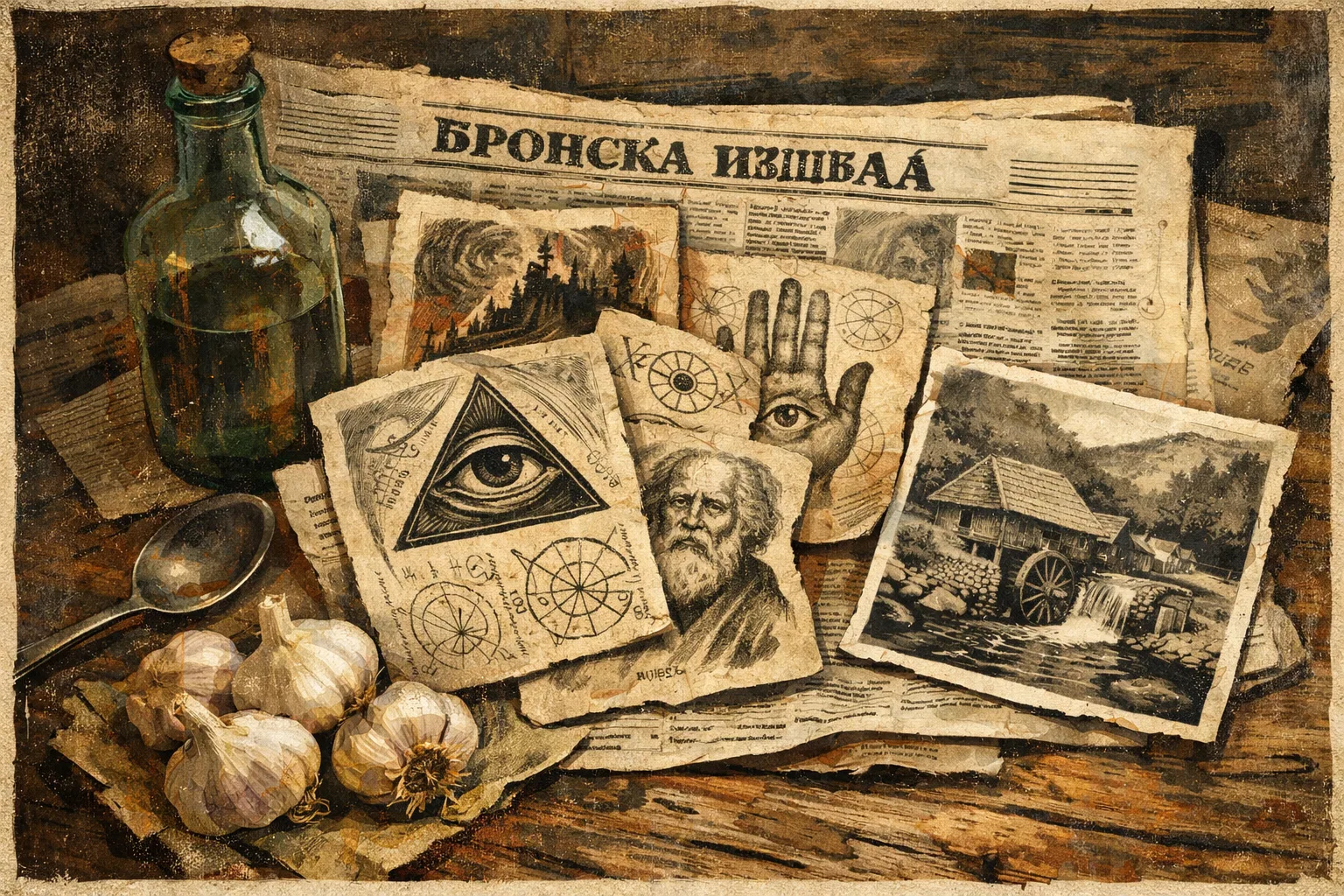
The Kremna prophecies are probably Serbia’s most durable example of retrospective prediction. They are attributed to two nineteenth-century villagers, Miloš and Mitar Tarabić, whose visions were supposedly written down by a local Orthodox priest. Later publications credited them with foreseeing political assassinations, the fall of dynasties, world wars, technological change and the break-up of Yugoslavia. The appeal is obvious: obscure rural seers appear to describe modern events in language recorded decades before they happened.
The central problem is not that every saying attributed to the Tarabić family must have been invented. It is that no stable, securely dated master text survives against which later versions can be checked. Serbian sceptical writer Voja Antonić compared editions and argued that the prophecy had repeatedly changed, with new details appearing as history supplied fresh events to “predict”. Academic research likewise treats the tradition as an evolving political and cultural text rather than a fixed nineteenth-century document. A recent study from the University of Belgrade traces how the prophecy was used and reshaped in Serbian political life from its emergence through the First World War.[medium.com]medium.comFalse Prophets?A Brief History of the Tarabić Family and…May 16, 2016 — Voja Antonić, a Serbian inventor and writer, researched the prophecy in an ef…
That makes the mechanism unusually clear. A vague prediction can be matched to many events; a precise prediction is impressive only when its wording can be proved to pre-date the event. With Kremna, the most striking passages tend to be known from later editions. Differences between versions are sometimes explained by believers as evidence that governments censored inconvenient predictions, but this defence makes the claim impossible to disprove: both the presence and absence of a passage can be presented as proof.
The prophecies have also benefited from repetition without textual comparison. Newspapers and popular books often reproduce the successful “hits” while ignoring failed, altered or undated statements. Each new crisis supplies another opportunity to reinterpret a broad phrase. The result is not necessarily one centrally planned fraud. It is closer to a collaborative legend, revised by editors, enthusiasts, political actors and audiences who prefer a dramatic match to a dull question about publication history.
A medical mystery turned into a political weapon
The 1985 case of Đorđe Martinović shows how an unresolved incident can become more influential than a demonstrable fabrication. Martinović, a Serbian farmer in Kosovo, was admitted to hospital with severe injuries caused by a broken bottle. He initially said that two Albanian men had attacked him. Investigators and medical teams then produced conflicting conclusions: some accounts said he had admitted causing the injury accidentally during a sexual act, while one medical team judged self-infliction physically improbable. A later forensic commission considered it possible. No alleged attackers were convicted, and the basic circumstances were never established beyond reasonable dispute.[wikipedia.org]WikipediaĐorđe Martinović incidentĐorđe Martinović incident
The uncertainty did not prevent the case from acquiring a settled public meaning. Serbian newspapers, writers and nationalist campaigners presented Martinović as a victim of organised Albanian brutality. His injury was compared with torture and martyrdom; painter Mića Popović depicted the scene through the visual language of crucifixion. Petitions and speeches transformed one disputed event into an emblem of the supposed persecution of all Serbs in Kosovo.[Wikipedia]WikipediaĐorđe Martinović incidentĐorđe Martinović incident
Calling the whole affair a simple hoax would go beyond the evidence. Martinović may have lied, confessed under pressure, withdrawn a truthful accusation, or been caught in an investigation distorted by politics. What can be shown is that a contested personal story was converted into a collective political certainty. The unresolved forensic evidence mattered less than the narrative structure: an innocent Serbian farmer, unnamed Albanian assailants and authorities supposedly unwilling to protect him.
The affair became powerful because it arrived when trust between Kosovo’s Serbian and Albanian communities was already deteriorating. Its imagery could be understood immediately, while medical disagreement required patience and qualification. Once the case had been made to represent an entire people, questioning Martinović’s account could itself be portrayed as hostility towards Serbian victims. That is a common feature of propaganda built on uncertain events: the emotional claim becomes morally harder to challenge than the factual claim is intellectually difficult to prove.
The vampire warning that advertised a village
In late 2012, international media reported that residents around the Serbian village of Zarožje had been warned about the possible return of Sava Savanović, a vampire from Serbian folklore. The immediate hook was the collapse of an old watermill associated with the legend. Reports described local concern, brisk sales of garlic and advice to place religious symbols in homes. The story was frequently presented with a half-serious tone, leaving readers unsure whether villagers, officials or journalists genuinely believed a vampire was at large.[Gizmodo]gizmodo.comBy Lauren Davis PublishedSerbian village council issues warning that a vampire may…December 2, 2012 — 2 Dec 2012 — Serbian village council issues warnin…
Sava Savanović was not an invented internet monster. He belongs to an established Serbian literary and folkloric tradition, and the mill provided a real place around which the story could gather. What changed in 2012 was the framing. A local legend became a news event, aided by remarks from local officials and the obvious tourism value of international attention.
This is best understood as publicity built from folklore rather than a fraudulent attempt to prove the supernatural. Some participants may have enjoyed the legend sincerely; others plainly recognised its promotional potential. Foreign reports often amplified the most picturesque details because “Serbian village exploits vampire heritage” was less irresistible than “vampire may be loose”.
The episode illustrates the porous boundary between belief, humour and marketing. Nobody needed to manufacture a fake corpse or forged document. The stunt worked by leaving the level of seriousness unresolved. Officials could attract visitors without directly insisting that vampires existed, while readers and broadcasters supplied the sensational interpretation themselves.
Serbia’s “magnetic” children
In 2011, television footage and photographs of Serbian children apparently attracting spoons, plates and other objects to their bodies circulated internationally. Seven-year-old Bogdan became the best-known example, followed by reports of other children with similar abilities. The demonstrations looked striking because metal objects appeared to cling to bare skin without support.[sundaytimes.lk]sundaytimes.lkOpen source on sundaytimes.lk.
The claim failed a basic test: objects made from materials that are not magnetic could also be made to stick. Smooth glass and ceramic items adhering to a chest do not demonstrate magnetism. Sceptical explanations pointed instead to skin friction, moisture, body oils, posture and the slight backward lean often visible in such demonstrations. Similar “human magnet” claims lose much of their effect when the skin is dried or dusted with powder, reducing adhesion.[Live Science]livescience.comLive Science Famed Magnetic Boy Is Probably Just Very StickyLive Science Famed Magnetic Boy Is Probably Just Very Sticky
There is little reason to treat the children themselves as calculating fraudsters. Families may have sincerely misinterpreted an amusing bodily trick, while television producers had a strong incentive to present it as unexplained. The deception lay mainly in the demonstration: viewers were shown objects sticking, then encouraged to accept “magnetism” as the only explanation without measurements of a magnetic field or properly controlled tests.
The story also shows why visual evidence can be more misleading than an unsupported rumour. The footage was real. The objects really did cling to the skin. What was false was the conclusion attached to the images. This type of claim survives because debunking requires a distinction many viewers do not instinctively make: a genuine video can still be evidence for the wrong explanation.
The secret Yugoslav space programme
A polished 2012 trailer claimed that socialist Yugoslavia had developed a secret space programme and sold it to the United States, allowing President John F. Kennedy to accelerate the race to the Moon. Archive footage, solemn narration, real Cold War history and images of Yugoslav military installations gave the story the texture of a suppressed documentary revelation. The video attracted extensive attention, and many viewers treated its central claim as fact.[airandspace.si.edu]airandspace.si.eduWhat do you Make of the "Houston, we have a problemWhat do you Make of the "Houston, we have a problem
The trailer became the basis for the 2016 film Houston, We Have a Problem!, a deliberately deceptive blend of documentary, satire and fiction. Its invented testimony was placed alongside genuine facts: Yugoslavia received substantial American assistance, maintained contacts with both Cold War blocs, had engineers who later worked in the United States, and possessed impressive underground military facilities. Those truths made the fabricated transaction feel plausible.[wikipedia.org]WikipediaHouston, We Have a Problem! (filmHouston, We Have a Problem! (film
The Smithsonian’s National Air and Space Museum challenged the trailer soon after it appeared, noting that the alleged programme and sale lacked credible historical evidence. Yugoslavia did participate in scientific exchange, and Belgrade hosted events connected with space research, but this is a long way from possessing a hidden programme capable of transforming NASA.[airandspace.si.edu]airandspace.si.eduWhat do you Make of the "Houston, we have a problemWhat do you Make of the "Houston, we have a problem
This case belongs partly to the wider history of Yugoslavia rather than Serbia alone, but Belgrade, Tito’s state institutions and the shared post-Yugoslav memory of scientific ambition are central to its appeal in Serbia. It also differs from an ordinary fraud because the filmmakers eventually made the fictionality of their project visible. The initial trailer, however, demonstrated how quickly cinematic authority can produce belief. Real archive images did not prove the invented connection between them; editing supplied that connection.
The story remains persuasive because it flatters several audiences at once. It offers former Yugoslav viewers a lost history of technological greatness, gives conspiracy enthusiasts a secret explanation for the Apollo programme and turns complicated American-Yugoslav relations into a single dramatic bargain. Its survival is a reminder that fact-checking individual images is not enough. The sequence in which true facts are arranged may itself create a false historical claim.

“Operation Horseshoe” and the danger of false certainty
During NATO’s 1999 bombing campaign, German ministers publicised what they described as a Serbian-Yugoslav plan, codenamed Operation Horseshoe, to drive Kosovo Albanians from the province. Maps and briefings were presented as evidence that mass expulsion had been prepared in advance. The alleged plan became an important part of the public case for understanding Serbian operations as a centrally designed campaign.[wikipedia.org]WikipediaOperation HorseshoeOperation Horseshoe
The documentary status of the plan has remained disputed. Later accounts indicated that information supplied through Bulgarian intelligence channels had not been verified. Critics, including retired German general Heinz Loquai, argued that a broad assessment of Yugoslav military activity was converted into a more specific operational plan than the evidence supported. Academic analysis has likewise distinguished between the well-documented expulsion and displacement of Kosovo Albanians and the narrower claim that a particular authenticated document called Operation Horseshoe directed the campaign.[balkaninsight.com]balkaninsight.comall balkan countriesall balkan countries
That distinction is essential. Doubt about the document does not erase the crimes, forced displacement and violence committed by Serbian and Yugoslav forces in Kosovo. Conversely, evidence of those acts does not authenticate every document or briefing used to describe them. Treating either proposition as proof of the other replaces investigation with political loyalty.
Operation Horseshoe is therefore less a conventional Serbian hoax than a case in which Serbia was the subject of a potentially misleading wartime claim. It belongs in this history because it shows how quickly intelligence, maps and official language can acquire an authority greater than their verified provenance. It also demonstrates why exposing an exaggerated or unauthenticated claim must not be used to deny independently documented abuses.

Why these stories kept working
Serbia’s famous doubtful stories succeeded for different reasons, but several shared features explain their longevity.
They attached fiction to something real. Kremna was a real village with a genuine prophetic tradition. The vampire mill existed. Objects truly stuck to children’s skin. Yugoslavia had authentic space scientists and Cold War links. Martinović was genuinely and terribly injured. Operation Horseshoe was discussed amid real mass displacement. The false or uncertain conclusion was anchored to a fact that could be photographed, visited or emotionally grasped.
They exploited missing originals. The absence of a securely dated Kremna manuscript allowed prophecy texts to evolve. The absence of an authenticated Horseshoe document left room for both official certainty and sweeping denial. Where provenance is weak, later retellings tend to become more definite rather than less.
They rewarded dramatic intermediaries. Publishers sold prophecy books, television programmes obtained striking footage, local promoters gained tourism coverage, filmmakers built an audience and political actors acquired useful symbols. The people spreading a story did not always need to believe it fully; they needed it to attract attention or support a wider argument.
They blurred categories. Folklore was reported as news, adhesion was labelled magnetism, docufiction looked like documentary and an unresolved criminal allegation became political proof. Once categories are blurred, a correction aimed at one form of claim may miss the version audiences actually remember.
They were emotionally satisfying. A rural prophet who sees the modern world, a persecuted national martyr, an ancient vampire, a miraculous child and a hidden technological triumph are all more memorable than textual criticism, forensic disagreement or ordinary physics. Emotional neatness gives these stories a durability that factual uncertainty rarely enjoys.
How to judge a Serbian hoax claim
The most useful test is not whether a story sounds strange. Genuine history is often strange. The better question is whether the evidence available today could have supported the claim when it first appeared.
For prophecies, the decisive evidence is a dated text that existed before the predicted event. For paranormal demonstrations, the test is whether controls rule out friction, posture, hidden support and selective filming. For historical documents, provenance matters: who produced the item, when it first appeared, whether an original survives and whether independent archives confirm it. For wartime allegations, the authenticity of a particular document must be separated from the broader record of events on the ground.
Serbia’s hoax history is most illuminating where the final verdict remains qualified. Some stories were deliberate entertainment; some were commercial exaggerations; some may have begun as sincere mistakes; others became propaganda because uncertainty was politically inconvenient. Their common lesson is that a claim does not need to be wholly fabricated to mislead. It may contain real people, places, images and suffering, yet still create a false understanding through omission, retrospective editing or unjustified certainty.
Amazon book picks
Further Reading
No matched book cards were available for How Did Serbia's Strangest Stories Become Believable?, so this fallback keeps a direct Amazon reading path visible.
Topical books
fact checking Serbia guide
Browse books, explainers and reference titles related to this topic.
Search AmazonRelated search
Serbian folklore guide
Browse books, explainers and reference titles related to this topic.
Search AmazonRelated search
Đorđe Martinović incident guide
Browse books, explainers and reference titles related to this topic.
Search AmazonEndnotes
1.
Source: medium.com
Title: False Prophets?
Link:https://medium.com/issuesthatmatter/false-prophets-a-brief-history-of-the-tarabi%C4%87-family-and-the-prophecy-from-kremna-e92f6cf849d2
Source snippet
A Brief History of the Tarabić Family and...May 16, 2016 — Voja Antonić, a Serbian inventor and writer, researched the prophecy in an ef...
Published: May 16, 2016
2.
Source: ceeol.com
Title: article detail
Link:https://www.ceeol.com/search/article-detail?id=1350091
Source snippet
Kremansko proročanstvo od nastanka do Prvog svetskog...by M Stajić · 2025 · Cited by 1 — This paper offers a diachronic overview of...
3.
Source: Wikipedia
Title: Đorđe Martinović incident
Link:https://en.wikipedia.org/wiki/%C4%90or%C4%91e_Martinovi%C4%87_incident
4.
Source: books.openedition.org
Title: Open Edition Books The Nonconformists
Link:https://books.openedition.org/ceup/856?lang=en
Source snippet
From Principle to CatharsisOn that day, a Serbian farmer named Djordje Martinović was found bleeding in his field near the town of Gnjila...
5.
Source: gizmodo.com
Title: By Lauren Davis Published
Link:https://gizmodo.com/serbian-village-council-issues-warning-that-a-vampire-m-5964919
Source snippet
Serbian village council issues warning that a vampire may...December 2, 2012 — 2 Dec 2012 — Serbian village council issues warnin...
Published: December 2, 2012
6.
Source: sundaytimes.lk
Link:https://www.sundaytimes.lk/110227/Timestwo/t2_10.html
7.
Source: airandspace.si.edu
Title: What do you Make of the “Houston, we have a problem
Link:https://airandspace.si.edu/stories/editorial/what-do-you-make-houston-we-have-problem-film-claiming-secret-yugoslavian-space
8.
Source: Wikipedia
Title: Houston, We Have a Problem! (film)
Link:https://en.wikipedia.org/wiki/Houston%2C_We_Have_a_Problem%21_%28film%29
9.
Source: fipresci.org
Link:https://fipresci.org/report/the-reality-behind-the-reality/
10.
Source: Wikipedia
Title: Operation Horseshoe
Link:https://en.wikipedia.org/wiki/Operation_Horseshoe
11.
Source: publications.parliament.uk
Link:https://publications.parliament.uk/pa/cm199900/cmselect/cmfaff/28/2811.htm
12.
Source: Wikipedia
Title: Prophecy from Kremna
Link:https://en.wikipedia.org/wiki/Prophecy_from_Kremna
13.
Source: Wikipedia
Title: Sava Savanović
Link:https://en.wikipedia.org/wiki/Sava_Savanovi%C4%87
14.
Source: Wikipedia
Title: Unusual articles
Link:https://en.wikipedia.org/wiki/Wikipedia%3AUnusual_articles
15.
Source: Wikipedia
Title: Incident de Đorđe Martinović
Link:https://ca.wikipedia.org/wiki/Incident_de_%C4%90or%C4%91e_Martinovi%C4%87
16.
Source: youtube.com
Title: Yugoslav Space Program: The UNBELIEVABLE TRUTH Behind the Hoax
Link:https://www.youtube.com/watch?v=J6qrTRBCgAQ
Source snippet
"Houston, We Have a Problem!" - Yugoslavian Space Program Original Trailer...
17.
Source: youtube.com
Title: “Houston, We Have a Problem!”
Link:https://www.youtube.com/watch?v=KBYy5qmVJrE
Source snippet
The Chilling Legend of Sava Savanović | Serbia's First Vampire...
18.
Source: livescience.com
Title: Live Science Famed Magnetic Boy Is Probably Just Very Sticky
Link:https://www.livescience.com/12986-magnetic-people-sticky-bogdan.html
19.
Source: balkaninsight.com
Title: all balkan countries
Link:https://balkaninsight.com/2012/01/10/bulgaria-leaked-milosevic-ethnic-cleansing-plan/bi/all-balkan-countries/
Additional References
20.
Source: youtube.com
Title: The Chilling Legend of Sava Savanović | Serbia’s First Vampire
Link:https://www.youtube.com/watch?v=Z3oJpGTGn3I
Source snippet
"Kremna prophecies" Tarabic Serbia Prophecy of Kremna - In Search of Alaya In Search of Alaya...
21.
Source: library.oapen.org
Link:https://library.oapen.org/bitstream/20.500.12657/24993/1/1005109.pdf
Source snippet
A History of Yugoslavia... Djordje Martinović, a farmer from Gnjilane, who showed up at a hospital severally injured on. 1 May 1985...
Published: May 1985
22.
Source: eap-iea.org
Link:https://eap-iea.org/index.php/eap/article/view/1330?articlesBySameAuthorPage=2
Source snippet
EAP IEAThe Kremna Prophecy from Its Origins to the First World War3 Jul 2025 — This paper offers a diachronic overview of the origin, evo...
23.
Source: facebook.com
Link:https://www.facebook.com/IFJAsiaPacific/posts/indonesia-ika-ningtyas-and-zainal-ishaq-two-fact-checkers-from-tempo-media-and-a/3588402251193061/
24.
Source: academia.edu
Link:https://www.academia.edu/19831424/The_[Martinovic
25.
Source: researchgate.net
Link:https://www.researchgate.net/publication/331619384_Headlines_as_Fake_News_Discursive_Deception_in_Serbia%27s_Daily_Informer
26.
Source: facebook.com
Link:https://www.facebook.com/groups/589445355951479/posts/1430943931801613/
27.
Source: reddit.com
Link:https://www.reddit.com/r/OrthodoxChristianity/comments/w0e7ct/are_prophecies_from_kremna_in_serbia_valid_or_a/
28.
Source: facebook.com
Link:https://www.facebook.com/groups/323369753123229/posts/1203788441748018/
29.
Source: academia.edu
Link:https://www.academia.edu/38517422/Headlines_as_fake_news_discursive_deception_in_Serbias_daily_Informer
Amazon book picks
Further Reading
Books and field guides related to How Did Serbia's Strangest Stories Become Believable?. Use these as the next step if you want deeper reading beyond the article.
Extraordinary Popular Delusions and the Madness of Crowds
Rating: 4.0/5 from 5 Google Books ratings
Examines how collective myths and dubious claims spread.
Mistakes Were Made (but Not by Me)
Shows how people defend beliefs and reinterpret evidence.
The Demon-Haunted World
Rating: 4.5/5 from 43 Google Books ratings
Explains why extraordinary stories become convincing despite weak evidence.
Topic Tree
Follow this branch
Related pages 192
- Albanian Hoaxes
- Algerian Hoaxes
- Antigua Deceptions
- Argentina Hoaxes
- Armenian Hoaxes
- +187 more in sidebar