How Deception Took Root in Benin
Benin does not have a well-documented catalogue of spectacular newspaper hoaxes, fake monsters or celebrated photographic frauds comparable with those of some larger media markets.
Page outline Jump by section
Introduction
These cases matter because they show several ways that falsehood takes hold. Some were deliberate frauds; others were exaggerations built around real events. Some benefited traders, officials or politicians, while others spread because familiar names, dramatic images and messages forwarded by trusted friends seemed authoritative. The central lesson is not that Beninese audiences were unusually credulous. It is that deception becomes persuasive when it borrows the appearance of established power: a royal court, a church, a government office, a respectable business or a news report.
First, which Benin?
Any investigation must begin with a naming trap. The modern Republic of Benin occupies the territory formerly called Dahomey and took its present name in 1975. The historic Kingdom of Benin, however, was centred on Benin City in what is now southern Nigeria. The celebrated Benin Bronzes therefore come from Nigeria, not from the Republic of Benin. The British Museum explicitly identifies their origin as Benin City, now within the Federal Republic of Nigeria.[British Museum]britishmuseum.orgBritish MuseumBenin BronzesOver 900 objects from the historic Kingdom of Benin are currently cared for by the British Museum. is now loca…
This confusion repeatedly contaminates popular history, museum discussions and online lists of “Beninese” mysteries. A forged object advertised as a “Benin bronze”, for example, may imitate the court art of the Nigerian kingdom without having any connection to the present-day country. Conversely, royal objects looted by French forces from Abomey in the 1890s genuinely belong to the history of Dahomey and modern Benin. The distinction is geographical, political and cultural, not merely pedantic.
The confusion also illustrates how misinformation can survive without a single hoaxer. Search engines repeat ambiguous labels; articles shorten “Kingdom of Benin” to “Benin”; readers reasonably assume that the name refers to the modern state. The result is a durable error produced by repetition rather than conspiracy.
How Dahomey became a colonial spectacle
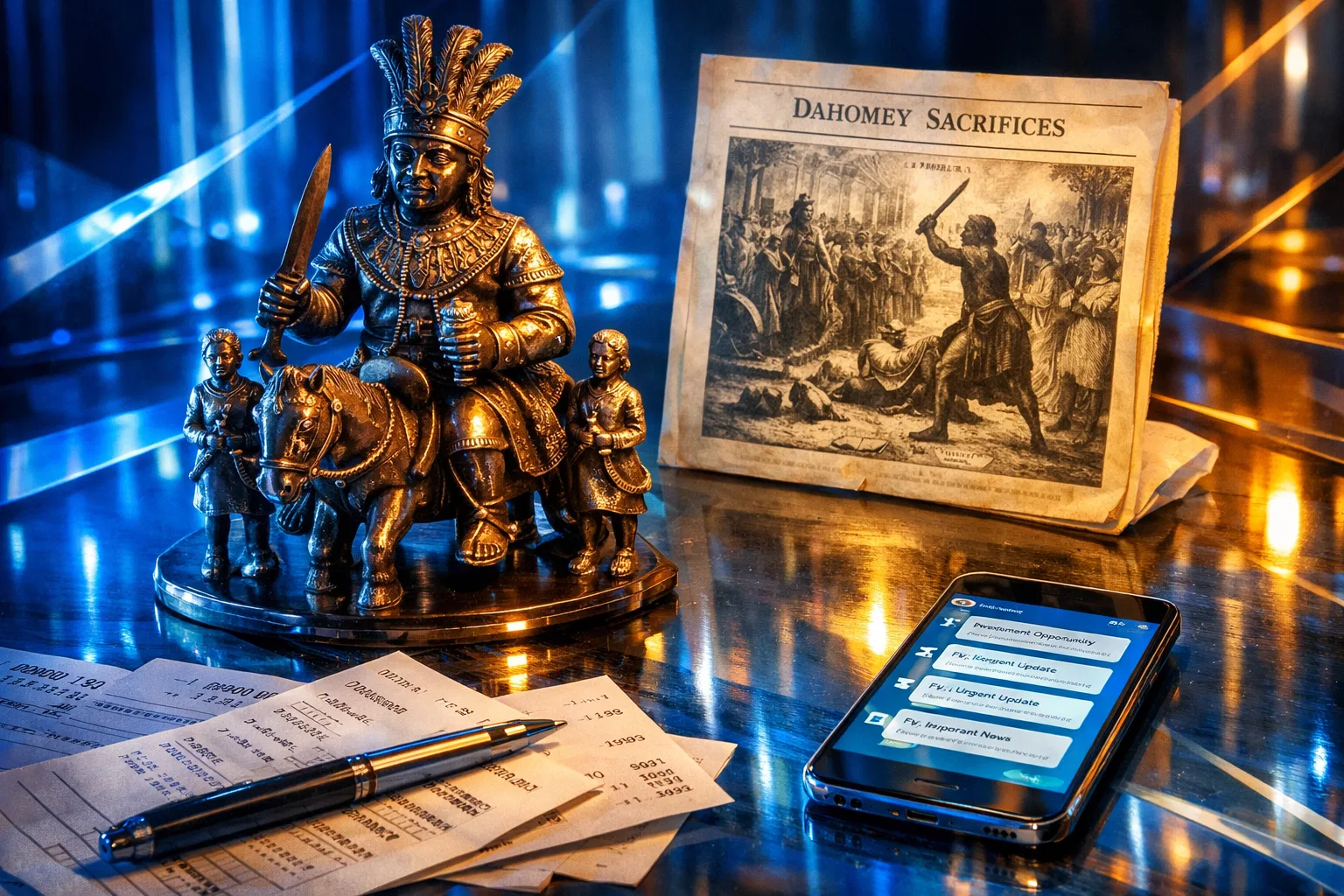
The strongest historical material within Benin’s hoax history lies in the unstable boundary between observation, propaganda and sensational exaggeration. European merchants, travellers, missionaries and military officers described Dahomey as a disciplined, militarised kingdom associated with slave trading, royal ritual and human sacrifice. Elements of that picture were real. The distortion came from turning incomplete observations into extravagant claims about an entire society.

The inflated arithmetic of human sacrifice
Human sacrifice formed part of some royal and funerary ceremonies in Dahomey, so the subject cannot honestly be dismissed as a European invention. The harder question is scale. Reports ranged from limited ritual killings to claims that hundreds or thousands of people died at a single ceremony. Historians have long warned that such figures were often based on hearsay, hostile witnesses, duplicated stories or travellers trying to impress readers at home. A Cambridge history of the Guinea coast characterises human sacrifice in Dahomey as a limited and special feature rather than the permanent mass slaughter suggested by the most lurid accounts.[Cambridge University Press & Assessment]resolve.cambridge.orgCambridge University Press & AssessmentTHE GUINEA COASTIn Dahomey, as in so many other societies of the pre-feudal world, human sacrifice…
The numbers also served political and commercial arguments. Eighteenth-century writers involved in disputes over the slave trade presented Dahomey in sharply different ways. Some opponents of abolition portrayed enslavement by Europeans as a supposed rescue from African despotism or sacrificial death. Thomas McCaskie notes that the trader and writer Archibald Dalzel, an anti-abolitionist, depicted Dahomey as aggressively militaristic, despotic and sacrificial.[Cambridge University Press & Assessment]cambridge.orgCambridge University Press & AssessmentExiled from History: Africa in Hegel's Academic Practiceby TC McCaskie · 2019 · Cited by 19 — Norr…
That does not make every report false. It means the reports were produced by interested observers. Slave traders, abolitionists, missionaries, diplomats and colonial officers all selected details that helped their causes. A killing witnessed directly, a number supplied by an interpreter and a rumour heard at the coast could merge into one authoritative-sounding account.
The most responsible conclusion is therefore uncomfortable but clear: ritual killing existed, while the most dramatic totals are often impossible to verify and were sometimes politically useful exaggerations. Calling the entire subject a colonial fabrication erases victims; accepting every nineteenth-century figure repeats propaganda.
The women soldiers and the “Amazon” invention
Dahomey’s women soldiers were real. By the nineteenth century, the kingdom maintained a substantial female military corps that fought in campaigns and later resisted French forces. Europeans called them “Amazons”, comparing them with the women warriors of Greek mythology. The label was not their own and encouraged outsiders to imagine a separate society of ferocious women rather than units embedded in the king’s army, palace and political system.[Smithsonian Magazine]smithsonianmag.comOpen source on smithsonianmag.com.
The deception here was largely one of framing. Travel writers and showmen emphasised novelty, physical toughness and alleged hostility to men. Some descriptions treated the soldiers as proof that Dahomey was an exotic reversal of normal society. The classical nickname supplied an instantly recognisable story: these were supposedly Africa’s legendary Amazons brought to life.
Modern popular culture has produced a different simplification. The 2022 film The Woman King drew welcome attention to the soldiers but created fictional central characters and presented an internal movement against the slave trade more clearly and heroically than the historical evidence supports. Dahomey’s rulers and army participated extensively in wars that produced captives for sale, although the economy, motives of individual soldiers and changing policies were more complex than either celebration or condemnation allows.[Smithsonian Magazine]smithsonianmag.comOpen source on smithsonianmag.com.
The old colonial version made the women into savage curiosities. The modern heroic version risks making them uncomplicated liberation figures. Neither is a literal hoax in the usual sense, but both show how a documented institution can be reshaped to satisfy the expectations of its audience.
The ICC Services fraud
Benin’s clearest large-scale modern fraud was the collapse of ICC Services and related deposit-taking companies in 2010. The scheme promised extraordinary investment returns, reportedly reaching 150 to 200 per cent in a quarter. It appeared to accept savings and invest them profitably. In reality, investigators concluded that money from new customers was being used to pay earlier depositors: the defining mechanism of a Ponzi scheme.[dandc.eu]dandc.euOutraged by court hearingsOutraged by court hearings
The fraud succeeded because it did not look marginal. ICC Services maintained offices, sponsored charitable activity and cultivated associations with religious and political authority. Its managers appeared alongside influential people, and the organisation’s links with the Celestial Church of Christ gave its public image a moral and spiritual dimension. For customers who distrusted conventional banks or had limited access to formal investment products, visible payouts and community recommendations could seem more convincing than warnings about regulation.
Early investors were apparently paid, which transformed beneficiaries into recruiters. A neighbour who had received a generous return was more persuasive than an anonymous advertisement. As deposits accumulated, the payments themselves seemed to prove that the business model worked. This is why Ponzi schemes can survive even when the promised returns are mathematically implausible: temporary success is manufactured with incoming money.
When rumours of insolvency intensified in April 2010, the system unravelled. Company officials were arrested, properties were seized and the state attempted to recover funds. The International Monetary Fund estimated losses at more than 150 billion CFA francs, with more than 150,000 people defrauded; other estimates placed the number of affected depositors considerably higher. Many victims had invested savings, borrowed money or proceeds from small businesses.[dandc.eu]dandc.euOutraged by court hearingsOutraged by court hearings
The scandal became politically explosive because the company had enjoyed conspicuous access to officials. Victims and opposition figures asked whether public authorities had ignored warning signs or lent the scheme legitimacy. The eventual trial did establish criminal responsibility for key company figures: in 2019 senior ICC Services directors received ten-year prison sentences for offences including defrauding the public and illegal banking. Yet court-ordered compensation represented only a small fraction of the reported losses.[The Guardian Nigeria]guardian.ngOpen source on guardian.ng.
ICC Services remains a particularly important Beninese deception because it combined four powerful trust signals:
- Religious respectability: faith-based language and relationships suggested moral reliability.
- Visible generosity: charitable spending made the organisation appear prosperous and socially useful.
- Elite proximity: appearances with officials were interpreted as unofficial state approval.
- Real early payments: money taken from later customers created convincing evidence for earlier ones.
The victims were not fooled by a single clever lie. They were confronted with an entire stage set of legitimacy.
Rumours in the digital public square
Benin’s contemporary misinformation is often less theatrical than ICC Services but much faster. Research on the country’s “fake news ecosystem” describes a mixture of fabricated stories, misleading images, false official notices and rumours circulating through social media, messaging applications, online outlets and conventional broadcasting. The same falsehood can move from a private message to Facebook, then into radio discussion and back online with the added prestige of having been “reported”.[banouto.bj]banouto.bj20220408 fake news au benin une etude revele les principales facettes20220408 fake news au benin une etude revele les principales facettes
Political tension creates especially fertile conditions. During disputed elections, claims about arrests, military movements, candidates, violence or institutional decisions can spread before journalists have access to reliable evidence. Internet shutdowns compound the problem: they may slow circulation, but they also prevent citizens and reporters from checking claims against multiple sources. Benin experienced a nationwide internet disruption during the April 2019 parliamentary election, a vote from which opposition parties had effectively been excluded.[Wikipedia]Wikipedia2019 Beninese parliamentary election2019 Beninese parliamentary election
Some rumours exploit the authority of a government body or national company. In August 2024, for example, claims circulated that Nigeria could cut Benin’s electricity supply because of unpaid debts. Benin’s electricity production company publicly denied that such a cut was expected. The rumour worked because it attached a plausible regional dependency to the language of an imminent crisis.[banouto.bj]banouto.bjBénin: la SBPE dément toute possibilité de coupure dBénin: la SBPE dément toute possibilité de coupure d
Other false stories concern alleged troop movements, secret security operations or imminent unrest. These claims can be difficult to classify. Some are deliberate political disinformation, while others begin as misunderstood events or fearful speculation. A photograph of soldiers may be genuine but old; a military convoy may be real but travelling for an unrelated exercise. The misleading element often lies in the caption rather than the image.
Beninese news organisations have responded by developing specialist verification desks and training programmes. Banouto’s fact-checking work, now published under the Badona identity, investigates suspect claims and provides media-literacy training. Benin’s media regulator has also supported fact-checking workshops for journalists.[ODIL]odil.orgOpen source on odil.org.
This response has its own tension. Laws against “false information” may punish genuine fraud or dangerous fabrication, but broad provisions can also be used against journalists, critics or citizens who make mistakes. Comparative research by Africa Check found that African states had expanded legal measures against misinformation despite limited evidence that criminalisation alone reduced the problem.[Africa Check]africacheck.orgOpen source on africacheck.org.
Spiritual claims, folklore and the limits of debunking
Benin’s international image is strongly associated with Vodun, particularly around Ouidah and the former royal centres of Dahomey. That association has generated tourist tales about curses, supernatural punishments, animated objects and secret rites. Some are commercial inventions or journalistic embellishments. Others are sincere religious claims whose truth cannot be tested in the same way as a forged document or a Ponzi scheme.
This distinction matters. A ritual performed for protection is not automatically a hoax because an outsider does not share its religious assumptions. A priest making a testable claim—for example, that a paid ceremony guarantees a specific financial result—is making a different kind of assertion. Evidence can assess the promised result, the practitioner’s methods and whether clients were knowingly deceived, even if it cannot settle the broader question of spiritual reality.
Colonial writers frequently failed to make this distinction. Religious objects were described as primitive trickery, while priests were cast as manipulators controlling fearful populations. Such accounts often ignored the social, legal, medical and historical roles of religious institutions. Modern sceptical writing repeats the error when it treats all traditional belief as fraud.
At the opposite extreme, romantic accounts may accept every dramatic story as authentic ancient tradition. Traditions change, performances adapt to tourism, and explanations offered to visitors may be simplified or newly invented. The useful question is not “Is Vodun a hoax?” but “Who is making this particular claim, what exactly is promised, and what evidence could confirm or disprove it?”
Why the false stories endure
Benin’s best-known deceptions survive because they are attached to memorable narratives rather than isolated facts.
The colonial Dahomey story offered an empire of blood sacrifice and warrior women. It suited debates over slavery, missionary intervention and conquest. Later versions inverted the moral arrangement, turning the same kingdom into a symbol of unambiguous resistance and female liberation. Each account removes inconvenient evidence to make the past easier to use.
ICC Services offered a modern morality play about wealth, faith and corrupt power, but its mechanism was painfully ordinary. New deposits paid old obligations until confidence failed. What made it exceptional was the scale of its social legitimacy and the damage when that legitimacy collapsed.
Digital rumours compress the same process into hours. A familiar logo, an old photograph, a voice note from a relative or a screenshot purporting to show an official statement can substitute for evidence. Corrections arrive later and usually lack the urgency of the original warning.
Benin’s hoax history is therefore not chiefly a parade of ingenious fakes. It is a history of borrowed authority. Colonial travellers borrowed the authority of eyewitness testimony. Popular entertainment borrows the authority of history. Ponzi operators borrowed religion and political proximity. Online rumours borrow the visual language of government notices and journalism. The recurring exposure method is equally consistent: separate the appearance of authority from the underlying evidence, identify who benefits, reconstruct the chain of transmission and check whether the earliest available source actually supports the story.
Amazon book picks
Further Reading
Books and field guides related to How Deception Took Root in Benin. Use these as the next step if you want deeper reading beyond the article.
The Fate of Africa
Provides broad context for political myths, governance and public trust across Africa.
King Leopold's Ghost
Explores how power, propaganda and colonial narratives shaped perceptions of Africa.
The Door of No Return
Covers themes of slavery, trade and historical narratives relevant to Benin.
West Africa 1000-1800. A history of West Africa 1000-1800, by...
Places Benin and Dahomey within wider West African historical developments.
eBay marketplace picks
Marketplace Samples
Example marketplace items related to this page. Use the search link to explore similar finds on eBay.


Endnotes
1.
Source: resolve.cambridge.org
Link:https://resolve.cambridge.org/core/services/aop-cambridge-core/content/view/42C2387FE1BEC483C7B0E3EE3D615DB4/9781139054584c4_p223-324_CBO.pdf/the-guinea-coast.pdf
Source snippet
Cambridge University Press & AssessmentTHE GUINEA COASTIn Dahomey, as in so many other societies of the pre-feudal world, human sacrifice...
2.
Source: cambridge.org
Link:https://www.cambridge.org/core/journals/history-in-africa/article/exiled-from-history-africa-in-hegels-academic-practice/182C63265C32C1A213269BAFA65DBFDA
Source snippet
Cambridge University Press & AssessmentExiled from History: Africa in Hegel's Academic Practiceby TC McCaskie · 2019 · Cited by 19 — Norr...
3.
Source: dandc.eu
Title: Outraged by court hearings
Link:https://www.dandc.eu/en/article/financial-scandal-rocking-benin-and-former-presidents-name-mentioned-often-its-context
4.
Source: guardian.ng
Link:https://guardian.ng/news/world/ponzi-scheme-firm-bosses-in-benin-jailed-for-10-years/
5.
Source: banouto.bj
Title: 20220408 fake news au benin une etude revele les principales facettes
Link:https://www.banouto.bj/societe/article/20220408-fake-news-au-benin-une-etude-revele-les-principales-facettes
6.
Source: Wikipedia
Title: 2019 Beninese parliamentary election
Link:https://en.wikipedia.org/wiki/2019_Beninese_parliamentary_election
7.
Source: banouto.bj
Title: Bénin: la SBPE dément toute possibilité de coupure d’
Link:https://www.banouto.bj/societe/article/20240826-benin-la-sbpe-dement-toute-possibilite-de-coupure-d-electricite-venant-du-nigeria
8.
Source: odil.org
Link:https://odil.org/initiative/benin-check-info/
9.
Source: banouto.bj
Link:https://banouto.bj/societe/article/20250521-lutte-contre-la-desinformation-au-benin-la-haac-outille-les-journalistes-en-fact-checking
10.
Source: Wikipedia
Link:https://en.wikipedia.org/wiki/Dahomey
11.
Source: Wikipedia
Title: Benin Expedition of 1897
Link:https://en.wikipedia.org/wiki/Benin_Expedition_of_1897
12.
Source: Wikipedia
Title: Kingdom of Benin
Link:https://en.wikipedia.org/wiki/Kingdom_of_Benin
13.
Source: Wikipedia
Title: Annual Customs of Dahomey
Link:https://en.wikipedia.org/wiki/Annual_Customs_of_Dahomey
14.
Source: Wikipedia
Title: Republic of Dahomey
Link:https://en.wikipedia.org/wiki/Republic_of_Dahomey
15.
Source: Wikipedia
Title: Benin Bronzes
Link:https://en.wikipedia.org/wiki/Benin_Bronzes
16.
Source: Wikipedia
Title: Art of the Kingdom of Benin
Link:https://en.wikipedia.org/wiki/Art_of_the_Kingdom_of_Benin
17.
Source: Wikipedia
Link:https://en.wikipedia.org/wiki/Benin
18.
Source: Wikipedia
Title: History of the Kingdom of Dahomey
Link:https://en.wikipedia.org/wiki/History_of_the_Kingdom_of_Dahomey
19.
Source: facebook.com
Link:https://www.facebook.com/groups/228494318645608/posts/1505245987637095/
20.
Source: facebook.com
Link:https://www.facebook.com/punchnewspaper/posts/the-facebook-page-allegedly-belonging-to-dr-boniface-igbeneghu-described-the-bbc/2670278933010252/
21.
Source: facebook.com
Link:https://www.facebook.com/znbctoday/posts/gold-scam-cases-rise-as-dec-probes-million-dollar-fraudby-arnold-tututhe-drug-en/1317617363803559/
22.
Source: facebook.com
Link:https://www.facebook.com/TheICIR/posts/pictures-can-mislead-in-several-ways-when-they-contain-false-information-are-doc/4025475384233816/
23.
Source: facebook.com
Link:https://www.facebook.com/ambafrance.benin/posts/la-france-et-loif-appuient-banouto-pour-outiller-les-journalistes-contre-les-inf/3988160277909302/
24.
Source: facebook.com
Title: en ligne certains utilisateurs diffusent de fausses informations mais comment d
Link:https://www.facebook.com/brutafr/posts/-en-ligne-certains-utilisateurs-diffusent-de-fausses-informations-mais-comment-d/1356018829875569/
25.
Source: facebook.com
Link:https://www.facebook.com/Banouto.info/posts/apr%C3%A8s-la-communication-inaugurale-valdez-onanina-sp%C3%A9cialiste-en-fact_checking-%C3%A0-/2887545474866127/
26.
Source: facebook.com
Link:https://www.facebook.com/Banouto.info/posts/-vous-faites-du-fact-checking-au-b%C3%A9nin-cette-opportunit%C3%A9-est-pour-vous-vous-%C3%AAtes/1424022906415757/
27.
Source: facebook.com
Link:https://www.facebook.com/BernamaTV/posts/global-supply-crisis-464-false-news-content-items-detected-in-one-monthdigitalbe/1299146332377369/
28.
Source: facebook.com
Link:https://www.facebook.com/nbstelevision/posts/the-government-has-dismissed-reports-circulating-on-social-media-with-plans-to-s/1370906578407498/
29.
Source: facebook.com
Link:https://www.facebook.com/groups/933187425485125/posts/1189912623145936/
30.
Source: facebook.com
Link:https://www.facebook.com/groups/162684065024832/posts/292071135419457/
31.
Source: cambridge.org
Link:https://www.cambridge.org/core/books/precolonial-state-in-west-africa/dahomey-and-the-royal-palace-sphere/DA7C55D20CD20F61D1F8EB262C36C2D9
32.
Source: cambridge.org
Link:https://www.cambridge.org/core/books/cambridge-world-history-of-violence/empire-race-and-ethnicity/0597FCD05DE76F99B72062436A22869A
33.
Source: cambridge.org
Link:https://www.cambridge.org/core/journals/international-review-of-social-history/article/chain-of-murder-in-the-slave-trade-a-wider-context-of-the-zong-massacre/B94B605F1EDD131DD125DB6CB73DFA89
34.
Source: cambridge.org
Title: Part II
Link:https://www.cambridge.org/core/books/understanding-colonial-nigeria/conquest-and-colonization/AB669B8FF5182AF88015BB090BBCD370
35.
Source: cambridge.org
Title: The Experience of Internment (Part II)
Link:https://www.cambridge.org/core/books/colonial-captivity-during-the-first-world-war/experience-of-internment/79C2CB48ED4472EBBF02FCC7601EDEC8
36.
Source: resolve.cambridge.org
Title: the atlantic slave trade
Link:https://resolve.cambridge.org/core/services/aop-cambridge-core/content/view/BB1A43B644A210783EDA0A251982664C/9780511800375c7_p131-163_CBO.pdf/the-atlantic-slave-trade.pdf
37.
Source: cambridge.org
Link:https://www.cambridge.org/core/books/african-voices-on-slavery-and-the-slave-trade/slavery-observed-european-travelers-accounts/B498E8199F71A5B27AF133B644CF7B55
38.
Source: cambridge.org
Title: Cases (Part II)
Link:https://www.cambridge.org/core/books/converting-rulers/cases/B827122FFD493AAA64632CAC948948BB/core-reader
39.
Source: cambridge.org
Title: The First World War (Part II)
Link:https://www.cambridge.org/core/books/war-and-citizenship/first-world-war/9695C8CFFEBD77A8DC054DE3CDADF9CD
40.
Source: 2009-2017.state.gov
Link:https://2009-2017.state.gov/j/drl/rls/hrrpt/2010/af/154331.htm
41.
Source: britishmuseum.org
Link:https://www.britishmuseum.org/about-us/british-museum-story/contested-objects-collection/benin-bronzes
Source snippet
British MuseumBenin BronzesOver 900 objects from the historic Kingdom of Benin are currently cared for by the British Museum. is now loca...
42.
Source: smithsonianmag.com
Link:https://www.smithsonianmag.com/history/real-warriors-woman-king-dahomey-agojie-amazons-180980750/
43.
Source: africacheck.org
Link:https://africacheck.org/fact-checks/blog/governments-africa-have-doubled-false-news-laws-little-effect-another-way-possible
44.
Source: africacheck.org
Link:https://africacheck.org/sites/default/files/media/documents/2021-06/misinformation-policy-in-sub-saharan-africa-2-bad-law-legal-and-regulatory-responses-to-misinfor.pdf
45.
Source: smithsonianmag.com
Title: our top ten stories of 2022 180981333
Link:https://www.smithsonianmag.com/history/our-top-ten-stories-of-2022-180981333/
46.
Source: smithsonianmag.com
Link:https://www.smithsonianmag.com/tag/based-true-story/?page=5
47.
Source: smithsonianmag.com
Link:https://www.smithsonianmag.com/author/meilan-solly/?page=7
48.
Source: africacheck.org
Title: press release nigeria fact checkers coalition sets situation rooms fight false
Link:https://africacheck.org/fact-checks/blog/press-release-nigeria-fact-checkers-coalition-sets-situation-rooms-fight-false
49.
Source: africacheck.org
Title: not snubbed nigerian government says it wasnt candidate
Link:https://africacheck.org/fact-checks/meta-programme-fact-checks/not-snubbed-nigerian-government-says-it-wasnt-candidate
50.
Source: africacheck.org
Title: footage shows nigerian anti government protest edo state not
Link:https://www.africacheck.org/fact-checks/meta-programme-fact-checks/footage-shows-nigerian-anti-government-protest-edo-state-not
51.
Source: africacheck.org
Title: no governor nigerias edo state did not arrest reporter over
Link:https://africacheck.org/fact-checks/meta-programme-fact-checks/no-governor-nigerias-edo-state-did-not-arrest-reporter-over
52.
Source: africacheck.org
Link:https://africacheck.org/what-we-do/african-fact-checking-awards
53.
Source: africacheck.org
Link:https://africacheck.org/fact-checks/blog/nigeriadecides2023-how-old-or-young-are-candidates-where-are-women-and-who-has-phd
54.
Source: africacheck.org
Link:https://africacheck.org/third-party-fact-checks
55.
Source: africacheck.org
Title: oil money guns fact checking nigerian presidential hopefuls claims town hall tv
Link:https://africacheck.org/fact-checks/reports/oil-money-guns-fact-checking-nigerian-presidential-hopefuls-claims-town-hall-tv
56.
Source: africacheck.org
Title: nigeria debate2019 did presidential candidates get their facts straight
Link:https://africacheck.org/fact-checks/reports/nigeria-debate2019-did-presidential-candidates-get-their-facts-straight
57.
Source: postalmuseum.si.edu
Link:https://postalmuseum.si.edu/exhibition/international-philately-africa-western-africa/benin
58.
Source: qiraatafrican.com
Link:https://qiraatafrican.com/en/13005/benin/
59.
Source: acsouth.edu
Title: British Museum
Link:https://www.acsouth.edu/wp-content/uploads/2023/02/British-Museum-Benin-Bronzes.pdf
60.
Source: africacenter.org
Title: africa check sorting facts from fakes
Link:https://africacenter.org/publication/africa-check-sorting-facts-from-fakes/
Additional References
61.
Source: newyorker.com
Link:https://www.newyorker.com/culture/cultural-comment/sisterhood-and-slavery-in-the-woman-king
Source snippet
It follows General Nanisca, played by Viola Davis, leading an all-female unit of warriors called the Agojie in a mission of liberation. T...
62.
Source: jstor.org
Title: The ‘AMAZONS’ OF DAHOMEY*
Link:https://www.jstor.org/stable/40341664
Source snippet
The 'AMAZONS' OF DAHOMEY* - ROBIN LAWby R Law · 1993 · Cited by 37 — The 'Amazons' of Classical Antiquity were not merely female war...
63.
Source: researchgate.net
Link:https://www.researchgate.net/publication/372258596_Monkeypox_Disinformation_and_Fact-Checking_A_Review_of_Ten_Iberoamerican_Countries_in_the_Context_of_Public_Health_Emergency
64.
Source: jstor.org
Link:https://www.jstor.org/stable/pdf/669506.pdf
65.
Source: imf.org
Link:https://www.imf.org/-/media/files/publications/cr/2023/english/1benea2023002.pdf
66.
Source: instagram.com
Link:https://www.instagram.com/reel/DU8OA-dDNQ4/
67.
Source: cddwestafrica.org
Link:https://www.cddwestafrica.org/uploads/reports/file/Benin_s-Fake-News-Ecosystem_.pdf
68.
Source: gppi.net
Link:https://gppi.net/assets/WatsonHabte_Digital-Threats-to-Elections_2024_final.pdf
69.
Source: cipesa.org
Link:https://cipesa.org/wp-content/files/briefs/report/Disinformation-Pathways-and-Effects-Case-Studies-from-Five-African-Countries-Report-2.pdf
70.
Source: ourfakehistory.com
Link:https://ourfakehistory.com/index.php/season-7/episode-154-what-became-of-the-benin-bronzes-part-i/
Topic Tree
Follow this branch
Related pages 192
- Albanian Hoaxes
- Algerian Hoaxes
- Antigua Deceptions
- Argentina Hoaxes
- Armenian Hoaxes
- +187 more in sidebar