Within German Hoaxes
When Appearances Became Proof in Imperial Germany
The Captain of Köpenick and Clever Hans succeeded because observers trusted uniforms, confidence and unconscious signals.
On this page
- How a uniform opened Köpenick town hall
- How Clever Hans read unconscious human cues
- What both cases reveal about testing appearances
Page outline Jump by section
Introduction
Some German hoax stories depended on forged objects, fabricated documents or invented histories. Others worked through something simpler: performance. In two of the most famous episodes of Imperial Germany, observers accepted extraordinary claims because appearances themselves seemed to provide proof. The 1906 Captain of Köpenick affair showed how a military uniform could generate instant authority. The case of Clever Hans, the horse supposedly capable of arithmetic, showed how a convincing public demonstration could persuade even trained investigators. Neither episode relied primarily on hidden machinery or elaborate forgery. Instead, both exploited assumptions about what people believed they were seeing. Their enduring importance lies in the mechanisms they revealed: obedience to visible authority and confidence in apparently direct observation.[wikipedia.org]WikipediaWilhelm VoigtMay 11, 2003 — Friedrich Wilhelm Voigt was a German con man and impostor. In his most famous exploit, Voigt masqueraded as a military off…
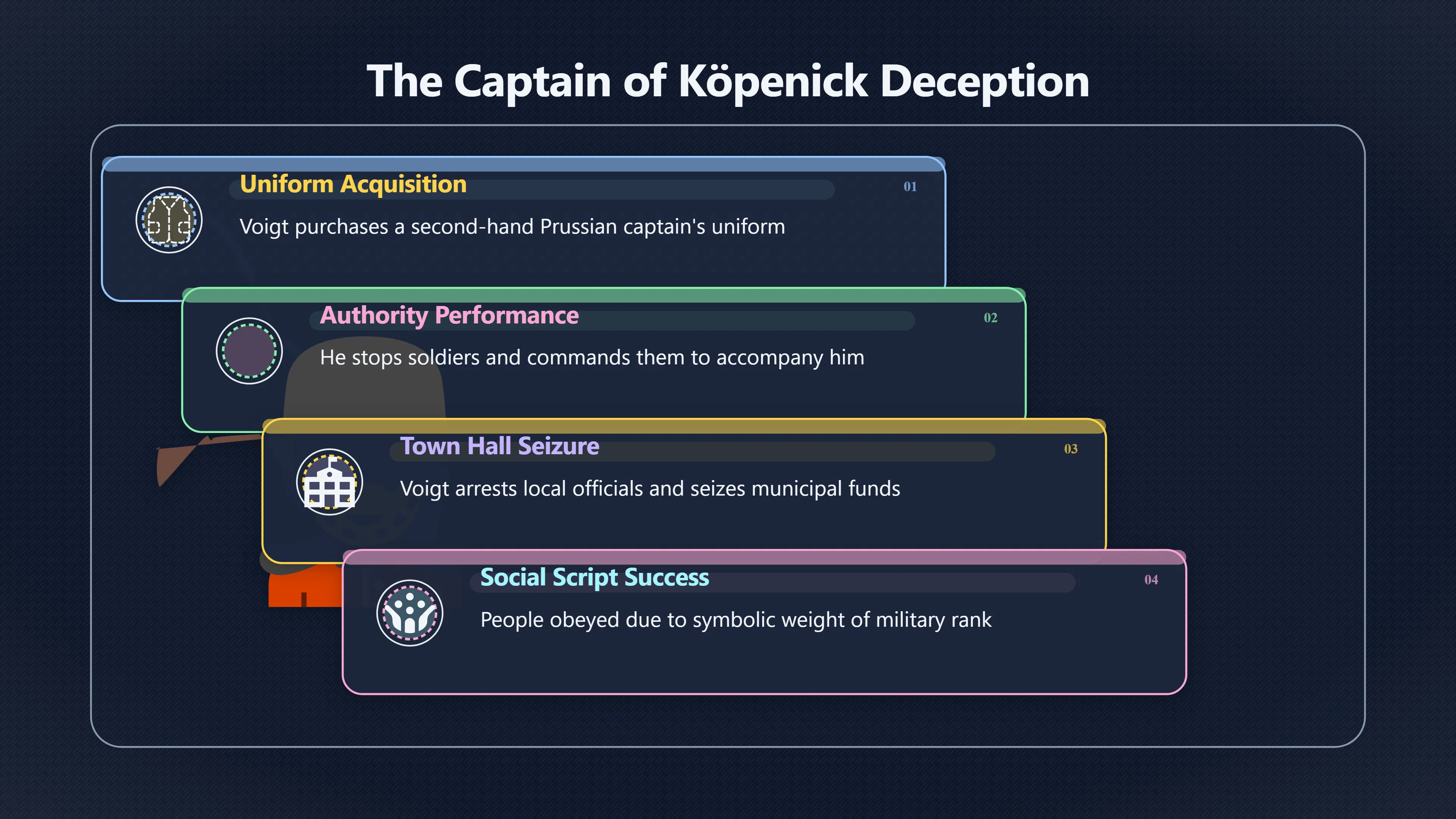
How a uniform opened Köpenick town hall
In October 1906, the former shoemaker and convicted fraudster Friedrich Wilhelm Voigt put on a second-hand Prussian captain’s uniform and transformed himself, at least temporarily, into an unquestioned authority figure. He stopped soldiers in Berlin, ordered them to accompany him, travelled to the town hall in Köpenick, arrested local officials and seized municipal funds. Remarkably, most of the people involved obeyed him without demanding convincing documentation.[wikipedia.org]WikipediaWilhelm VoigtMay 11, 2003 — Friedrich Wilhelm Voigt was a German con man and impostor. In his most famous exploit, Voigt masqueraded as a military off…
The deception succeeded because the uniform itself functioned as evidence. Imperial Germany placed enormous symbolic weight on military rank and discipline. Soldiers were trained to obey apparent superiors, and civilians were accustomed to treating officers with deference. Voigt exploited these expectations. Once observers accepted the visual signal of authority, his confident behaviour filled in the rest of the story. The performance generated its own credibility.[historynet.com]historynet.comcaptain of kopenickHistoryNet'Captain of Köpenick'4 Mar 2020 — In October 1906, a man in a Prussian captain's uniform arrested the mayor and treasurer of Kö…
What makes the Captain of Köpenick episode especially revealing is that many participants were not fooled by a sophisticated lie. They were persuaded by a social script. The uniform, commands and military bearing created a situation in which questioning the apparent officer seemed less reasonable than obeying him. Later retellings turned Voigt into a folk hero and a satirical symbol of excessive respect for hierarchy. The affair became famous precisely because it exposed how easily visible authority could substitute for genuine verification.[jstor.org]jstor.orgThe Captain of Köpenick and the Uniform Fantasies…by J Schneider · 2022 · Cited by 1 — Even the Berlin court found at his trial t…
How Clever Hans read unconscious human cues
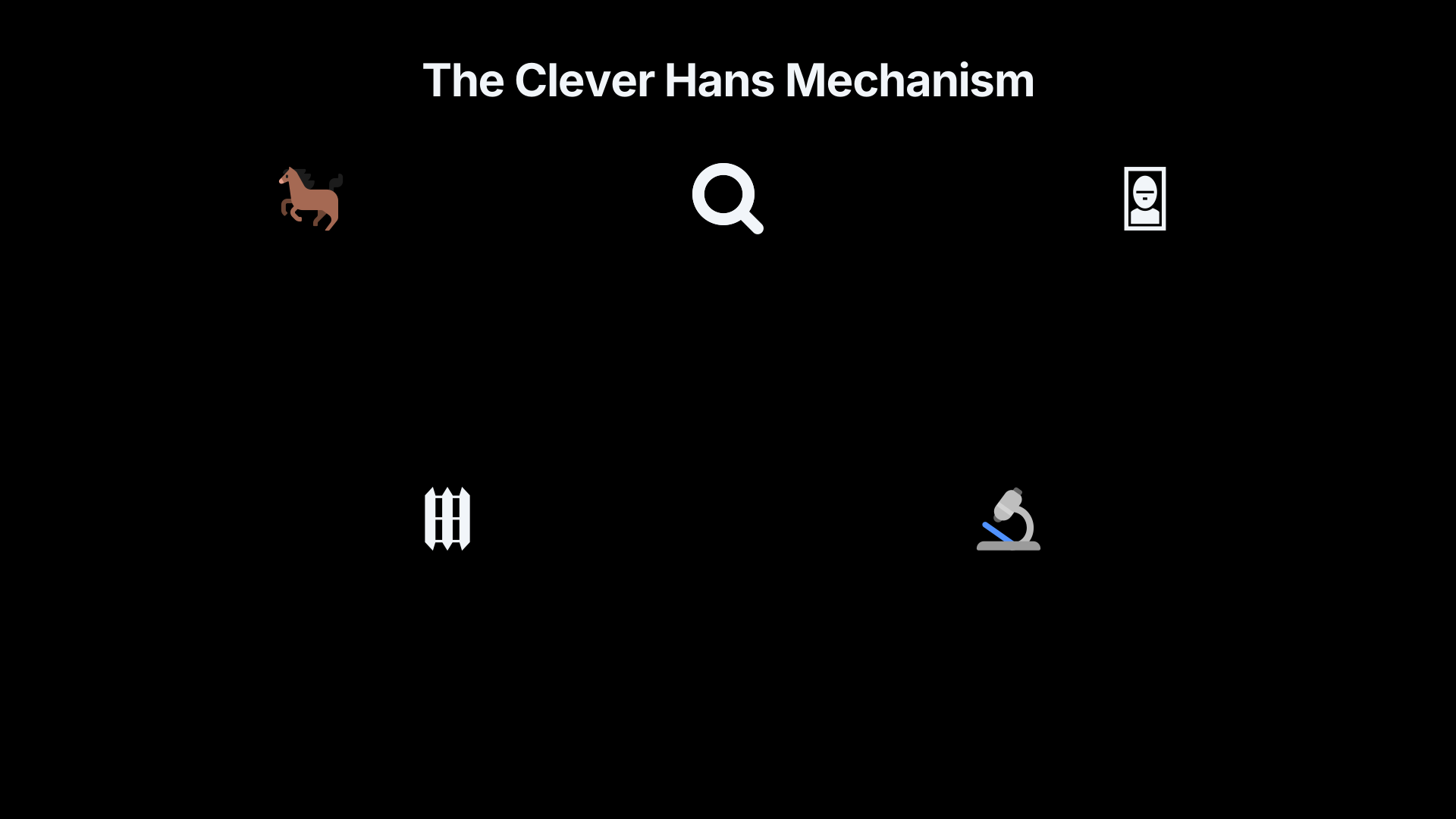
Only a few years earlier, Germany had become fascinated by another remarkable performer. Clever Hans was a horse owned by Wilhelm von Osten, a retired schoolteacher who believed animals could be educated to perform intellectual tasks. During public demonstrations Hans appeared able to solve arithmetic problems, identify dates, spell words and answer questions by tapping his hoof. Audiences, journalists and many observers were astonished.[wikipedia.org]WikipediaClever HansClever Hans
The case became so well known that a commission of experts was assembled in 1904 to investigate. Importantly, the commission found no evidence of obvious trickery. Hans appeared to succeed under conditions that seemed to rule out conventional fraud. This early investigation helped strengthen public confidence in the horse’s supposed abilities.[Wikipedia]WikipediaClever HansClever Hans
The mystery was eventually solved by psychologist Oskar Pfungst. Rather than asking whether von Osten was cheating, Pfungst examined exactly when Hans succeeded and when he failed. Through systematic tests he discovered that the horse performed well only when it could see a person who knew the correct answer. When visual access was blocked, or when the questioner did not know the answer, Hans’s accuracy collapsed.[Wikipedia]WikipediaClever HansClever Hans
Pfungst concluded that Hans was responding to tiny, unconscious signals. As the horse approached the correct number of taps, questioners would subtly change posture, facial tension or expression. When the correct answer was reached, that tension relaxed. Hans had become extraordinarily skilled at detecting these involuntary cues. The horse was not secretly calculating; it was reading people.[wikipedia.org]WikipediaClever HansClever Hans
The discovery became one of the most influential lessons in modern psychology. Researchers still refer to the “Clever Hans effect” when subjects appear successful because they are responding to unintended clues rather than demonstrating the ability being tested.[wikipedia.org]WikipediaOskar PfungstOskar Pfungst
What both cases reveal about testing appearances
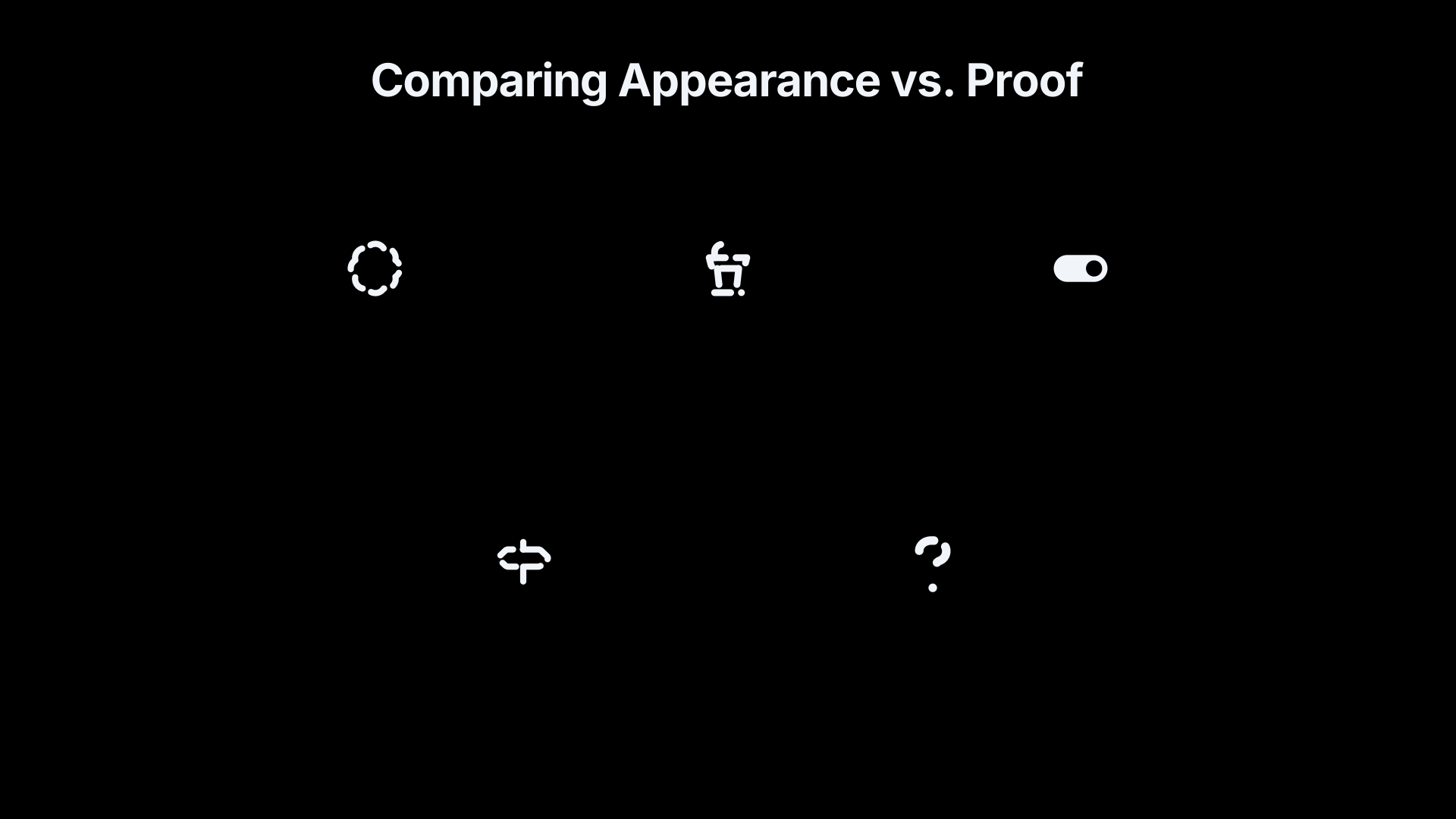
At first glance, the Captain of Köpenick and Clever Hans seem unrelated. One involved an impostor in a uniform; the other a horse in a scientific controversy. Yet both demonstrate the same underlying problem: people often treat appearances as evidence.
In the Köpenick affair, authority appeared real because it matched familiar visual signals. In the Hans case, intelligence appeared real because observers saw apparently successful performances. In both episodes, audiences believed they were witnessing direct proof. The crucial mistake was failing to examine the mechanism producing that proof.[historynet.com]historynet.comcaptain of kopenickHistoryNet'Captain of Köpenick'4 Mar 2020 — In October 1906, a man in a Prussian captain's uniform arrested the mayor and treasurer of Kö…
The investigations that exposed the truth also shared a common feature. Debunkers did not merely ask whether the claim sounded plausible. They altered the conditions of the performance. Voigt’s authority vanished once officials checked who he actually was. Hans’s mathematical talent vanished when access to unconscious human cues was removed. Changing the conditions revealed what the performance truly depended upon.[Wikipedia]WikipediaWilhelm VoigtMay 11, 2003 — Friedrich Wilhelm Voigt was a German con man and impostor. In his most famous exploit, Voigt masqueraded as a military off…
These cases remain influential because they illustrate a broader principle in the history of hoaxes and mistaken beliefs: convincing demonstrations are not necessarily reliable demonstrations. A uniform can create authority without authority existing. A successful performance can create evidence without proving the claimed ability. The most effective tests often involve asking what invisible assumptions are making the performance work.[amusingplanet.com]amusingplanet.comwilhelm voigt amiable scoundrelAmusing PlanetWilhelm Voigt: The Amiable Scoundrel1 Dec 2025 — For a few hours on October 16, Voigt, armed with nothing more than authori…
The wider consequences of Convincing Acts
Both episodes continue to circulate in Germany’s cultural memory because they reveal weaknesses that remain familiar. People still respond to symbols of authority, impressive demonstrations and apparent expertise. Modern researchers invoke the Clever Hans effect when discussing experimental bias, while the Captain of Köpenick remains a shorthand for the power of status and institutional deference.[wikipedia.org]WikipediaOskar PfungstOskar Pfungst
Viewed together, these stories are less about gullibility than about ordinary human shortcuts. Most people cannot verify everything they see, so they rely on signals that usually work: uniforms, confidence, expertise and successful demonstrations. The Captain of Köpenick and Clever Hans became famous because they exposed how those shortcuts can sometimes turn appearances into proof when proof has not actually been established.[historynet.com]historynet.comcaptain of kopenickHistoryNet'Captain of Köpenick'4 Mar 2020 — In October 1906, a man in a Prussian captain's uniform arrested the mayor and treasurer of Kö…
Amazon book picks
Further Reading
Books and field guides related to When Appearances Became Proof in Imperial Germany. Use these as the next step if you want deeper reading beyond the article.
The Invisible Gorilla
Shows how observation can be misleading, echoing Clever Hans lessons.
Thinking, Fast and Slow
Explains judgment errors behind accepting appearances as evidence.
Mistakes Were Made (but Not by Me)
Addresses self-justification and belief persistence.
eBay marketplace picks
Marketplace Samples
Live-tested eBay searches with available results related to this page.

Endnotes
1.
Source: Wikipedia
Title: Wilhelm Voigt
Link:https://en.wikipedia.org/wiki/Wilhelm_Voigt
Source snippet
May 11, 2003 — Friedrich Wilhelm Voigt was a German con man and impostor. In his most famous exploit, Voigt masqueraded as a military off...
Published: May 11, 2003
2.
Source: historynet.com
Title: captain of kopenick
Link:https://historynet.com/captain-of-kopenick/
Source snippet
HistoryNet'Captain of Köpenick'4 Mar 2020 — In October 1906, a man in a Prussian captain's uniform arrested the mayor and treasurer of Kö...
Published: October 1906
3.
Source: Wikipedia
Title: Clever Hans
Link:https://en.wikipedia.org/wiki/Clever_Hans
4.
Source: hoaxes.org
Title: the captain of koepenick
Link:https://hoaxes.org/archive/permalink/the_captain_of_koepenick
Source snippet
The Captain of Köpenick (1906)On October 16, 1906, an out-of-work German shoemaker named Wilhelm Voigt donned a second-hand military capt...
Published: October 16, 1906
5.
Source: factinate.com
Link:https://www.factinate.com/people/captain-kopenick-and-prank-shook-empire
Source snippet
The Captain of Köpenick And The Prank That Shook An...In October 1906, Voigt purchased a second-hand captain's uniform from a B...
Published: October 1906
6.
Source: jstor.org
Link:https://www.jstor.org/stable/27232011
Source snippet
The Captain of Köpenick and the Uniform Fantasies...by J Schneider · 2022 · Cited by 1 — Even the Berlin court found at his trial t...
7.
Source: Wikipedia
Title: The Captain of Köpenick (play)
Link:https://en.wikipedia.org/wiki/The_Captain_of_K%C3%B6penick_%28play%29
8.
Source: skeptoid.com
Link:https://skeptoid.com/episodes/633
9.
Source: Wikipedia
Title: Kluger Hans
Link:https://de.wikipedia.org/wiki/Kluger_Hans
10.
Source: Wikipedia
Title: Oskar Pfungst
Link:https://de.wikipedia.org/wiki/Oskar_Pfungst
11.
Source: Wikipedia
Title: Oskar Pfungst
Link:https://en.wikipedia.org/wiki/Oskar_Pfungst
12.
Source: pmc.ncbi.nlm.nih.gov
Title: PMCThe “Clever Hans Phenomenon” revisited
Link:https://pmc.ncbi.nlm.nih.gov/articles/PMC3921203/
13.
Source: futurelearn.com
Link:https://www.futurelearn.com/info/courses/logical-and-critical-thinking/0/steps/9163
14.
Source: link.springer.com
Link:https://link.springer.com/rwe/10.1007/978
15.
Source: clever.com
Link:https://www.clever.com/
16.
Source: youtube.com
Link:http://www.youtube.com/watch?v=FZ8wCHPlar4
17.
Source: amusingplanet.com
Title: wilhelm voigt amiable scoundrel
Link:https://www.amusingplanet.com/2025/12/wilhelm-voigt-amiable-scoundrel.html
Source snippet
Amusing PlanetWilhelm Voigt: The Amiable Scoundrel1 Dec 2025 — For a few hours on October 16, Voigt, armed with nothing more than authori...
18.
Source: damninteresting.com
Title: clever hans the math horse
Link:https://www.damninteresting.com/clever-hans-the-math-horse/
19.
Source: x.com
Link:https://x.com/SociologenHD/status/2073334648113942960
Additional References
20.
Source: deutschlandmuseum.de
Link:https://www.deutschlandmuseum.de/en/history/calendar/1906-10-16-the-captain-of-koepenick/
Source snippet
The Captain of KöpenickFriedrich Wilhelm Voigt, a shoemaker from Tilsit in East Prussia, was first imprisoned for theft...
21.
Source: weirdhistorian.com
Link:https://www.weirdhistorian.com/clever-hans-horse-knew-everything-sort/
22.
Source: reddit.com
Link:https://www.reddit.com/r/askscience/comments/izhlq6/how_is_the_clever_hans_effect_accounted_for_in/
23.
Source: reddit.com
Link:https://www.reddit.com/r/todayilearned/comments/n1avgn/til_about_clever_hans_a_horse_that_was_claimed_to/
24.
Source: gutenberg.org
Link:https://www.gutenberg.org/files/33936/33936-h/33936-h.htm
25.
Source: facebook.com
Title: our member kalus is a member of an historical reenactment group which commemorat
Link:https://www.facebook.com/GermanColonialEmpire/posts/our-member-kalus-is-a-member-of-an-historical-reenactment-group-which-commemorat/1348410077320111/
26.
Source: youtube.com
Link:http://www.youtube.com/watch?v=spkYdxTb5Jc
27.
Source: youtube.com
Link:http://www.youtube.com/watch?v=zMSJNd67DQM
28.
Source: youtube.com
Link:http://www.youtube.com/watch?v=N2Hp4sHuX5w
29.
Source: youtube.com
Link:http://www.youtube.com/watch?v=Se2_r_shLNM
Topic Tree