Within Tunisia
Did Tunisia's Army Refuse to Fire?
An unverified report that soldiers would not fire on protesters helped create courage, uncertainty and a lasting national legend.
On this page
- How the Claim Spread During the Uprising
- Why Protesters and Officials Found It Plausible
- How Rumour Became Revolutionary Memory
Page outline Jump by section
Introduction
One of the most influential stories of Tunisia’s 2010–11 revolution was also one of its most difficult to verify. As protests spread across the country and President Zine el-Abidine Ben Ali’s regime appeared increasingly unstable, reports circulated that the Tunisian army had refused orders to shoot demonstrators. The claim rapidly became a symbol of the uprising: a reassuring signal to protesters that mass participation might be safer than many had feared, and a warning to regime insiders that state repression could no longer be taken for granted.[New Lines Magazine]newlinesmag.comhow disinformation fueled the tunisian revolutionAmmar, however, refused, and without the military to defend him Ben Ali fled the country. Ammar was…Read more…
What makes this episode notable in a history of contested truth is not that the army certainly obeyed or certainly disobeyed a specific order. Rather, the crucial point is that the story spread faster than definitive evidence. During the decisive days of the revolution, uncertainty itself became politically powerful. The rumour helped shape expectations, and those expectations influenced behaviour on the streets and inside the state. Years later, the story survives as a national legend even though historians and military specialists continue to debate exactly what happened.[Belfer Center]belfercenter.orghow disinformation fueled tunisian revolution 0Ammar, however, refused, and without the military to defend him Ben Ali fled the country. Ammar was…Read more…
How the Claim Spread During the Uprising
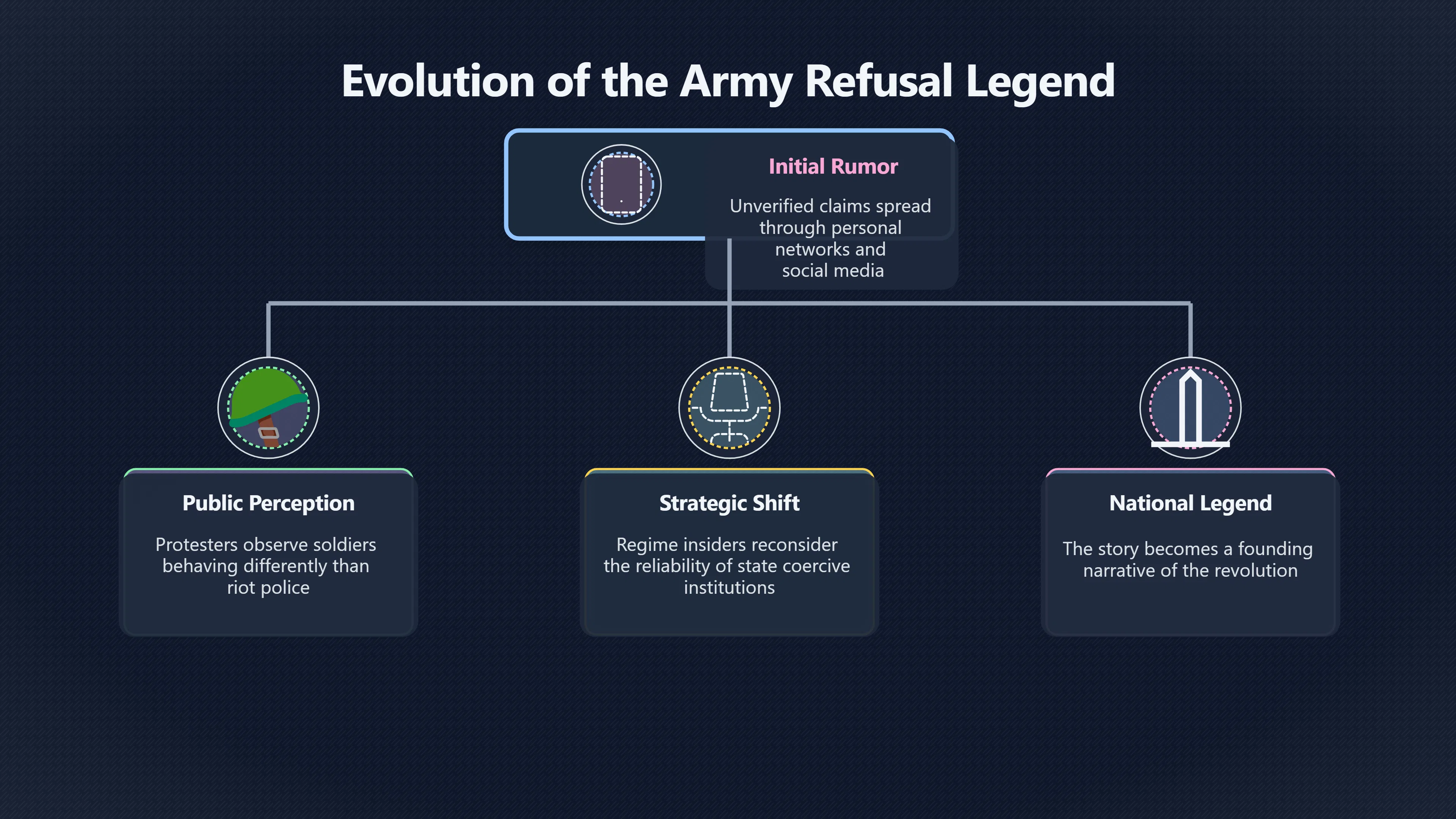
The most famous version of the story centred on General Rachid Ammar, the army chief. According to the widely repeated account, Ben Ali ordered the military to fire on protesters, Ammar refused, and the regime lost the ability to suppress the uprising by force. The narrative became so popular that Ammar was celebrated as “the man who said no”, a figure who had supposedly chosen the nation over the president.[New Lines Magazine]newlinesmag.comhow disinformation fueled the tunisian revolutionAmmar, however, refused, and without the military to defend him Ben Ali fled the country. Ammar was…Read more…
The problem is that the story circulated before clear documentation emerged. Tunisia in January 2011 was an environment of collapsing trust, fragmented information and intense political uncertainty. State media lacked credibility, independent reporting faced obstacles, and rumours travelled through personal networks, satellite television, social media and word of mouth. In that atmosphere, reports about the army’s position acquired enormous significance.[New Lines Magazine]newlinesmag.comhow disinformation fueled the tunisian revolutionAmmar, however, refused, and without the military to defend him Ben Ali fled the country. Ammar was…Read more…
As the protests expanded, many Tunisians observed a visible difference between the military and the internal security apparatus. Police and security forces were associated with the regime’s repression, while soldiers often appeared less confrontational in public spaces. This distinction made reports of military restraint seem believable even when evidence remained incomplete.[Carnegie Endowment]carnegieendowment.orga quiet revolution the tunisian military after ben aliCarnegie EndowmentA Quiet Revolution: The Tunisian Military After Ben Ali24 Feb 2016 — While General Ammar was widely rumored to have ref…
The rumour therefore functioned less like a conventional false story and more like an evolving interpretation of ambiguous events. People saw soldiers who were not behaving like riot police and concluded that the army had chosen a different side.
Why Protesters and Officials Found It Plausible
The claim gained traction because it matched existing realities, even if the details were uncertain.
For protesters, the rumour offered something invaluable: a reduction in fear. Revolutionary movements often depend on people believing that participation is possible and that repression has limits. If citizens thought the army would not massacre demonstrators, more people could join marches, strikes and public gatherings. The rumour therefore helped alter perceptions of risk.[New Lines Magazine]newlinesmag.comhow disinformation fueled the tunisian revolutionAmmar, however, refused, and without the military to defend him Ben Ali fled the country. Ammar was…Read more…
For officials within the regime, the same story carried the opposite message. If senior figures believed the army might not guarantee the president’s survival, their incentives changed. Elites frequently abandon authoritarian rulers when they sense that coercive institutions are no longer fully reliable. The mere possibility of military neutrality could therefore influence political calculations regardless of whether a formal order had ever been issued.[cddrl.fsi.stanford.edu]cddrl.fsi.stanford.eduThe Army's Decision to Repress: A Turning Point in Tunisia's…Why did the Tunisian army repressed protesters in the revolt of the Gafsa…
The claim also appeared plausible because Tunisia’s military occupied a distinctive position within the state. Unlike the security services, the army had historically played a more limited political role. Scholars examining the revolution have argued that military leaders saw little advantage in becoming the regime’s primary instrument of repression during the uprising.[cddrl.fsi.stanford.edu]cddrl.fsi.stanford.eduThe Army's Decision to Repress: A Turning Point in Tunisia's…Why did the Tunisian army repressed protesters in the revolt of the Gafsa…
Importantly, plausibility is not proof. A believable rumour can influence events long before anyone establishes whether it is fully accurate.

Was There Really an Order to Fire?
This question remains at the centre of the debate.
Some accounts maintain that Ammar rejected a direct order to shoot protesters and that this refusal was a decisive factor in Ben Ali’s downfall. The story has appeared repeatedly in media coverage, memoirs and popular retellings of the revolution.[New Lines Magazine]newlinesmag.comhow disinformation fueled the tunisian revolutionAmmar, however, refused, and without the military to defend him Ben Ali fled the country. Ammar was…Read more…
However, later research and interviews have cast doubt on the simplest version of the narrative. Analysts writing about the revolution have noted that evidence for a specific order-and-refusal confrontation is surprisingly thin. Some scholars and military observers argue that no such direct order has ever been conclusively documented. Others suggest that the reality was more complex, involving negotiations, institutional interests and strategic calculations rather than a single dramatic act of defiance.[belfercenter.org]belfercenter.orghow disinformation fueled tunisian revolution 0Ammar, however, refused, and without the military to defend him Ben Ali fled the country. Ammar was…Read more…
The distinction matters because popular memory often compresses complicated events into a single symbolic moment. A revolution involving thousands of actors, shifting loyalties and uncertain information is easier to remember as the story of one general refusing one order.
Yet even critics of the legend generally acknowledge that the Tunisian military did not become the regime’s principal tool for crushing the uprising in the way many protesters feared. The debate concerns the mechanism and the details, not the broader perception that the army behaved differently from the security forces.[Carnegie Endowment]carnegieendowment.orga quiet revolution the tunisian military after ben aliCarnegie EndowmentA Quiet Revolution: The Tunisian Military After Ben Ali24 Feb 2016 — While General Ammar was widely rumored to have ref…
How Rumour Became Revolutionary Memory
After Ben Ali fled Tunisia on 14 January 2011, the army-refusal story became embedded in public memory. Ammar emerged as one of the most popular figures in the country, and the rumour became part of the revolution’s founding narrative.[Carnegie Endowment]carnegieendowment.orgCarnegie EndowmentA Quiet Revolution: The Tunisian Military After Ben Ali24 Feb 2016 — The rumor that General Rachid Ammar refused the or…
This transformation illustrates how revolutionary myths are created. A rumour that begins as an attempt to explain uncertain events can become a collective memory that expresses what people believe happened in a broader moral sense. Many Tunisians saw the story as capturing a larger truth: that the regime ultimately failed because not every state institution was willing to defend it at any cost.[Carnegie Endowment]carnegieendowment.orgCarnegie EndowmentA Quiet Revolution: The Tunisian Military After Ben Ali24 Feb 2016 — The rumor that General Rachid Ammar refused the or…
At the same time, later investigations and legal controversies surrounding the revolution complicated the heroic image. Questions about responsibility for deaths during the uprising and debates over the military’s conduct encouraged a more nuanced reassessment of events. The result has not been a complete rejection of the story but a gradual recognition that the historical record is more ambiguous than the legend suggests.[JusticeInfo.net]justiceinfo.netJustice Info.net Tunisia: General Rachid Ammar, a 'hero of the revolutionJustice Info.net Tunisia: General Rachid Ammar, a 'hero of the revolution
The episode therefore occupies an unusual place in Tunisia’s history of contested truth. It was not a fabricated newspaper hoax, a forged document or a deliberate scam. Instead, it was an unverified claim that became politically consequential before it could be conclusively checked. The rumour mattered because people acted on it.
What the Story Reveals About Revolutions and Information
The army-refusal rumour demonstrates a broader lesson about moments of political upheaval: information does not have to be fully verified to alter events. During revolutions, people make decisions based on expectations, probabilities and signals from others. A believable report can change behaviour even when its factual status remains uncertain.[New Lines Magazine]newlinesmag.comhow disinformation fueled the tunisian revolutionAmmar, however, refused, and without the military to defend him Ben Ali fled the country. Ammar was…Read more…
In Tunisia, the claim that soldiers would not fire on protesters helped create a new psychological environment. Protesters gained confidence, regime supporters faced uncertainty, and observers began to imagine a post-Ben Ali future. Whether the famous confrontation occurred exactly as later retellings describe it is still debated. What is far less disputed is that the rumour itself became part of the revolutionary process.[Belfer Center]belfercenter.orghow disinformation fueled tunisian revolution 0Ammar, however, refused, and without the military to defend him Ben Ali fled the country. Ammar was…Read more…
For that reason, the story remains one of the most revealing examples in modern Tunisian history of how uncertain information can acquire the force of political reality. The claim’s power came not from definitive proof, but from the fact that enough people believed it at a decisive moment.[New Lines Magazine]newlinesmag.comhow disinformation fueled the tunisian revolutionAmmar, however, refused, and without the military to defend him Ben Ali fled the country. Ammar was…Read more…
Amazon book picks
Further Reading
Books and field guides related to Did Tunisia's Army Refuse to Fire?. Use these as the next step if you want deeper reading beyond the article.
eBay marketplace picks
Marketplace Samples
Live-tested eBay searches with available results related to this page.



Endnotes
1.
Source: cddrl.fsi.stanford.edu
Link:https://cddrl.fsi.stanford.edu/publications/the_armys_decision_to_repress_a_turning_point_in_tunisias_regime_change
Source snippet
The Army's Decision to Repress: A Turning Point in Tunisia's...Why did the Tunisian army repressed protesters in the revolt of the Gafsa...
2.
Source: storymaps.arcgis.com
Title: Arc GIS Story Maps Military Influence on the Tunisian Arab Spring
Link:https://storymaps.arcgis.com/stories/23cd374e675d4043aee88a02d44d345b
3.
Source: justiceinfo.net
Title: Justice Info.net Tunisia: General Rachid Ammar, a ‘hero of the revolution
Link:https://www.justiceinfo.net/en/87785-tunisia-general-rachid-ammar-hero-revolution-charged-with-homicide.html
4.
Source: justiceinfo.net
Title: 25416 remembering january 2011 with light on tunisia army abuses
Link:https://www.justiceinfo.net/en/25416-remembering-january-2011-with-light-on-tunisia-army-abuses.html
Published: january 2011
5.
Source: newlinesmag.com
Title: how disinformation fueled the tunisian revolution
Link:https://newlinesmag.com/essays/how-disinformation-fueled-the-tunisian-revolution/
Source snippet
Ammar, however, refused, and without the military to defend him Ben Ali fled the country. Ammar was...Read more...
6.
Source: carnegieendowment.org
Link:https://carnegieendowment.org/russia-eurasia/research/2016/02/a-quiet-revolution-the-tunisian-military-after-ben-ali
Source snippet
Carnegie EndowmentA Quiet Revolution: The Tunisian Military After Ben Ali24 Feb 2016 — The rumor that General Rachid Ammar refused the or...
7.
Source: belfercenter.org
Title: how disinformation fueled tunisian revolution 0
Link:https://www.belfercenter.org/publication/how-disinformation-fueled-tunisian-revolution-0
Source snippet
Ammar, however, refused, and without the military to defend him Ben Ali fled the country. Ammar was...Read more...
8.
Source: carnegieendowment.org
Title: a quiet revolution the tunisian military after ben ali
Link:https://carnegieendowment.org/research/2016/02/a-quiet-revolution-the-tunisian-military-after-ben-ali
Source snippet
Carnegie EndowmentA Quiet Revolution: The Tunisian Military After Ben Ali24 Feb 2016 — While General Ammar was widely rumored to have ref...
9.
Source: Wikipedia
Link:https://en.wikipedia.org/wiki/Tunisia
Additional References
10.
Source: fondemos.com
Title: tunisia the divergent paths taken by the security forces in 2011
Link:https://www.fondemos.com/en/the-fondemos-review/case-study/tunisia-the-divergent-paths-taken-by-the-security-forces-in-2011/
Source snippet
Tunisia: the divergent paths taken by the security forces in...3 Feb 2026 — General Rachid Ammar reportedly refused a direct order from...
11.
Source: youtube.com
Title: Tunisian Colonel recalls departure of former ruler
Link:https://www.youtube.com/watch?v=hwGQdazRPMM
Source snippet
Tunisian revolution 2011 documentary army Tunisia Revolution A historic moment "CLEAR" mmxanonymous...
12.
Source: youtube.com
Title: Soldiers of Democracy? Military Legacies and the Arab Spring
Link:https://www.youtube.com/watch?v=ym7soZRfpZA
Source snippet
"Unhealthy Norms" | Sharan Grewal on U.S. Training for Foreign Militaries...
13.
Source: airuniversity.af.edu
Title: signesmida e
Link:https://www.airuniversity.af.edu/Portals/10/ASPJ_French/journals_E/Volume-07_Issue-2/signesmida_e.pdf
Source snippet
Air UniversityActions of the Tunisian Army in Gafsa in 2008 and during the...by PHD LANDRY SIGNÉ — This article is the first attempt to...
14.
Source: usafa.edu
Link:https://www.usafa.edu/app/uploads/Arbiters-of-Social-Unrest-Military-Responses-to-the-Arab-Spring-Parsons-Taylor.pdf
15.
Source: tni.org
Link:https://www.tni.org/files/2023-01/the_arab_uprisings_a_decade_of_struggles.pdf
16.
Source: ebsco.com
Link:https://www.ebsco.com/research-starters/politics-and-government/tunisian-uprising
17.
Source: youtube.com
Title: “Unhealthy Norms” | Sharan Grewal on U.S. Training for Foreign Militaries
Link:https://www.youtube.com/watch?v=HJdQzyth8p8
Source snippet
What Sparked Tunisian Revolution?...
18.
Source: youtube.com
Link:https://www.youtube.com/watch?v=5geKqaKY1Fw
19.
Source: youtube.com
Link:https://www.youtube.com/watch?v=yl6Mt-hIDto
Topic Tree