Which Bolivian Mysteries Survive the Evidence?
Bolivia’s best-known stories of deception are not dominated by a single spectacular fraud.
Page outline Jump by section
Introduction
Some of these stories may involve deliberate fabrication. Others are better described as pseudoscience, commercial exaggeration, partisan propaganda or sincere misinterpretation. That distinction matters. A forged artefact has a maker and an intention; an archaeological myth may grow through repeated copying, selective photographs and the removal of inconvenient context. Bolivia’s cases show that a claim does not need a single hoaxer to become a durable falsehood. It needs an evocative object, an uncertain gap in the record and promoters willing to tell a simpler, more dramatic story than the evidence supports.
The “Sumerian” relics of Lake Titicaca
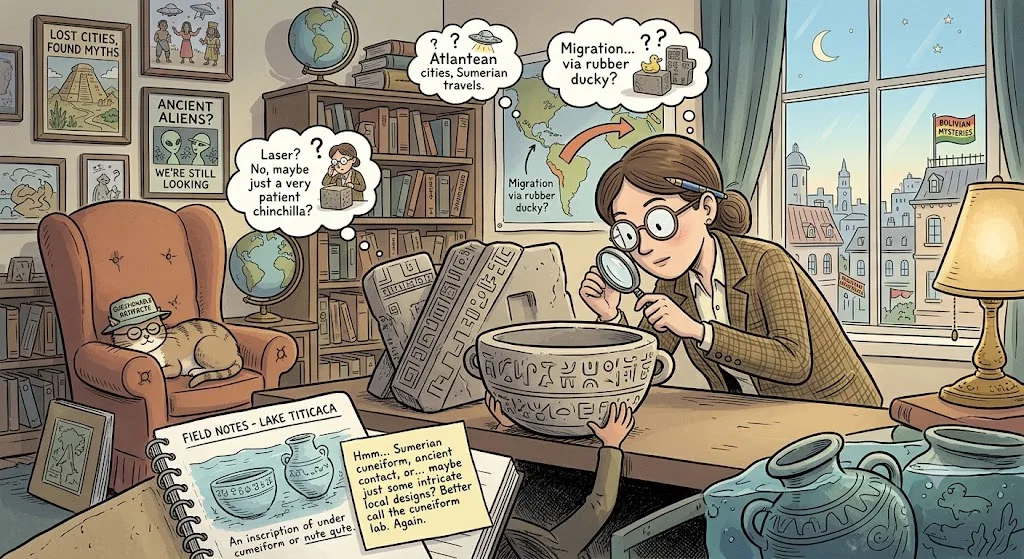
The Fuente Magna bowl is often presented online as one of archaeology’s forbidden discoveries: a stone vessel supposedly found near Lake Titicaca and inscribed in an ancient Mesopotamian script. In its strongest form, the claim says that Sumerians reached Bolivia thousands of years before Columbus, leaving written proof of transoceanic contact.
The central problem is not that such contact is philosophically impossible. It is that the object lacks a secure archaeological context. The bowl was not excavated under controlled conditions, and the story of its discovery circulated long before the markings received sustained attention as alleged cuneiform. The American Schools of Overseas Research notes that Bolivian journalist Mario Montaño Aragón appears to have been an early promoter of the cuneiform interpretation, linking it to a wider theory of ancient Semitic influence in the Andes.[asor.org]asor.orgask near eastern professionalANE TODAY – 201609 – Ask a Near Eastern Professional…January 24, 2018 — In the case of the Fuente Magna bowl, the first person to see…
The purported translation was later championed by Clyde Winters, who identified the marks as an early Sumerian script and constructed an elaborate account of Mesopotamian settlement in South America. His argument depends on matching selected scratches to characters from unrelated writing systems and then assigning them a coherent religious text. The resulting interpretation is widely reproduced on mystery websites, usually without independent confirmation from specialists in cuneiform, Andean archaeology or the history of writing.[faculty.ucr.edu]faculty.ucr.eduThe Decipherment of the Fuente Magna BowlIt is believed that the Fuente Magna was probably crafted by Sumerian people who settled in Boli…
A sceptical examination reaches a less exciting conclusion. The marks do not form recognised Sumerian cuneiform, the claimed translation is not reproducible, and the absence of documented provenance prevents the bowl from serving as evidence for ancient contact. Archaeological provenance means knowing precisely where an object was found, in which soil layer and alongside what other material. Without it, researchers cannot reliably establish age, association or authenticity. One detailed critical review consequently judges the bowl likely to be a modern creation or alteration rather than an excavated ancient text.[Archaeology Review]ahotcupofjoe.netIt was likely created shortly before it was allegedly foundArchaeology ReviewThe Fuente Magna Bowl: Not Cuneiform and not SumerianNovember 26, 2017 — 25 Nov 2017 — The bowl itself is without archa…
The nearby Pokotia monolith has been drawn into the same narrative. Promoters claim that lines and surface marks on the sculpture constitute “linear Sumerian” writing and that they support the Fuente Magna translation. Yet these readings circulate mainly through alternative-history publications and pages reproducing Winters’s interpretation, not through peer-reviewed studies of Tiwanaku sculpture or ancient Mesopotamian languages. By contrast, current archaeological research treats Tiwanaku monoliths through their stone sources, imagery, ritual setting and relationships with other Andean objects—not as misplaced Near Eastern documents.[ancient-origins.net]ancient-origins.netexceptional inscription pokotia monument evidence sumerian script bolivia 021392This makes the text very significant because it supports the discovery of Sumerian symbols on the…Read more…
It is therefore safest to describe the Fuente Magna and Pokotia claims as unsupported pseudohistory, with the possibility of modern alteration particularly serious in the bowl’s case. Calling either object a conclusively exposed forgery would go beyond the public evidence: no identified forger has confessed, and no complete scientific investigation has established exactly when every disputed mark was made. What has failed is the extraordinary interpretation. There is no credible chain of evidence linking the objects to Sumerian travellers.
The story survives because it reverses a familiar historical hierarchy. Instead of Europe “discovering” the Americas, it imagines ancient peoples crossing oceans and participating in a forgotten global civilisation. That idea can feel liberating, but it also diminishes the real achievement of Andean societies by explaining local culture through foreign visitors.
How Tiwanaku became an “impossible” city
Tiwanaku and its Pumapunku complex contain precisely cut stone blocks, monumental platforms and sophisticated architectural planning. Their quality has made them a favourite setting for claims that ancient Bolivians could not have built them unaided.
Television programmes and online videos commonly add several assertions: that Pumapunku is about 12,000 or 14,000 years old, that its stones were cut by lasers or machine tools, that they fit with modern industrial tolerances, and that the site appeared without a developmental history. One episode description for Ancient Aliens, for example, advertised Pumapunku as nearly 14,000 years old and inexplicable to conventional archaeology.[IMDb]imdb.comNo one knows who designed and built this complexIMDb"Ancient Aliens" Mystery of Puma Punku (TV Episode 2012)At nearly 14,000 years old, the ruins of Puma Punku are the oldest and most b…
The archaeological record tells a different story. Tiwanaku developed through a long regional history and emerged as a major urban and ceremonial centre during the first millennium AD. Scholarly accounts generally place its urban expansion from around AD 500 or 600, while UNESCO describes it as the political and spiritual centre of a major pre-Hispanic culture whose builders mastered the carving and polishing of several kinds of stone.[unesco.org]whc.unesco.orgOpen source on unesco.org.
Pumapunku was not a mysterious structure dropped intact onto the landscape. It was part of a wider architectural programme involving platforms, plazas, portals and ceremonial routes. Some sections were unfinished, damaged or displaced; later generations also quarried the ruins for building stone. This helps explain the scattered blocks that fringe media often present as the remains of a sudden ancient catastrophe.[Cambridge Assets]assets.cambridge.org9780521816359 excerpt9780521816359 excerpt
Nor are the stones evidence of computer-guided machinery. Researchers have studied quarry sources, transport distances and carving sequences. Sandstone was used extensively in major structures, with andesite incorporated into architecture and sculpture during later phases. The survival of unfinished surfaces and intermediate stages of carving is especially important: it shows workmanship in progress rather than objects produced instantaneously by an unknown technology.[Cambridge University Press & Assessment]cambridge.orgthey areCambridge University Press & AssessmentAnalysis of the Bennett and Ponce Monoliths of Tiwanaku…by JV Criales · 2025 · Cited by 6 — San…
There are genuine unanswered questions. Archaeologists do not possess every tool used at the site, and experimental reconstructions cannot reproduce every feature with certainty. But “some techniques remain uncertain” is not equivalent to “the builders lacked the ability”. Stone-working experiments have demonstrated that fine geometric forms can be produced with plausible stone tools, patience and specialist knowledge. The work was difficult and skilled, not supernatural.[Wikipedia]WikipediaOpen source on wikipedia.org.
The extraterrestrial version spreads partly through photographic selection. Close-ups isolate the most regular blocks, while unfinished stones, construction debris and the broader settlement disappear from view. Numerical claims are repeated without measurements, and uncertainty about a particular tool becomes evidence of an entirely different civilisation. The argument also rests on an old prejudice: that impressive Indigenous engineering must have come from outsiders.
The corrective is not to pretend that Tiwanaku is fully understood. It is to treat its mysteries as archaeological questions about labour, landscape, political authority and craft learning. Those questions are more demanding—and ultimately more interesting—than the claim that aliens did it.
The sunken city that was really a series of sites
Lake Titicaca genuinely contains submerged archaeological material. That fact has encouraged a second layer of claims about intact cities, paved streets and an Andean Atlantis beneath the water.
Systematic underwater work has found substantial evidence. UNESCO reports that Bolivian investigations beginning in 2012 involved more than 1,350 dives and identified about twenty submerged sites and over 20,000 objects spanning the Tiwanaku and Inca periods. The discoveries are important for understanding ritual offerings, exchange and the changing use of the lakeshore.[UNESCO]unesco.orgprotecting underwater cultural heritage lake titicacaprotecting underwater cultural heritage lake titicaca
Research around Khoa Reef, near the Island of the Sun, also uncovered ritual deposits including ornaments, ceramics and animal remains. These finds indicate organised ceremonial activity on and around the lake, not merely accidental loss.[The Guardian]theguardian.comThe Guardian Archaeologists discover 'exceptional' site at Lake TiticacaThe Guardian Archaeologists discover 'exceptional' site at Lake Titicaca
Popular retellings often make a subtle but crucial substitution. “Submerged archaeological sites” becomes “a submerged city”; ritual deposits become the contents of temples; walls or foundations become streets belonging to a lost metropolis. Tourist pages have repeated claims that a complete temple and neighbouring city were discovered around 2000, sometimes presenting the event as proof that an old legend had been confirmed.[Machu Picchu Trek]machupicchutrek.netMachu Picchu Trek Lake Titicaca RuinsMachu Picchu Trek Lake Titicaca Ruins
The evidence supports neither a single intact city nor an Andean Atlantis. Lake levels and shorelines have changed, and people used islands, reefs and lakeside settlements over many centuries. Material may now lie underwater because of environmental change, erosion, deliberate deposition or activity close to former shorelines. A collection of sites from different periods should not be compressed into one vanished urban centre.
This is an example of exaggeration growing around real science rather than a wholly invented hoax. Archaeologists did find remarkable objects. The misleading step was packaging a complex regional record as a spectacular lost-city revelation. That version offers clearer images and better headlines, but it obscures what the discoveries actually show: Lake Titicaca was a sacred and politically important landscape whose waters formed part of ritual life.
The 2019 election and the danger of declaring a hoax too quickly
The disputed Bolivian presidential election of October 2019 belongs in a different category. It was not an antiquities fraud or folklore tale, but a struggle over statistical evidence in which the words “fraud”, “coup” and “false narrative” acquired immediate political force.
Evo Morales needed either a majority of votes or a lead of at least ten percentage points to avoid a second round. A preliminary reporting system stopped updating publicly when about 84 per cent of votes had been processed. When reporting resumed, Morales’s margin had widened sufficiently to raise the prospect of a first-round victory. The interruption, together with circulating videos and claims of irregular ballot handling, triggered protests before the final count was complete.[The Guardian]theguardian.comOpen source on theguardian.com.
The Organisation of American States initially described the changing trend as difficult to explain. Its later audit reported serious irregularities and concluded that the declared result could not be validated. The organisation has repeatedly stressed that its conclusions did not rest on a statistical trend alone but also on findings concerning electoral computer systems, records and the chain of custody.[Organization of American States]oas.orgpress release.asppress release.asp
Other researchers challenged a central part of the public fraud narrative. Analyses associated with the Center for Economic and Policy Research argued that later-reporting areas were more favourable to Morales and that his final margin could be predicted from patterns visible before the interruption. In that account, the change was not an inexplicable jump but a geographical effect of votes arriving in a non-random order.[CEPR]cepr.netanalysis of the 2019 bolivia electionanalysis of the 2019 bolivia election
Critics of those analyses responded that explaining the broad trend did not resolve every documented irregularity. They argued that statistical work aimed at the ten-point margin addressed only part of the OAS case and could not by itself prove that the entire process was clean.[The Washington Post]washingtonpost.comyes bolivias 2019 election was problematic heres whyyes bolivias 2019 election was problematic heres why
The responsible conclusion is narrower than the slogans used in 2019. The claim that a late change in the preliminary count was, by itself, proof of fraud was not justified. Later statistical research demonstrated plausible non-fraudulent reasons for Morales’s growing lead. At the same time, this does not automatically erase every procedural and technical concern raised by the OAS audit.
This episode shows how contested evidence becomes propaganda. A suspicious-looking graph was easier to communicate than the mechanics of geographically ordered vote reporting. Once political action accelerated, later distinctions—between statistical anomaly, administrative failure, manipulation and outcome-changing fraud—struggled to catch up. Each side could then accuse the other of perpetrating the real hoax.
The case remains unusually sensitive because the consequences were immediate: mass unrest, Morales’s resignation under military pressure, an interim government and continuing argument over whether Bolivia had experienced electoral fraud, a coup, or both institutional failure and anti-democratic intervention. It is better treated as a disputed evidential crisis than filed under a simple list of proven hoaxes.
Why Bolivia attracts stories of forbidden history
The strongest Bolivian examples share several mechanisms even when their subjects are very different.
A gap becomes proof. Missing excavation records around the Fuente Magna bowl are treated not as a reason for caution but as evidence that institutions are suppressing it. Unknown details of Tiwanaku stone-working are converted into proof that ordinary explanations are impossible.
Real objects lend authority to invented narratives. The bowl exists. Pumapunku’s masonry is extraordinary. Lake Titicaca contains archaeological sites. The deception or distortion lies in the story attached to the evidence, not necessarily in the physical evidence itself.
Foreign explanations overshadow local achievement. Sumerians, Atlanteans and extraterrestrials are repeatedly credited with Bolivian monuments. Such claims can sound admiring while reproducing the assumption that Indigenous societies could not have developed complex engineering, political organisation or scientific knowledge.
Media reward certainty. “Archaeologists investigate a network of submerged ritual locations” is accurate but less marketable than “lost city discovered”. Television and social platforms also favour isolated visual puzzles: a sharply cut block, an unfamiliar skull or a row of scratches that resembles writing.
Correction is slower than promotion. A sensational claim can be expressed in one sentence. Explaining provenance, geological sourcing, statistical sampling or cultural chronology requires time. Once an image has been detached from its original context, later debunking may appear to believers as part of the alleged cover-up.
Bolivia’s history of contested truth therefore offers a broader lesson about hoaxes. False stories are not always built from fabricated evidence. They often arise when authentic remains are stripped of context and made to answer questions they were never capable of settling. The most effective response is not ridicule but reconstruction: where the object came from, who first interpreted it, which claims were added later, what tests could be repeated and where uncertainty genuinely remains.

Amazon book picks
Further Reading
Books and field guides related to Which Bolivian Mysteries Survive the Evidence?. Use these as the next step if you want deeper reading beyond the article.
Frauds, Myths, and Mysteries: Science and Pseudoscience in Ar...
Explains how archaeological myths and unsupported claims persist.
Lost City of the Incas
Provides historical context for Andean archaeology and the creation of enduring discovery legends.
The Tiwanaku
Directly addresses the civilization behind many Bolivian archaeological claims.
Fingerprints of the Gods
Represents the kind of lost-civilisation claims discussed across multiple Bolivian mystery topics.
eBay marketplace picks
Marketplace Samples
Live-tested eBay searches with available results related to this page.

Endnotes
1.
Source: asor.org
Title: ask near eastern professional
Link:https://www.asor.org/anetoday/2016/09/ask-near-eastern-professional
Source snippet
ANE TODAY – 201609 – Ask a Near Eastern Professional...January 24, 2018 — In the case of the Fuente Magna bowl, the first person to see...
Published: January 24, 2018
2.
Source: faculty.ucr.edu
Link:https://faculty.ucr.edu/~legneref/archeol/fuentema.htm
Source snippet
The Decipherment of the Fuente Magna BowlIt is believed that the Fuente Magna was probably crafted by Sumerian people who settled in Boli...
3.
Source: ancient-origins.net
Title: exceptional inscription pokotia monument evidence sumerian script bolivia 021392
Link:https://www.ancient-origins.net/artifacts-ancient-writings/exceptional-inscription-pokotia-monument-evidence-sumerian-script-bolivia-021392
Source snippet
This makes the text very significant because it supports the discovery of Sumerian symbols on the...Read more...
4.
Source: faculty.ucr.edu
Link:https://faculty.ucr.edu/~legneref/biados/texts/monolito.htm
Source snippet
The Back and side inscriptions on the Pokotia MonolithThe inscriptions on the back of the Pokotia statue define the role of the Putaki or...
5.
Source: cambridge.org
Title: they are
Link:https://www.cambridge.org/core/journals/latin-american-antiquity/article/drunken-mountains-analysis-of-the-bennett-and-ponce-monoliths-of-tiwanaku-ad-5001100-from-a-multispecies-perspective/33F80E9D04F8E4DB292F823399C24FD5
Source snippet
Cambridge University Press & AssessmentAnalysis of the Bennett and Ponce Monoliths of Tiwanaku...by JV Criales · 2025 · Cited by 6 — San...
6.
Source: imdb.com
Title: No one knows who designed and built this complex
Link:https://www.imdb.com/title/tt2288271/
Source snippet
IMDb"Ancient Aliens" Mystery of Puma Punku (TV Episode 2012)At nearly 14,000 years old, the ruins of Puma Punku are the oldest and most b...
7.
Source: whc.unesco.org
Link:https://whc.unesco.org/en/list/567/
8.
Source: cambridge.org
Link:https://www.cambridge.org/core/books/cambridge-world-history/tiwanaku-urban-origins-distributed-centers-and-animate-landscapes/11C9A994760749C90F20F677EA617164
9.
Source: cambridge.org
Link:https://www.cambridge.org/core/journals/latin-american-antiquity/article/out-of-many-one-style-and-social-boundaries-in-tiwanaku/B302B212FF9B243CA048F761162C8C5C
10.
Source: assets.cambridge.org
Title: 9780521816359 excerpt
Link:https://assets.cambridge.org/97805218/16359/excerpt/9780521816359_excerpt.pdf
11.
Source: cambridge.org
Link:https://www.cambridge.org/core/services/aop-cambridge-core/content/view/33F80E9D04F8E4DB292F823399C24FD5/S104566352300072Xa.pdf/drunken-mountains-analysis-of-the-bennett-and-ponce-monoliths-of-tiwanaku-ad-500-1100-from-a-multispecies-perspective.pdf
12.
Source: Wikipedia
Link:https://en.wikipedia.org/wiki/Pumapunku
13.
Source: unesco.org
Title: protecting underwater cultural heritage lake titicaca
Link:https://www.unesco.org/en/articles/protecting-underwater-cultural-heritage-lake-titicaca
14.
Source: oas.org
Title: press release.asp
Link:https://www.oas.org/en/media_center/press_release.asp?sCodigo=E-109%2F19
15.
Source: oas.org
Title: press release.asp
Link:https://www.oas.org/en/media_center/press_release.asp?sCodigo=E-064%2F20
16.
Source: cepr.net
Title: analysis of the 2019 bolivia election
Link:https://cepr.net/publications/analysis-of-the-2019-bolivia-election/
17.
Source: cepr.net
Title: observing the observers the oas in the 2019 bolivian elections
Link:https://cepr.net/publications/observing-the-observers-the-oas-in-the-2019-bolivian-elections/
18.
Source: cepr.net
Title: bolivia 2020 3
Link:https://cepr.net/wp-content/uploads/2020/03/bolivia-2020-3.pdf
19.
Source: cepr.net
Link:https://cepr.net/newsroom/new-report-debunks-claims-that-bolivias-equivalent-of-the-us-electoral-blue-shift-must-be-fraudulent/
20.
Source: whc.unesco.org
Link:https://whc.unesco.org/archive/2018/whc18-42com-7B-en.pdf
21.
Source: unesdoc.unesco.org
Link:https://unesdoc.unesco.org/ark%3A/48223/pf0000219552
22.
Source: whc.unesco.org
Link:https://whc.unesco.org/archive/2013/whc13-37com-8e-en.pdf
23.
Source: unesdoc.unesco.org
Link:https://unesdoc.unesco.org/ark%3A/48223/pf0000392430
24.
Source: whc.unesco.org
Link:https://whc.unesco.org/archive/2013/whc13-37com-7B-Add-en.pdf
25.
Source: cambridge.org
Title: Early urban landscapes (Part III)
Link:https://www.cambridge.org/core/books/cambridge-world-history/early-urban-landscapes/EB9A7E5EE9220F7E6433ED6A32A2D5A4
26.
Source: cambridge.org
Link:https://www.cambridge.org/core/journals/latin-american-antiquity/article/plazas-and-processional-paths-in-tiwanaku-temples-divergence-convergence-and-encounter-at-omo-m10-moquegua-peru/B22CA2137BBD1ABC4D084D96AF178ECC
27.
Source: cambridge.org
Link:https://www.cambridge.org/core/books/understanding-collapse/collapse-in-the-andes/314E556EAFCC81D7CC9F4FFDE86DEBF5
28.
Source: cambridge.org
Link:https://www.cambridge.org/core/journals/latin-american-antiquity/article/domestic-life-and-vertical-integration-in-the-tiwanaku-heartland/EB886F435BD54D1B2413BDAD01F38239
29.
Source: ancient-origins.net
Link:https://www.ancient-origins.net/pokotia
30.
Source: ancient-origins.net
Title: puma punku 002
Link:https://www.ancient-origins.net/ancient-places-americas/puma-punku-002
31.
Source: Wikipedia
Title: List of fact checking websites
Link:https://en.wikipedia.org/wiki/List_of_fact-checking_websites
32.
Source: Wikipedia
Title: Ica stones
Link:https://en.wikipedia.org/wiki/Ica_stones
33.
Source: ahotcupofjoe.net
Title: It was likely created shortly before it was allegedly found
Link:https://ahotcupofjoe.net/2017/11/fuente-magna-bowl-not-cuneiform-not-sumerian/
Source snippet
Archaeology ReviewThe Fuente Magna Bowl: Not Cuneiform and not SumerianNovember 26, 2017 — 25 Nov 2017 — The bowl itself is without archa...
Published: November 26, 2017
34.
Source: theguardian.com
Title: The Guardian Archaeologists discover ‘exceptional’ site at Lake Titicaca
Link:https://www.theguardian.com/science/2019/apr/01/archaeologists-discover-exceptional-site-at-lake-titicaca
35.
Source: machupicchutrek.net
Title: Machu Picchu Trek Lake Titicaca Ruins
Link:https://www.machupicchutrek.net/lake-titicaca-ruins/
36.
Source: theguardian.com
Link:https://www.theguardian.com/world/2019/oct/21/bolivia-confusion-over-election-results-sparks-fear-and-protests
37.
Source: washingtonpost.com
Title: yes bolivias 2019 election was problematic heres why
Link:https://www.washingtonpost.com/politics/2020/03/10/yes-bolivias-2019-election-was-problematic-heres-why/
38.
Source: historicmysteries.com
Title: fuente magna
Link:https://www.historicmysteries.com/archaeology/fuente-magna/33818/
39.
Source: scribd.com
Title: Clyde Winters
Link:https://www.scribd.com/document/712764988/Clyde-Winters-African-Empires-in-Ancient-America-2012
40.
Source: washingtonpost.com
Link:https://www.washingtonpost.com/politics/2020/02/26/bolivia-dismissed-its-october-elections-fraudulent-our-research-found-no-reason-suspect-fraud/
Additional References
41.
Source: livescience.com
Link:https://www.livescience.com/26792-tiwanaku.html
Source snippet
Tiwanaku's development was supported by innovative agricultural techniques, such as raised-field farming and the domestication of llama a...
42.
Source: youtube.com
Title: The Fuente Magna Bowl: Did Sumerians Reach Ancient Bolivia? | Documentary
Link:https://www.youtube.com/watch?v=8AFFQ8BAKKI
Source snippet
We Were Wrong About Puma Punku - The Greatest Mystery Finally Solved...
43.
Source: youtube.com
Title: We Were Wrong About Puma Punku
Link:https://www.youtube.com/watch?v=N1l69YKj8EU
Source snippet
Ancient Aliens Guy SLAMS Other Fake Archaeologists...
44.
Source: academia.edu
Link:https://www.academia.edu/44802161/Considering_Certain_Lithic_Artifacts_of_Tiahuanaco_Tiwanaku_and_Pumapunku_Bolivia_as_Geopolymer_Constructs
45.
Source: researchgate.net
Link:https://www.researchgate.net/publication/335699977_Tiahuanaco_monuments_Tiwanaku_Pumapunku_in_Bolivia_are_made_of_geopolymer_artificial_stones_created_1400_years_ago
46.
Source: facebook.com
Link:https://www.facebook.com/JayvenDeLuca/posts/the-sumerian-script-they-found-in-the-andesbolivia-1958-a-farmer-going-about-his/926982456911235/
47.
Source: repo.darmajaya.ac.id
Link:https://repo.darmajaya.ac.id/4381/1/Fake%20News%2C%20Propaganda%2C%20and%20Plain%20Old%20Lies_%20How%20to%20Find%20Trustworthy%20Information%20in%20the%20Digital%20Age%20%28%20PDFDrive%20%29.pdf
48.
Source: facebook.com
Link:https://www.facebook.com/groups/149844915349213/posts/2210953425905008/
49.
Source: facebook.com
Link:https://www.facebook.com/groups/478956409706716/posts/2127872761481731/
50.
Source: facebook.com
Link:https://www.facebook.com/groups/852847715448660/posts/1652976298769127/
Topic Tree
Follow this branch
Related pages 192
- Albanian Hoaxes
- Algerian Hoaxes
- Antigua Deceptions
- Argentina Hoaxes
- Armenian Hoaxes
- +187 more in sidebar