Within Slovak Hoaxes
Did Velestur Forge Slovakia's Ancient Past?
The Velestur carvings promised proof of ancient Slovak literacy, but their script and discovery story point towards a nationalist-era forgery.
On this page
- What the inscription was claimed to say
- How language and letterforms exposed the forgery
- Why patriotic audiences found it convincing
Page outline Jump by section
Introduction
The Velestúr inscription is one of Slovakia’s most famous disputed artefacts because it appeared to offer something nineteenth-century national revivalists desperately wanted: proof that ancient Slovaks possessed their own written language long before the medieval period. According to its promoters, mysterious carvings on a rock near Kremnica recorded events from deep antiquity and demonstrated the existence of an ancient literate Slavic population in central Slovakia. For a time, the inscription was celebrated as evidence of a glorious and largely undocumented past.

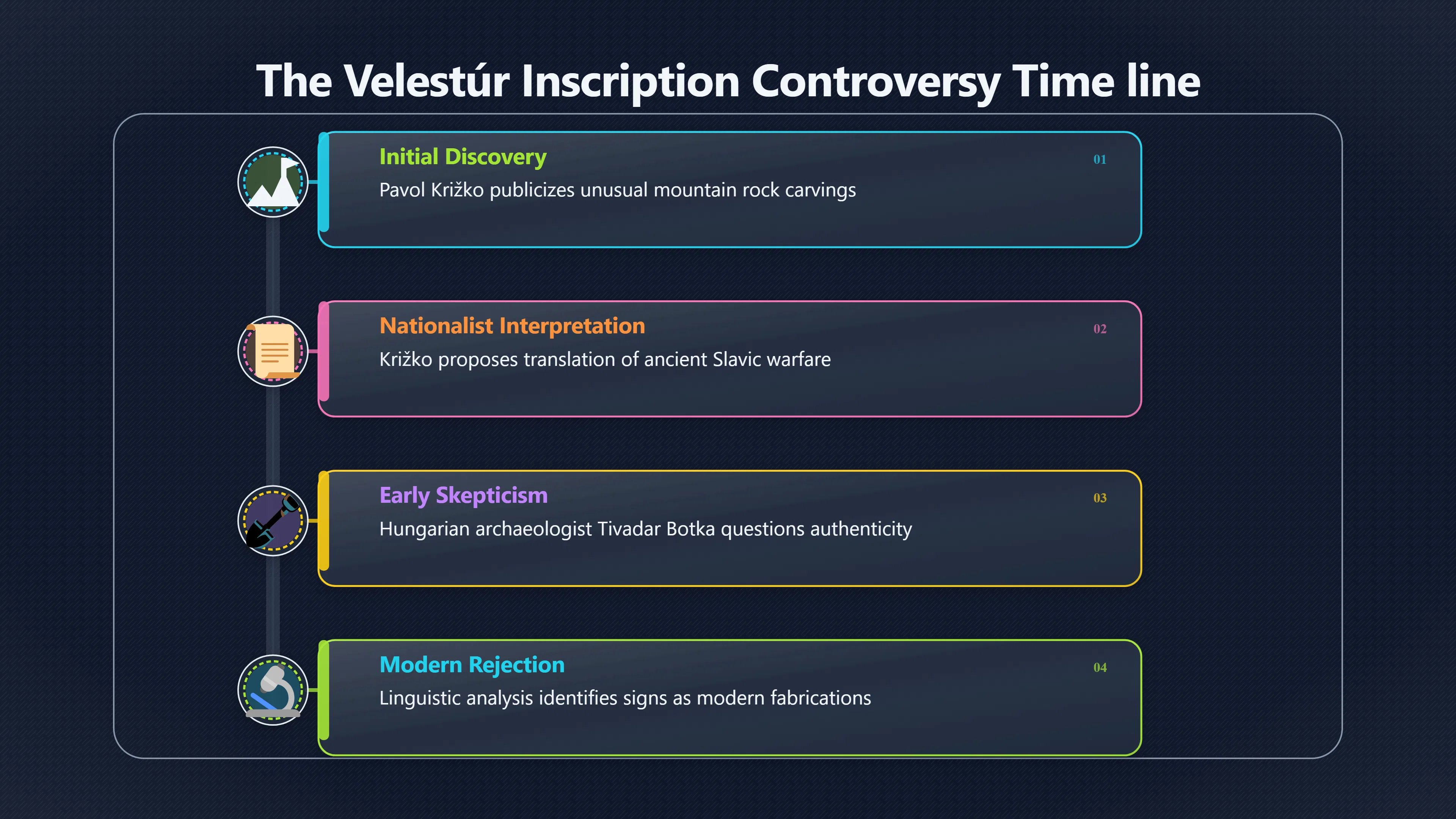
Modern scholarship has reached a very different conclusion. Linguistic analysis, comparisons with known writing systems, and investigation of the inscription’s discovery history have led most researchers to regard it as a modern fabrication or heavily altered carving rather than an authentic ancient text. The Velestúr affair remains important not merely because of the inscription itself, but because it reveals how national aspirations, weak archaeological standards and the desire for historical legitimacy can combine to create persuasive but misleading evidence.[Academia]academia.eduAcademia(PDF) Fehér SEP SUPP 1 41 52 készJanuary 1, 2022 — Fehér, Bence A SPURIOUS INSCRIPTION IN QUADIA – WRITTEN OVER AN ORIGINAL ONE?…
What the inscription was claimed to say
The story began in the 1860s when Pavol Križko, a teacher and later archivist associated with Kremnica, publicised a series of unusual rock carvings in the mountains of central Slovakia. The most famous appeared on Mount Velestúr. Križko argued that the signs formed a genuine ancient inscription and proposed a translation that described warfare and the destruction of settlements in a distant past. Other carvings were interpreted as evidence of ancient Slavic religious or historical traditions.[Academia]academia.eduAcademia(PDF) Fehér SEP SUPP 1 41 52 készJanuary 1, 2022 — Fehér, Bence A SPURIOUS INSCRIPTION IN QUADIA – WRITTEN OVER AN ORIGINAL ONE?…
If authentic, the inscription would have been extraordinary. At a time when many Central European peoples were constructing modern national identities, written evidence from antiquity carried enormous prestige. Archaeological finds, chronicles and inscriptions were often used to demonstrate that a nation had deep historical roots. The Velestúr carving seemed to provide exactly that kind of proof.
The inscription’s appeal rested not only on the marks carved into the rock but also on the story built around them. Križko supplied both a decipherment and a historical interpretation. The text appeared to confirm a narrative of ancient Slovak continuity and resistance, making it emotionally and politically attractive to patriotic audiences.[Academia]academia.eduAcademia(PDF) Fehér SEP SUPP 1 41 52 készJanuary 1, 2022 — Fehér, Bence A SPURIOUS INSCRIPTION IN QUADIA – WRITTEN OVER AN ORIGINAL ONE?…
How language and letterforms exposed the forgery
The strongest case against authenticity comes from the inscription itself. Scholars examining the characters found that they do not behave like a coherent ancient writing system. Instead, the signs appear to be a mixture of forms borrowed from several different sources.
Research by epigrapher Bence Fehér argues that the inscription combines elements resembling Germanic runes, Etruscan characters and forms associated with later published versions of Hungarian runic writing. Such a combination would be highly implausible in a genuine ancient inscription. Rather than reflecting a real historical script, the letterforms look more like the product of someone assembling exotic symbols from books and antiquarian literature available in the nineteenth century.[Academia]academia.eduAcademia(PDF) Fehér SEP SUPP 1 41 52 készJanuary 1, 2022 — Fehér, Bence A SPURIOUS INSCRIPTION IN QUADIA – WRITTEN OVER AN ORIGINAL ONE?…
The language presents similar problems. The proposed readings do not correspond convincingly to a historically credible ancient Slavic text. Critics noted that the decipherment depended heavily on imagination and selective interpretation rather than established linguistic principles. The inscription seemed to say what its discoverer wanted it to say rather than what the carved symbols objectively supported.[Academia]academia.eduAcademia(PDF) Fehér SEP SUPP 1 41 52 készJanuary 1, 2022 — Fehér, Bence A SPURIOUS INSCRIPTION IN QUADIA – WRITTEN OVER AN ORIGINAL ONE?…
Doubts emerged surprisingly early. Hungarian archaeologist Tivadar Botka questioned the inscription’s authenticity soon after its publication. Later, the Kremnica historian Michal Matunák assembled further arguments against the claim that the carving represented genuine ancient Slovak writing. Over time, scholarly opinion moved increasingly towards rejection of the inscription’s authenticity.[Academia]academia.eduAcademia(PDF) Fehér SEP SUPP 1 41 52 készJanuary 1, 2022 — Fehér, Bence A SPURIOUS INSCRIPTION IN QUADIA – WRITTEN OVER AN ORIGINAL ONE?…
A forgery built on a possible older carving
One of the most intriguing developments in the debate is the suggestion that the Velestúr inscription may not be a simple invention carved onto a blank rock. Fehér has argued that traces beneath the visible carving may indicate the existence of an older inscription that was misunderstood, altered or overwritten. In this interpretation, Križko may have encountered weathered markings whose original meaning had become obscure and then recut or expanded them according to his own expectations.[Academia]academia.eduAcademia(PDF) Fehér SEP SUPP 1 41 52 készJanuary 1, 2022 — Fehér, Bence A SPURIOUS INSCRIPTION IN QUADIA – WRITTEN OVER AN ORIGINAL ONE?…
This possibility helps explain some unusual features of the site. The rock occupies a prominent position in a region that saw significant activity during the Roman era. Fehér suggests that fragments of an authentic ancient inscription may once have existed there, perhaps connected with Roman military movements during the Marcomannic Wars. If so, the tragedy of the Velestúr affair is that a potentially valuable archaeological trace may have been damaged in the process of transforming it into evidence for a different historical narrative.[Academia]academia.eduAcademia(PDF) Fehér SEP SUPP 1 41 52 készJanuary 1, 2022 — Fehér, Bence A SPURIOUS INSCRIPTION IN QUADIA – WRITTEN OVER AN ORIGINAL ONE?…
The theory does not rescue Križko’s translation or the claim of ancient Slovak literacy. Instead, it offers a more complicated picture in which a real but poorly understood relic may have been reworked into a nationalist-era historical fantasy.[Academia]academia.eduAcademia(PDF) Fehér SEP SUPP 1 41 52 készJanuary 1, 2022 — Fehér, Bence A SPURIOUS INSCRIPTION IN QUADIA – WRITTEN OVER AN ORIGINAL ONE?…
Why patriotic audiences found it convincing
To understand why the inscription attracted support, it is necessary to consider the political atmosphere of the nineteenth century. Across Central and Eastern Europe, intellectuals were collecting folklore, studying language and searching for evidence of national origins. Many groups lacked extensive written records from early periods of their history. Any apparent discovery that pushed national history further into the past could therefore become highly significant.
The Velestúr inscription arrived at exactly the right moment to satisfy these hopes. It appeared to answer difficult historical questions with dramatic certainty. Rather than relying on fragmentary chronicles or disputed archaeological interpretations, supporters could point to a tangible object carved into the landscape itself.
Importantly, belief in the inscription does not necessarily imply deliberate dishonesty on the part of all its defenders. Nineteenth-century archaeology and historical linguistics were still developing. Scholars often worked with incomplete information and methods that would not meet modern standards. Patriotic enthusiasm could easily encourage sincere misinterpretation, especially when the evidence appeared to support cherished cultural aspirations.[Academia]academia.eduAcademia(PDF) Fehér SEP SUPP 1 41 52 készJanuary 1, 2022 — Fehér, Bence A SPURIOUS INSCRIPTION IN QUADIA – WRITTEN OVER AN ORIGINAL ONE?…
When a famous fake creates more fakes
The Velestúr controversy gained an additional layer when later discoveries appeared to confirm the original inscription. Closer examination suggested that at least one supposedly related inscription was itself a modern imitation inspired by Križko’s work. Researchers identified differences in carving technique and weathering that pointed towards a recent origin.[Academia]academia.eduAcademia(PDF) Fehér SEP SUPP 1 41 52 készJanuary 1, 2022 — Fehér, Bence A SPURIOUS INSCRIPTION IN QUADIA – WRITTEN OVER AN ORIGINAL ONE?…
This phenomenon is common in the history of forged antiquities. Once a celebrated artefact enters public memory, copies and imitations often emerge. Sometimes they are created as jokes, sometimes as local curiosities, and sometimes as deliberate attempts to reinforce belief in the original claim. The result can be a chain of mutually reinforcing “evidence” in which later fabrications are presented as independent confirmation.
The Velestúr case therefore illustrates a recurring pattern in historical hoaxes: a questionable object gains cultural importance, and its reputation begins generating new artefacts that appear to strengthen the story while actually making it harder to separate fact from fiction.[Academia]academia.eduAcademia(PDF) Fehér SEP SUPP 1 41 52 készJanuary 1, 2022 — Fehér, Bence A SPURIOUS INSCRIPTION IN QUADIA – WRITTEN OVER AN ORIGINAL ONE?…
Why Velestúr still matters
Today the Velestúr inscription is less important as a historical source than as a lesson in how historical myths are created. The carving promised a simple answer to complex questions about origins, identity and continuity. Because the claim was emotionally appealing and politically useful, it gained attention despite serious evidential weaknesses.
The inscription also demonstrates the value of interdisciplinary investigation. Archaeologists, historians, epigraphers and linguists approached the problem from different angles, yet their conclusions largely converged. The script lacked consistency, the language was implausible, the historical interpretation depended on speculation, and the physical evidence failed to support the dramatic claims attached to it.[Academia]academia.eduAcademia(PDF) Fehér SEP SUPP 1 41 52 készJanuary 1, 2022 — Fehér, Bence A SPURIOUS INSCRIPTION IN QUADIA – WRITTEN OVER AN ORIGINAL ONE?…
Within Slovakia’s history of famous deceptions and contested truths, Velestúr occupies a special place. It was not merely a forged object but an attempt to manufacture a deeper national past. Its lasting significance lies in showing how powerful that desire can be—and how careful scholarship can eventually distinguish between cultural aspiration and historical evidence.[Academia]academia.eduAcademia(PDF) Fehér SEP SUPP 1 41 52 készJanuary 1, 2022 — Fehér, Bence A SPURIOUS INSCRIPTION IN QUADIA – WRITTEN OVER AN ORIGINAL ONE?…
Amazon book picks
Further Reading
Books and field guides related to Did Velestur Forge Slovakia's Ancient Past?. Use these as the next step if you want deeper reading beyond the article.
Frauds, Myths, and Mysteries: Science and Pseudoscience in Ar...
Directly parallels the Velestúr inscription controversy.
The Demon-Haunted World
Rating: 4.5/5 from 43 Google Books ratings
Explains how attractive but unsupported claims survive scrutiny.
The Archaeology of Knowledge
Encourages critical thinking about historical narratives and evidence.
The Horse, the Wheel, and Language
Illustrates how linguistic evidence is used to investigate ancient pasts.
eBay marketplace picks
Marketplace Samples
Live-tested eBay searches with available results related to this page.


Endnotes
1.
Source: academia.edu
Link:https://www.academia.edu/89256683/Feh%C3%A9r_SEP_SUPP_1_41_52_k%C3%A9sz
Source snippet
Academia(PDF) Fehér SEP SUPP 1 41 52 készJanuary 1, 2022 — Fehér, Bence A SPURIOUS INSCRIPTION IN QUADIA – WRITTEN OVER AN ORIGINAL ONE?...
Published: January 1, 2022
2.
Source: academia.edu
Link:https://www.academia.edu/124829169/Notes_on_the_rock_inscription_of_Tren%C4%8D%C3%ADn_CIL_III_13439_in_STUDIA_EPIGRAPHICA_PANNONICA_SUPPLEMENTUM_2
Source snippet
inThe Trenčín inscription is crucial for understanding the Marcomannic wars' context. · It details a military presence at Laugaricio duri...
3.
Source: folklore.ee
Link:https://www.folklore.ee/folklore/sites/default/files/2025-07/fl_ejf_71x.pdf
4.
Source: academia.edu
Link:https://www.academia.edu/89274680/The_runiform_script_from_K%C3%A1poszt%C3%A1smegyer_that_nobody_believed_in
Source snippet
In 1971, two potsherds with inscriptions … artifacts have been often dismissed as forgeries. This study argues that one of the fragments is...
5.
Source: academia.edu
Link:https://www.academia.edu/114385115/Gheorghe_Lazar_Commemorations_of_a_man_of_vision_p
Source snippet
lar, related to Gheorghe Lazăr's life and activity.Read more...
6.
Source: academia.edu
Link:https://www.academia.edu/40877216/STATE_OF_THE_HUNGARIAN_BRONZE_AGE_RESEARCH_Proceedings_of_the_conference_held_between_17th_and_18th_of_December_2014
Source snippet
STATE OF THE HUNGARIAN BRONZE AGE RESEARCH...18 Dec 2014 — The 2014 conference aimed to assess and redirect the Hungarian Bronze Age res...
Additional References
7.
Source: researchgate.net
Link:https://www.researchgate.net/profile/Cristian-Gazdac-2/publication/356759273_Orbis_Antiquus_Studia_in_Honorem_Ioannis_Pisonis/links/61aa56e7092e735ae2da3ace/Orbis-Antiquus-Studia-in-Honorem-Ioannis-Pisonis.pdf
Source snippet
study and publication of Roman inscriptions was the field in which Professor Ioan Piso most fully proved his erudition...
8.
Source: real.mtak.hu
Link:https://real.mtak.hu/155189/1/MKI_Ephemeris_Hungarologica_II_02_003.pdf
Source snippet
Runiform Inscription from Dombóby B Fehér · 2022 — Until now, medieval Hungarian runiform inscriptions were known almost exclusively from...
9.
Source: real.mtak.hu
Title: Intensive archaeological
Link:https://real.mtak.hu/215133/1/Dobosi-Borhy_ThelegionarytileryofBrigetioandtheWatchtoweratKurucdomb.pdf
Source snippet
archaeologicaeby L Dobosi · 2022 · Cited by 6 — is attested by an altar inscription, The inscription reads: [F]ortu[nae] / sacrum / Prisc...
10.
Source: real.mtak.hu
Title: 170 article p37
Link:https://real.mtak.hu/209356/1/170-article-p37.pdf
Source snippet
and inscription inscriptions in classical and early...by Á Mikó · 2024 — The article contains six case studies on the problems of archit...
11.
Source: library.oapen.org
Link:https://library.oapen.org/bitstream/handle/20.500.12657/105081/9783737017794.pdf?isAllowed=y&sequence=1
Source snippet
Copernicus in the Culture of Memory6 Oct 2025 — inscription' ('To a Pole born in Prussia', 'to a Polish philosopher') and ordered it to b...
12.
Source: real.mtak.hu
Title: feher bence
Link:https://real.mtak.hu/145828/1/feher_bence.pdf
Source snippet
identified epigraphic and peri-...by B Fehér · 2021 — The author discusses the items where the scratches are po- tentially runiform insc...
13.
Source: youtube.com
Link:https://www.youtube.com/watch?v=UUNbQ4WjicI
14.
Source: youtube.com
Link:https://www.youtube.com/watch?v=WPj-XuFhXI4
15.
Source: youtube.com
Link:https://www.youtube.com/watch?v=_de8iy_Xva4
Topic Tree