How False Stories Learned to Look Official
Botswana does not have a well-documented national catalogue of spectacular forged relics, fake monsters or elaborate historical impostures.
Page outline Jump by section
Introduction
The best-known cases reveal a repeated pattern. A claim arrives in the visual form of news or government communication; it supplies emotionally powerful details; readers share it before checking the original source; and an official denial follows only after the falsehood has gained momentum. Some stories appear to have been invented for attention or political flattery. Others were straightforward attempts to collect personal information or money. A few caused genuine public fear. The evidence is therefore less a gallery of colourful old hoaxes than a record of how trust, authority and anxiety have been exploited in Botswana’s changing media environment.[sundaystandard.info]sundaystandard.infofacebook hoax sends botswana panickingSunday StandardFacebook hoax sends Botswana panicking11 Dec 2013 — Rumours about 20 revellers being raped and two murdered swept through…
The Facebook story that frightened the country
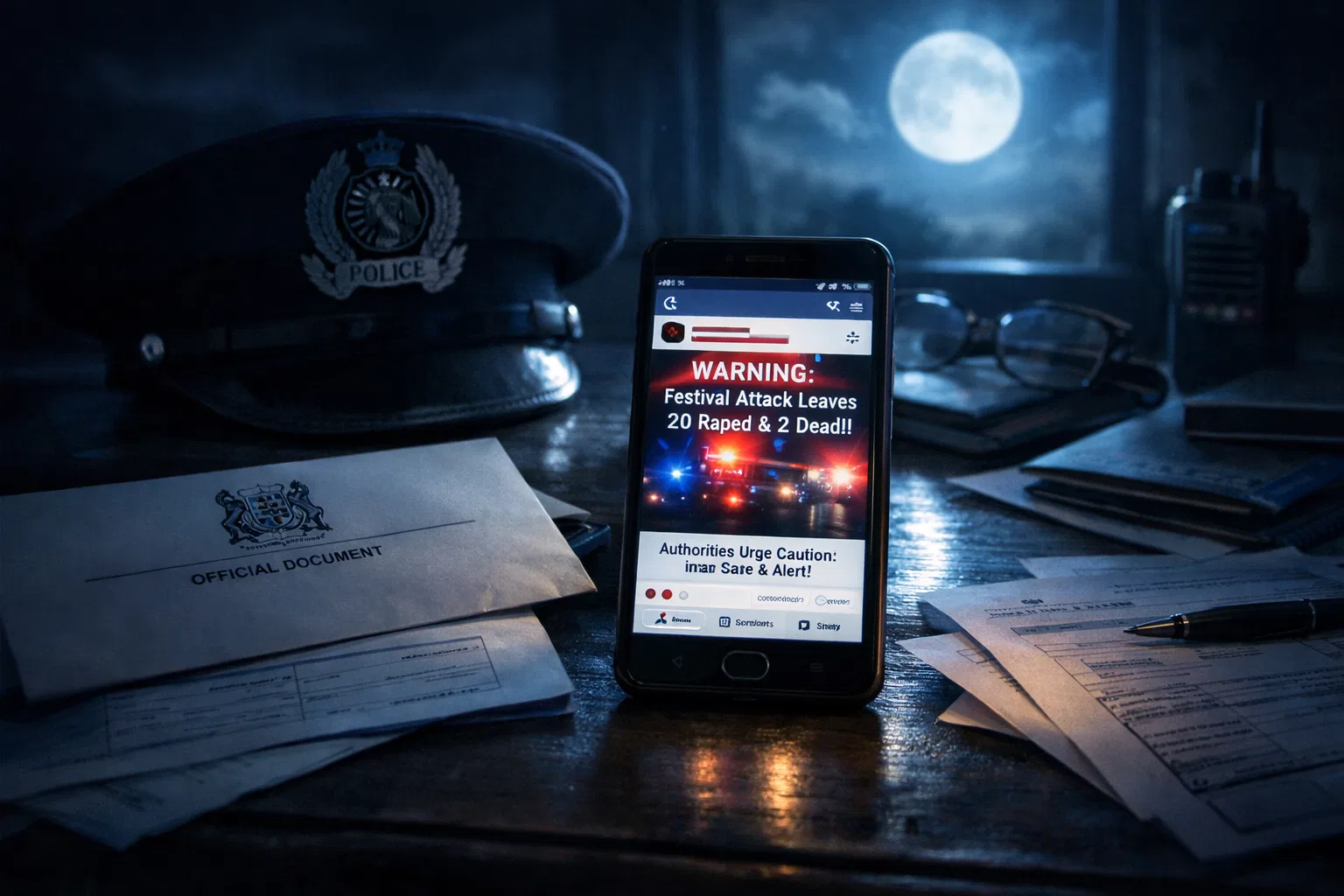
One of Botswana’s most memorable online scares emerged in December 2013, when claims circulated that a group of revellers had been attacked after attending a festival. According to the viral account, 20 people had been raped and two murdered. The story spread rapidly on Facebook and caused alarm across the country, despite the absence of verified police reports supporting its dramatic details. The Sunday Standard described it plainly as a Facebook hoax that had sent Botswana into panic.[Sunday Standard]sundaystandard.infofacebook hoax sends botswana panickingSunday StandardFacebook hoax sends Botswana panicking11 Dec 2013 — Rumours about 20 revellers being raped and two murdered swept through…
The story worked because it resembled a public warning rather than an obvious joke. It combined a recognisable social setting with specific numbers, extreme violence and an implied lesson about personal safety. Such details give an urban legend the texture of reporting: a place, an event and a supposed tally of victims. Research into viral legends suggests that successful rumours often combine news-like specificity with the emotional force and memorability of a frightening tale.[arXiv]arxiv.orgarXiv Why Do Urban Legends Go Viral?Why Do Urban Legends Go Viral?January 22, 2016…
Its effect also depended on timing. By 2013, social platforms had made it possible for an unverified claim to move between friendship networks faster than newspapers or broadcasters could investigate it. A message passed on by somebody personally known to the recipient could feel more trustworthy than an anonymous website, even when nobody in the chain had encountered a victim, witness or police statement.
This was not merely harmless folklore. False accounts of rape and murder can frighten families, damage events and businesses, divert police attention and make later warnings harder to assess. The episode demonstrated an important shift in Botswana’s rumour culture: a story no longer needed a newspaper editor, radio producer or prominent storyteller to acquire a national audience. Repetition itself could provide the appearance of confirmation.
Invented honours and fabricated government news
A different kind of hoax flourished by flattering national pride. In August 2016, online reports announced that President Ian Khama had been named the “world’s best president” and was being considered as the next secretary-general of the United Nations. Botswana’s Office of the President formally disassociated itself from the reports, identifying them as a hoax circulated under headlines published by dubious websites.[IOL]iol.co.za2016 08 09 worlds best president story a hoax says botswanaWorld's best president story a hoax, says Botswana9 Aug 2016 — “The Office of the President has become aware and wishes to dissociate…
The falsehood was persuasive for several reasons. Botswana was widely praised internationally for political stability and comparatively strong public institutions, so a prestigious award did not sound impossible. The reports also attached the claim to familiar international institutions and presented it in the language of conventional political news. Yet there was no credible awarding body, transparent selection process or United Nations announcement behind the supposed honour.
Nobody needed to lose money for the story to be useful to its promoters. Sensational praise generates clicks, advertising impressions and social engagement, especially when readers are encouraged to share a story as an expression of patriotism. It also illustrates why positive misinformation can be as revealing as a threatening rumour. Readers may scrutinise an insulting allegation but lower their guard when a claim confirms something they would like to be true.
A related fabrication in 2017 claimed that Botswana had introduced new visa requirements forcing Zimbabwean travellers to apply through missions in neighbouring countries. The report was falsely attributed to a Mmegi journalist and to Botswana’s minister responsible for international affairs. Botswana’s embassy in Harare rejected it as a hoax. Here, the borrowed elements were not merely a government name but a recognisable newspaper, journalist and minister: enough authentic-looking detail to make the invented policy appear administratively plausible.[Herald Online]heraldonline.co.zwHerald OnlineBotswana refutes visa regime claimsJune 28, 2017 — Through its embassy in Harare, the Botswana government said in a media st…
Forged public notices have used the same technique. In 2019, Botswana Police Service had to deny a circulating statement promising a reward to anyone who reported a person who habitually drove without a licence. The document was fictitious, but its official-looking format and plausible law-enforcement theme helped it travel.[Daily News]dailynews.gov.bwDaily NewsBPS warns the public about fake media releaseBotswana Police Service (BPS) has dismissed as fake, a media release dated 24th Ju…
These cases show that the most important part of a modern hoax is often not the lie itself but the imitation surrounding it. Logos, official titles, copied writing styles and the name of a real journalist can supply a false statement with the authority it lacks.
When the hoax becomes a financial trap
Botswana’s most consequential online deceptions are often better described as impersonation scams than as publicity hoaxes. Their purpose is not simply to make people believe a false story. Belief is the first step towards obtaining a payment, identity details or access to an account.
In 2019, Botswana’s government warned about social-media posts and emails using the identity of minister Unity Dow. The messages claimed that she had access to international funding for small businesses and that recipients had been selected as beneficiaries. Applicants were reportedly asked to pay P2,600 for forms. The claimed connection to a senior minister and an international development fund supplied both prestige and urgency.[Daily News]dailynews.gov.bwnews detailmore…
The following year, another fake Facebook page impersonated Botswana’s finance ministry and advertised business grants supposedly offered in partnership with international organisations. The linked application form displayed the logo of Botswana Innovation Hub and requested personal information. Africa Check found that the page was managed from outside Botswana, while both the ministry and the innovation agency warned that the offer was fraudulent.[Africa Check]africacheck.orgAfrica Check Scam!Botswana's finance ministry not advertising…8 Jul 2020 — A post on the Facebook page Ministry of Finance and Economic Development -Bot…
During the economic uncertainty of the COVID-19 period, fraudulent funding claims had an unusually receptive audience. Entrepreneurs faced disruption, governments were announcing genuine relief measures, and international agencies were regularly associated with emergency support. A counterfeit grant therefore fitted the surrounding news environment. The deception did not need to invent an entirely unfamiliar world; it merely inserted a false opportunity into a real crisis.
Other versions claimed that the finance ministry was distributing International Monetary Fund grants or cheap loans. Botswana’s official news service reported the ministry’s warning that no such grants existed and that the supplied link might be intended to swindle users.[Daily News]dailynews.gov.bwDaily News IMF grants Facebook post scamDaily News IMF grants Facebook post scam
The formula has remained remarkably consistent:
- Borrow a trusted identity. The account uses the name of a ministry, minister, bank or familiar company.
- Offer exceptional access. Victims are told that they qualify for a grant, loan, job or funding programme.
- Create urgency. The opportunity appears temporary, limited or already approved.
- Request a small commitment. A form, fee or set of personal details is presented as a routine administrative step.
- Move the victim away from official channels. Communication shifts to private messages, unfamiliar websites or payment instructions.
Botswana’s ministries had encountered fake Facebook profiles even before the pandemic. The government warned in 2017 about a false finance-minister account promoting supposed World Bank loans, as well as an impostor account purporting to represent the vice-president.[Daily News]dailynews.gov.bwOpen source on dailynews.gov.bw.
The Bank of Botswana has likewise issued alerts about fake content and unauthorised use of its logo, while Botswana’s computer incident response organisation has documented scams promoted through sponsored social-media adverts that imitate recognisable retailers. These cases mark the transition from relatively crude messages to professionally presented fraud: paid placement, copied branding and websites designed to resemble legitimate commerce.[Bank of Botswana]bankofbotswana.bwBank of Botswana Public Notice: Scam AlertBank of Botswana Public Notice: Scam Alert
False deaths and the high cost of being first
Some misinformation spreads because publishers and individual users race to announce dramatic news before verification. In March 2025, concern centred on false reporting about Lesedi Molapisi, a Botswana national facing a possible death sentence in Bangladesh. Botswana’s press and officials criticised reports wrongly suggesting that an execution had already occurred, warning that irresponsible publication could distress relatives and undermine diplomatic efforts to assist those involved.[Mmegi Online]mmegi.bwOpen source on mmegi.bw.
This sort of story sits between hoax and journalistic failure. The person who first invents or alters the information may act deliberately, while many later sharers may sincerely believe they are repeating breaking news. Once established, however, the false version gains credibility each time another account, blog or informal news page copies it.
A death claim is particularly resistant to casual correction. It is emotionally overwhelming, highly shareable and often difficult for the public to verify directly. Families and officials may also need time before making statements, leaving a temporary information gap that false reports can occupy. By the time a denial appears, screenshots and reposts may have detached the claim from its original source.
The episode reflects a wider problem in online publishing: the reward for being first is immediate, while the reputational cost of being wrong is delayed and uneven. Corrections seldom travel with the same urgency as the original claim. People who saw the false headline may never encounter the later denial.
Panic, folklore and the boundary of the hoax
Not every disturbing or supernatural account circulating in Botswana should be labelled a hoax. Stories about witchcraft, ritual murder or unexplained misfortune may be folklore, sincerely held belief, speculation or attempts to interpret genuine crimes. Calling all such narratives deliberate fraud would erase important differences between deception and belief.
Rumour becomes especially dangerous when it assigns guilt to a living person without evidence. Anthropological work on Botswana has described how accusations of witchcraft can move through gossip and community discussion after a sudden death or personal crisis. The people repeating such claims may not understand themselves as hoaxers, but the accusations can still produce exclusion, fear or violence.[Scholarly Publications]scholarlypublications.universiteitleiden.nlOpen source on universiteitleiden.nl.
The distinction matters because the remedy differs. A fabricated ministry page can be exposed by comparing account histories, web addresses and official statements. A supernatural accusation is tied more deeply to grief, social relationships and explanations of misfortune. Publishing a blunt “debunking” without understanding that setting may fail to persuade anyone and can appear dismissive of the community’s actual concerns.
The same care is needed with crime rumours. Botswana, like neighbouring countries, has experienced real cases involving violence and allegations of ritual motivation. A particular circulating allegation may be false without proving that every concern in the category is imaginary. Responsible investigation must separate the verified event, the police evidence, the suspected motive and the stories later attached to it.
This boundary between hoax, rumour and belief is one of the most revealing parts of Botswana’s deception history. Deliberate fabricators often exploit stories that already feel culturally or politically intelligible. They do not create public fears from nothing; they attach false particulars to existing anxieties.

Why these stories were believable
Botswana’s documented hoaxes differ in subject, but their persuasive machinery is strikingly similar.
They copied authority. Government crests, ministry names, ministerial identities and the appearance of official notices allowed false claims to arrive pre-packaged with institutional credibility. The recipient was encouraged to recognise the source rather than inspect it.
They fitted real circumstances. Fake relief grants appeared during economic disruption. False travel rules circulated in a region where cross-border policy changes have immediate practical consequences. Crime stories drew on genuine concerns about safety. A fabricated claim is easiest to accept when it resembles something that could reasonably happen.
They supplied concrete details. Exact victim numbers, payment amounts, ministerial names and supposed international partners made the stories feel reportable. Specificity can resemble evidence even when the details themselves are invented.
They travelled through trusted relationships. A dubious website may be ignored, but the same link forwarded by a relative, colleague or friend acquires social endorsement. Studies of misinformation sharing have found that trust in online information, emotional pressure and information overload can increase the circulation of unverified material.[arXiv]arxiv.orgarXiv Why do People Share Misinformation during the COVID-19 Pandemic?arXiv Why do People Share Misinformation during the COVID-19 Pandemic?
They exploited unequal verification speeds. A false claim can be drafted in minutes. Establishing the truth may require contacting police, embassies, families, ministries or banks. The hoax gains a head start, particularly during emergencies.
Botswana’s experience during COVID-19 made these pressures especially visible. A study focused on the country described the proliferation of false news through social media as both an information problem and a records problem: rapidly circulating posts competed with reliable public documents, while preserving a trustworthy account of government decisions became more difficult.[ResearchGate]researchgate.netResearch Gate Social media use and the proliferation of fake news duringResearch Gate Social media use and the proliferation of fake news during
How the deceptions were exposed
Most Botswana cases were not solved through dramatic confessions. They were dismantled through ordinary verification.
For fake government announcements, investigators compared the circulating account or document with the institution’s verified communication channels. Page-creation dates, administrator locations, altered logos and unfamiliar application addresses provided clues. In the 2020 grant scam, the difference between the legitimate finance-ministry page and the impostor page was visible in their management information, while the supposed partner organisation directly denied involvement.[Africa Check]africacheck.orgAfrica Check Scam!Botswana's finance ministry not advertising…8 Jul 2020 — A post on the Facebook page Ministry of Finance and Economic Development -Bot…
False news reports were checked against primary institutions. The “world’s best president” claim collapsed because no legitimate award-giving body or United Nations process supported it, and the presidency denied the story. The visa claim failed when Botswana’s diplomatic representatives stated that no such policy had been announced.[IOL]iol.co.za2016 08 09 worlds best president story a hoax says botswanaWorld's best president story a hoax, says Botswana9 Aug 2016 — “The Office of the President has become aware and wishes to dissociate…
Crime and death rumours required confirmation from police, relatives, lawyers or diplomatic officials rather than reliance on repeated posts. In each case, the central question was not how many sites carried the claim but whether any accountable source with direct knowledge had confirmed it.
Botswana’s authorities have also used public warnings and legal deterrence. The Botswana Communications Regulatory Authority stated during the pandemic that creating or forwarding false information through online platforms could attract prosecution or fines. Police had earlier warned that social media could be used for threats, blackmail, extortion and other offences rather than existing outside ordinary law.[bocra.org.bw]bocra.org.bwOpen source on bocra.org.bw.
Legal threats, however, do not solve the whole problem. A rule against false information can deter malicious fabricators, but it can also raise concerns if definitions are broad or enforcement is not transparent. More durable protection comes from accessible official communication, independent journalism, rapid corrections and a public habit of checking the original source before sharing.
What Botswana’s hoax history reveals
Botswana’s most significant deceptions are not famous because of ingenious props or elaborate theatrical performances. Their power came from modest acts of imitation: a copied logo, a invented quotation, a fake Facebook page or a frightening story told with enough detail to look witnessed.
The cases reveal three broader changes. First, public authority has become visually reproducible. Anyone can imitate the outward appearance of a ministry or news organisation. Secondly, the boundaries between rumour, publication and fraud have blurred. A falsehood may begin as a private message, become a viral warning, be copied by an informal publisher and finally serve as bait for theft. Thirdly, exposure is now a contest over speed as much as evidence. Official corrections must reach people while the false version is still moving.
The most useful lesson is therefore not simply to distrust the internet. Many genuine warnings, grants and policy announcements also appear online. The better test is whether the claim can be traced to an accountable origin: a verified institutional channel, a named reporter with supporting evidence, a police reference, a published policy document or a person directly involved.
Botswana’s record also cautions against treating belief in a hoax as evidence of national gullibility. These stories succeeded by exploiting ordinary human responses: concern for safety, respect for authority, hope for financial help, national pride and the impulse to warn others. The same mechanisms operate elsewhere. What makes the Botswana cases distinctive is the particular authority they borrowed and the social circumstances into which they were released.
Amazon book picks
Further Reading
Books and field guides related to How False Stories Learned to Look Official. Use these as the next step if you want deeper reading beyond the article.
Factfulness
Explains how alarming false stories gain traction and distort public understanding.
eBay marketplace picks
Marketplace Samples
Live-tested eBay searches with available results related to this page.


Endnotes
1.
Source: iol.co.za
Title: 2016 08 09 worlds best president story a hoax says botswana
Link:https://iol.co.za/news/africa/2016-08-09-worlds-best-president-story-a-hoax-says-botswana/
Source snippet
World's best president story a hoax, says Botswana9 Aug 2016 — “The Office of the President has become aware and wishes to dissociate...
2.
Source: arxiv.org
Title: arXiv Why Do Urban Legends Go Viral?
Link:https://arxiv.org/abs/1601.06081
Source snippet
Why Do Urban Legends Go Viral?January 22, 2016...
Published: January 22, 2016
3.
Source: mmegi.bw
Link:https://www.mmegi.bw/news/online-media-cautioned-against-spreading-hoaxes/news
4.
Source: arxiv.org
Title: arXiv Why do People Share Misinformation during the COVID-19 Pandemic?
Link:https://arxiv.org/abs/2004.09600
5.
Source: researchgate.net
Title: Research Gate Social media use and the proliferation of fake news during
Link:https://www.researchgate.net/publication/353983523_Social_media_use_and_the_proliferation_of_fake_news_during_the_COVID-19_pandemic_in_Botswana_the_archives_and_records_management_dilemma
6.
Source: bocra.org.bw
Link:https://www.bocra.org.bw/sites/default/files/covid19-docs/BOCRA%20-%20False%20Information%20on%20Online%20Platforms.pdf
7.
Source: facebook.com
Link:https://www.facebook.com/MvLSports/posts/tragic-loss-cheick-tour%C3%A9s-story-and-the-dangers-of-fake-football-agentsthe-footb/1399286308865068/
8.
Source: facebook.com
Link:https://www.facebook.com/groups/405592603200842/posts/2495548747538540/
9.
Source: facebook.com
Link:https://www.facebook.com/TheWeekendPostBW/posts/allegations-made-by-the-former-president-are-misleading-and-a-distortion-of-the-/5365688443455666/
10.
Source: facebook.com
Link:https://www.facebook.com/SundayStandardBW/posts/a-new-report-by-media-and-democracy-watchdog-intelwatch-has-warned-that-botswana/934882385586841/
11.
Source: facebook.com
Link:https://www.facebook.com/groups/405592603200842/posts/2224622664631151/
12.
Source: facebook.com
Link:https://www.facebook.com/groups/405592603200842/posts/2063095017450584/
13.
Source: facebook.com
Link:https://www.facebook.com/Okavango247/posts/the-legend-behind-the-voice-on-radio-botswana-mme-boemo-dibeela-nyaza/5401257836584630/
14.
Source: facebook.com
Link:https://www.facebook.com/groups/271188599725638/posts/3265206573657144/
15.
Source: facebook.com
Link:https://www.facebook.com/100068608360137/posts/how-dan-kenosi-fakes-the-newsdan-kenosi-is-the-toast-of-the-moment-for-his-perce/185408976529053/
16.
Source: facebook.com
Link:https://www.facebook.com/100068860614629/posts/poor-and-vulnerable-botswanas-ritual-killings-expose-deep-seated-social-illin-bo/1248782817427060/
17.
Source: facebook.com
Link:https://www.facebook.com/100063756602298/posts/arsenals-triumph-triggers-viral-botswana-holiday-hoaxeven-though-the-celebration/1585610576907481/
18.
Source: facebook.com
Link:https://www.facebook.com/groups/772675937477438/posts/1427852765293082/
19.
Source: facebook.com
Title: Econet Telecom Lesotho
Link:https://www.facebook.com/EconetLesotho/posts/impostor-noticeeconet-telecom-lesotho-notifies-its-customers-of-the-impostor-who/1190610147787612/
20.
Source: facebook.com
Link:https://www.facebook.com/100044223980158/posts/%F0%9D%90%87%F0%9D%90%8E%F0%9D%90%96-%F0%9D%90%81%F0%9D%90%80%F0%9D%90%93%F0%9D%90%92%F0%9D%90%96%F0%9D%90%80%F0%9D%90%8D%F0%9D%90%80-%F0%9D%90%96%F0%9D%90%84%F0%9D%90%91%F0%9D%90%84-%F0%9D%90%81%F0%9D%90%91%F0%9D%90%80%F0%9D%90%88%F0%9D%90%8D%F0%9D%90%96%F0%9D%90%80%F0%9D%90%92%F0%9D%90%87%F0%9D%90%84%F0%9D%90%83-1%EF%B8%8F%E2%83%A3-%F0%9D%97%9C%F0%9D%97%A1-%F0%9D%97%95%F0%9D%97%A2%F0%9D%97%A7%F0%9D%97%A6%F0%9D%97%AA%F0%9D%97%94%F0%9D%97%A1%F0%9D%97%94-batswana-were-brainwashed-to-belie/1495305765286875/
21.
Source: facebook.com
Link:https://www.facebook.com/ntvAfricaGoodMorning/posts/-botswana-botswana-forensic-audit-enters-second-phase-probing-corruption-africag/1333108582155284/
22.
Source: facebook.com
Link:https://www.facebook.com/100047414761258/posts/publishing-forwarding-or-creating-false-information-using-online-platforms-is-an/230075241711279/
23.
Source: facebook.com
Link:https://www.facebook.com/TheVoiceBW/posts/news-update-botswana-energy-regulatory-authority-bera-has-issued-an-alert-about-/1391652772784039/
24.
Source: facebook.com
Link:https://www.facebook.com/UNinBotswana/posts/how-can-un-agencies-in-botswana-help-people-distinguish-between-disinformation-a/3154773854556496/
25.
Source: researchgate.net
Link:https://www.researchgate.net/publication/274202517_Oracles_Trauma_and_the_Limits_of_Contextualization_Naming_the_Witch_in_Contemporary_Kenya
26.
Source: researchgate.net
Link:https://www.researchgate.net/figure/Use-of-social-media-as-source-of-news-Botswana-2014-2019-Source-Afrobarometer-2020_fig1_353983523
27.
Source: reportfraud.police.uk
Link:https://www.reportfraud.police.uk/collection/newsroom/
28.
Source: youtube.com
Title: Bank of Botswana Raises Concern Over Financial Reporting & Banking Panic
Link:https://www.youtube.com/watch?v=RbLZta-XV4A
Source snippet
President Boko vs. The Media: Bold Reforms or Rising Tensions in Botswana?...
29.
Source: sundaystandard.info
Title: facebook hoax sends botswana panicking
Link:https://www.sundaystandard.info/facebook-hoax-sends-botswana-panicking/
Source snippet
Sunday StandardFacebook hoax sends Botswana panicking11 Dec 2013 — Rumours about 20 revellers being raped and two murdered swept through...
30.
Source: africacheck.org
Title: Africa Check Scam!
Link:https://africacheck.org/fact-checks/meta-programme-fact-checks/scam-botswanas-finance-ministry-not-advertising-business
Source snippet
Botswana's finance ministry not advertising...8 Jul 2020 — A post on the Facebook page Ministry of Finance and Economic Development -Bot...
31.
Source: dailynews.gov.bw
Link:https://dailynews.gov.bw/news-detail/50604
Source snippet
Daily NewsBPS warns the public about fake media releaseBotswana Police Service (BPS) has dismissed as fake, a media release dated 24th Ju...
32.
Source: heraldonline.co.zw
Link:https://www.heraldonline.co.zw/botswana-refutes-visa-regime-claims/
Source snippet
Herald OnlineBotswana refutes visa regime claimsJune 28, 2017 — Through its embassy in Harare, the Botswana government said in a media st...
Published: June 28, 2017
33.
Source: dailynews.gov.bw
Title: news detail
Link:https://dailynews.gov.bw/news-detail/49427
Source snippet
more...
34.
Source: dailynews.gov.bw
Title: Daily News IMF grants Facebook post scam
Link:https://dailynews.gov.bw/news-detail/57683
35.
Source: dailynews.gov.bw
Link:https://dailynews.gov.bw/news-detail/39451
36.
Source: dailynews.gov.bw
Link:https://dailynews.gov.bw/news-detail/33671
37.
Source: bankofbotswana.bw
Title: Bank of Botswana Public Notice: Scam Alert
Link:https://www.bankofbotswana.bw/press-release/public-notice-scam-alert-fake-content-and-unauthorised-use-bank-botswana-logo
38.
Source: scholarlypublications.universiteitleiden.nl
Link:https://scholarlypublications.universiteitleiden.nl/access/item%3A3144777/view
39.
Source: dailynews.gov.bw
Link:https://dailynews.gov.bw/news-detail/13464
40.
Source: africacheck.org
Title: botswana has not cut electricity supply or closed borders
Link:https://africacheck.org/fact-checks/meta-programme-fact-checks/botswana-has-not-cut-electricity-supply-or-closed-borders
41.
Source: africacheck.org
Title: four ways disinformation about migration circulating south africa
Link:https://africacheck.org/fact-checks/blog/four-ways-disinformation-about-migration-circulating-south-africa
42.
Source: africacheck.org
Title: yes lumpy skin disease threat beef farming botswana
Link:https://africacheck.org/fact-checks/meta-programme-fact-checks/yes-lumpy-skin-disease-threat-beef-farming-botswana
43.
Source: africacheck.org
Title: no botswana judges didnt declare suspension british
Link:https://africacheck.org/fact-checks/meta-programme-fact-checks/no-botswana-judges-didnt-declare-suspension-british
44.
Source: africacheck.org
Title: state nation address fact checked
Link:https://africacheck.org/fact-checks/reports/state-nation-address-fact-checked
45.
Source: africacheck.org
Title: yes sa has less water person botswana namibia
Link:https://africacheck.org/fact-checks/reports/yes-sa-has-less-water-person-botswana-namibia
46.
Source: africacheck.org
Link:https://africacheck.org/fact-checks
47.
Source: africacheck.org
Link:https://africacheck.org/third-party-fact-checks
48.
Source: africacheck.org
Link:https://africacheck.org/
49.
Source: dailynews.gov.bw
Link:https://dailynews.gov.bw/news-detail/56179
50.
Source: dailynews.gov.bw
Title: 29 05 2026 07 25 49 1780032349 dailynews pdf
Link:https://dailynews.gov.bw/common_up/dailynews/dailynews_pdf/29-05-2026_07-25-49_1780032349_dailynews_pdf.pdf
51.
Source: dailynews.gov.bw
Title: 09 07 2024 08 42 09 1720507329 dailynews pdf
Link:https://dailynews.gov.bw/common_up/dailynews/dailynews_pdf/09-07-2024_08-42-09_1720507329_dailynews_pdf.pdf
52.
Source: dailynews.gov.bw
Link:https://dailynews.gov.bw/news-detail/89003
53.
Source: dailynews.gov.bw
Link:https://dailynews.gov.bw/news-detail/34443
54.
Source: dailynews.gov.bw
Link:https://dailynews.gov.bw/news-detail/91292
55.
Source: sk.sagepub.com
Link:https://sk.sagepub.com/ency/edvol/journalism/chpt/hoaxes
56.
Source: journals.nust.ac.zw
Link:https://journals.nust.ac.zw/index.php/sajcis/article/view/337/346
57.
Source: sundaystandard.info
Title: botswana records three cases of covid 19 disinfodemic
Link:https://www.sundaystandard.info/botswana-records-three-cases-of-covid-19-disinfodemic/
58.
Source: gov.bw
Link:https://www.gov.bw/ministries/ministry-higher-education
59.
Source: finance.gov.bw
Link:https://www.finance.gov.bw/index.php?Itemid=135&id=11&limitstart=72&option=com_content&view=category
Additional References
60.
Source: youtube.com
Title: Botswana Denies Link To ‘False-Flagged’ Tanker Disabled By US | Firstpost Africa
Link:https://www.youtube.com/watch?v=V60pVm0ezoI
Source snippet
Botswana Denies Hosting a US Military Base, Reaffirms Sovereignty | Firstpost Africa...
61.
Source: youtube.com
Title: Press Freedom Under Fire in Botswana | BEF vs Duma Boko Controversy
Link:https://www.youtube.com/watch?v=MhAzxhoD7Fs
Source snippet
Botswana Denies Link To 'False-Flagged' Tanker Disabled By US | Firstpost Africa...
62.
Source: youtube.com
Title: President Boko vs. The Media: Bold Reforms or Rising Tensions in Botswana?
Link:https://www.youtube.com/watch?v=yO3WqEo2MhU
Source snippet
Press Freedom Under Fire in Botswana | BEF vs Duma Boko Controversy...
63.
Source: studymode.com
Link:https://www.studymode.com/subjects/case-study-botswana-a-diamond-in-the-rough-page10.html
64.
Source: cirt.org.bw
Link:https://www.cirt.org.bw/warnings/online-scam-claimed-several-victims-botswana
65.
Source: scribd.com
Link:https://www.scribd.com/document/916988627/botswana-23
66.
Source: hangar1publishing.com
Link:https://hangar1publishing.com/blogs/cryptids/famous-cryptid-hoaxes?srsltid=AfmBOooEoSDQ0uFVyPk0O4t_0HuRceTFuWB7VEF1N-oyMf_eReUH00DL
67.
Source: baselgovernance.org
Link:https://baselgovernance.org/cms/api/assets/950c3e7c-dd66-475a-9764-8061670df909/2016-gcrsport-en.pdf?v=20220427115607000
68.
Source: reddit.com
Link:https://www.reddit.com/r/monarchism/comments/syvwft/my_should_x_be_a_monarchy_map/
69.
Source: instagram.com
Link:https://www.instagram.com/p/DXgreKMAMhO/
Topic Tree
Follow this branch
Related pages 192
- Albanian Hoaxes
- Algerian Hoaxes
- Antigua Deceptions
- Argentina Hoaxes
- Armenian Hoaxes
- +187 more in sidebar