Within Rwanda Hoaxes
How One False Broadcast Helped Unleash Massacre
A fabricated assassination warning gained credibility from state radio and helped trigger deadly attacks on Tutsi civilians in Bugesera.
On this page
- What Radio Rwanda claimed
- Why the invented source sounded credible
- From repeated warning to organised violence
Page outline Jump by section
Introduction
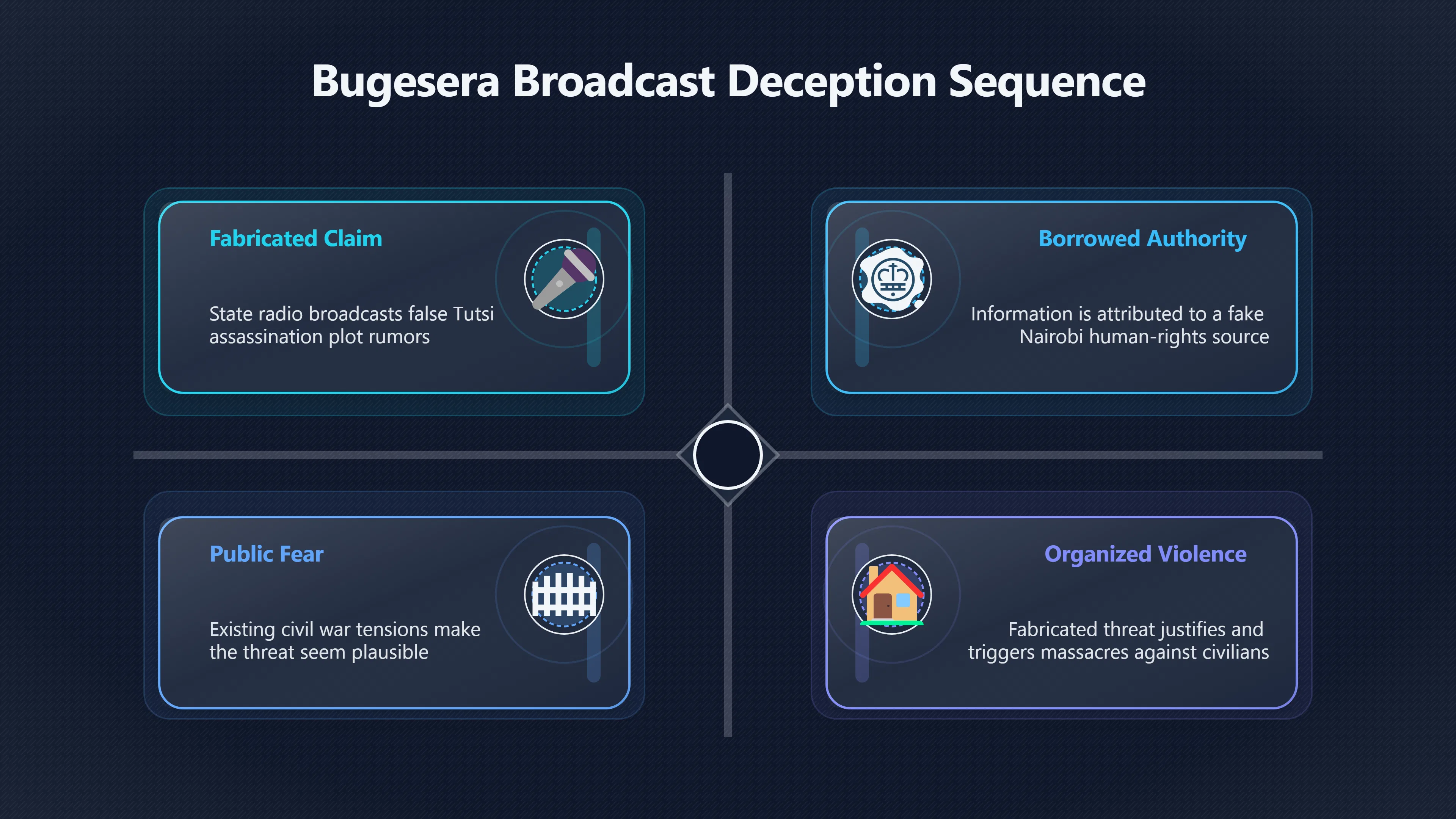
In March 1992, a false report broadcast by Rwanda’s state radio helped turn rumour into mass violence. Radio Rwanda repeatedly aired claims that Tutsi activists in the Bugesera region were preparing to assassinate prominent Hutu leaders. The warning was presented as if it came from a credible human-rights source based in Nairobi, giving the allegation an air of independent verification. In reality, investigators and later judicial proceedings found no evidence for the supposed assassination plot. The broadcast became one of the clearest examples in Rwanda’s modern history of how fabricated information, delivered through a trusted institution, could help justify attacks on civilians. Within days, organised violence spread across Bugesera and hundreds of Tutsi were killed.[justiceinfo.net]justiceinfo.netJustice Info.net NAHIMAN A ORDERED BROADCAST THAT INCITEDNAHIMANA ORDERED BROADCAST THAT INCITED…May 20, 2001 — 21 May 2001 — Former director of Radio-Télévision Libre des Mille Collines (RTL…

The episode occupies an important place in Rwanda’s history of deception because it was not simply a rumour passed between neighbours. It was a false claim amplified by state media during a period of war, political uncertainty and ethnic tension. The Bugesera broadcast showed how an invented threat could be made to look real enough to encourage violence on a large scale.[JusticeInfo.net]justiceinfo.netJustice Info.net NAHIMAN A ORDERED BROADCAST THAT INCITEDNAHIMANA ORDERED BROADCAST THAT INCITED…May 20, 2001 — 21 May 2001 — Former director of Radio-Télévision Libre des Mille Collines (RTL…
What Radio Rwanda Claimed
The central allegation was that Tutsi in Bugesera were secretly planning to murder local Hutu officials and political leaders. The story was presented as a warning from a respected human-rights organisation supposedly operating from Nairobi. By attributing the information to an external observer rather than to government officials, the broadcast suggested that the threat had been independently discovered and verified.[JusticeInfo.net]justiceinfo.netJustice Info.net NAHIMAN A ORDERED BROADCAST THAT INCITEDNAHIMANA ORDERED BROADCAST THAT INCITED…May 20, 2001 — 21 May 2001 — Former director of Radio-Télévision Libre des Mille Collines (RTL…
The claim appeared at a moment when Rwanda was already unsettled by the civil war that had begun with the invasion of the Rwandan Patriotic Front (RPF) in 1990. Genuine fears about security existed across the country. The false report exploited those fears by implying that ordinary Tutsi civilians in Bugesera were part of a coordinated conspiracy. Rather than identifying specific suspects or presenting evidence, the warning encouraged listeners to view an entire community as a hidden danger.[Human Rights Watch]hrw.orgHuman Rights WatchLeave None to Tell the Story: Genocide in Rwanda, March…Hutu remembered the slaughter of tens of thousands of Hutu b…
Later investigations found no credible evidence that the alleged assassination plan existed. The story is therefore remembered not as an intelligence failure but as a fabricated or knowingly misleading report that helped create a justification for violence.[JusticeInfo.net]justiceinfo.netJustice Info.net NAHIMAN A ORDERED BROADCAST THAT INCITEDNAHIMANA ORDERED BROADCAST THAT INCITED…May 20, 2001 — 21 May 2001 — Former director of Radio-Télévision Libre des Mille Collines (RTL…
Why the Invented Source Sounded Credible
A key reason the broadcast proved influential was the way it borrowed authority from institutions that listeners trusted.
In early 1990s Rwanda, Radio Rwanda was the dominant national broadcaster. Many citizens relied on it as their principal source of information. A claim carried by state radio naturally appeared more reliable than a local rumour. When the broadcaster further stated that the information originated from a human-rights organisation outside Rwanda, the story acquired a second layer of credibility.[JusticeInfo.net]justiceinfo.netJustice Info.net NAHIMAN A ORDERED BROADCAST THAT INCITEDNAHIMANA ORDERED BROADCAST THAT INCITED…May 20, 2001 — 21 May 2001 — Former director of Radio-Télévision Libre des Mille Collines (RTL…
The political atmosphere also mattered. Many Hutu feared attacks from the RPF and remembered earlier ethnic violence in neighbouring Burundi. At the same time, many Tutsi feared renewed persecution. In such an environment, dramatic warnings about secret plots seemed plausible to audiences already primed by fear and uncertainty. The effectiveness of the deception did not depend on strong evidence; it depended on fitting existing anxieties.[Human Rights Watch]hrw.orgHuman Rights WatchLeave None to Tell the Story: Genocide in Rwanda, March…Hutu remembered the slaughter of tens of thousands of Hutu b…
The Bugesera case illustrates a recurring propaganda technique: presenting an alleged future attack as justification for immediate action. By convincing listeners that violence was imminent, propagandists could frame aggression as self-defence. Historians of Rwanda have identified this pattern repeatedly in the years preceding the 1994 genocide.[Human Rights Watch]hrw.orgHuman Rights WatchLeave None to Tell the Story: Genocide in Rwanda, March…Hutu remembered the slaughter of tens of thousands of Hutu b…
From Repeated Warning to Organised Violence
The significance of the Bugesera broadcast lies not merely in the falsehood itself but in what followed.
Soon after the warnings circulated, attacks began against Tutsi communities in the Bugesera region. Houses were burned, civilians were assaulted and large numbers of people were killed. Contemporary human-rights investigations and later historical studies concluded that the violence was not a spontaneous reaction to an actual assassination plot. Instead, the fabricated threat helped create the political and psychological conditions in which organised attacks could proceed.[wikipedia.org]WikipediaBugesera massacresBugesera massacres
The massacres demonstrated how media messages could act as signals. A broadcast from a state institution suggested that authorities accepted the narrative of a Tutsi conspiracy. For some local officials, militias and civilians, that message effectively legitimised action against people identified as part of the supposed threat. The result was a deadly chain reaction in which a false claim became a practical justification for persecution and killing.[Wikipedia]WikipediaBugesera massacresBugesera massacres
Human Rights Watch later described Bugesera as one of several massacres carried out against Tutsi before 1994, showing that large-scale anti-Tutsi violence was already occurring before the genocide itself.[Refworld]refworld.orgHuman Rights Watch World Report 1994 - Rwanda1 Jan 1994 — Using this excuse, the government killed approximately 2,000 Tutsi betw…
How Investigators Connected the Broadcast to the Massacres
The Bugesera broadcasts did not disappear into obscurity after the violence. They became part of the historical and legal record examined by researchers, journalists and international prosecutors.
Witnesses before the International Criminal Tribunal for Rwanda testified that Ferdinand Nahimana, then head of the state media organisation ORINFOR, authorised the dissemination of the communiqué that incited violence in Bugesera. Testimony presented to the tribunal linked the broadcast directly to the atmosphere that preceded the massacres.[JusticeInfo.net]justiceinfo.netJustice Info.net NAHIMAN A ORDERED BROADCAST THAT INCITEDNAHIMANA ORDERED BROADCAST THAT INCITED…May 20, 2001 — 21 May 2001 — Former director of Radio-Télévision Libre des Mille Collines (RTL…
The political consequences were significant. Following pressure from opposition parties and criticism of Radio Rwanda’s role, Nahimana was removed from his position. Although he faced no immediate punishment for the Bugesera episode, the incident damaged his standing within the state broadcasting system. He later became a founder of Radio Télévision Libre des Mille Collines (RTLM), the station that would gain international notoriety for its role in inciting the 1994 genocide.[Wikipedia]WikipediaBugesera massacresBugesera massacres
For historians, the Bugesera case became an early warning sign. It showed that mass violence could be encouraged not only through direct orders but also through fabricated reports presented as credible news.[Human Rights Watch]hrw.orgHuman Rights WatchALEAVE NONE TO TELL THE STORY@by A Des Forges · 1999 · Cited by 2470 — We address the human rights practices of governm…

Why claims about Bugesera Broadcast remained persuasive
The false Bugesera broadcast remains one of Rwanda’s most revealing examples of media-driven deception because the falsehood was relatively simple. There was no elaborate forgery, complex conspiracy or sophisticated propaganda campaign. Instead, a fabricated warning was attached to a trusted source and repeated through a trusted medium.
Its importance lies in demonstrating how authority can transform misinformation into something far more dangerous. Listeners were not persuaded by evidence that a Tutsi assassination plot existed; they were persuaded because the claim appeared to come from institutions they believed. Once accepted, the story helped justify real-world violence against innocent people.[justiceinfo.net]justiceinfo.netJustice Info.net NAHIMAN A ORDERED BROADCAST THAT INCITEDNAHIMANA ORDERED BROADCAST THAT INCITED…May 20, 2001 — 21 May 2001 — Former director of Radio-Télévision Libre des Mille Collines (RTL…
Within Rwanda’s broader history of political deception, the Bugesera broadcast stands as a stark example of how a false report can become a deadly instrument. It illustrates the power of manufactured credibility and the consequences that can follow when trusted media present invention as fact.[Wikipedia]WikipediaBugesera massacresBugesera massacres
Amazon book picks
Further Reading
Books and field guides related to How One False Broadcast Helped Unleash Massacre. Use these as the next step if you want deeper reading beyond the article.
"Leave None to Tell the Story"
Covers incidents such as Bugesera and the role of misinformation.
We wish to inform you that tomorrow we will be killed with ou...
Explains how false narratives helped mobilise violence.
eBay marketplace picks
Marketplace Samples
Live-tested eBay searches with available results related to this page.


Endnotes
1.
Source: justiceinfo.net
Title: Justice Info.net NAHIMAN A ORDERED BROADCAST THAT INCITED
Link:https://www.justiceinfo.net/en/16253-en-en-nahimana-ordered-broadcast-that-incited-massacres-says-witness70197019.html
Source snippet
NAHIMANA ORDERED BROADCAST THAT INCITED...May 20, 2001 — 21 May 2001 — Former director of Radio-Télévision Libre des Mille Collines (RTL...
Published: May 20, 2001
2.
Source: Wikipedia
Title: Bugesera massacres
Link:https://en.wikipedia.org/wiki/Bugesera_massacres
3.
Source: refworld.org
Link:https://www.refworld.org/reference/annualreport/hrw/1994/en/93184
Source snippet
Human Rights Watch World Report 1994 - Rwanda1 Jan 1994 — Using this excuse, the government killed approximately 2,000 Tutsi betw...
4.
Source: truthcommissions.humanities.mcmaster.ca
Title: Rwanda 1993
Link:https://truthcommissions.humanities.mcmaster.ca/wp-content/uploads/2019/07/Rwanda-1993.pdf
Source snippet
on human rights violations in rwandaDuring the Commission's investigation, which lasted from January 7-21, 1993, it visited five of the e...
5.
Source: refworld.org
Link:https://www.refworld.org/reference/countryrep/hrw/1999/97537
6.
Source: hrw.org
Link:https://www.hrw.org/reports/pdfs/r/rwanda/rwanda993.pdf
Source snippet
Human Rights WatchALEAVE NONE TO TELL THE STORY@by A Des Forges · 1999 · Cited by 2470 — We address the human rights practices of governm...
7.
Source: hrw.org
Link:https://www.hrw.org/reports/1999/rwanda/Geno1-3-10.htm
Source snippet
Human Rights WatchLeave None to Tell the Story: Genocide in Rwanda, March...Hutu remembered the slaughter of tens of thousands of Hutu b...
8.
Source: hrw.org
Link:https://www.hrw.org/sites/default/files/reports/RWANDA936.PDF
Additional References
9.
Source: article19.org
Title: rwanda broadcasting genocide
Link:https://www.article19.org/data/files/pdfs/publications/rwanda-broadcasting-genocide.pdf
Source snippet
ARTICLE 19Broadcasting Genocide:12 Apr 1994 — killings were reported by journalists and human rights... These groups became the targets...
10.
Source: youtube.com
Title: Not My Words: The Actor Who Carries the Voice of Genocide | United Nations
Link:https://www.youtube.com/watch?v=izDR4W68txE
Source snippet
The UN International Criminal Tribunal for Rwanda metes out justice...
11.
Source: amnesty.org
Link:https://www.amnesty.org/es/wp-content/uploads/2021/06/afr470091992en.pdf
Source snippet
Amnesty InternationalUA/SC UA 84/92 Possible extrajudicial Executions 11 March11 Mar 2021 — and killing of Tutsi in Kanzenze district and...
12.
Source: youtube.com
Title: Media Trial: The RUGGIU case. Part I
Link:https://www.youtube.com/watch?v=GJWKkKJTOO8
Source snippet
Not My Words: The Actor Who Carries the Voice of Genocide | United Nations...
13.
Source: minijust.gov.rw
Link:https://www.minijust.gov.rw/fileadmin/user_upload/Minijust/Publications/Reports/National_reports/Report_on_the_attack_on_Falcon_50_Presidential_Plane.pdf
14.
Source: peaceau.org
Link:https://www.peaceau.org/uploads/report-rowanda-genocide.pdf
15.
Source: internews.org
Link:https://internews.org/wp-content/uploads/legacy/resources/TheMedia%26TheRwandaGenocide.pdf?sv1bPS4YU=GIsTv
16.
Source: files.ethz.ch
Link:https://www.files.ethz.ch/isn/125423/1036_FalconReport.pdf
17.
Source: facebook.com
Title: 2 massacres of tutsi in bugeseraon 3rd 1992 journalist jean baptiste bamwanga br
Link:https://www.facebook.com/RwandaNow/posts/2-massacres-of-tutsi-in-bugeseraon-3rd-1992-journalist-jean-baptiste-bamwanga-br/2747046515348818/
18.
Source: youtube.com
Title: The UN International Criminal Tribunal for Rwanda metes out justice
Link:https://www.youtube.com/watch?v=uCvWBBADfTY
Topic Tree