Within Venezuela Hoaxes
Was De Loys's Ape Ever a Real Discovery?
A staged spider monkey photograph became evidence for a supposed American ape because its scale, specimen and provenance could not be checked.
On this page
- What the photograph appeared to show
- Why zoologists identified a spider monkey
- Who turned the image into a scientific claim
Page outline Jump by section
Introduction
Was De Loys’s ape ever a real discovery? Nearly a century after it was announced, the answer accepted by mainstream zoology is no. The famous photograph that appeared to show a large, tailless ape from the Venezuela–Colombia border is now widely regarded as either a staged image of a spider monkey or a dramatic misidentification that was transformed into a sensational scientific claim. The case became famous not because of strong evidence, but because a single striking photograph seemed to show something impossible: an anthropoid ape living in the Americas, where no native apes are known to exist. The story remains one of Venezuela’s most famous examples of an image outrunning the evidence behind it.[Wikipedia]WikipediaDe Loys's apeDe Loys's ape
What the photograph appeared to show
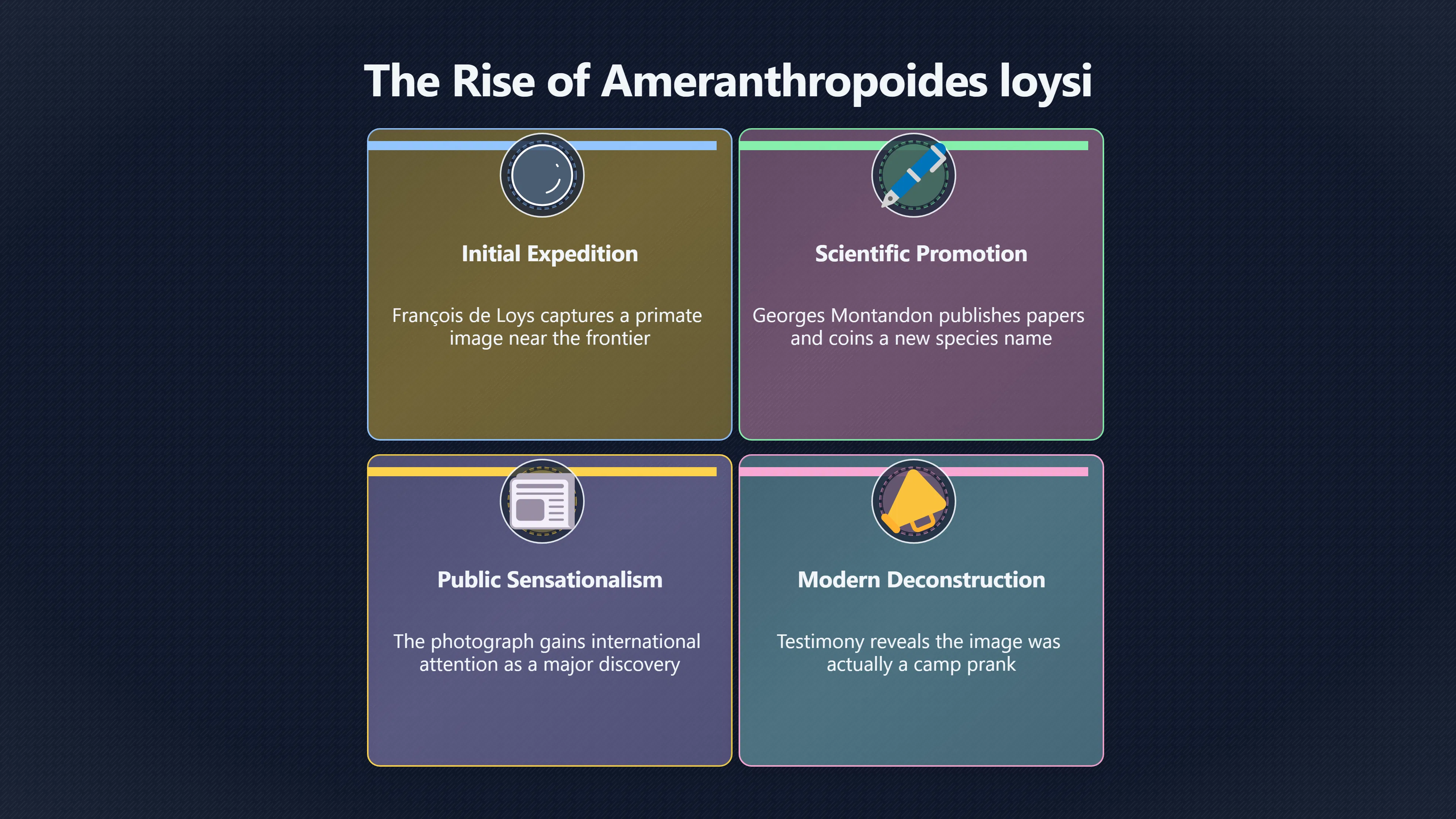
The story emerged publicly in 1929 when Swiss geologist François de Loys and anthropologist Georges Montandon presented a photograph of a dead primate allegedly encountered during an expedition near the Venezuela–Colombia frontier. According to the published account, the animal was unusually large, lacked a tail, possessed only 32 teeth, and stood roughly human height when alive. Montandon proposed a scientific name, Ameranthropoides loysi, and argued that it represented a previously unknown anthropoid ape.[Wikipedia]WikipediaDe Loys's apeDe Loys's ape
The image itself was powerful. It showed a long-limbed primate posed upright on a crate, supported by a stick beneath its chin. To many readers, the animal looked unlike any familiar New World monkey. Because photographs carried great authority in the early twentieth century, the image seemed to provide direct visual proof of an extraordinary discovery.[Wikipedia]WikipediaDe Loys's apeDe Loys's ape
Yet the photograph contained a critical weakness: there was no reliable scale. The crate beneath the animal had unknown dimensions, and the image did not allow independent observers to verify the claimed height. The body was posed in a way that could exaggerate size, while the alleged absence of a tail could not be checked from the visible angle.[Wikipedia]WikipediaDe Loys's apeDe Loys's ape
Why zoologists identified a spider monkey
The claim immediately faced scepticism from zoologists because it contradicted established knowledge of primate distribution. South America is home to monkeys, not anthropoid apes. Any genuine discovery of a native ape would have required exceptionally strong evidence. Instead, the entire case rested on a single photograph and de Loys’s testimony.[Wikipedia]WikipediaDe Loys's apeDe Loys's ape
Critics such as the British anatomist Arthur Keith argued that the animal closely resembled a spider monkey. Spider monkeys possess long limbs, relatively small bodies and facial features consistent with the photographed specimen. Keith also pointed out that the photograph did not conclusively show the absence of a tail. A tail could have been hidden behind the body, obscured by the pose, or removed before the photograph was taken.[Wikipedia]WikipediaDe Loys's apeDe Loys's ape
The lack of physical evidence proved equally damaging. No preserved skeleton, skin or skull was ever produced for scientific examination. De Loys claimed that remains had been lost during difficult travel conditions after the expedition. Without a specimen, zoologists had no way to test the extraordinary claims about anatomy, dentition or classification.[AAPG]aapg.orgA Monkey's Photo, a Prankster Petroleum Geologist and…1 Nov 2020 — According to de Loys, the ape's skin was removed afterwards, an…
As the years passed, the spider-monkey explanation became increasingly persuasive because it required far fewer assumptions. Instead of proposing an unknown ape species surviving undetected in South America, critics argued that the photograph simply depicted a known monkey presented in a misleading way.[Wikipedia]WikipediaDe Loys's apeDe Loys's ape
Who turned the image into a scientific claim
An important part of the story concerns not only François de Loys but also Georges Montandon, the anthropologist who promoted the photograph.
De Loys had reportedly taken the picture years before it became famous. The image gained international attention only after Montandon encountered it and began presenting it as evidence of a new primate. He published scientific papers, coined the name Ameranthropoides loysi, and attempted to fit the supposed creature into wider theories about human origins.[Wikipedia]WikipediaDe Loys's apeDe Loys's ape
Montandon’s interest was not purely zoological. He promoted a controversial theory known as “hologenesis”, which proposed separate evolutionary origins for different human populations. The supposed American ape offered apparent support for ideas that many later scholars regarded as scientifically unsound and entangled with racial thinking common in some circles of the era. The photograph therefore served a broader intellectual agenda beyond simple animal classification.[Wikipedia]WikipediaDe Loys's apeDe Loys's ape
This helps explain why a weakly documented photograph received such enthusiastic promotion. The image appeared to provide evidence for a theory that Montandon already wished to advance. Rather than the photograph creating the theory, the theory made the photograph unusually attractive.[Wikipedia]WikipediaDe Loys's apeDe Loys's ape

The testimony that changed the story
The most damaging evidence against the ape claim emerged decades later through accounts from people who had known de Loys personally.
A particularly influential testimony came from Venezuelan physician Enrique Tejera, who had worked in the same oil-exploration environment and knew de Loys. Tejera stated that the famous creature was not an unknown ape at all but an ordinary spider monkey associated with the expedition. According to his account, the photograph originated as a joke involving a pet monkey rather than as documentation of a scientific discovery.[AAPG]aapg.orgA Monkey's Photo, a Prankster Petroleum Geologist and…1 Nov 2020 — According to de Loys, the ape's skin was removed afterwards, an…
Tejera described de Loys as a practical joker and argued that Montandon subsequently transformed the image into a sensational anthropological claim. Modern discussions of the case frequently identify this testimony as the key clue explaining how a camp prank evolved into one of the twentieth century’s most famous cryptozoological controversies.[AAPG]aapg.orgA Monkey's Photo, a Prankster Petroleum Geologist and…1 Nov 2020 — According to de Loys, the ape's skin was removed afterwards, an…
Not every historian agrees on every detail. Some researchers have suggested that the surviving evidence does not prove precisely how the photograph was staged or exactly what role each participant played. However, these debates concern the mechanics of the deception rather than the existence of a genuine American ape. The scientific consensus remains that the photograph does not document a previously unknown anthropoid species.[Idaho State University]isu.eduAmeranthropoides loysiIdaho State UniversityAmeranthropoides loysi Montandon 1929Ameranthropoides loysi Montandon 1929: The History of a Primatological Fraud…
How De Loys’s entered public memory
De Loys’s ape survives in popular culture because it combines several elements that make mysteries hard to forget.
First, there is the photograph itself. A dramatic image often has greater staying power than pages of technical criticism. Many people encounter the picture before learning about the missing specimen, uncertain scale and later testimony.[Wikipedia]WikipediaDe Loys's apeDe Loys's ape
Second, the story fits a familiar narrative of lost discoveries in remote jungles. Even after zoologists rejected the claim, the image continued to circulate in cryptozoology books and discussions about unknown primates. The absence of definitive physical evidence allowed enthusiasts to keep proposing alternative explanations.[Bio Articles & Tutorials]biologyonline.comBio Articles & Tutorials Ameranthropoides loysiBio Articles & TutorialsAmeranthropoides loysi - Biology Online Archive ArticleControversy continues about the authenticity of the animal…
Finally, the case offers a lasting lesson about scientific evidence. The photograph looked convincing because it appeared to be direct documentation. Yet the crucial information needed to verify the claim—scale, provenance, specimens and independent examination—was missing. The episode demonstrates how easily a compelling image can create belief when the underlying evidence cannot be checked.[Wikipedia]WikipediaDe Loys's apeDe Loys's ape
What De Loys’s ape reveals about hoaxes and evidence
Among Venezuela-related hoax stories, De Loys’s ape remains a classic example of how a dramatic visual claim can gain authority despite weak supporting evidence. The photograph suggested a revolutionary zoological discovery, but the case depended on missing specimens, unverifiable measurements and testimony that changed over time. Subsequent analysis pointed instead to a spider monkey whose appearance had been manipulated by pose, framing or presentation.[Wikipedia]WikipediaDe Loys's apeDe Loys's ape
The enduring significance of the story is not that an ape was discovered in South America. It is that a single photograph, amplified by an enthusiastic promoter and a receptive audience, briefly convinced many people that such a discovery might have occurred. In that sense, De Loys’s ape remains one of the most instructive examples of how extraordinary claims can spread long before extraordinary evidence exists.[Wikipedia]WikipediaDe Loys's apeDe Loys's ape
Amazon book picks
Further Reading
Books and field guides related to Was De Loys's Ape Ever a Real Discovery?. Use these as the next step if you want deeper reading beyond the article.
Why People Believe Weird Things
Explains belief in sensational scientific and paranormal claims.
Extraordinary Popular Delusions and the Madness of Crowds
Rating: 4.0/5 from 5 Google Books ratings
Shows how dramatic claims can spread beyond the evidence.
The Demon-Haunted World
Rating: 4.5/5 from 43 Google Books ratings
Teaches evidence-based evaluation of extraordinary discoveries.
eBay marketplace picks
Marketplace Samples
Live-tested eBay searches with available results related to this page.



Endnotes
1.
Source: Wikipedia
Title: De Loys’s ape
Link:https://en.wikipedia.org/wiki/De_Loys%27s_ape
2.
Source: aapg.org
Link:https://www.aapg.org/news-and-media/explorer/a-monkeys-photo-a-prankster-petroleum-geologist-and-a-fraudulent-anthropologist/?srsltid=AfmBOoqIERP_WnbgbkIfYZ7ilE-7kGI4K5hX9q6Et03WoLWdF0aQgFOp
Source snippet
A Monkey's Photo, a Prankster Petroleum Geologist and...1 Nov 2020 — According to de Loys, the ape's skin was removed afterwards, an...
3.
Source: aapg.org
Title: a monkeys photo a prankster petroleum geologist and a fraudulent anthropologist
Link:https://www.aapg.org/news-and-media/explorer/a-monkeys-photo-a-prankster-petroleum-geologist-and-a-fraudulent-anthropologist/?srsltid=AfmBOooeGQHgwTaJgwpMW2YoKjitYFPFNf0FscO5FcOxL9-tAwePhoRE
Source snippet
A Monkey's Photo, a Prankster Petroleum Geologist and...1 Nov 2020 — According to de Loys, the ape's skin was removed afterwards, an...
4.
Source: futilitycloset.com
Title: ameranthropoides loysi
Link:https://www.futilitycloset.com/2005/06/21/ameranthropoides-loysi/
Source snippet
Futility ClosetAmeranthropoides Loysi21 Jun 2005 — The animals behaved like monkeys, holding onto shrubs and branches. The male escaped...
5.
Source: biologyonline.com
Title: Bio Articles & Tutorials Ameranthropoides loysi
Link:https://www.biologyonline.com/articles/ameranthropoides-loysi
Source snippet
Bio Articles & TutorialsAmeranthropoides loysi - Biology Online Archive ArticleControversy continues about the authenticity of the animal...
6.
Source: isu.edu
Title: Ameranthropoides loysi
Link:https://www.isu.edu/media/libraries/rhi/book-reviews/Ameranthropoides-loysi.pdf
Source snippet
Idaho State UniversityAmeranthropoides loysi Montandon 1929Ameranthropoides loysi Montandon 1929: The History of a Primatological Fraud...
Additional References
7.
Source: youtube.com
Title: Arthur C Clarke’s Mysterious World | Ep 11. Dragons, Dinosaurs and Giant Snakes
Link:https://www.youtube.com/watch?v=Sv4WIUf1h3c
Source snippet
Legendary Creatures of South America - Documentary...
8.
Source: historyofgeology.fieldofscience.com
Title: De Loys’ Ape
Link:https://historyofgeology.fieldofscience.com/2011/02/de-loys-ape.html
Source snippet
de Loys´ ape - Ameranthropoides loysi... It seems unlikely that such a scientist may have perpetuated the fraud of the Ameranthropoides...
9.
Source: theparanormalguide.com
Title: de loys ape
Link:https://www.theparanormalguide.com/blog/de-loys-ape
Source snippet
De Loys' Ape8 Apr 2014 — The story was accompanied by a photograph, the only evidence besides his account of the incident. It showed what...
10.
Source: youtube.com
Title: De Loys’ Ape: A Eugenics Inspired Hoax?
Link:https://www.youtube.com/watch?v=_HhlZL6apZs
Source snippet
Arthur C Clarke's Mysterious World | Ep 11. Dragons, Dinosaurs and Giant Snakes...
11.
Source: reddit.com
Link:https://www.reddit.com/r/Cryptozoology/comments/1gxj6y6/here_is_one_of_the_many_postscripts_to_the_de/
12.
Source: facebook.com
Link:https://www.facebook.com/animalesprehistoricoslatam/posts/el-fraude-del-simio-de-loys-pseudosciencia-al-servicio-del-racismoen-plena-era-d/1270330051876212/
13.
Source: youtube.com
Title: The Racist Cryptid | De Loys’ Ape
Link:https://www.youtube.com/watch?v=L6i2lAvbql4
Source snippet
De Loys' Ape: A Eugenics Inspired Hoax?...
14.
Source: karlshuker.blogspot.com
Title: a picture of monkey business or how
Link:https://karlshuker.blogspot.com/2017/07/a-picture-of-monkey-business-or-how.html
15.
Source: youtube.com
Title: Cryptid Profile
Link:https://www.youtube.com/watch?v=CIt6uJdrqRQ
Source snippet
The Racist Cryptid | De Loys' Ape...
16.
Source: youtube.com
Title: Legendary Creatures of South America
Link:https://www.youtube.com/watch?v=O405MMT1W54
Topic Tree