Within Sri Lankan Hoaxes
How the Grease Devil Panic Turned Deadly
Rumours of grease-covered attackers fused crime, folklore and distrust into a panic that led to patrols, killings and clashes with security forces.
On this page
- From Folklore to Nationwide Alarm
- Why Communities Distrusted Official Denials
- The Violence Caused by Mistaken Identity
Page outline Jump by section
Introduction
In 2011, Sri Lanka was swept by reports of mysterious night-time attackers known as “grease devils” – men supposedly coated in grease who slipped into homes, assaulted women and escaped before they could be caught. What began as scattered reports of prowlers quickly turned into a nationwide panic. Villagers formed armed patrols, strangers were chased through the streets, and rumours spread faster than verified facts. Yet the most important question is not whether grease devils existed. It is who suffered because people believed that a hidden, coordinated menace was everywhere.

The panic is often remembered as a strange episode of folklore or mass hysteria. In reality, it became deadly. Innocent people were killed after being mistaken for grease devils, communities clashed with police and soldiers, and already vulnerable minority populations experienced a new wave of fear in the fragile years after Sri Lanka’s civil war. The real story is less about a supernatural intruder than about how distrust, insecurity and rumour combined to produce genuine victims.[Cambridge University Press & Assessment]cambridge.orgCambridge University Press & AssessmentDemonic Violence and Moral Panic in Postwar Sri Lankaby R Venugopal · 2015 · Cited by 17 — Rumors…
From Folklore to Nationwide Alarm
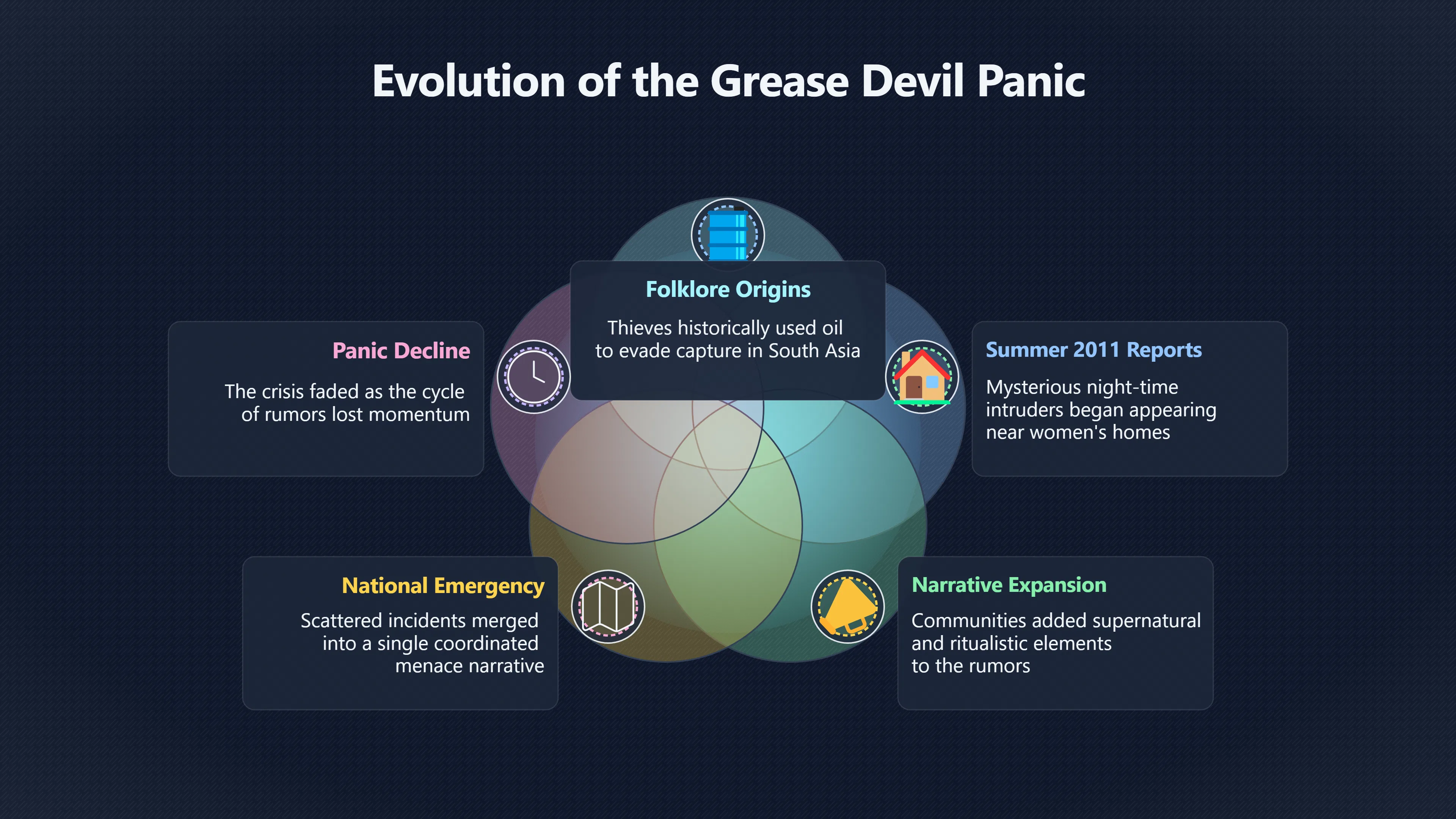
The idea of a grease-covered intruder was not entirely new. In South Asian folklore and criminal lore, thieves were sometimes said to cover themselves with oil or grease to make capture difficult. During the summer of 2011, however, the figure changed into something much larger and more frightening. Reports described mysterious men appearing at night, particularly around women’s homes, and vanishing before they could be identified.[Reuters]reuters.comGrease Devil" panic grips rural Sri LankaReuters"Grease Devil" panic grips rural Sri LankaAugust 12, 2011 — 12 Aug 2011 — Panic over nighttime assaults blamed on "grease devils"…
The rumours spread across multiple districts within weeks. Different communities added their own explanations. Some believed the attackers were ordinary criminals. Others thought they were specially trained operatives. More extreme stories claimed they possessed supernatural abilities or were involved in bizarre rituals. As often happens during moral panics, every unexplained incident began to be interpreted through a single frightening narrative.[Cambridge University Press & Assessment]cambridge.orgCambridge University Press & AssessmentDemonic Violence and Moral Panic in Postwar Sri Lankaby R Venugopal · 2015 · Cited by 17 — Rumors…
Researchers studying the episode later concluded that the crisis was not a single hoax with one mastermind. Some assaults appear to have been real crimes, some sightings were probably misidentifications, and many reports were rumours repeated as fact. What transformed these scattered events into a national emergency was the belief that all of them were connected.[JSTOR]jstor.orgExplaining the Grease Devil CrisisExplaining the Grease Devil Crisis - Sri Lankaby R VENUGOPAL · 2015 · Cited by 17 — In this postwar dystopia, the LTTE as a putative…
Why Communities Distrusted Official Denials
The panic unfolded only two years after the end of Sri Lanka’s civil war. In many Tamil and Muslim areas, trust in state institutions was already weak. Heavy military deployment, unresolved wartime grievances and reports of crime created an atmosphere in which official reassurances carried little weight.[jstor.org]jstor.orgExplaining the Grease Devil CrisisExplaining the Grease Devil Crisis - Sri Lankaby R VENUGOPAL · 2015 · Cited by 17 — In this postwar dystopia, the LTTE as a putative…
Government officials, police and military representatives generally denied the existence of any organised grease-devil network. Yet these denials often failed to calm fears. Residents reported chasing suspected attackers who allegedly disappeared into police stations, army camps or other security installations. Whether these reports were accurate or mistaken, they reinforced existing suspicions among communities already inclined to distrust official explanations.[Wikipedia]WikipediaGrease devil crisis in Sri LankaGrease devil crisis in Sri Lanka
Another factor was the uncertainty surrounding genuine crime. Several regions had experienced burglaries, assaults and attacks on women before the panic reached its peak. Because people knew real crimes were occurring, they found it easier to believe that a larger hidden threat existed as well. Official claims that nothing unusual was happening therefore sounded implausible to many residents.[RePub]repub.eur.nlRe Publinking war, war economy and post-war crime in Sri Lankalinking war, war economy and post-war crime in Sri LankaJune 5, 2019 — by S Jayasundara-Smits · 2019 · Cited by 21 — this article in…
The result was a dangerous information vacuum. Rumours became more credible than official statements, and local vigilance groups increasingly took security into their own hands.[JSTOR]jstor.orgExplaining the Grease Devil CrisisExplaining the Grease Devil Crisis - Sri Lankaby R VENUGOPAL · 2015 · Cited by 17 — In this postwar dystopia, the LTTE as a putative…
The Violence Caused by Mistaken Identity
The most immediate victims were people wrongly identified as grease devils.
As fear intensified, villagers organised night patrols armed with sticks, knives and improvised weapons. Suspicious strangers, travellers and anyone behaving unexpectedly could become targets. In one of the most notorious incidents, two men accused of being grease devils were hacked to death by a mob in Kotagala. Around the same time, a young man searching for grease devils died after triggering an electrified trap intended for wild animals.[Reuters]reuters.comGrease Devil" panic grips rural Sri Lanka, at least threeGrease Devil" panic grips rural Sri Lanka, at least three
The violence spread beyond vigilante attacks. By August 2011, clashes between local residents and security forces were occurring in several districts. A police officer was killed during unrest linked to grease-devil fears, while other confrontations resulted in deaths, injuries and mass arrests. Reuters reported that at least five people had died in incidents connected to the panic.[Reuters]reuters.comPolice officer killed in Sri Lanka "Grease Devil" riotPolice officer killed in Sri Lanka "Grease Devil" riot
People with no connection to any alleged attacks found themselves trapped inside a climate of suspicion. Wildlife officers conducting an elephant census were mistaken for grease devils in eastern Sri Lanka, leading to confrontations that escalated into broader unrest. Similar episodes occurred elsewhere as ordinary activities were reinterpreted through the lens of panic.[Wikipedia]WikipediaGrease devil crisis in Sri LankaGrease devil crisis in Sri Lanka

Women Were Among the Main Victims
Although public memory often focuses on vigilante violence, women were among the groups most directly affected.
The rumours centred on attacks against women, and many reports involved intruders entering homes at night. Whether every allegation was true mattered less than the fact that women increasingly felt unsafe. Families restricted movement after dark, communities organised constant patrols, and fear became part of everyday life.[Cambridge University Press & Assessment]cambridge.orgCambridge University Press & AssessmentDemonic Violence and Moral Panic in Postwar Sri Lankaby R Venugopal · 2015 · Cited by 17 — Rumors…
Researchers examining the crisis found that the panic had a lasting effect on women’s sense of security, particularly in minority communities already coping with post-war uncertainty. Stories of harassment, sexual assault and attempted assault circulated widely, reinforcing the belief that women were specifically being targeted. Even after the panic subsided, memories of vulnerability remained.[Wikipedia]WikipediaGrease devil crisis in Sri LankaGrease devil crisis in Sri Lanka
In this sense, the grease-devil scare cannot be dismissed as a harmless rumour. It amplified genuine fears about violence against women and made daily life more restrictive for many people.[Crisis Group]crisisgroup.orgSee also. “'Grease Devil' another ruse to destabilize country – Reli-.Read moreCrisis Groupsri lanka: women's insecurity in the north and east20 Dec 2011 — See Crisis Group, Sri Lanka: Post-War Progress Report, 13 Se…
Was There Ever a Single Grease Devil?
One reason the story remains compelling is that it resists a simple explanation.
Police arrested dozens of people accused of impersonating grease devils, spreading rumours or committing crimes while exploiting the panic. This suggests that some offenders may have used the legend as cover for theft, harassment or assault. Yet investigators never uncovered evidence for a nationwide conspiracy or a single organised group responsible for all reported incidents.[Wikipedia]WikipediaGrease devil crisis in Sri LankaGrease devil crisis in Sri Lanka
Academic studies of the crisis generally describe it as a moral panic: a situation in which real incidents, rumours, fear and existing social tensions combine to create a threat that appears much larger and more coordinated than the evidence supports. The grease devil became a symbolic figure onto which different communities projected anxieties about crime, sexual violence, militarisation and political power.[cambridge.org]cambridge.orgCambridge University Press & AssessmentDemonic Violence and Moral Panic in Postwar Sri Lankaby R Venugopal · 2015 · Cited by 17 — Rumors…
That interpretation helps explain why the phenomenon spread so rapidly and then faded. The panic did not end because one culprit was captured. It declined when the cycle of rumours, sightings and confrontations gradually lost momentum.[Wikipedia]WikipediaGrease devil crisis in Sri LankaGrease devil crisis in Sri Lanka
What the Panic Reveals
The grease-devil episode occupies an unusual place in Sri Lanka’s history of contested truths. Unlike a forged artefact or a fabricated photograph, it was not built around a single false object or fraudulent claim. Instead, it was a collective story created from fear, uncertainty and fragments of reality.
The most enduring lesson is that the real victims were not only those who reported attacks. Innocent men were killed after being mistaken for grease devils. Communities suffered violent confrontations with authorities. Women lived under heightened fear and restrictions. Minority populations already burdened by post-war insecurity saw their distrust deepen further.[Reuters]reuters.comGrease Devil" panic grips rural Sri Lanka, at least threeGrease Devil" panic grips rural Sri Lanka, at least three
For that reason, the grease-devil panic is best understood not as a tale about a mysterious monster, but as a case study in how rumours can become dangerous when they collide with genuine social anxieties. The creature itself may never have existed in the form people imagined, but the consequences were painfully real.[JSTOR]jstor.orgExplaining the Grease Devil CrisisExplaining the Grease Devil Crisis - Sri Lankaby R VENUGOPAL · 2015 · Cited by 17 — In this postwar dystopia, the LTTE as a putative…
Amazon book picks
Further Reading
Books and field guides related to How the Grease Devil Panic Turned Deadly. Use these as the next step if you want deeper reading beyond the article.
Extraordinary Popular Delusions and the Madness of Crowds
Rating: 4.0/5 from 5 Google Books ratings
Shows how fear-driven collective beliefs escalate.
The Demon-Haunted World
Rating: 4.5/5 from 43 Google Books ratings
Addresses extraordinary claims and weak evidence.
eBay marketplace picks
Marketplace Samples
Live-tested eBay searches with available results related to this page.
Endnotes
1.
Source: cambridge.org
Link:https://www.cambridge.org/core/journals/journal-of-asian-studies/article/demonic-violence-and-moral-panic-in-postwar-sri-lanka-explaining-the-grease-devil-crisis/1B9A7A938B1A9175CF70FB66D4F6C99A
Source snippet
Cambridge University Press & AssessmentDemonic Violence and Moral Panic in Postwar Sri Lankaby R Venugopal · 2015 · Cited by 17 — Rumors...
2.
Source: jstor.org
Title: Explaining the Grease Devil Crisis
Link:https://www.jstor.org/stable/43552756
Source snippet
Explaining the Grease Devil Crisis - Sri Lankaby R VENUGOPAL · 2015 · Cited by 17 — In this postwar dystopia, the LTTE as a putative...
3.
Source: reuters.com
Title: “Grease Devil” panic grips rural Sri Lanka
Link:https://www.reuters.com/article/lifestyle/grease-devil-panic-grips-rural-sri-lanka-idUSTRE77B46V/
Source snippet
Reuters"Grease Devil" panic grips rural Sri LankaAugust 12, 2011 — 12 Aug 2011 — Panic over nighttime assaults blamed on "grease devils"...
Published: August 12, 2011
4.
Source: Wikipedia
Title: Grease devil crisis in Sri Lanka
Link:https://en.wikipedia.org/wiki/Grease_devil_crisis_in_Sri_Lanka
5.
Source: reuters.com
Title: “Grease Devil” panic grips rural Sri Lanka, at least three
Link:https://www.reuters.com/article/world/grease-devil-panic-grips-rural-sri-lanka-at-least-three-idUSTRE77B0ZR/
6.
Source: reuters.com
Title: Police officer killed in Sri Lanka “Grease Devil” riot
Link:https://www.reuters.com/article/world/police-officer-killed-in-sri-lanka-grease-devil-riot-idUSTRE77K2BX/
7.
Source: crisisgroup.org
Title: See also. “’Grease Devil’ another ruse to destabilize country – Reli-.Read more
Link:https://www.crisisgroup.org/sites/default/files/217-sri-lanka-women-s-insecurity-in-the-north-and-east.pdf
Source snippet
Crisis Groupsri lanka: women's insecurity in the north and east20 Dec 2011 — See Crisis Group, Sri Lanka: Post-War Progress Report, 13 Se...
8.
Source: repub.eur.nl
Title: Re Publinking war, war economy and post-war crime in Sri Lanka
Link:https://repub.eur.nl/pub/116596/Repub_116596_O-A.pdf
Source snippet
linking war, war economy and post-war crime in Sri LankaJune 5, 2019 — by S Jayasundara-Smits · 2019 · Cited by 21 — this article in...
Published: June 5, 2019
9.
Source: womensmediacenter.com
Title: sri lanka
Link:https://womensmediacenter.com/women-under-siege/conflicts/sri-lanka
Additional References
10.
Source: scispace.com
Link:https://scispace.com/pdf/demonic-violence-and-moral-panic-in-postwar-sri-lanka-ke29go18ut.pdf
Source snippet
Drawing on the available evidence at hand, it has.Read more...
11.
Source: tandfonline.com
Link:https://www.tandfonline.com/doi/full/10.1080/09584935.2016.1141176
Source snippet
Taylor & Francis OnlineSecuritization and its discontents: the end of Sri Lanka's...by J Spencer · 2016 · Cited by 24 — After the ceasef...
12.
Source: youtube.com
Title: Al-Shabaab exploits Kenya’s divisions to wage war
Link:https://www.youtube.com/watch?v=j13wvZND5zk
Source snippet
Election info changes quickly. Verify responses with official sources...
13.
Source: youtube.com
Title: Inside Al Shabaab: The extremist group trying to seize Somalia
Link:https://www.youtube.com/watch?v=KVSw0E9Y1RI
Source snippet
How Al-Shabab is recruiting young men from Kenya...
14.
Source: youtube.com
Title: Somalia: Govt bans Al Shabaab ‘propaganda’ contents
Link:https://www.youtube.com/watch?v=Vean7jaorHc
Source snippet
Inside Al Shabaab: The extremist group trying to seize Somalia...
15.
Source: youtube.com
Link:https://www.youtube.com/watch?v=5hKAyQIc5rk
Source snippet
Al-Shabaab exploits Kenya's divisions to wage war...
16.
Source: youtube.com
Title: How Al-Shabab is recruiting young men from Kenya
Link:https://www.youtube.com/watch?v=xc6wfF9sV90
Source snippet
Inside Al Shabaab (2017): Terror group tackles drought...
17.
Source: researchgate.net
Link:https://www.researchgate.net/publication/280947556_Demonic_Violence_and_Moral_Panic_in_Postwar_Sri_Lanka_Explaining_the_Grease_Devil_Crisis
18.
Source: scite.ai
Link:https://scite.ai/reports/demonic-violence-and-moral-panic-YQvAXK
19.
Source: gizmodo.com
Title: hysteria over the grease devil urban legend is causin 5833340
Link:https://gizmodo.com/hysteria-over-the-grease-devil-urban-legend-is-causin-5833340
Topic Tree