Within Luxembourg Hoaxes
The Census That Failed to Erase Luxembourg
The cancelled 1941 census reveals how occupation authorities tried to turn controlled answers into proof of voluntary German identity.
On this page
- How the occupation redefined national identity
- Why resistance groups targeted the census
- What the cancellation revealed about consent
Page outline Jump by section
Introduction
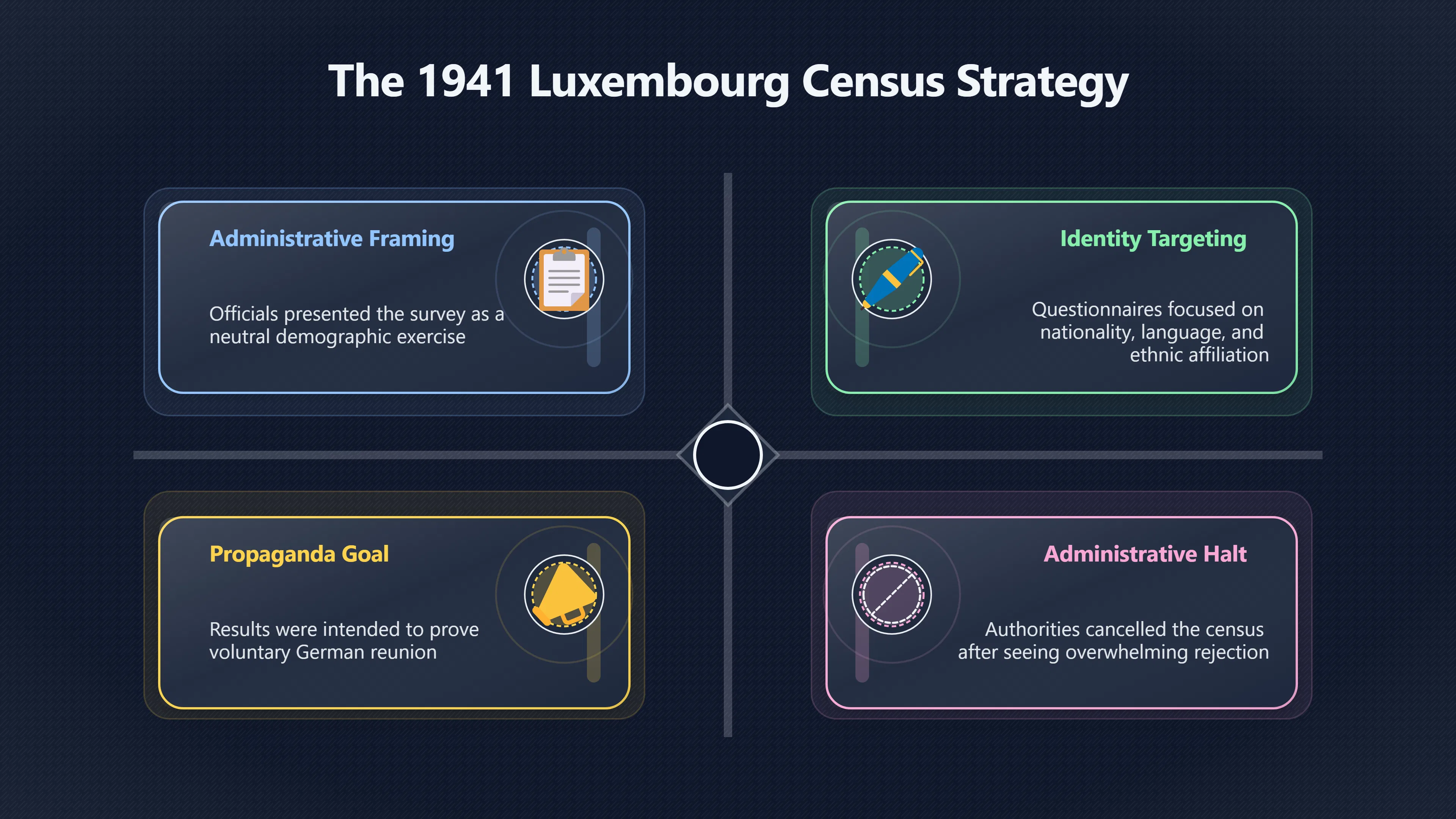
The failed Luxembourg census of 10 October 1941 was one of the most revealing propaganda defeats suffered by Nazi Germany in occupied Western Europe. Presented as an administrative survey, it was designed to produce apparent proof that Luxembourgers considered themselves German by nationality, language and ethnic identity. Occupation officials hoped to transform controlled answers into evidence that annexation was not conquest but a voluntary reunion with the German nation. Instead, the census exposed the limits of Nazi Germanisation. Resistance networks recognised the political purpose behind the questionnaire, organised a remarkably successful campaign of civic defiance, and encouraged citizens to answer “Luxembourgish” to every key question. Faced with overwhelming rejection of the identity it sought to impose, the occupation administration halted the exercise, turning a planned demonstration of consent into a public embarrassment.[Wikipedia]WikipediaLuxembourg ResistanceLuxembourg Resistance

The Census That Failed to Erase Luxembourg
By 1941, Nazi authorities had moved far beyond military occupation. Luxembourg’s institutions were being reshaped to fit the administrative structures of the Third Reich, while schools, public life and cultural organisations were subjected to a programme intended to convince the population that they were fundamentally German. The central claim was not merely that Germany ruled Luxembourg, but that Luxembourgers had always belonged to the German national community and should therefore welcome incorporation into the Reich.[fasos-research.nl]fasos-research.nloccupation and annexation during the second world warBy 1941, Luxembourg's native institutions had been virtually replaced by the administrative-political framework of Nazi Germany, while it…
The census became a crucial test of that narrative. Officially known as the Personenstandsaufnahme, it was scheduled for 10 October 1941 and included three politically charged questions concerning nationality, mother tongue and ethnic or racial affiliation. Occupation officials expected respondents to identify themselves as German in all three categories. If they did so, the results could be presented as statistical proof that annexation reflected the population’s true wishes.[uni.lu]orbilu.uni.luORBilu: Detailed Reference - University of Luxembourgby D SCUTO · 2024 — The "Personenstandsaufnahme" of 10 October 1941, a census…
This is why the episode belongs in any history of deception and propaganda in Luxembourg. The census was not simply a demographic exercise. It was an attempt to manufacture legitimacy through administrative procedures that appeared neutral while serving a predetermined political goal.[Wikipedia]WikipediaVolksdeutsche BewegungIn 1941 the civil administrator ordered a referendum, disguised as a census, in which the Luxembourgers were supposed to admit their Germ…
How the Occupation Redefined National Identity
The Germanisation campaign relied on a mixture of cultural pressure, language policy and racial ideology. Nazi officials pointed to the fact that Luxembourgish belongs to the Germanic language family and used this linguistic relationship as evidence that Luxembourgers were Germans who had been separated from their national homeland. The argument ignored the distinction between language and political identity and downplayed Luxembourg’s independent statehood and multilingual traditions.[fasos-research.nl]fasos-research.nloccupation and annexation during the second world warBy 1941, Luxembourg's native institutions had been virtually replaced by the administrative-political framework of Nazi Germany, while it…
Language became a particularly important battleground. Occupation authorities sought to weaken symbols of Luxembourg’s distinctiveness while promoting identification with Germany. Ironically, these efforts strengthened the symbolic importance of Luxembourgish. What had long been a familiar everyday language increasingly became a marker of national survival. Historians of the occupation have noted that measures intended to absorb Luxembourg into the Reich often had the opposite effect by sharpening awareness of a separate Luxembourgish identity.[tdl.org]wtamu-ir.tdl.orgOpen source on tdl.org.
The census therefore carried significance beyond paperwork. By asking people to declare their nationality, language and ethnicity, the occupation authorities attempted to convert personal identity into political evidence. A favourable result could be used internationally and domestically to support claims that annexation enjoyed popular backing.[Wikipedia]WikipediaVolksdeutsche BewegungIn 1941 the civil administrator ordered a referendum, disguised as a census, in which the Luxembourgers were supposed to admit their Germ…

Why Resistance Groups Targeted the Census
Luxembourg’s resistance organisations quickly recognised what the census was meant to achieve. Although resistance activity in 1941 was still largely focused on information networks, underground publications and patriotic mobilisation rather than armed struggle, activists understood that the census could become a powerful propaganda weapon if left uncontested.[Wikipedia]WikipediaLuxembourg ResistanceLuxembourg Resistance
Their response was both simple and effective. Through leaflets, clandestine communication networks and word of mouth, they urged citizens to answer the three questions with the same response: “Luxembourgish”. The slogan became famous as “three times Luxembourgish”, a concise instruction that transformed an individual administrative act into a collective demonstration of national identity.[RTL Today]today.rtl.lunational remembrance day luxembourg commemorates world war ii resistance 2347464national remembrance day luxembourg commemorates world war ii resistance 2347464
Several factors made the campaign unusually successful:
- The message was easy to understand. Citizens did not need to join a resistance group or engage in sabotage; they simply had to fill in a form in a particular way.
- The stakes were clear. Many Luxembourgers understood that the census was linked to broader annexation plans.
- Participation carried symbolic power. A private answer on a government form became a public statement when repeated by thousands of people.
- The campaign crossed social divisions. It appealed to a shared sense of national identity rather than a particular political ideology.[time.com]time.comcensus protest10, 1941, census date, the resistance mounted an underground leafleting campaign, asking people to answer the census…Read more…
The resistance effectively turned the occupiers’ own instrument into a referendum on Germanisation.
What the Cancellation Revealed About Consent
The occupation authorities expected the census to confirm their assumptions. Instead, early returns reportedly indicated overwhelming rejection of the desired answers. Faced with evidence that the exercise was producing exactly the opposite result from the one intended, the authorities cancelled the census before it could become a formal demonstration of resistance. Contemporary accounts and later commemorations commonly describe the episode as a major propaganda defeat for the occupation regime.[wikipedia.org]WikipediaLuxembourg ResistanceLuxembourg Resistance
Many retellings state that more than 95 per cent of respondents answered “Luxembourgish” to the key questions. Historians have debated aspects of the surviving evidence and the precise measurement of participation because the census was interrupted and not completed in the normal manner. Nevertheless, there is broad agreement on the central point: the occupation authorities realised the results would undermine rather than legitimise their Germanisation programme.[Wikipedia]WikipediaGerman occupation of Luxembourg during World War IIGerman occupation of Luxembourg during World War II
The failure exposed a weakness common to many propaganda systems. Authoritarian governments can control institutions, media and official procedures, but they cannot automatically control how people interpret those procedures. The census had been designed to create an appearance of voluntary agreement. Once the population recognised the intended manipulation, the same mechanism produced evidence of dissent instead.[Wikipedia]WikipediaVolksdeutsche BewegungIn 1941 the civil administrator ordered a referendum, disguised as a census, in which the Luxembourgers were supposed to admit their Germ…
From Wartime Defiance to National Memory
The 1941 census occupies a special place in Luxembourg’s memory of the Second World War. Alongside the 1942 resistance to forced conscription, it is remembered as a moment when ordinary citizens collectively rejected the occupation’s attempt to redefine who they were. The event remains central to commemorations of resistance and national remembrance.[uni.lu]orbilu.uni.luORBilu: Detailed Reference - University of Luxembourgby D SCUTO · 2024 — The "Personenstandsaufnahme" of 10 October 1941, a census…
Its significance extends beyond Luxembourg. The episode demonstrates how statistics, surveys and official questionnaires can be used as political tools. The census was not a hoax in the conventional sense of a forged object or fabricated story. Rather, it was an effort to create a misleading impression of public consent through an apparently neutral administrative process. What makes the story remarkable is that the deception failed. Citizens understood the intended narrative before it could be established, and their coordinated response transformed a planned demonstration of loyalty into one of the clearest rejections of Nazi Germanisation in occupied Europe.[wikipedia.org]WikipediaVolksdeutsche BewegungIn 1941 the civil administrator ordered a referendum, disguised as a census, in which the Luxembourgers were supposed to admit their Germ…
Amazon book picks
Further Reading
Books and field guides related to The Census That Failed to Erase Luxembourg. Use these as the next step if you want deeper reading beyond the article.
The Third Reich in Power
Provides context for Germanisation campaigns and political control.
On Tyranny
Directly addresses resistance to authoritarian attempts to reshape identity.
eBay marketplace picks
Marketplace Samples
Live-tested eBay searches with available results related to this page.



Endnotes
1.
Source: Wikipedia
Title: Luxembourg Resistance
Link:https://en.wikipedia.org/wiki/Luxembourg_Resistance
2.
Source: Wikipedia
Title: Volksdeutsche Bewegung
Link:https://en.wikipedia.org/wiki/Volksdeutsche_Bewegung
Source snippet
In 1941 the civil administrator ordered a referendum, disguised as a census, in which the Luxembourgers were supposed to admit their Germ...
3.
Source: time.com
Title: census protest
Link:https://time.com/5822950/census-protest/
Source snippet
10, 1941, census date, the resistance mounted an underground leafleting campaign, asking people to answer the census...Read more...
4.
Source: fasos-research.nl
Title: occupation and annexation during the second world war
Link:https://fasos-research.nl/occupationstudies/occupation-and-annexation-during-the-second-world-war/
Source snippet
By 1941, Luxembourg's native institutions had been virtually replaced by the administrative-political framework of Nazi Germany, while it...
5.
Source: Wikipedia
Link:https://en.wikipedia.org/wiki/Luxembourg
Source snippet
LuxembourgLuxembourg's culture, people, and languages are greatly influenced by France and Germany: Luxembourgish, a Germanic language, i...
6.
Source: en.moovijob.com
Title: luxembourgish a language of history identity and future
Link:https://en.moovijob.com/blog/article/luxembourgish-a-language-of-history-identity-and-future
Source snippet
Moovijob.comLuxembourgish: a language of history, identity and future27 Aug 2025 — In the 1941 census, however, the population rejected G...
7.
Source: wtamu-ir.tdl.org
Link:https://wtamu-ir.tdl.org/server/api/core/bitstreams/e1d496c0-d673-4cee-b49d-ac8820c41406/content
8.
Source: today.rtl.lu
Title: the history of luxembourgish and other languages in luxembourg 1431432
Link:https://today.rtl.lu/luxembourg-insider/history/the-history-of-luxembourgish-and-other-languages-in-luxembourg-1431432
9.
Source: today.rtl.lu
Title: national remembrance day luxembourg commemorates world war ii resistance 2347464
Link:https://today.rtl.lu/news/luxembourg/national-remembrance-day-luxembourg-commemorates-world-war-ii-resistance-2347464
10.
Source: today.rtl.lu
Title: luxembourg remembers the victims of the nazi occupation 2126401
Link:https://today.rtl.lu/news/luxembourg/luxembourg-remembers-the-victims-of-the-nazi-occupation-2126401
11.
Source: Wikipedia
Title: German occupation of Luxembourg during World War II
Link:https://en.wikipedia.org/wiki/German_occupation_of_Luxembourg_during_World_War_II
12.
Source: Wikipedia
Title: Personenstandsaufnahme (Luxemburg)
Link:https://de.wikipedia.org/wiki/Personenstandsaufnahme_%28Luxemburg%29
13.
Source: chronicle.lu
Title: 57444 national day of commemoration 2025 a government statement
Link:https://www.chronicle.lu/category/at-home/57444-national-day-of-commemoration-2025-a-government-statement
14.
Source: Wikipedia
Title: Census in Germany
Link:https://en.wikipedia.org/wiki/Census_in_Germany
15.
Source: luxembourg.public.lu
Title: second world war
Link:https://luxembourg.public.lu/en/society-and-culture/history/second-world-war.html
16.
Source: luxembourg.public.lu
Link:https://luxembourg.public.lu/dam-assets/publications/a-propos-des-langues-au-luxembourg/a-propos-des-langues-en.pdf
17.
Source: orbilu.uni.lu
Link:https://orbilu.uni.lu/handle/10993/61265
Source snippet
ORBilu: Detailed Reference - University of Luxembourgby D SCUTO · 2024 — The "Personenstandsaufnahme" of 10 October 1941, a census...
Published: October 1941
Additional References
18.
Source: youtube.com
Title: Back to the Reich
Link:https://www.youtube.com/watch?v=5SLlNrhTDso
Source snippet
The Luxembourg Resistance's Greatest Victory in WW2...
19.
Source: zpb.lu
Title: Zp BWorld War
Link:https://zpb.lu/wp-content/uploads/2020/10/META_BRO_2e_guerre_mondiale_double_EN_web.pdf
Source snippet
World War - Luxembourg9 Oct 2020 — On the census forms of. 10 October 1941, residents also had to indicate their nationality, mother t...
Published: October 1941
20.
Source: youtube.com
Title: Heim ins Reich: A Failed Nazi Annexation
Link:https://www.youtube.com/watch?v=fwGUsJ8zn_0
Source snippet
Back to the Reich - Attempted annexation of Luxembourg under Adolf Hitler...
21.
Source: reddit.com
Link:https://www.reddit.com/r/PropagandaPosters/comments/nojqfl/end_this_foreign_gibberish_your_language_is/
22.
Source: researchgate.net
Link:https://www.researchgate.net/publication/387190021_National_Socialist_Ethnicity_and_Citizenship_Policy_under_Growing_Military_Pressure_in_Occupied_Luxembourg
23.
Source: researchgate.net
Link:https://www.researchgate.net/publication/395835337_The_making_of_the_Luxembourgish_language_A_former_dialect_becomes_the_pivot_of_a_multilingual_society
24.
Source: reddit.com
Link:https://www.reddit.com/r/HistoryMemes/comments/175o5mk/germanisation_of_luxembourg_in_a_nutshell/
25.
Source: charteroakgenealogy.com
Link:https://charteroakgenealogy.com/luxembourg/
26.
Source: luxtoday.lu
Link:https://luxtoday.lu/en/society-en/three-times-luxembourgish-how-an-act-of-civic-courage-became-a-symbol-of-a-nation
27.
Source: youtube.com
Title: German occupation policy in Luxembourg
Link:https://www.youtube.com/watch?v=tK5lnqk2WAs
Source snippet
Luxembourg Resistance | Wikipedia audio article...
Topic Tree