Within Georgia Hoaxes
Why Did Georgia Believe War Had Begun?
A simulated Russian attack looked so much like real news that viewers called relatives, overloaded networks and prepared to flee.
On this page
- How the broadcast copied real breaking news
- Why the recent war made the scenario believable
- Political motives, public panic and official backlash
Page outline Jump by section
Introduction
On the evening of 13 March 2010, many Georgians briefly believed that a new war with Russia had begun. A prime-time broadcast on the television channel Imedi interrupted normal programming with what appeared to be a breaking-news bulletin: Russian forces were advancing, political leaders were under attack, and the Georgian state was collapsing. The report was fictional, but it was presented in a format so similar to genuine news coverage that thousands of viewers accepted it as real. The result was widespread panic, frantic phone calls, overloaded communications networks, public anger, and a lasting debate about media responsibility in a country still traumatised by the 2008 Russo-Georgian War.[Civil Georgia]civil.geiaFake Report on Renewed War Triggers Panic, Anger…March 13, 2010 — 14 Mar 2010 — minute long fake report by Imedi television stati…

Although sometimes described simply as a television hoax, the episode was more than a prank. It became one of the most controversial media events in modern Georgian history because it demonstrated how easily familiar news conventions can override scepticism when a fictional scenario closely matches recent fears and lived experience.[OSCE]cdn.osce.orgStatement on Fictitious Imedi Television Broadcast in GeorgiaMarch 18, 2010 — The March 13 fictitious broadcast on Imedi television w…
Why Did Georgia Believe War Had Begun?
The broadcast succeeded because it did not ask viewers to believe something extraordinary. It asked them to believe a version of a disaster that had already happened.
Less than two years earlier, Georgia and Russia had fought a short but intense war. Russian troops had entered Georgian territory, thousands of people had been displaced, and memories of military conflict remained fresh. When Imedi presented a scenario involving renewed Russian intervention, many viewers did not see it as implausible fiction. They saw it as a frightening but realistic continuation of existing tensions.[civil.ge]civil.geiaFake Report on Renewed War Triggers Panic, Anger…March 13, 2010 — 14 Mar 2010 — minute long fake report by Imedi television stati…
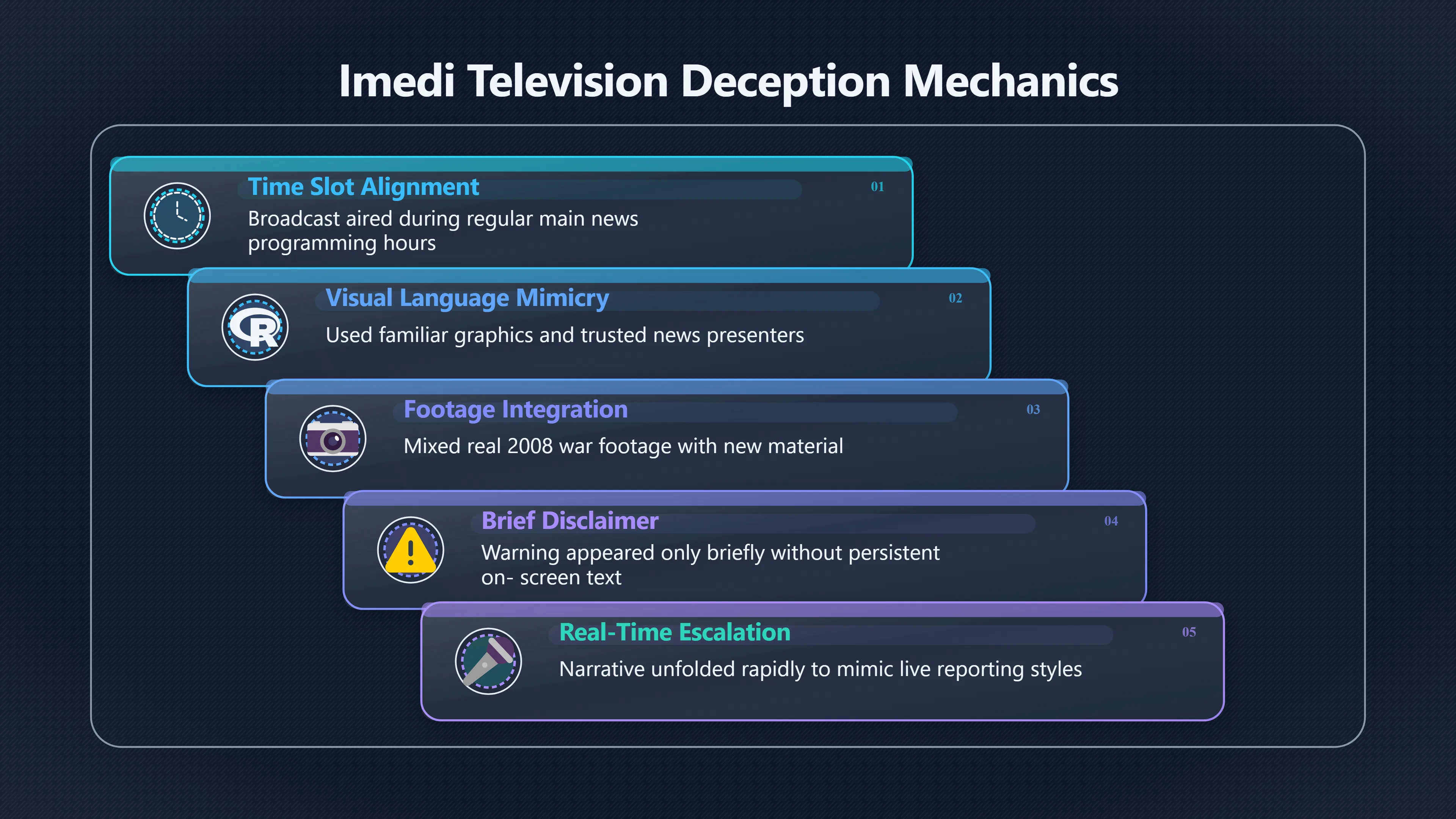
The programme also exploited the authority of television news. Viewers were accustomed to receiving urgent national information through evening broadcasts. Unlike obvious satire or drama, the report used trusted presenters, familiar graphics, and the visual language of emergency reporting. For many people, especially those who joined after the opening disclaimer, there was little immediate reason to suspect they were watching a simulation.[Civil Georgia]civil.geiaFake Report on Renewed War Triggers Panic, Anger…March 13, 2010 — 14 Mar 2010 — minute long fake report by Imedi television stati…
How the Broadcast Copied Real Breaking News
The programme was carefully designed to resemble an authentic news emergency.
Imedi shifted the broadcast into the time slot normally associated with its main news programme. Rather than appearing as a clearly separated documentary or fictional reconstruction, it was presented as a special edition of regular news coverage. Viewers saw reporters, anchors and graphics that looked identical to those used during genuine crises.[Wikipedia]Wikipedia2010 Georgian news report hoax2010 Georgian news report hoax
Several techniques made the deception particularly persuasive:
- Real war footage from the 2008 conflict was mixed with newly produced material.
- Breaking-news presentation styles were used throughout the programme.
- Recognisable political figures appeared within the fictional scenario.
- Military and political developments unfolded in real time, mimicking ordinary news reporting.
- The disclaimer appeared only briefly, and no persistent on-screen warning remained during most of the broadcast.[civil.ge]civil.geiaFake Report on Renewed War Triggers Panic, Anger…March 13, 2010 — 14 Mar 2010 — minute long fake report by Imedi television stati…
The fictional narrative escalated rapidly. It described unrest in Tbilisi, political turmoil, attacks on leaders, renewed Russian military intervention, and eventually reports that President Mikheil Saakashvili had been killed. The scenario was sensational, but each stage built upon existing geopolitical anxieties rather than introducing obviously impossible events.[Wikipedia]Wikipedia2010 Georgian news report hoax2010 Georgian news report hoax
What Happened When Viewers Thought It Was Real?
The immediate reaction demonstrated the power of trusted media during moments of uncertainty.
Across Georgia, people rushed to contact relatives and friends. Telephone networks experienced heavy traffic as citizens attempted to verify the reports. Some residents began preparing to leave their homes, while others sought information from local authorities or neighbouring communities. Reports described fear, confusion and widespread uncertainty during and immediately after the broadcast.[rferl.org]rferl.orgRadioFreeEurope/RadioLibertyPublic Panic, Opposition Anger Over Report Of Mock…14 Mar 2010 — Georgians reacted with fear and in some c…
The panic was especially acute because many viewers had personal memories of the 2008 conflict. Families who had previously fled fighting or experienced displacement interpreted the reports through the lens of recent experience. The programme therefore activated real trauma rather than abstract political concern.[The Guardian]theguardian.comrussia georgia fake invasion reportThe GuardianRussian invasion scare sweeps Georgia after TV hoax14 Mar 2010 — Georgians rally in central Tbilisi against a local televisio…
International observers later noted that the consequences extended beyond embarrassment. In a region where military tensions remained unresolved, false reports of invasion carried the potential to create misunderstandings among civilians, officials and security personnel. The concern was not merely that viewers were fooled, but that a fabricated emergency could affect behaviour in the real world.[OSCE]cdn.osce.orgStatement on Fictitious Imedi Television Broadcast in GeorgiaMarch 18, 2010 — The March 13 fictitious broadcast on Imedi television w…
Political Motives and the Debate Over Intent
The central controversy was not only whether the programme was misleading, but why it had been broadcast in the first place.
Imedi defended the simulation as a warning about potential threats facing Georgia. Senior figures at the station argued that the scenario illustrated dangers that could realistically emerge if Russia exerted pressure on the country or if domestic political instability weakened the state. From this perspective, the broadcast was presented as a cautionary exercise rather than a deception for its own sake.[Wikipedia]Wikipedia2010 Georgian news report hoax2010 Georgian news report hoax
Critics were unconvinced. Opposition politicians, journalists and media watchdogs argued that the programme blurred the line between journalism and political messaging. Some objected to the way opposition figures were portrayed within the fictional narrative, claiming the programme implied that government opponents would collaborate with a foreign enemy during a national crisis.[civil.ge]civil.geiaFake Report on Renewed War Triggers Panic, Anger…March 13, 2010 — 14 Mar 2010 — minute long fake report by Imedi television stati…
Questions also arose over whether government officials had prior knowledge of the broadcast. Alleged leaked recordings fuelled speculation about political involvement, although disputes over authenticity and responsibility prevented a definitive resolution. The controversy deepened public suspicion and ensured that the discussion extended well beyond the original programme itself.[Wikipedia]Wikipedia2010 Georgian news report hoax2010 Georgian news report hoax
Why the Backlash Was So Severe
The strongest criticism focused on journalistic ethics rather than politics alone.
Observers argued that viewers can reasonably expect fictional content to be clearly distinguished from factual reporting. The problem was not that a hypothetical scenario had been created; it was that the scenario was embedded within a format that closely resembled a genuine emergency bulletin. The Organisation for Security and Co-operation in Europe (OSCE), diplomats, journalists and media organisations criticised the decision not to identify the simulation clearly throughout the broadcast.[OSCE]cdn.osce.orgStatement on Fictitious Imedi Television Broadcast in GeorgiaMarch 18, 2010 — The March 13 fictitious broadcast on Imedi television w…
Georgia’s communications regulator concluded that broadcasting standards had been breached and required the station to apologise. Imedi eventually issued an apology for the panic caused, although it continued to defend the broader purpose of the programme.[Wikipedia]Wikipedia2010 Georgian news report hoax2010 Georgian news report hoax
The backlash reflected a wider concern: if audiences cannot distinguish between real reporting and fictional political scenarios, public trust in news becomes vulnerable. In a country facing genuine security threats, that trust was viewed as especially important.[OSCE]cdn.osce.orgStatement on Fictitious Imedi Television Broadcast in GeorgiaMarch 18, 2010 — The March 13 fictitious broadcast on Imedi television w…
What the Incident Revealed About Media and Fear
The Imedi broadcast remains memorable because it exposed a weakness common to many media environments. People rarely evaluate every report from first principles during a perceived emergency. Instead, they rely on signals such as trusted presenters, familiar graphics, established broadcasters and remembered experience.
In March 2010, those signals pointed in the wrong direction. A fictional programme borrowed the authority of real journalism, while recent war memories supplied the emotional context that made the story believable. The resulting panic was not evidence of unusual gullibility. It was evidence that realistic misinformation can spread rapidly when it arrives through familiar channels and reinforces fears that already exist.[civil.ge]civil.geiaFake Report on Renewed War Triggers Panic, Anger…March 13, 2010 — 14 Mar 2010 — minute long fake report by Imedi television stati…
For Georgia, the episode became a landmark case in the risks of media simulation. It is still cited as an example of how easily the boundary between warning, propaganda, drama and news can collapse when broadcasters prioritise emotional impact over clear disclosure.[eurasianet.org]eurasianet.orggeorgia fake tv report about russian invasion makes truth stranger than fictionGeorgia: Fake TV Report about Russian Invasion Makes…15 Mar 2010 — A media controversy in Georgia involving a fake report about a Russ…
Amazon book picks
Further Reading
Books and field guides related to Why Did Georgia Believe War Had Begun?. Use these as the next step if you want deeper reading beyond the article.
Thinking, Fast and Slow
Explains cognitive shortcuts that influence belief during uncertainty.
eBay marketplace picks
Marketplace Samples
Live-tested eBay searches with available results related to this page.

Endnotes
1.
Source: civil.ge
Link:https://civil.ge/archives/119972
Source snippet
iaFake Report on Renewed War Triggers Panic, Anger...March 13, 2010 — 14 Mar 2010 — minute long fake report by Imedi television stati...
Published: March 13, 2010
2.
Source: cdn.osce.org
Link:https://cdn.osce.org/sites/default/files/f/documents/9/0/67494.pdf
Source snippet
Statement on Fictitious Imedi Television Broadcast in GeorgiaMarch 18, 2010 — The March 13 fictitious broadcast on Imedi television w...
Published: March 18, 2010
3.
Source: eurasianet.org
Title: georgia fake tv report about russian invasion makes truth stranger than fiction
Link:https://eurasianet.org/georgia-fake-tv-report-about-russian-invasion-makes-truth-stranger-than-fiction
Source snippet
Georgia: Fake TV Report about Russian Invasion Makes...15 Mar 2010 — A media controversy in Georgia involving a fake report about a Russ...
4.
Source: Wikipedia
Title: 2010 Georgian news report hoax
Link:https://en.wikipedia.org/wiki/2010_Georgian_news_report_hoax
5.
Source: rferl.org
Link:https://www.rferl.org/a/Georgians_Denounce_Fake_Report_Of_Russian_Invasion/1983412.html
Source snippet
RadioFreeEurope/RadioLibertyPublic Panic, Opposition Anger Over Report Of Mock...14 Mar 2010 — Georgians reacted with fear and in some c...
6.
Source: theguardian.com
Title: russia georgia fake invasion report
Link:https://www.theguardian.com/world/2010/mar/14/russia-georgia-fake-invasion-report
Source snippet
The GuardianRussian invasion scare sweeps Georgia after TV hoax14 Mar 2010 — Georgians rally in central Tbilisi against a local televisio...
7.
Source: iwpr.net
Title: georgia fake tv report storm
Link:https://iwpr.net/global-voices/georgia-fake-tv-report-storm
Source snippet
Institute for War & Peace ReportingGeorgia: Fake TV Report Storm19 Mar 2010 — Producers of a fake Georgian television news item, which re...
8.
Source: abcnews.com
Link:https://abcnews.com/International/warning-russian-invasion-georgian-tv-fake/story?id=10104695
Additional References
9.
Source: euractiv.com
Title: russian invasion tv hoax fuels anger in georgia
Link:https://www.euractiv.com/news/russian-invasion-tv-hoax-fuels-anger-in-georgia/
Source snippet
Euractiv'Russian invasion' TV hoax fuels anger in Georgia15 Mar 2010 — 'Russian invasion' TV hoax fuels anger in Georgia. Georgia's oppos...
10.
Source: youtube.com
Title: Georgia panics after fake report about Russian Invasion
Link:https://www.youtube.com/watch?v=Ptwu6Bt1oZY
Source snippet
Georgia fake Russian invasion Imedi 2010 Georgian TV Airs Report on Russian Invasion Associated Press...
11.
Source: youtube.com
Title: Fake Russian invasion broadcast sparks Georgian panic
Link:https://www.youtube.com/watch?v=s9RLqH4Z4UA
Source snippet
Georgia panics after fake report about Russian Invasion...
12.
Source: humanrightshouse.org
Link:https://humanrightshouse.org/articles/fake-report-on-renewed-war-in-georgia-triggers-panic/
13.
Source: youtube.com
Title: “Russia invasion” news stirs panic in Georgia
Link:https://www.youtube.com/watch?v=0M80zRa_hnI
Source snippet
Georgian TV Airs Report on Russian Invasion...
14.
Source: youtube.com
Title: Fake War Part 1 of 2 (English Sub)
Link:https://www.youtube.com/watch?v=YNB3gx3v1Bo
Source snippet
Fake Russian invasion broadcast sparks Georgian panic...
15.
Source: youtube.com
Title: Georgian TV Airs Report on Russian Invasion
Link:https://www.youtube.com/watch?v=WMJvWtBfGLA
Source snippet
Fake War Part 1 of 2 (English Sub)...
16.
Source: abc.net.au
Title: invasion hoax sparks panic in georgia
Link:https://www.abc.net.au/news/2010-03-14/invasion-hoax-sparks-panic-in-georgia/363538
17.
Source: europeansources.info
Title: fake broadcast sparks georgian fears
Link:https://www.europeansources.info/record/fake-broadcast-sparks-georgian-fears/
Topic Tree